








Categories
Discover our diverse collection of categories covering multiple topics to meet your various interestsDa\'wa cards that highlight great meanings of the verses of the Holy Quran and the noble prophetic hadiths in a simple style and attractive display that helps the Muslim to have a deeper understanding of his religion in an easy way
﴿ وَلَقَدۡ خَلَقۡنَا ٱلۡإِنسَٰنَ مِن صَلۡصَٰلٖ مِّنۡ حَمَإٖ مَّسۡنُونٖ ﴾
سورة الحجر
And We did certainly create man out of clay from an altered black mud.

﴿ وَٱلَّذِيٓ أَوۡحَيۡنَآ إِلَيۡكَ مِنَ ٱلۡكِتَٰبِ هُوَ ٱلۡحَقُّ مُصَدِّقٗا لِّمَا بَيۡنَ يَدَيۡهِۗ إِنَّ ٱللَّهَ بِعِبَادِهِۦ لَخَبِيرُۢ بَصِيرٞ ﴾
سورة فاطر
31. And what We have revealed to you (O Muhammad صلى الله عليه وسلم), of the Book (the Qur’ân), it is the (very) truth [that you (Muhammad صلى الله عليه وسلم) and your followers must act on its instructions], confirming that which was (revealed) before it. Verily! Allâh is indeed All-Aware, and All-Seer of His slaves.
﴿ وَإِن تَدۡعُوهُمۡ إِلَى ٱلۡهُدَىٰ لَا يَسۡمَعُواْۖ وَتَرَىٰهُمۡ يَنظُرُونَ إِلَيۡكَ وَهُمۡ لَا يُبۡصِرُونَ ﴾
سورة الأعراف
And if you invite them to guidance, they do not hear; and you see them looking at you while they do not see.
﴿ لَا يَسۡتَطِيعُونَ نَصۡرَهُمۡ وَهُمۡ لَهُمۡ جُندٞ مُّحۡضَرُونَ ﴾
سورة يس
They are not able to help them, and they [themselves] are for them soldiers in attendance.[1282]
﴿ وَأَصۡبَحَ ٱلَّذِينَ تَمَنَّوۡاْ مَكَانَهُۥ بِٱلۡأَمۡسِ يَقُولُونَ وَيۡكَأَنَّ ٱللَّهَ يَبۡسُطُ ٱلرِّزۡقَ لِمَن يَشَآءُ مِنۡ عِبَادِهِۦ وَيَقۡدِرُۖ لَوۡلَآ أَن مَّنَّ ٱللَّهُ عَلَيۡنَا لَخَسَفَ بِنَاۖ وَيۡكَأَنَّهُۥ لَا يُفۡلِحُ ٱلۡكَٰفِرُونَ ﴾
سورة القصص
Those who had wished for his position the day before started saying, “Oh, it is surely Allah Who extends provisions to whom He wills or restricts it. If Allah had not favored us, He could have caused the earth to swallow us too. Oh, indeed the disbelievers will never succeed.”
﴿ وَإِذۡ قُلۡنَا ٱدۡخُلُواْ هَٰذِهِ ٱلۡقَرۡيَةَ فَكُلُواْ مِنۡهَا حَيۡثُ شِئۡتُمۡ رَغَدٗا وَٱدۡخُلُواْ ٱلۡبَابَ سُجَّدٗا وَقُولُواْ حِطَّةٞ نَّغۡفِرۡ لَكُمۡ خَطَٰيَٰكُمۡۚ وَسَنَزِيدُ ٱلۡمُحۡسِنِينَ ﴾
سورة البقرة
58. And (remember) when We said: "Enter this town (Jerusalem) and eat bountifully therein with pleasure and delight wherever you wish, and enter the gate in prostration (or bowing with humility) and say: ‘Forgive us,’ and We shall forgive you your sins and shall increase (reward) for the good-doers."
﴿ خَلَقَ ٱلۡإِنسَٰنَ مِن صَلۡصَٰلٖ كَٱلۡفَخَّارِ ﴾
سورة الرحمن
14. He created man (Adam) from sounding clay like the clay of pottery.
﴿ يَأۡتُوكَ بِكُلِّ سَحَّارٍ عَلِيمٖ ﴾
سورة الشعراء
to bring you every learned magician.”
﴿ إِنَّ هَٰذَا لَهُوَ حَقُّ ٱلۡيَقِينِ ﴾
سورة الواقعة
95. Verily, this! This is an absolute Truth with certainty.
Al-Azdiyyah, viz. Mussah, reported: I performed Hajj and came to Umm Salamah and said (to her): "O mother of the believers, Samurah ibn Jundub commands women to complete the prayers abandoned during menstrual period." She said: "They should not do so. The Prophet's wives would refrain (from prayer) for forty days during postpartum bleeding, and the Prophet (may Allah's peace and blessings be upon him) would not command them to complete the prayers abandoned during that period."
Narrated by At-Termedhy - Narrated by Abu Daoud - Narrated by Ahmad - Ad-Daarimi
Umm Salamah (may Allah be pleased with her) corrected a Fatwa given by the noble Companion Samurah ibn Jundub (may Allah be pleased with him) where he commanded women to make up for the prayers abandoned during their menses. She said: "They should not do so," citing as evidence for her opinion that "the Prophet's wives would refrain (from prayer) for forty days during postpartum bleeding, and the Prophet (may Allah's peace and blessings be upon him) would not command them to complete the prayers abandoned during that period." There is something confusing here, as Mussah asked Umm Salamah about the ruling on prayer in terms of menses, informing that Samurah commanded women to make up for them, but Umm Salamah gave her reply involving the prayer during the postpartum period. To clear this confusion, we say: First: Menstrual period in the question was meant to refer to the postpartum period, as indicated by the reply. Second: Umm Salamah gave her reply concerning prayer during the postpartum period, which is shorter in duration than the menstrual period, for the menses occur 12 times every year, unlike the postpartum period. So, she clarified that the Almighty Lawgiver pardoned women in terms of the prayer abandoned during the postpartum period which rarely recurs; so what about the menses which come frequently; and Allah knows best.
Sālim ibn Abu al-Ja‘d reported: A man said: "I wish I had prayed and got comfort." When the people seemed to disapprove of his statement, he said: "I heard the Messenger of Allah (may Allah's peace and blessings be upon him) say: 'O Bilāl, call the Iqāmah for the prayer; give us comfort by it.'"
Narrated by Abu Daoud
A man from the Companions said: I wish I had prayed and got comfort. Those around him seemed to disapprove of his statement. So, he said: I heard the Prophet (may Allah's peace and blessings be upon him) say: O Bilāl, make the call to prayer and proclaim its commencement so that we will get comfort by it. This is because it includes private communication with Allah Almighty and provides relief for the soul and the heart.
‘Ali ibn Abi Tālib (may Allah be pleased with him) reported that the Messenger of Allah (may Allah’s peace and blessings be upon him) said: “May Allah fill their graves and houses with fire, as they distracted us from the middle prayer until the sun set.” In another narration: “They distracted us from the middle prayer”, meaning: the ‘Asr prayer. Then he offered it between the Maghrib and the ‘Ishā'. Ibn Mas‘ūd (may Allah be pleased with him) reported: The polytheists distracted the Messenger of Allah (may Allah’s peace and blessings be upon him) from observing the ‘Asr prayer till the sun became red or yellow. So the Messenger of Allah (may Allah’s peace and blessings be upon him) said: "May Allah fill their bellies and graves with fire!"
Narrated by Muslim - Narrated by Bukhari & Muslim
The polytheists kept the Messenger (may Allah's peace and blessings be upon him) and his Companions too preoccupied to offer the ‘Asr prayer till sunset, as they were garrisoned to protect Madīnah against them. Consequently, the Messenger (may Allah’s peace and blessings be upon) invoked Allah, the Almighty, against them, asking Him to fill their stomachs, houses, and graves with fire as a punishment for hurting him and his Companions and distracting them from offering the ‘Asr, which is the best prayer.
Jundub ibn Sufyān al-Bajali (may Allah be pleased with him) reported that the Prophet (may Allah's peace and blessings be upon him) said: "Whoever performs the Fajr prayer will be under the protection of Allah. O son of Adam, beware lest Allah should call you to account for violating His protection.”
Narrated by Ahmad - Narrated by Muslim
This Hadīth shows the virtue of the Fajr prayer, and that by performing it one becomes under Allah's protection. Another narration by Abu Nu‘aym adds: "in congregation." Then he warned against harming those under Allah's protection, saying: Do not incur the punishment of Allah by harming those whom Allah has protected, for doing so leads to Allah's punishment and to entering Hellfire. It could also be a warning against neglecting the Fajr prayer or doing a wrong deed that incurs Allah's questioning about the non-implementation of His commandments. This indicates that the Fajr prayer is like the key to the rest of the daily prayers, and perhaps to all the deeds of the day that follow it. It is like a covenant with Allah wherein one is committed to obeying Allah's commandments and avoiding His prohibitions.
Anas ibn Mālik (may Allah be pleased with him) reported that the Prophet (may Allah's peace and blessings be upon him) ordered Bilāl to pronounce the Adhān in pairs and the Iqāmah in singles.
Narrated by Bukhari & Muslim
The Prophet (may Allah's peace and blessings be upon him) commanded his Muezzin, Bilāl (may Allah be pleased with him), to pronounce the Adhān in pairs, because it is meant to draw the attention of those who are absent from the mosque, so its phrases are to be said twice. This excludes the Takbīr in the beginning, as it was authentically reported as being said four times, and the word of Tawḥīd (lā ilāha illā Allah) at the end, as it is authentically reported as being said once. The Prophet (may Allah's peace and blessings be upon him) also commanded Bilāl to pronounce the Iqāmah in singles, because it is meant to draw the attention of those in attendance. He was commanded to say each sentence once, except for the Takbīr and "qad qāmat aṣ-ṣalāh" (the prayer has started), as it was authentically reported as being doubled.
Abu Ash-Sha‘thā' reported: As we were sitting in the mosque with Abu Hurayrah (may Allah be pleased with him) the Muezzin proclaimed the Adhān and then a man stood up in the mosque and started walking out. Abu Hurayrah followed him with his eyes until he went out of the mosque. Thereupon, Abu Hurayrah said: "As for this man, he has disobeyed the Prophet (may Allah’s peace and blessings be upon him)."
Narrated by Muslim
Abu Ash-Sha‘thā' relates in this Hadīth that they were sitting with Abu Hurayrah (may Allah be pleased with him) in the mosque, and the Muezzin proclaimed the Adhān. Then, a man stood up and walked. Meanwhile, Abu Hurayrah kept looking at him to know whether he would leave the mosque or what. Then, when it became clear that the man was actually leaving, Abu Hurayrah (may Allah be pleased with him) stated that this act runs counter to the Prophet’s guidance.
‘Abdullāh ibn ‘Abdur-Rahmān ibn Abi Sa‘sa‘ah reported: Abu Sa‘īd al-Khudri (may Allah be pleased with him) said to me: "I see that you like sheep and wilderness. So whenever you are with your sheep - or in the wilderness - and you want to call the Adhān, raise your voice, for whoever hears the voice of the Muezzin, whether it be a human being, a Jinn, or any other creature, they will testify in his favor on the Day of Judgment." Abu Sa‘īd added: "I heard this from the Messenger of Allah (may Allah’s peace and blessings be upon him)."
Narrated by Bukhari
‘Abdullāh ibn ‘Abdur-Rahmān ibn Abi Sa‘sa‘ah reported: Abu Sa‘īd al-Khudri (may Allah be pleased with him) said to me: "I see that you like sheep and wilderness. So whenever you are with your sheep - or in the wilderness - and you want to call the Adhān, raise your voice, for whoever hears the voice of the Muezzin, whether that be a human being, a Jinn, or any other creature, they will testify in his favor (the Muezzin) on the Day of Judgment." It is said that "any creature" applies to whoever's testimony can be accepted. It is also said that it may generally apply to anything that can hear, even from among the animals, excluding inanimate objects. They will testify that he was one of those who called the Adhān, indicating his merit and highlighting his reward thereby.
Abu Hurayrah (may Allah be pleased with him) reported that the Prophet (may Allah's peace and blessings be upon him) said: "When the call to prayer is announced, the devil takes to his heels and breaks wind with noise so as not to hear the call. When the call to prayer is over, he returns. When the Iqāmah is announced, he takes to his heels, and after it is over, he returns again to distract the attention of the worshiper and make him remember things which were not on his mind before the prayer, saying: 'Remember such-and-such, and remember such-and-such,' until the worshiper forgets how many units of prayer he performed.”
Narrated by Bukhari & Muslim
When the Muezzin (person who makes the call to prayer) announces the Adhān, the devil runs away from the place where the call to prayer is being made so as not to hear it. "And breaks wind with noise": The apparent meaning is that the devil intentionally lets out this noise, which is passing gas, to avoid listening to the sound of the Muezzin, or as a way of belittling the Adhān as foolish people do. It is also possible that he experiences extreme fear when he hears the call to prayer and, because of his fear, he makes that sound. Another possibility is that he intentionally does this to do the opposite of what is appropriate for prayer, which is the state of purification, by causing "Hadath" (a state of ritual impurity). When the Adhān is finished, he returns. When the Iqāmah is announced, he turns his back, and after it is finished, he returns to distract the attention of the worshiper. The devil first ran away when he heard the call to prayer to avoid listening to the declaration of Oneness of Allah and the other statements of the Adhān which are part of declaring creed and establishing the rituals of Islam. He dislikes to hear Dhikr. This is what is meant by the verse: {from the evil of Al-Waswās al-Khannās (the whisperer who withdraws)} [Sūrat An-Nās: 4]. Al-Khannās means the one who withdraws and disappears when Allah's name is mentioned. Then he comes back to distract the worshiper from focusing on his prayer by saying to him: "Remember this, remember that," which are things that were not on his mind before he started praying. He continues to do that throughout the prayer, until the person loses his concentration on prayer and becomes confused regarding how much of the prayer he has already performed. The devil comes during the prayer, though there is recitation of the Qur'an in it, because the majority of recitation in prayer is done silently, so the devil tries to find his way to corrupt it and destroy the worshiper's focus and humility in it. One opinion held that the reason the devil flees when the call to prayer is announced is to avoid the obligation of bearing witness in favor of the son of Adam on the Day of Judgment, as stated in the Hadīth reported by Abu Sa‘īd.
‘Abdullāh ibn Zayd (may Allah be pleased with him) reported: When the Messenger of Allah (may Allah's peace and blessings be upon him) ordered that a bell be rung to gather the people for prayer, I saw a dream where a man was going around carrying a bell. I said to him: "O slave of Allah, are you selling this bell?" He said: "What will you do with it?" I said: "We will call the people to prayer." He said: "Shall I direct you to what is better than it?" I replied: ‘Yes.’ He said: "Say: 'Allah is the Greatest (four times); I bear witness that there is no god but Allah (twice); I bear witness that Muhammad is the Messenger of Allah (twice); come to prayer (twice); come to success (twice); Allah is the Greatest (twice); there is no god but Allah.'" Then he stood close behind me and said: "Then, when the prayer is about to begin, say: 'Allah is the Greatest (twice); I bear witness that there is no god but Allah; I bear witness that Muhammad is the Messenger of Allah; come to prayer; come to success; the prayer is about to commence (twice) [In another narration: “And if it is the Fajr prayer, say: ‘prayer is better than sleep (twice).’”]; Allah is the Greatest (twice); there is no god but Allah.'" When I woke up, I went to the Messenger of Allah (may Allah's peace and blessings be upon him) and informed him of my dream. He said: ‘Indeed, it is a true dream, Allah Willing! Go and teach these words to Bilāl, and let him make the call to prayer with them, as his voice is more melodious than yours.’ So I took Bilāl and taught him those words, and he made the call to prayer therewith. ‘Umar ibn al-Khattāb heard it while at home, and so he came out dragging his garment and saying: "By the One Who sent you with the truth, O Messenger of Allah, I saw the same dream that he saw!" Thereupon, the Prophet (may Allah's peace and blessings be upon him) said: "All praise is due to Allah."
Narrated by Abu Daoud - Narrated by Ahmad - Ad-Daarimi
This noble Hadīth relates the story of the Adhān, which goes as follows: The Prophet (may Allah's peace and blessings be upon him) wished to use a bell – like the Christians – to gather the people for prayer with its sound. He refrained from doing this, however, because it is something that belongs to and distinguishes the Christians. Then, one of the Companions, ‘Abdullāh ibn Zayd (may Allah be pleased with him) saw in a dream that someone was selling a bell, and he wished to buy it and use it to gather the people for prayer. However, the man said to him: “Shall I direct you to what is better than it?” He then taught him the words of the Adhān. Thereafter, he went to the Prophet (may Allah's peace and blessings be upon him) in the morning and related the dream to him, and he stated that this was a true dream and asked ‘Abdullāh to recite those words to Bilāl, who had a more melodious voice, so that he could pronounce the Adhān therewith. When ‘Umar ibn al-Khattāb (may Allah be pleased with him) heard the Adhān, he went to the Prophet (may Allah's peace and blessings be upon him) and informed him that he had also seen the same dream.
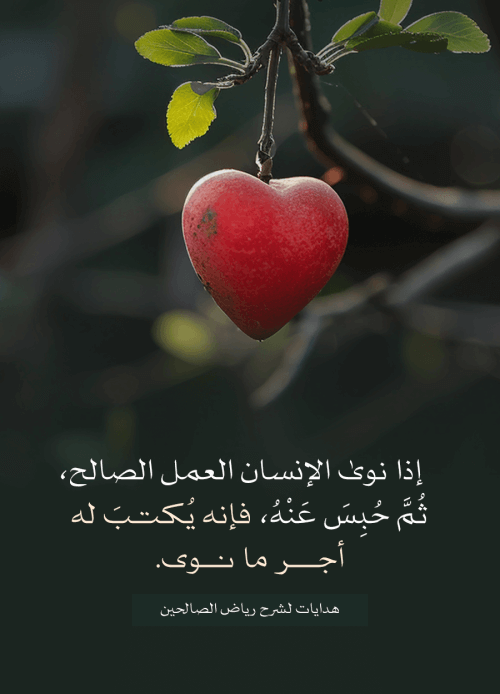
If someone intends to do a good deed but was prevented by a valid excuse, he shall gain the reward of his intention.
Riyadh Al-Salheen with explanation and benefits
Variation of reward for good deeds is based on sincerity and following of the Prophet’s guidance. The more a person is sincere to Allah, and the keener he is on following the Prophet (may Allah’s peace and blessings be upon him), the more perfect his worship will be, and consequently his reward will be bigger.
Riyadh Al-Salheen with explanation and benefits
People differ with regards to their acts of worship according to their intentions. The intentions of some people have reached the ultimate level of sincerity (to Allah) and keenness in following the Sunnah (of the Messenger of Allah) with regard to doing good and righteous deeds, while the intentions of others are below that.
Riyadh Al-Salheen with explanation and benefits
Anyone partaking a role with transgressors and wrongdoers will share their punishment because it is inclusive.
Riyadh Al-Salheen with explanation and benefits
If someone intends to do a good deed but was prevented by a valid excuse, he shall gain the reward of his intention.
Riyadh Al-Salheen with explanation and benefits
Actions are recompensed according to the intentions behind them, and the individual shall receive the reward of what he intended even if the outcome was contrary to his intention.
Riyadh Al-Salheen with explanation and benefits
There is not a single good deed intended sincerely to please Allah except that its doer will be raised in rank and status thereby, so that he would reap the full reward.
Riyadh Al-Salheen with explanation and benefits
Love and contentment is measured by good deeds and intentions because they are the criteria for Allah’s acceptance of the servant; perhaps a small deed reaps great reward because of the intention behind it and perhaps a big deed reaps little reward because of the intention behind it
Riyadh Al-Salheen with explanation and benefits
One of the proofs Allah supports the servant is the latter’s sincere endeavor to rectify his intention and purify his heart by good deeds.
هدايات لشرح رياض الصالحين