








Categories
Discover our diverse collection of categories covering multiple topics to meet your various interestsDa\'wa cards that highlight great meanings of the verses of the Holy Quran and the noble prophetic hadiths in a simple style and attractive display that helps the Muslim to have a deeper understanding of his religion in an easy way
﴿ بِأَنَّ رَبَّكَ أَوۡحَىٰ لَهَا ﴾
سورة الزلزلة
because your Lord has inspired it [to do so].

﴿ يَحۡلِفُونَ بِٱللَّهِ لَكُمۡ لِيُرۡضُوكُمۡ وَٱللَّهُ وَرَسُولُهُۥٓ أَحَقُّ أَن يُرۡضُوهُ إِن كَانُواْ مُؤۡمِنِينَ ﴾
سورة التوبة
62. They swear by Allâh to you (Muslims) in order to please you, but it is more fitting that they should please Allâh and His Messenger (Muhammad صلى الله عليه وسلم), if they are believers.
﴿ قَالَ لَئِنِ ٱتَّخَذۡتَ إِلَٰهًا غَيۡرِي لَأَجۡعَلَنَّكَ مِنَ ٱلۡمَسۡجُونِينَ ﴾
سورة الشعراء
[Pharaoh] said, "If you take a god other than me, I will surely place you among those imprisoned."
﴿ أَلَآ إِنَّهُمۡ يَثۡنُونَ صُدُورَهُمۡ لِيَسۡتَخۡفُواْ مِنۡهُۚ أَلَا حِينَ يَسۡتَغۡشُونَ ثِيَابَهُمۡ يَعۡلَمُ مَا يُسِرُّونَ وَمَا يُعۡلِنُونَۚ إِنَّهُۥ عَلِيمُۢ بِذَاتِ ٱلصُّدُورِ ﴾
سورة هود
Unquestionably, they [i.e., the disbelievers] turn away their breasts to hide themselves from him. Unquestionably, [even] when they cover themselves in their clothing, He [i.e., Allāh] knows what they conceal and what they declare. Indeed, He is Knowing of that within the breasts.
﴿ فَبِأَيِّ ءَالَآءِ رَبِّكُمَا تُكَذِّبَانِ ﴾
سورة الرحمن
38. Then which of the Blessings of your Lord will you both (jinn and men) deny?
﴿ مَّن كَانَ يُرِيدُ ٱلۡعَاجِلَةَ عَجَّلۡنَا لَهُۥ فِيهَا مَا نَشَآءُ لِمَن نُّرِيدُ ثُمَّ جَعَلۡنَا لَهُۥ جَهَنَّمَ يَصۡلَىٰهَا مَذۡمُومٗا مَّدۡحُورٗا ﴾
سورة الإسراء
Whoever desires this fleeting life[16], We hasten therein whatever We will to whoever We please. Then We prepare for him Hell, which he will enter, despised and rejected.
﴿ وَيَجۡعَلُونَ لِلَّهِ مَا يَكۡرَهُونَۚ وَتَصِفُ أَلۡسِنَتُهُمُ ٱلۡكَذِبَ أَنَّ لَهُمُ ٱلۡحُسۡنَىٰۚ لَا جَرَمَ أَنَّ لَهُمُ ٱلنَّارَ وَأَنَّهُم مُّفۡرَطُونَ ﴾
سورة النحل
And they attribute to Allāh that which they dislike [i.e., daughters], and their tongues assert the lie that they will have the best [from Him]. Assuredly, they will have the Fire, and they will be [therein] neglected.[706]
﴿ فَقَالُوٓاْ أَبَشَرٗا مِّنَّا وَٰحِدٗا نَّتَّبِعُهُۥٓ إِنَّآ إِذٗا لَّفِي ضَلَٰلٖ وَسُعُرٍ ﴾
سورة القمر
And said, "Is it one human being[1582] among us that we should follow? Indeed, we would then be in error and madness.
﴿ فَنَادَىٰهَا مِن تَحۡتِهَآ أَلَّا تَحۡزَنِي قَدۡ جَعَلَ رَبُّكِ تَحۡتَكِ سَرِيّٗا ﴾
سورة مريم
24. Then [the babe ‘Îsâ (Jesus) or Jibrîl (Gabriel)] cried unto her from below her, saying: "Grieve not: your Lord has provided a water stream under you.
‘Ā’ishah (may Allah be pleased with her) reported: The Messenger of Allah (may Allah’s peace and blessings be upon him) liked sweets and honey, and whenever he finished the ‘Asr prayer, he would visit his wives and stay closely with them, one after another. He once visited Hafsah and remained with her for longer than usual. I inquired about it, and it was said to me: ‘A woman from her tribe gifted her a leather vessel containing honey, and she gave some of it to the Messenger of Allah (may Allah’s peace and blessings be upon him) to drink.’ I said: "By Allah, we will play a trick on him." So I mentioned the story to Sawdah and said to her: "When he visits you, he will come near you, whereupon you should say to him: 'O Messenger of Allah, have you eaten Maghafīr (bad-smelling gum)?' He will say: 'No.' Then say to him: 'What about this smell then?' It was very hard on the Messenger of Allah (may Allah’s peace and blessings be upon him) that a bad smell would emit from him. He will say: 'Hafsah has given me a drink of honey.' Then say to him: 'Its bees must have sucked from ‘Urfut (a foul-smelling plant).' I too will tell him the same. And you, O Safiyyah, also say the same.’ When the Prophet (may Allah's peace and blessings be upon him) visited Sawdah, the following happened, as related by Sawdah, who said: 'By the One other than Whom there is no god, I was about to tell him what you had told me while he was still at the door, out of fear from you.’ But when the Messenger (may Allah's peace and blessings be upon him) came near her, she said to him: ‘O Messenger of Allah, have you eaten Maghāfīr?’ He replied: ‘No.’ ‘I said: 'What about this smell then?' He said: 'Hafsah has given me a drink of honey.' I said: 'Its bees must have sucked ‘Urfut.'’ When he visited me, I told him the same, and when he visited Safiyyah, she too said the same. When he visited Hafsah again, she said to him: ‘O Messenger of Allah, shall I give you a drink of it (the honey)?’ He said: ‘I have no desire for it.’ Sawdah said: ‘Glory be to Allah! By Allah, we have deprived him of it.’ I said to her: ‘Keep quiet!’”
Narrated by Bukhari & Muslim
In this Hadīth, ‘Ā’ishah (may Allah be pleased with her) mentioned that the Messenger of Allah (may Allah’s peace and blessings be upon him) liked all sweet foods and honey, and that when he finished the ‘Asr prayer, he would visit his wives, one after another, and approach each of them, kissing and caressing her. She goes on to relate that the Prophet (may Allah's peace and blessings be upon him) once visited Hafsah (may Allah be pleased with her) and stayed with her for longer than usual. ‘Ā’ishah asked about the reason and learned that one of Hafsah’s female relatives had given her a small vessel of honey as a gift and that she gave the Prophet (may Allah's peace and blessings be upon him) a drink of it. ‘Ā’ishah (may Allah be pleased with her) felt jealous and planned, together with Sawdah and Safiyyah, that when the Prophet (may Allah's peace and blessings be upon him) visited any of them, she would ask him whether he had eaten Maghāfīr, which is a foul-smelling gum. The noble Prophet (may Allah's peace and blessings be upon him) hated that any unpleasant odor should ever emit from him. So when he visited Hafsah (may Allah be pleased with her) again and she offered honey to him, he declined it. In another version: “He swore that he would never drink it again.” Different versions of this Hadīth differ over who gave the Prophet (may Allah's peace and blessings be upon him) the drink of honey. It has been mentioned that he had drunk it in the apartment of Zaynab or Sawdah. Some scholars deemed it more likely that Zaynab was the one who gave him the drink of honey and that Hasfah was ‘Ā’ishah’s partner in the plan. Some scholars proposed that the different versions might refer to more than one story.
‘Amr ibn Shu‘ayb reported from his father that his grandfather said that the Messenger of Allah (may Allah’s peace and blessings be upon him) said: “The son of Adam cannot make a vow concerning what is not his; he cannot free a slave who is not his; and he cannot divorce a woman who is not his (wife).”
Narrated by Ibn Majah - Narrated by At-Termedhy - Narrated by Abu Daoud - Narrated by Ahmad
In this Hadīth, the Prophet (may Allah's peace and blessings be upon him) explains that one can handle only things that he owns, and that disposing of things that one does not own is void. This rule applies to the acts mentioned in the Hadīth as follows: 1. The vow: Making a vow concerning a thing that one does not own at the time of making the vow is void. Even if one comes to own that thing later, he neither has to fulfill his vow nor offer expiation. 2. Emancipation of a slave: One cannot free a salve who is not his, because emancipation in this case in objectless. 3. Divorce: It is void if made by a man concerning a woman who is not his wife, because the right of divorce belongs exclusively to the husband who has the right to intimacy, and also because the Prophet (may Allah's peace and blessings be upon him) said: “One cannot divorce a woman who is not his (wife)”.
‘Ā'ishah (may Allah be pleased with her) reported: This verse: {Allah does not impose blame upon you for what is unintentional in your oaths} [Sūrat al-Baqarah: 225) was revealed concerning saying: "No, by Allah" and "Yes, by Allah".
Narrated by Bukhari
Allah, the Almighty, says what means: {Allah does not impose blame upon you for what is unintentional in your oaths} [Sūrat al-Baqarah: 225]. According to ‘Ā'ishah (may Allah be pleased with her) the unintentional oath in this verse means what people usually say during their conversations with no intention of making an oath such as: "No, by Allah" and "Yes, by Allah". This ruling also applies to oaths that people make concerning past events, based on wrong assumptions. Similarly, anyone who makes an oath believing that he is right, but then finds out that it is otherwise, does not have to offer expiation because it is an invalid oath according to the verse: {Allah does not impose blame upon you for what is unintentional in your oaths} [Sūrat al-Baqarah: 225]. According to this verse, Allah, the Almighty, will not punish people or make it binding on them to offer expiation for such unintentional oaths. The same ruling applies to making an oath that someone would do something, believing that he is going to honor that oath, but he does not. Of course, this ruling applies with priority to the example mentioned by ‘Ā'ishah (may Allah be pleased with her) as she was present at the time of the revelation, and she was also knowledgeable about the language of the Arabs.
‘Uqbah ibn ‘Āmir (may Allah be pleased with him) reported that the Messenger of Allah (may Allah's peace and blessings be upon him) said: "The expiation for a vow is the same as the expiation for an oath."
Narrated by Muslim
This Hadīth states that the atonement for breaking a vow is the same as the atonement for breaking an oath, which is feeding ten poor people, or providing them with clothes, or emancipating a slave. If one cannot do any of that, he fasts three days. This is the atonement for failing to fulfill a vow. Vows that are meant here are of different types: First, to make an absolute vow. For example, one vows in general terms without naming something, or says that if he does such and such thing, a vow is due on him to Allah. If not fulfilled, this vow must be expiated in the same way an unfulfilled oath is expiated. Second, to make a vow to commit a sin or miss an obligation. This vow must not be fulfilled. In this regard, ‘Ā'ishah (may Allah be pleased with her) reported that the Prophet (may Allah's peace and blessings be upon him) said: ''No vow should be taken to commit a sin, and its expiation is that of an oath.'' Third, to vow to do something that is to too hard to observe, such as a continuous act of physical worship or an exorbitant expense, etc. An expatiation for an oath is to be made in this case. ‘Ā'ishah (may Allah be pleased with her) said concerning a man who vowed to give his money in charity to the needy: ''The expiation of an oath (is due on him).'' Fourth, vowing to do an act of righteousness, such as praying, fasting, performing Hajj or ‘Umrah, with the intention of getting closer to Allah. Such a vow must be fulfilled, whether it is absolute or conditional on the occurrence of a good thing or the removal of a bad thing. For example, one says: if Allah cures my sick relative, or if my wealth that is not with me returns to me safe, then I will do such-and-such (i.e., I will give charity, etc), then he has to fulfill the vow if his condition is met.
Abu Hurayrah (may Allah be pleased with him) reported that the Prophet (may Allah's peace and blessings be upon him) said: "Whoever manumits a Muslim, Allah will save from Hell each organ of his body for each organ of him (i.e. of the manumitted person).''
Narrated by Bukhari & Muslim
In this Hadīth, Abu Hurayrah (may Allah be pleased with him) says that the Prophet (may Allah's peace and blessings be upon him) explained the virtue of emancipating people from slavery. It is one of the greatest acts of worship that draws one closer to Allah and frees him from Hell. If one manumits slaves for Allah's sake, his reward is that Allah will set him free from Hell. Since the reward is of the same kind of the deed, the manumitter is rewarded by being manumitted from Hell. This immense reward is – and Allah knows best – because a slave has no control over himself, for he is subject to someone else who controls him just as he controls a riding animal. So, emancipating him is like taking him out of nonexistence into existence. He is freed from the harm of slavery and is given control over himself. He can thus implement the religious rulings that apply to him and make his own decisions according to his free will and choice within the limits of Shariah.
Jābir ibn ‘Abdullāh (may Allah be pleased with him) reported that a man from the Ansār declared that a slave of his would be free after his death. Another version says that the Prophet (may Allah's peace and blessings be upon him) was told that a man from his Companions declared that a slave of his would be free after his own death although he had no property other than him (this slave). So, the Prophet sold him for eight hundred dirhams and sent the money to him.
Narrated by Bukhari & Muslim
A man from the Ansār promised that a slave that he owned would be free after his own death although the master had no other property. As the Prophet (may Allah's peace and blessings be upon him) was told of this, he considered this deal a waste of resources. So, he did not approve of this act. Meanwhile, he sold the slave for eight hundred dirhams and sent the money to the master. The priority for the poor master was to take care of himself and his family rather than emancipate his productive slave, and thus the indigent family would survive on begging. Finally, even though this tradition was applicable at some point in history and has no relevance today, something can be learned from it. Slavery is still practiced in some places like Africa, just as it was practiced since the time of Adam until after the coming of Islam. However, the attitude of Islam toward slavery is to eliminate it.
Abu Hurayrah (may Allah be pleased with him) reported that the Prophet (may Allah's peace and blessings be upon him) said: "Sulaymān ibn Dawūd (peace be upon him) said: 'I will indeed have sexual intercourse with seventy women at night, and each one of them will give birth to a child who will fight in the cause of Allah.' It was said to him: 'Say: Allah willing!' But he did not do so. He had intercourse with them all, but none of them gave birth, except for one woman who gave birth to half a person." Upon this, the Messenger (may Allah's peace and blessings be upon him) said: "If he had said, 'Allah willing,' he would not have failed in his oath, and his desire would have been fulfilled."
Narrated by Bukhari & Muslim
Prophet Sulaymān ibn Dawūd (peace be upon him) said to his interlocutor that he would have intercourse with seventy wives of his. It was permissible to combine such a number of wives in Sulaymān's time, or it was something specific to him. His intention was that each woman would give birth to a boy would who fight in the cause of Allah. His interlocutor told him to say: "Allah willing!" But he forgot to do so. He had intercourse with his wives, but none of them gave birth, except for one woman who gave birth to a stillborn. The Prophet (may Allah's peace and blessings be upon him) said that if Sulaymān had said "Allah willing", he would have fulfilled his oath and realized his wish.
Ka‘b ibn Mālik (may Allah be pleased with him) reported: I said: "O Messenger of Allah, I would like to give all of my wealth as a charity for the sake of Allah and His Messenger to make my repentance fully approved." The Prophet (may Allah's peace and blessings be upon him) said: "Keep some of your wealth, for this is better for you."
Narrated by Bukhari & Muslim
Ka‘b ibn Mālik al-Ansāri (may Allah be pleased with him) was one of three Companions who did not join the battle of Tabūk without a valid excuse but without being guilty of hypocrisy. When the Prophet (may Allah's peace and blessings be upon him) came back, he refrained from talking to them and told his Companions to do the same. They remained in that state of abandonment until Allah, the Exalted, revealed that He forgave their fault. The Prophet and the Companions were pleased with this. Ka‘b was so happy with Allah's pleasure and acceptance of his repentance that he wanted to give his entire fortune in charity for the sake of Allah, the Almighty. However, the Prophet (may Allah's peace and blessings be upon him) instructed him to keep some of his wealth. When Allah, the Almighty, knew about his truthful intention and sincere repentance, He forgave his sins even though he did not actually go through with it. Indeed, Allah does not burden a person beyond his scope. Therefore, Ka‘b gave part of his fortune in charity out of joy with Allah's pleasure and to gain Allah's reward in the Hereafter, and he kept part of it in order to be able to take care of his and his family's expenses. Verily, Allah is Ever-Merciful to His servants.
‘Abdullah ibn ‘Umar (may Allah be pleased with him) reported that the Messenger of Allah (may Allah's peace and blessings be upon him) said: "Whoever frees his share of a common slave and he has sufficient money to free him completely, should let its price be estimated by a just man and give his partners the price of their shares and manumit the slave; otherwise (i.e. if he has not sufficient money) he manumits the slave partially."
Narrated by Bukhari & Muslim
If a person has a share, albeit small, to the ownership of a slave, male or female, and he manumits part of it, the slave will be manumitted as much as this part. If the manumitter is well-to-do enough to afford to pay the share of his partner, he ought to manumit the slave wholly, assessing his partner's market value and giving it to him. If he is not that rich, however, he can manumit the slave partially, as much as his share in his ownership, with the rest remaining in bondage.
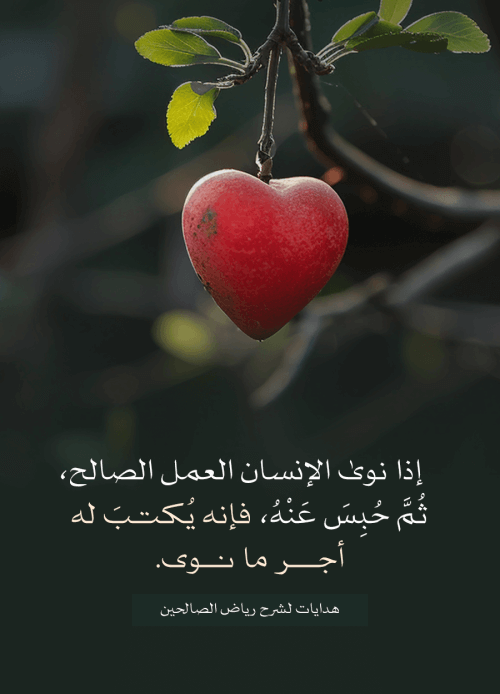
If someone intends to do a good deed but was prevented by a valid excuse, he shall gain the reward of his intention.
Riyadh Al-Salheen with explanation and benefits
Variation of reward for good deeds is based on sincerity and following of the Prophet’s guidance. The more a person is sincere to Allah, and the keener he is on following the Prophet (may Allah’s peace and blessings be upon him), the more perfect his worship will be, and consequently his reward will be bigger.
Riyadh Al-Salheen with explanation and benefits
People differ with regards to their acts of worship according to their intentions. The intentions of some people have reached the ultimate level of sincerity (to Allah) and keenness in following the Sunnah (of the Messenger of Allah) with regard to doing good and righteous deeds, while the intentions of others are below that.
Riyadh Al-Salheen with explanation and benefits
Anyone partaking a role with transgressors and wrongdoers will share their punishment because it is inclusive.
Riyadh Al-Salheen with explanation and benefits
If someone intends to do a good deed but was prevented by a valid excuse, he shall gain the reward of his intention.
Riyadh Al-Salheen with explanation and benefits
Actions are recompensed according to the intentions behind them, and the individual shall receive the reward of what he intended even if the outcome was contrary to his intention.
Riyadh Al-Salheen with explanation and benefits
There is not a single good deed intended sincerely to please Allah except that its doer will be raised in rank and status thereby, so that he would reap the full reward.
Riyadh Al-Salheen with explanation and benefits
Love and contentment is measured by good deeds and intentions because they are the criteria for Allah’s acceptance of the servant; perhaps a small deed reaps great reward because of the intention behind it and perhaps a big deed reaps little reward because of the intention behind it
Riyadh Al-Salheen with explanation and benefits
One of the proofs Allah supports the servant is the latter’s sincere endeavor to rectify his intention and purify his heart by good deeds.
هدايات لشرح رياض الصالحين