


Categories
Discover our diverse collection of categories covering multiple topics to meet your various interestsDa\'wa cards that highlight great meanings of the verses of the Holy Quran and the noble prophetic hadiths in a simple style and attractive display that helps the Muslim to have a deeper understanding of his religion in an easy way
﴿ فِي جَنَّةٍ عَالِيَةٖ ﴾
سورة الحاقة
in a lofty garden,

﴿ أَوَلَمۡ يَرَوۡاْ أَنَّا نَسُوقُ ٱلۡمَآءَ إِلَى ٱلۡأَرۡضِ ٱلۡجُرُزِ فَنُخۡرِجُ بِهِۦ زَرۡعٗا تَأۡكُلُ مِنۡهُ أَنۡعَٰمُهُمۡ وَأَنفُسُهُمۡۚ أَفَلَا يُبۡصِرُونَ ﴾
سورة السجدة
27. Have they not seen how We drive water to the dry land that has no vegetation, and therewith bring forth crops providing food for their cattle and themselves? Will they not then see?
﴿ وَٱلَّذِينَ هُمۡ لِلزَّكَوٰةِ فَٰعِلُونَ ﴾
سورة المؤمنون
and those who give zakah[1],
﴿ وَءَاتِ ذَا ٱلۡقُرۡبَىٰ حَقَّهُۥ وَٱلۡمِسۡكِينَ وَٱبۡنَ ٱلسَّبِيلِ وَلَا تُبَذِّرۡ تَبۡذِيرًا ﴾
سورة الإسراء
26. And give to the kinsman his due and to the Miskîn [4] (poor) and to the wayfarer. But spend not wastefully (your wealth) in the manner of a spendthrift.[5] (Tafsir At-Tabarî)
﴿ إِنَّا لَنَنصُرُ رُسُلَنَا وَٱلَّذِينَ ءَامَنُواْ فِي ٱلۡحَيَوٰةِ ٱلدُّنۡيَا وَيَوۡمَ يَقُومُ ٱلۡأَشۡهَٰدُ ﴾
سورة غافر
51. Verily, We will indeed make victorious Our Messengers and those who believe (in the Oneness of Allâh - Islâmic Monotheism) in this world’s life and on the Day when the witnesses will stand forth, (i.e. Day of Resurrection) -
﴿ يَٰٓأَيُّهَا ٱلَّذِينَ ءَامَنُواْ خُذُواْ حِذۡرَكُمۡ فَٱنفِرُواْ ثُبَاتٍ أَوِ ٱنفِرُواْ جَمِيعٗا ﴾
سورة النساء
O you who believe, take your precautions, then march out in groups or march out all together.
﴿ فَلَا تُطِعِ ٱلۡكَٰفِرِينَ وَجَٰهِدۡهُم بِهِۦ جِهَادٗا كَبِيرٗا ﴾
سورة الفرقان
52. So obey not the disbelievers, but strive against them (by preaching) with the utmost endeavour with it (the Qur’ân).
﴿ يَلۡبَسُونَ مِن سُندُسٖ وَإِسۡتَبۡرَقٖ مُّتَقَٰبِلِينَ ﴾
سورة الدخان
wearing fine silk and heavy brocade, facing one another.
﴿ مَا تَذَرُ مِن شَيۡءٍ أَتَتۡ عَلَيۡهِ إِلَّا جَعَلَتۡهُ كَٱلرَّمِيمِ ﴾
سورة الذاريات
42. It spared nothing that it reached, but blew it into broken spreads of rotten ruins.
Talhah ibn ‘Ubaydullah (may Allah be pleased with him) reported: A man from the people of Najd, with disheveled hair, came to the Messenger of Allah (may Allah's peace and blessings be upon him). We could hear his loud voice but could not understand what he was saying until he came close to the Messenger of Allah (may Allah's peace and blessings be upon him) when it became clear that he was asking about Islam. The Messenger of Allah (may Allah's peace and blessings be upon him) said: "Five prayers every day and night." He said: Do I have to perform any besides these? He said: "No, unless you do so voluntarily. And fasting the month of Ramadan." He said: Do I have to fast any beyond this? He said: "No, unless you do so voluntarily." The Messenger of Allah (may Allah's peace and blessings be upon him) mentioned Zakah to him. He said: Do I have to pay any besides this? He said: "No, unless you do so voluntarily." He said: The man, then, turned away while saying: By Allah, I shall neither add to this nor omit from it. Thereupon, the Messenger of Allah (may Allah's peace and blessings be upon him) said: "He will succeed if he proves to be truthful."
Narrated by Bukhari & Muslim
A man from the people of Najd came to the Prophet (may Allah's peace and blessings be upon him). His hair was disheveled, his voice was loud, and his words could not be understood until he approached the Prophet (may Allah's peace and blessings be upon him) and asked him about the obligations of Islam. The Prophet (may Allah's peace and blessings be upon him) started with the prayer and informed him that Allah has enjoined upon him five obligatory prayers to be performed every day and night. He said: Do I have to perform any other prayer besides these five prayers? The Prophet (may Allah's peace and blessings be upon him) replied: No, unless you choose to perform something of the voluntary prayers. Then, he (may Allah's peace and blessings be upon him) said: Among what has been enjoined upon you by Allah is fasting the month of Ramadan. The man said: Do I have to fast any other day besides fasting Ramadan? He said: No, unless you choose to fast voluntarily. Afterward, the Prophet (may Allah's peace and blessings be upon him) mentioned Zakah to him. The man said: Do I have to give any charity besides the obligatory Zakah? He said: No, unless you do so voluntarily. After listening to the Prophet's words about such obligations, the man turned away and swore by Allah that he would adhere to them without any addition or omission. Thereupon, the Prophet (may Allah's peace and blessings be upon him) said: If this man is truthful regarding his oath, he will be among the successful.
Abu Hurayrah (may Allah be pleased with him) reported that the Prophet (may Allah's peace and blessings be upon him) said: "The best day upon which the sun has risen is Friday; on it Adam was created, on it he was admitted to Paradise, on it he was expelled therefrom, and the Hour will not take place except on Friday."
Narrated by Muslim
The Prophet (may Allah's peace and blessings be upon him) informs that the best day upon which the sun has risen is Friday. Some of the characteristics of this day are: that Allah created Adam (peace be upon him) on that day, He admitted him to Paradise on that day and He drove him out therefrom and sent him down to earth on that day, besides the fact that the Hour will not take place except on Friday.
Abu Hurayrah (may Allah be pleased with him) reported: I heard the Messenger of Allah (may Allah’s peace and blessings be upon him) say: "Whoever performs Hajj without engaging in rafath (sexual relations or obscene speech) or sinning will return like the day his mother gave birth to him."
Narrated by Bukhari & Muslim
The Prophet (may Allah's peace and blessings be upon him) points out that whoever performs Hajj without engaging in sexual relations and obscene speech, or evil acts, he will return home sinless. Sinning also includes doing the things prohibited while being in ihram. If these things are avoided, he returns from Hajj with his sins forgiven, as a baby is born free from sin.
‘Ā’ishah (may Allah be pleased with her) reported: I heard the Messenger of Allah (may Allah's peace and blessings be upon him) say: "No prayer should be offered in the presence of food or when he is resisting the need to relieve himself of the two filths."
Narrated by Muslim
The Messenger of Allah (may Allah's peace and blessings be upon him) forbade praying in the presence of food, which the praying person craves and wants very much. Also, he forbade praying while resisting the need to relieve oneself of the two filths - urine and stool - for this causes distraction.
Abu Hurayrah (may Allah be pleased with him) reported: The Messenger of Allah (may Allah's peace and blessings be upon him) said: "If you say to your companion 'listen' on Friday while the Imām is delivering the sermon, you have thus engaged in idle talk."
Narrated by Bukhari & Muslim
The Prophet (may Allah's peace and blessings be upon him) points out that one of the ethics that should be observed by those who attend the Friday sermon is to listen to the preacher to ponder over the delivered lessons and that whoever speaks - albeit the least of words - while the Imām is giving the sermon and tells someone to "keep silent" or to 'listen' has thus missed the merit of the Friday prayer.
Abu Hurayrah (may Allah be pleased with him) reported: I heard the Prophet (may Allah's peace and blessings be upon him) say: "Five are acts of Fitrah (natural disposition): circumcision, shaving the pubic hair, trimming the mustache, clipping the nails, and plucking the armpit hair."
Narrated by Bukhari & Muslim
The Prophet (may Allah's peace and blessings be upon him) mentioned five acts that belong to the religion of Islam and the practices of the messengers. First: Circumcision: This is to cut the foreskin of the glans of the male organ and to cut the tip of a female's clitoris. Second: Shaving the pubes. This is to cut the pubic hair, which grows around the sex organs. Third: trimming the mustache. This is to trim the hair that grows on a man's upper lip in a way that makes the lip visible. Fourth: Clipping the nails. Fifth: Plucking the armpit hair.
Ibn ‘Umar (may Allah be pleased with him) reported: The Prophet (may Allah's peace and blessings be upon him) said: "Trim the mustaches and let the beards grow."
Narrated by Bukhari & Muslim
The Prophet (may Allah's peace and blessings be upon him) enjoins that the mustache should be trimmed and not be left to grow; rather, it should be cut, and this should be done to a great extent. On the other hand, he enjoins that the beard should be left to grow long.
Humrān, the freed slave of 'Uthmān ibn' Affān, reported that he saw 'Uthmān ibn' Affān asking (for water) to perform ablution, and he poured water from his vessel over his hands and washed them thrice and then put his right hand in the water and rinsed his mouth and washed his nose by putting water in it and then blowing it out. Then, he washed his face thrice and his forearms up to the elbows thrice. Then, he passed his wet hands over his head and washed each foot thrice. After that, he said: "I saw the Prophet (may Allah's peace and blessings be upon him) perform ablution like this ablution of mine, and he said: 'If anyone performs ablution like this ablution of mine and offers two Rak'ahs during which he does not think of anything else, Allah will forgive his past sins.'"
Narrated by Bukhari & Muslim
'Uthmān ibn' Affān (may Allah be pleased with him) practically taught the Prophet's manner of ablution to make it clearer. He asked for water in a vessel and poured water on his hands three times. After that, he entered his right hand into the vessel, took water with it, put it in his mouth and let it out. Then, he sniffed water into his nose and then blew it out. Then, he washed his face three times and then washed his forearms up to the elbows three times. Then, he passed his wet hand over his head once. Then, he washed his feet along with the ankles three times. When he (may Allah be pleased with him) finished, he informed them that he saw the Prophet (may Allah's peace and blessings be upon him) perform ablution like that ablution and that he (may Allah's peace and blessings be upon him) gave them glad tidings that whoever performs ablution like his ablution and offers two Rak'ahs, with presence of mind and humility before his Almighty Lord, Allah will recompense him for this complete ablution and this sincere prayer by forgiving his past sins.
Abu Hurayrah (may Allah be pleased with him) reported that the Prophet (may Allah's peace and blessings be upon him) said: "Allah does not accept the prayer of any of you who is in the state of Hadath (minor ritual impurity) until he performs ablution."
Narrated by Bukhari & Muslim
The Prophet (may Allah's peace and blessings be upon him) clarified that Tahārah (ritual purity) is one of the conditions for the validity of prayer. Hence, whoever wants to pray must make Wudū’ (ablution) if he has already nullified his Wudū’ by defecating, urinating, sleeping, etc.
Repenting to Allah Almighty is a cause for quitting sins and for contentment with the provision that Allah alloted for His servant.
Riyadh Al-Salheen with explanation and benefits
Facing affliction with patience and expectation of the reward from Allah raises one’s ranks and expiates his sins.
Riyadh Al-Salheen with explanation and benefits
The afflictions befalling the believer is a proof that Allah loves him and wills good for him.
Riyadh Al-Salheen with explanation and benefits
Anyone who bears a calamity patiently and awaits Allah’s reward, Allah, the Exalted, will compensate him with better than what he lost either in himself or his family.
Riyadh Al-Salheen with explanation and benefits
When the believer bears patiently and awaits Allah’s reward, Allah Almighty expiates his sins.
Riyadh Al-Salheen with explanation and benefits
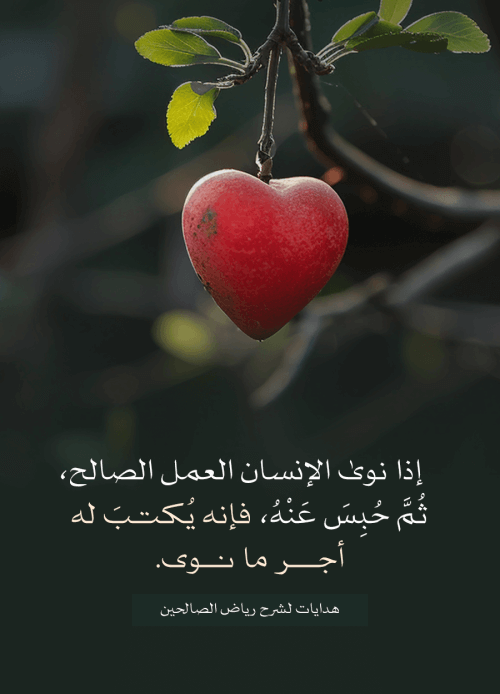
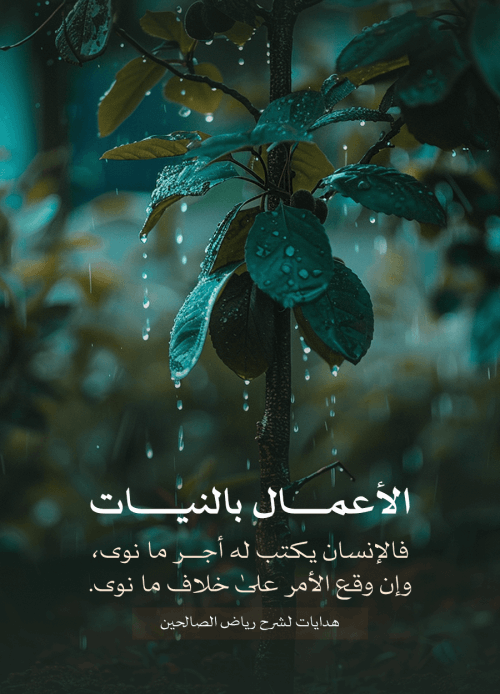
Truthfulness of the hearts is a cause to attain what is desired. Whoever intends to do a good deed will be rewarded for it even if he were unable to do it or failed to complete it.
Riyadh Al-Salheen with explanation and benefits
Thanking Allah for His blessings is one of the reasons for their permanence and increase.
Riyadh Al-Salheen with explanation and benefits
Once something is blessed, it becomes abundant even if it is little; and once something is stripped of blessings, it becomes little even if it is abundant.
Riyadh Al-Salheen with explanation and benefits
Taqwa is a [metaphorical] light helping the individual to discern between the truth and falsehood, the good and the harmful, and the [standard practice] of Sunnah from [religious] innovation.
Riyadh Al-Salheen with explanation and benefits