








Categories

Discover our diverse collection of categories covering multiple topics to meet your various interestsDa\'wa cards that highlight great meanings of the verses of the Holy Quran and the noble prophetic hadiths in a simple style and attractive display that helps the Muslim to have a deeper understanding of his religion in an easy way

﴿ إِنِّي جَزَيۡتُهُمُ ٱلۡيَوۡمَ بِمَا صَبَرُوٓاْ أَنَّهُمۡ هُمُ ٱلۡفَآئِزُونَ

سورة المؤمنون
line

Indeed, I have rewarded them this Day for their patient endurance - that they are the attainers [of success]."

﴿ وَمَثَلُ ٱلَّذِينَ كَفَرُواْ كَمَثَلِ ٱلَّذِي يَنۡعِقُ بِمَا لَا يَسۡمَعُ إِلَّا دُعَآءٗ وَنِدَآءٗۚ صُمُّۢ بُكۡمٌ عُمۡيٞ فَهُمۡ لَا يَعۡقِلُونَ

سورة البقرة
line

The example of those who disbelieve is like that of one who shouts at what hears nothing but calls and cries [i.e., cattle or sheep] - deaf, dumb and blind, so they do not understand.

﴿ لَهُۥ مُعَقِّبَٰتٞ مِّنۢ بَيۡنِ يَدَيۡهِ وَمِنۡ خَلۡفِهِۦ يَحۡفَظُونَهُۥ مِنۡ أَمۡرِ ٱللَّهِۗ إِنَّ ٱللَّهَ لَا يُغَيِّرُ مَا بِقَوۡمٍ حَتَّىٰ يُغَيِّرُواْ مَا بِأَنفُسِهِمۡۗ وَإِذَآ أَرَادَ ٱللَّهُ بِقَوۡمٖ سُوٓءٗا فَلَا مَرَدَّ لَهُۥۚ وَمَا لَهُم مِّن دُونِهِۦ مِن وَالٍ

سورة الرعد
line

11. For him (each person), there are angels in succession, before and behind him.[1] They guard him by the Command of Allâh. Verily! Allâh will not change the (good) condition of a people as long as they do not change their state (of goodness) themselves (by committing sins and by being ungrateful and disobedient to Allâh). But when Allâh wills a people’s punishment, there can be no turning back of it, and they will find besides Him no protector.

﴿ ثُمَّ لَتَرَوُنَّهَا عَيۡنَ ٱلۡيَقِينِ

سورة التكاثر
line

Again, you will see it with absolute certainty.

﴿ إِنَّ ٱلَّذِينَ ءَامَنُواْ وَعَمِلُواْ ٱلصَّٰلِحَٰتِ كَانَتۡ لَهُمۡ جَنَّٰتُ ٱلۡفِرۡدَوۡسِ نُزُلًا

سورة الكهف
line

As for those who believe and do righteous deeds, they will have gardens of Paradise[56] as a dwelling place[57],

﴿ يَٰٓأَيُّهَا ٱلنَّاسُ قَدۡ جَآءَكُم بُرۡهَٰنٞ مِّن رَّبِّكُمۡ وَأَنزَلۡنَآ إِلَيۡكُمۡ نُورٗا مُّبِينٗا

سورة النساء
line

O people, there has come to you conclusive evidence[111] from your Lord, and We have sent down to you a clear light[112].

﴿ إِنَّ ٱلۡمُتَّقِينَ فِي جَنَّٰتٖ وَنَعِيمٖ

سورة الطور
line

Indeed, the righteous will be in gardens and bliss,

﴿ وَإِنۡ أَرَدتُّمُ ٱسۡتِبۡدَالَ زَوۡجٖ مَّكَانَ زَوۡجٖ وَءَاتَيۡتُمۡ إِحۡدَىٰهُنَّ قِنطَارٗا فَلَا تَأۡخُذُواْ مِنۡهُ شَيۡـًٔاۚ أَتَأۡخُذُونَهُۥ بُهۡتَٰنٗا وَإِثۡمٗا مُّبِينٗا

سورة النساء
line

20. But if you intend to replace a wife by another and you have given one of them a Qintâr (of gold i.e. a great amount as Mahr) take not the least bit of it back; would you take it wrongfully without a right and (with) a manifest sin?

﴿ وُجُوهٞ يَوۡمَئِذٖ نَّاعِمَةٞ

سورة الغاشية
line

Other faces on that Day will be joyful,

﴿ سُبۡحَٰنَ ٱلَّذِي خَلَقَ ٱلۡأَزۡوَٰجَ كُلَّهَا مِمَّا تُنۢبِتُ ٱلۡأَرۡضُ وَمِنۡ أَنفُسِهِمۡ وَمِمَّا لَا يَعۡلَمُونَ

سورة يس
line

36. Glory be to Him Who has created all the pairs of that which the earth produces, as well as of their own (human) kind (male and female), and of that which they know not.

Ibn ‘Abbās (may Allah be pleased with him) reported: A man, who made Zhihār (pre-islamic form of divorce) against his wife yet had intercourse with her, went to the Prophet (may Allah's peace and blessings be upon him). He said: "O Messenger of Allah, I uttered Zhihār against my wife, then I had intercourse with her before atoning." He said: "What caused you to do that, may Allah have mercy upon you?" He said: "I saw her anklet in the moonlight." The Prophet (may Allah's peace and blessings be upon him) said: "Then do not approach her (have intercourse with her) until you do what Allah has ordered you to do (the atonement for Zhihār)."

Narrated by Ibn Majah - Narrated by At-Termedhy - An-Nasaa’i - Narrated by Abu Daoud
line

The Hadīth shows that this Companion was used to having intercourse with his wife so frequently. Being afraid that he would have sexual intercourse with her while fasting during Ramadan that had already started, he pronounced Zhihār against his wife. In other words, he likened her to a woman who is permanently prohibited for him to marry such as his mother, sister, aunt, etc. However, while she was serving him one night, he saw her anklet and was enticed into having intercourse with her, which he did. He later regretted this and went to the Prophet (may Allah's peace and blessings be upon him) asking about the ruling on what he did. The Prophet (may Allah's peace and blessings be upon him) ordered him not to touch his wife except after offering the expiation that Allah, the Exalted, has made obligatory for the one who made Zhihār against his wife. This Hadīth is a main reference on the issue of Zhihār.

Salamah ibn Sakhr (may Allah be pleased with him) reported: I was a man more given to sexual intercourse with women than others. When the month of Ramadan came, I feared lest I would have intercourse with my wife, and this would continue till the morning. So I swore that my wife would be as impermissible for me as my mother till the end of Ramadan. One night, however, when she was serving me, something of her was revealed, prompting me to jump upon her right away. In the morning, I went out to my people and informed them about this matter. I said: "Go along with me to the Messenger of Allah (may Allah's peace and blessings be upon him)." They said: "No, by Allah." So I went to the Prophet (may Allah's peace and blessings be upon him) and informed him of the matter. He said: "Did you really do it, Salamah?" I said: "I did it twice, O Messenger of Allah, I am content with the judgment of Allah. So take a decision about me as Allah revealed to you." He said: "Free a neck (a slave)." I said: 'By the One Who sent you with truth! I do not possess a neck other than this," striking the surface of my own neck. He said: "Then fast two consecutive months." I said: "Indeed, the very act I committed was because of fasting." He said: "Feed sixty poor people with a Wasq of dates." I said: "By the One Who sent you with truth! We passed the night hungry; there was no food in our house." He said: "Then go to the collector of Zakah of Banu Zurayq, and let him give it to you, and feed sixty poor people with a Wasq of dates, and you and your family eat the remaining dates." I came back to my people and said to them: "I found with you restriction and bad opinion, but I found with the Prophet (may Allah's peace and blessings be upon him) spaciousness and wise opinion. He has ordered me – or for me – to be given from your Zakah."

Narrated by Ibn Majah - Narrated by At-Termedhy - Narrated by Abu Daoud - Narrated by Ahmad - Ad-Daarimi
line

This Companion, Salamah ibn Sakhr (may Allah be pleased with him) wanted to halt copulation with his wife throughout the month of Ramadan given the intensity of his sexual desire. Therefore, out of fear that he might have intercourse with her, which would continue to the time of the Fajr, he took an oath of Zhihār, making her as impermissible for him as his mother until the end of the month. However, one night, he was allured into having sexual intercourse with her, which he did. Thereafter, he felt fearful of the consequences of his sin. So he requested his people to accompany him to the Messenger (may Allah's peace and blessings be upon him) to ask him about the ruling on this issue and beg him for pardon on his behalf, but they refused to go with him. So he went to the Prophet (may Allah's peace and blessings be upon him) by himself and related this incident to him. The Prophet (may Allah's peace and blessings be upon him) asked him if he was sure that he had actually done this, and Salamah replied in the affirmative. Thereupon, the Prophet (may Allah's peace and blessings be upon him) informed him of the ruling of Allah in his case; which is that he should free a slave; and if he cannot afford it, he should fast for two consecutive months; and if he is unable to do so, he should feed sixty poor people. However, Salamah (may Allah be pleased with him) informed the Prophet (may Allah's peace and blessings be upon him) of his helplessness and poverty, possessing no slave or even food. In response, the Prophet (may Allah's peace and blessings be upon him) ordered that he should be given dates from the charity of his people so that he could expiate therewith for his oath of Zhihār and take the rest to feed his wife and children.

Abu Hurayrah (may Allah be pleased with him) reported that a Bedouin man came to the Messenger of Allah (may Allah's peace and blessings be upon him) and said: "My wife has given birth to a black boy." The Prophet asked him: "Do you have camels?" He replied: 'Yes.' The Prophet asked: "What color are they?" He replied: 'Red.' The Prophet asked: "Is any of them gray?" He replied: 'Yes.' The Prophet asked: "From where did that grayness come?" He said: "It might have inherited it from its ancestors." The Prophet (may Allah's peace and blessings be upon him) said: "Perhaps this son of yours (also) inherited it (this color) from his ancestors."

Narrated by Bukhari & Muslim
line

A boy was born to a man from the tribe of Fazārah, and the color of the baby's skin was different from that of his father and mother. The father thus had doubts that the boy was not his child, so he went to the Prophet (may Allah's peace and blessings be upon him) to inform him that his wife gave birth to a black child, thus implying an accusation of adultery. The Prophet understood what he meant and wanted to convince the man and remove his doubt, so he made an analogy which is familiar and known to the man. He asked him if he had camels and what their color was. He replied in the affirmative and that they were red. He then asked him if there were any grey camels among them, and he said: 'Yes.' The Prophet then asked him where that different color came from. The man replied that perhaps it came by heredity from the lineage of the animal; one of its parentages. The Prophet (may Allah's peace and blessings be upon him) said that the case of his son was similar to this and that there might have been a black person in the man's ancestors, so therefore the boy inherited the color. The man was convinced with this sound analogy, and the doubts in his mind were removed.

‘Ā'ishah (may Allah be pleased with her) reported: The Messenger of Allah (may Allah's peace and blessings be upon him) entered upon me with his face shining with delight and said: "Have you not known that Mujazziz has recently looked at Zayd ibn Hārithah and Usāmah ibn Zayd and said: 'Indeed, these feet are related to one another?'" Another wording of the Hadīth adds: “Mujazziz was a lineage tracker.”

Narrated by Bukhari & Muslim
line

Zayd ibn Hārithah was white, and his son Usāmah was black, and people used to doubt their relation to one another due to their difference in color, suspecting the validity of Usāmah’s attribution to his father. This used to annoy the Messenger of Allah (may Allah's peace and blessings be upon him). Once, Mujazziz al-Mudliji, a lineage tracker, passed by them (Zayd and Usāmah), while their heads were covered with a piece of velvet and their legs were uncovered. On that, Mujazziz said: “Indeed, these feet are related to one another,” due to the resemblance that he saw between them. His speech was heard by the Prophet (may Allah's peace and blessings be upon him) who was extremely happy on hearing that, to the extent that he entered upon ‘Ā'ishah with his face glittering with joy and rejoice for being reassured of the validity of Usāmah’s attribution to his father's lineage; and for the rebuttal of the speech of those who unknowingly set their tongues loose regarding the honor of others.

‘Abdullāh ibn ‘Umar (may Allah be pleased with him) reported: During the lifetime of the Messenger of Allah (may Allah's peace and blessings be up on him), a man accused his wife of adultery and disclaimed her child. So the Messenger of Allah (may Allah's peace and blessings be upon him) ordered them both to swear the oath of condemnation against each other, as Allah, the Almighty, instructed, and they did. Then he decided that the child should be with the woman and separated them (the man and woman).

Narrated by Bukhari & Muslim
line

In this Hadīth, ‘Abdullāh ibn ‘Umar (may Allah be pleased with him) reports that a man accused his wife of adultery and denied his paternity of her child. She denied his claim and rejected his accusation. So, they swore the oath of condemnation against each other in this way: the husband swore by Allah four times that he is truthful in his accusation, and on the fifth time he invoked the curse of Allah upon himself (if he is a liar). Then the wife swore by Allah four times that he is a liar, and on the fifth time she invoked the anger of Allah upon herself (if he is truthful). After they had condemned one another, the Prophet (may Allah's peace and blessings be upon him) separated them permanently and let the child join the woman and be attributed to her. The child was cut off from the man and no longer attributed to him.

‘Abdullāh ibn ‘Umar (may Allah be pleased with him) reported: So-and-so came and asked: "O Messenger of Allah, if one of us finds his wife committing adultery: what should he do? If he were to speak, his statement would be a horrible matter, and if he were to remain silent, his silence about the matter would be horrible too." The Messenger of Allah (may Allah's peace and blessings be upon him) remained silent. After some time, the man came back to the Messenger of Allah (may Allah's peace and blessings be upon him) and said: "I have become afflicted by the very thing I asked you about." Then Allah, the Exalted, revealed these verses of Sūrat An-Nūr (which begins with): {And those who accuse their wives} [Sūrat- An-Nūr: 6]. The Prophet (may Allah's peace and blessings be upon him) recited them to him. Then he admonished him, exhorted him, and informed him that the torment of this world is less painful than the torment of the Hereafter. The man said: "No, by the One Who sent you with the Truth, I did not tell a lie against her." The Prophet (may Allah's peace and blessings be upon him) then called the wife and admonished her, exhorted her, and informed her that the torment of this world is less painful than the torment of the Hereafter. She said: "No, by the One Who sent you with the Truth, he is a liar." The Prophet (may Allah's peace and blessings be upon him) started with the man, who testified in the name of Allah four times that he was truthful, and the fifth time, he said: "Let Allah's curse fall upon me if I am a liar." Then the woman was summoned, and she testified four times by the name of Allah that her husband was among the liars, and the fifth time, she said: "Let the anger of Allah fall upon me if he is truthful." Then the Prophet (may Allah's peace and blessings be upon him) separated them and said: "Indeed, Allah knows that one of you is a liar, so would any of you repent?" He said this statement thrice. According to another wording of the Hadīth, the Prophet (may Allah's peace and blessings be upon him) said: "You have no right over her." The man said: "O Messenger of Allah, what about my money?" The Prophet (may Allah's peace and blessings be upon him) said: "You have no right to get back your money. If you have told the truth about her, then your money was in return for the sexual intercourse which you lawfully had with her, and if you have told a lie about her, then you are less rightful to get your money back."

Narrated by Bukhari & Muslim
line

Islam legislated the law of 'Li‘ān' (invoking the curse of Allah upon the liar among the two spouses for falsehood in the matter of witnessing adultery) as a solution to the problem of a husband witnessing another man committing adultery with his wife without four other witnesses (or visa versa). The husband cannot just be in suspicion about the matter: he must clearly witness the actual act of penetration of the adultery. The punishment for any false accusation and lying in this matter is extremely grievous (torment in Hellfire). The man in this story was feeling doubtful about the conduct of his wife and was worried that she might commit adultery. He was confused about what to do, for if he accused her (without the four witnesses) then he would undergo the relevant legal punishment (of whipping, etc), and if he remained silent about it then he would be considered a cuckold and suffer disgrace. He went to the Prophet (may Allah's peace and blessings be upon him) and mentioned these things to him. The Prophet (may Allah's peace and blessings be upon him) remained silent as he did not like to answer questions about issues which had not yet occurred, because this leads to evil and could possibly open the doors for evil to occur. In addition to that no verses were yet revealed to the Prophet (may Allah's peace and blessings be upon him) regarding this issue. After some time the same man who questioned the Prophet (may Allah's peace and blessings be upon him) saw the monstrosity (adultery) he had asked about previously and about which he had worries. Thereupon Allah revealed some rulings regarding this issue in Sūrat An-Nūr, as He says (what means) {Those who accuse their wives} [Qur'an 24:6]. The Prophet (may Allah's peace and blessings be upon him) recited these verses to the man, admonished him and reminded him that if he was lying in accusing his wife, then the worldly punishment of false accusations is less severe than the punishment of the Hereafter. The man swore the sacred oath by Allah that he was not lying about witnessing and accusing his wife of adultery. Then the Prophet (may Allah's peace and blessings be upon him) called the wife and admonished her and told her that the punishment of this life is less severe than the punishment of the Hereafter. Then she swore also that her husband was a liar. Then, the Prophet may Allah's peace and blessings be upon him, started by the one with whom Allah has started with (i.e. in the Qur'anic verses mentioned above), the husband. The man testified four times by Allah that he was truthful in what he accused his wife with, and upon the fifth time he invoked the curse of Allah upon himself if he was a liar. Then the Prophet (may Allah's peace and blessings be upon him) summoned his wife, and she testifies four times by Allah that her husband was a liar, and she also upon the fifth time invoked the anger of Allah upon herself if her husband was truthful. Then the Prophet (may Allah's peace and blessings be upon him) separated between them permanently (and irrevocably). Given that one of them was definitely a liar, the Prophet (may Allah's peace and blessings be upon him) urged them to repent. Then the husband requested his dowry back and the Prophet (may Allah's peace and blessings be upon him) said: "you have no right to claim the dowry: if you were truthful about her committing adultery then the dowry you gave her was in exchange for your sexual relations with her during your marriage. And if you were lying about her, then it is even less rightful that you would receive anything because you accused her of such a terrible lie and great falsehood.

‘Ā’ishah (may Allah be pleased with her) reported: Sa‘d ibn Abi Waqqās and ‘Abd ibn Zam‘ah disputed over (the lineage of) a boy. Sa‘d said: "O Messenger of Allah, this is the son of my brother ‘Utbah ibn Abi Waqqās. He entrusted him to me saying that he was his own son. Just look at him and see how he resembles him." ‘Abd ibn Zam‘ah said: "O Messenger of Allah, he is my brother, as he was born on the bed of my father from his slave girl." The Messenger of Allah (may Allah's peace and blessings be upon him) looked at the boy and saw that he clearly resembled ‘Utbah. Thereupon, he said: "He is yours, O ‘Abd ibn Zam‘ah. The child belongs to the owner of the bed, and the stone is for the one who commits illegal sexual intercourse. O Sawdah, cover yourself from him." So, that boy never saw Sawdah uncovered.

Narrated by Bukhari & Muslim
line

In the pre-Islamic era of ignorance, they used to impose taxes upon the slave girls, which they earned from practicing immorality, then they would attribute the child to the man who committed adultery with the slave girl if he claimed him. So ‘Utbah ibn Abi Waqqās had unlawful sexual intercourse with a slave girl belonging to Zam‘ah ibn al-Aswad, and he entrusted his brother Sa‘d to attribute the child to his lineage (‘Utbah's lineage). After the Conquest of Makkah, Sa‘d saw the boy and recognized him by his resemblance to his brother. So, he wanted to attribute him to his brother's lineage. On that, Sa‘d and ‘Abd ibn Zam‘ah disputed over the boy. Sa‘d supported his claim by the fact that his brother admitted that the boy was his child, and that there was a resemblance between them. Whereas ‘Abd ibn Zam‘ah said that he was his brother, born from the slave girl of his father, for his father was the master of the slave girl who gave birth to the boy, therefore he is the legitimate owner of the bed. Thereupon, the Prophet (may Allah's peace and blessings be upon him) looked at the boy and saw in him a clear resemblance to ‘Utbah. Yet, he ruled that the child belonged to Zam‘ah; saying that the child belongs to the owner of the bed in which he was born, and that the one who commits unlawful sexual intercourse gets nothing but failure and loss, for he has no link with the child. That is because, in principle, the child is to be attributed to the slave girl's owner who is entitled to have sexual intercourse with rightfully. However, when he saw the boys resemblance to ‘Utbah, he was cautious to let the boy look freely at his sister Sawdah bint Zam‘ah, on the basis that they were siblings. So, he ordered her to cover hereself from him as a precautionary measure. Hence, resemblance and supplementary proofs are not considered valid in the presence of owner of the bed.

Hilāl ibn Umayyah accused his wife of committing adultery with Sharīk ibn Sahmā', the brother of Al-Barā ibn Mālik from the side of his mother. He was the first man who practiced Li‘ān in Islam. He swore oaths of Li‘ān against his wife, so the Messenger of Allah (may Allah's peace and blessings be upon him) said: "Watch her, if she gives birth to a white-complexioned child having straight hair and sore eyes, he is the son of Hilāl ibn Umayyah, but if she gives birth to a child with eyes that appear to have antimony in them, curly hair, and thin shanks, then he is the son of Sharīk ibn Sahmā'." He (the narrator) said: "I was informed that she gave birth to a child having eyes that appear to have antimony in them, curly hair, and thin shanks."

Narrated by Muslim
line

This Hadīth indicates that the Companion Hilāl ibn Umayyah (may Allah be pleased with him) accused his wife of committing adultery with Sharīk ibn Sahmā', and she was pregnant. Hilāl wanted to deny his fatherhood of the child through Li‘ān. In this process, the husband and wife make testimonies, which they confirm with an oath and curse invoked on the one of them who is not saying the truth. Then the Prophet (may Allah's peace and blessings be upon him) mentioned signs whereby the child would be identified to belong to the husband or the adulterer. He said that if the child was in a perfect form and with straight hair, then he would belong to the husband, owing to the genetic similarity between them. And if the child had very dark eye lashes and curly hair, then he was the son of the adulterer, Sharīk ibn Sahmā'. The point of this Hadīth is that it is permissible to make Li‘ān against a pregnant wife.

‘Umar ibn al-Khattāb (may Allah be pleased with him) said: "If a man acknowledges his paternity of a child (even) for a moment, he has no right to deny it (later)."

Al-Bayhaqi
line

This report indicates that if a man acknowledges his paternity of a child, he has no right to deny this paternity or the child’s attribution to him later. This is because paternity is one of the rights that is established by acknowledgment, and a subsequent denial or negation is not acceptable.

Umm Salamah (may Allah be pleased with her) reported: A woman came to the Messenger of Allah (may Allah's peace and blessings be upon him) and said: "O Messenger of Allah, my daughter’s husband died, and she complains about her eye. Can we apply Kohl thereto?" The Messenger of Allah (may Allah's peace and blessings be upon him) said 'No' twice or thrice. Then he said: "It is only four months and ten days. In the pre-Islamic era, you women would throw away the dung after a year had passed." Zaynab said: “When a woman’s husband died, she would go into a small hut, wear her worst clothes and would not touch any kind of perfume until a whole year would pass. Then an animal – a donkey, bird, or sheep – would be brought to her and she would rub her skin with it. It was seldom that she would rub her skin with any animal except that it died! Then she would come out and be given a piece of dung, which she would throw away. Then, she would return to using perfume or anything else she liked.”

Narrated by Bukhari & Muslim
line

Islam came and relieved people of the hardship of the pre-Islamic era, especially the woman, who was mistreated and wronged but Islam preserved her rights. In this Hadīth, a woman came seeking a legal ruling from the Prophet (may Allah's peace and blessings be upon him) as she told him that her daughter’s husband had died and that her daughter was in her mourning period, during which she had to abstain from adornment. However, she complained about some pain in her eyes. The woman asked whether there was a concession allowing her daughter to use Kohl. The Prophet (may Allah's peace and blessings be upon him) said: "No", repeating it in confirmation of his disapproval. Then he made a remark about the considerable shortness of the duration of a widow’s period of mourning as a veneration of the husband, which is four months and ten days. Then he wondered why women would not endure this short period that involved ease and comfort? In the pre-Islamic era, a widow would observe the mourning period in a small house, like a den in the wilderness, and for a full year she would abstain from adornment, perfume, water, and mixing with people, such that the filth and dirt would accumulate on her body, while being secluded from people. When her mourning period ended, she would be given a piece of dung, which she would then throw away, as an indication that what she went through of confinement, hardship and difficulty is as insignificant as that piece of dung when compared to her husband's huge right upon her. When Islam came, it replaced such a distress with favor, and such a difficulty with ease. However, women were too impatient to refrain from applying Kohl to their eyes. That is why no concession was granted to such a woman in this case, in order not to be a means leading to allowing adornment for a woman in her mourning period.

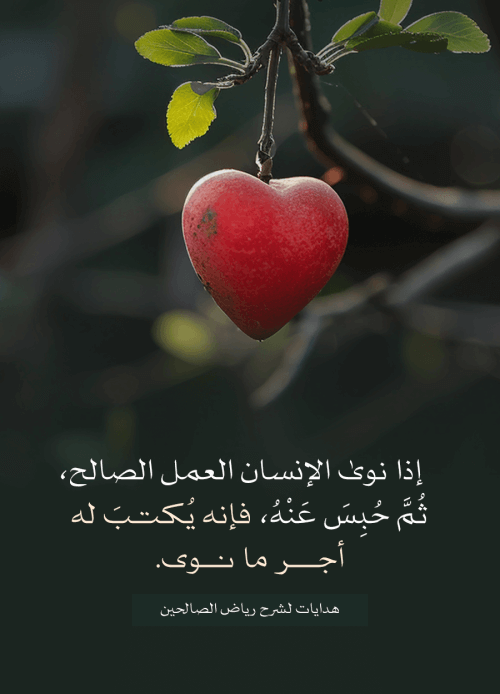
Waiting to do a good deed is in itself a good deed.

Riyadh Al-Salheen with explanation and benefits

Good intention leads its holder to good things.

Riyadh Al-Salheen with explanation and benefits

One of the manifestations of Allah’s mercy is that He uses justice to recompense the sinner but uses His grace and bounty to recompense the good-doer.

Riyadh Al-Salheen with explanation and benefits

Sincerity is one of the means to alleviate adversity because each one of them said: “O Allah! If I did that for Your sake only, then relieve us from the distress we are in.”

Riyadh Al-Salheen with explanation and benefits

Good deeds are means to alleviating adversity.

Riyadh Al-Salheen with explanation and benefits

“The righteousness of the heart results from the righteousness of deeds, and the righteousness of deeds results from the righteousness of intention.”

Riyadh Al-Salheen with explanation and benefits

Repentance is a cause for success, which is why a true successful person is the one seeking and committing to a means leading to success.

Riyadh Al-Salheen with explanation and benefits

Hastening to repentance is one of the causes to earning the pleasure of Allah with His servant.

Riyadh Al-Salheen with explanation and benefits

A believer who loves a people of faith becomes one of them even if his deeds are comparatively less.

Riyadh Al-Salheen with explanation and benefits

The absolute best day of a person’s life is the day Allah accepts his repentance and forgives him.

Riyadh Al-Salheen with explanation and benefits