








Categories
Discover our diverse collection of categories covering multiple topics to meet your various interestsDa\'wa cards that highlight great meanings of the verses of the Holy Quran and the noble prophetic hadiths in a simple style and attractive display that helps the Muslim to have a deeper understanding of his religion in an easy way
﴿ وَهُوَ يَخۡشَىٰ ﴾
سورة عبس
9. And is afraid (of Allâh and His punishment).

﴿ ثُمَّ أَرۡسَلۡنَا مُوسَىٰ وَأَخَاهُ هَٰرُونَ بِـَٔايَٰتِنَا وَسُلۡطَٰنٖ مُّبِينٍ ﴾
سورة المؤمنون
Then We sent Moses and his brother Aaron with Our signs and a clear authority[957]
﴿ أَمۡ حَسِبۡتُمۡ أَن تَدۡخُلُواْ ٱلۡجَنَّةَ وَلَمَّا يَعۡلَمِ ٱللَّهُ ٱلَّذِينَ جَٰهَدُواْ مِنكُمۡ وَيَعۡلَمَ ٱلصَّٰبِرِينَ ﴾
سورة آل عمران
Or do you think that you will enter Paradise while Allāh has not yet made evident those of you who fight in His cause and made evident those who are steadfast?
﴿ وَكَانَ لَهُۥ ثَمَرٞ فَقَالَ لِصَٰحِبِهِۦ وَهُوَ يُحَاوِرُهُۥٓ أَنَا۠ أَكۡثَرُ مِنكَ مَالٗا وَأَعَزُّ نَفَرٗا ﴾
سورة الكهف
34. And he had property (or fruit) and he said to his companion, in the course of mutual talk: "I am more than you in wealth and stronger in respect of men." (Tafsir Al-Qurtubî).
﴿ أَلَمۡ تَعۡلَمۡ أَنَّ ٱللَّهَ لَهُۥ مُلۡكُ ٱلسَّمَٰوَٰتِ وَٱلۡأَرۡضِ يُعَذِّبُ مَن يَشَآءُ وَيَغۡفِرُ لِمَن يَشَآءُۗ وَٱللَّهُ عَلَىٰ كُلِّ شَيۡءٖ قَدِيرٞ ﴾
سورة المائدة
40. Know you not that to Allâh (Alone) belongs the dominion of the heavens and the earth! He punishes whom He wills and He forgives whom He wills. And Allâh is Able to do all things.
﴿ وَلَئِن سَأَلۡتَهُم مَّنۡ خَلَقَ ٱلسَّمَٰوَٰتِ وَٱلۡأَرۡضَ لَيَقُولُنَّ ٱللَّهُۚ قُلۡ أَفَرَءَيۡتُم مَّا تَدۡعُونَ مِن دُونِ ٱللَّهِ إِنۡ أَرَادَنِيَ ٱللَّهُ بِضُرٍّ هَلۡ هُنَّ كَٰشِفَٰتُ ضُرِّهِۦٓ أَوۡ أَرَادَنِي بِرَحۡمَةٍ هَلۡ هُنَّ مُمۡسِكَٰتُ رَحۡمَتِهِۦۚ قُلۡ حَسۡبِيَ ٱللَّهُۖ عَلَيۡهِ يَتَوَكَّلُ ٱلۡمُتَوَكِّلُونَ ﴾
سورة الزمر
And if you asked them, "Who created the heavens and the earth?" they would surely say, "Allāh." Say, "Then have you considered[1351] what you invoke besides Allāh? If Allāh intended me harm, are they removers of His harm; or if He intended me mercy, are they withholders of His mercy?" Say, "Sufficient for me is Allāh; upon Him [alone] rely the [wise] reliers."
﴿ وَلَمَّا جَآءَتۡ رُسُلُنَآ إِبۡرَٰهِيمَ بِٱلۡبُشۡرَىٰ قَالُوٓاْ إِنَّا مُهۡلِكُوٓاْ أَهۡلِ هَٰذِهِ ٱلۡقَرۡيَةِۖ إِنَّ أَهۡلَهَا كَانُواْ ظَٰلِمِينَ ﴾
سورة العنكبوت
And when Our messengers [i.e., angels] came to Abraham with the good tidings,[1131] they said, "Indeed, we will destroy the people of that [i.e., Lot's] city. Indeed, its people have been wrongdoers."
﴿ كَذَٰلِكَۖ وَأَوۡرَثۡنَٰهَا بَنِيٓ إِسۡرَٰٓءِيلَ ﴾
سورة الشعراء
So it was, and We made the Children of Israel to inherit them.
﴿ فَخَرَجَ عَلَىٰ قَوۡمِهِۦ مِنَ ٱلۡمِحۡرَابِ فَأَوۡحَىٰٓ إِلَيۡهِمۡ أَن سَبِّحُواْ بُكۡرَةٗ وَعَشِيّٗا ﴾
سورة مريم
So he came out to his people from the prayer chamber and signaled to them to exalt [Allāh] in the morning and afternoon.
Abu Hurayrah (may Allah be pleased with him) reported that the Prophet (may Allah's peace and blessings be upon him) said: "A person may utter a word pleasing to Allah, the Almighty, without considering it of any significance, and because of it Allah raises his ranks; and a person may utter a word displeasing to Allah, the Almighty, without considering it of any significance, and because of it he sinks down into Hellfire." Abu ‘Abdur-Rahmān Bilāl ibn al-Hārith al-Muzani (may Allah be pleased with him) reported that the Messenger of Allah (may Allah's peace and blessings be upon him) said: "A person may utter a word pleasing to Allah, the Almighty, and he does not think it will yield such a result, and because of it Allah writes for him His pleasure until the Day he will meet Him; and a person may utter a word displeasing to Allah, the Almighty, and he does not think it will yield such a result, and because of it Allah writes for him His displeasure until the Day he will meet Him."
Narrated by Ibn Majah - Narrated by Bukhari - Narrated by At-Termedhy - Narrated by Ahmad - Maalik
A person may speak a word which Allah, the Almighty, loves and is pleased with, like advising, directing, or teaching others, and he does not realize the level it reaches in terms of the pleasure of Allah, the Almighty, and because of that word Allah raises him to lofty ranks. Likewise, a person may speak a word that displeases Allah, such as backbiting, gossip, and slander, and it causes him to fall into Hellfire on the Day of Resurrection.
Abu Umāmah (may Allah be pleased with him) reported that the Prophet (may Allah's peace and blessings be upon him) said: "The closest people to Allah are the ones who give the Salām first" [Abu Dāwud]. In the narration of At-Tirmidhi: The Messenger of Allah (may Allah's peace and blessings be upon him) was asked: "When two persons meet, who should give the Salām first?" He said: "The one who is closer to Allah."
Narrated by At-Termedhy - Narrated by Abu Daoud
The best of people and those who are the most obedient to Allah are the ones who hasten to greet their brothers with Salām (saying: As-Salāmu ‘alaykum). This is because he hastens to do an act of obedience to Allah, seeking Allah's reward. This is what makes him closest to Allah and most obedient to Him.
A man asked permission to see the Prophet (may Allah's peace and blessings be upon him). Thereupon, he said: "Let him in. What an evil brother of his people he is!"
Narrated by Bukhari & Muslim
A man asked permission to see the Prophet (may Allah's peace and blessings be upon him). So he said: "Let him in. What an evil brother -or son- of his people he is!" When the man sat with him, the Prophet (may Allah's peace and blessings be upon him) was cheerful and at ease with him. When the man left, ‘Ā’ishah said to him: "O Messenger of Allah, when you saw the man you said such and such about him, but then you met him with a cheerful face and you were at ease with him!" The Messenger of Allah (may Allah's peace and blessings be upon him) said: "O ‘Ā’ishah, when have you known me to be rude? The worst person in the sight of Allah on the Day of Resurrection is the one whom people avoid for their evil." That man was evil, and that was the reason why the Prophet (may Allah's peace and blessings be upon him) said about him in his absence what he deserves in order to warn people of his evil so that they would not be deceived by him. So if you see a person who is wicked and corrupt but has enchanted people with his eloquence, it is your duty to expose his corrupt character to people so that they would not be deceived by him. How many a man with an eloquent tongue and impressive style whom when you see you admire his figure and when he speaks you listen to his speech, but there is no good in him, so it is a duty to make this known to people. As to being nice to the man, the Prophet (may Allah's peace and blessings be upon him) did so in order to appease him. Scholars stated that appeasement is required in dealing with others, unlike adulation and compromise. Compromise that leads to forfeiting a religious obligation or committing a prohibition or overlooking it is absolutely impermissible; Allah, the Almighty, said: {They wish that you should compromise (in religion out of courtesy) with them, so they (too) would compromise with you} [Sūrat al-Qalam: 9]. As to appeasement and treating people in a way that realizes benefit and does not lead to the slightest harm, it is legitimate.
Al-Miqdād (may Allah be pleased with him) reported: We used to set aside for the Prophet (may Allah's peace and blessings be upon him) his share of milk, and he would come at night and offer greetings in a tone that did not disturb those who were asleep but was heard by those who were awake. So (one night), the Prophet (may Allah's peace and blessings be upon him) came and gave greetings as is he used to greet.
Narrated by Muslim
Al-Miqdād and those who were with him used to milk their sheep and drink their portion of milk, then they would leave the portion of the Prophet (may Allah's peace and blessings be upon him) until he came to drink it. So, when he would come at night while they were sleeping, he would give greetings (Salām) in a moderate tone that would not wake the sleeping person up, whereas it would be heard by the ones who were awake.
‘Ā’ishah (may Allah be pleased with her) reported: While the Messenger of Allah (may Allah’s peace and blessings be upon him) was eating food with six of his Companions, a Bedouin came in and ate it up in two morsels. Thereupon, the Messenger of Allah (may Allah’s peace and blessings be upon him) said: "If only he had mentioned the name of Allah, it would have been enough for all of you."
Narrated by Ibn Majah - Narrated by At-Termedhy - Narrated by Ahmad
The Prophet (may Allah's peace and blessings be upon him) was eating with six of his Companions. Meanwhile, a Bedouin entered and ate with them. He ate the rest of the food in two morsels. Thereupon, the Prophet (may Allah's peace and blessings be upon him) said: “If only he had mentioned the name of Allah, it would have been enough for all of you.” However, this man did not mention the name of Allah and that is why he consumed the remaining food in just two morsels and did not get satisfied. This indicates that failure to mention the name of Allah before eating renders the food bereft of blessing.
Wahshi ibn Harb (may Allah be pleased with him) reported that the Companions of the Messenger of Allah (may Allah’s peace and blessings be upon him) said: ''O Messenger of Allah, we eat but we do not get satiated." He said: "Perhaps you eat separately." They said: ''Yes.” He then said: "Get together over your food and mention the name of Allah, so that it will be blessed for you."
Narrated by Ibn Majah - Narrated by Abu Daoud - Narrated by Ahmad
The Companions told the Prophet (may Allah's peace and blessings be upon him) that they eat but they do not feel satiated. So he told them eating separately is one of the reasons for a non-blessed meal. Food is thus divided over several persons, each eating on their own plate; so the blessing is taken out of food. Another reason is not mentioning the name of Allah over food. Here the devil shares food with eaters, and the blessing is taken out of food.
Jabalah ibn Suhaym reported: We were afflicted with a year of drought at the time of ‘Abdullāh ibn Az-Zubayr. We were provided with dates. ‘Abdullāh ibn ‘Umar (may Allah be pleased with him) used to pass by us while we were eating and he would say: "Do not take two at a time, for indeed the Messenger of Allah (may Allah's peace and blessings be upon him) forbade taking two at a time." Then he said: "Unless one asks for his brother's permission."
Narrated by Bukhari & Muslim
Jabalah ibn Suhaym reported: We were afflicted with a year of drought with Ibn Az-Zubayr (may Allah be pleased with him) so he gave us dates. Ibn ‘Umar (may Allah be pleased with him) would pass by us while we were eating and inform us that the Prophet (may Allah's peace and blessings be upon him) forbade eating two dates at a time and any other food that is usually eaten one by one, when one is eating with a group, except with the permission of one's companions. Therefore, when you are with a group, do not eat two of the food that is normally eaten one by one – such as dates – at the same time because this harms your companions. So do not eat more than them unless you ask for their permission saying: Would you allow me to eat two dates at a time? If they agree, then there will be no harm in that. Note: A narration in Sahīh Al-Bukhāri reads: "He provided us with dates," meaning Ibn Az-Zubayr gave us the dates. In the narration of Al-Bayhaqi: "We were provided with dates," probably intending to say that the provider is Allah, the Exalted.
Jābir ibn ‘Abdullāh (may Allah be pleased with him) reported that the Prophet (may Allah's peace and blessings be upon him) said: “Do not supplicate against yourselves, do not supplicate against your children, and do not supplicate against your property, lest you do it at a time in which Allah answers all supplications so you will be granted what you asked for.”
Narrated by Muslim
In this Hadīth, the Messenger of Allah (may Allah’s peace and blessings be upon him) warns of supplicating against one’s children and property, because supplication is a serious matter, and Allah may answer it if it is made in an hour when all prayers are answered. Hence, it would actually harm the person who made the supplication and his children and property.
Abu Hurayrah (may Allah be pleased with him) reported that the Prophet (may Allah's peace and blessings be upon him) said: “The supplication of one of you is answered, as long as he is not in haste, saying: ‘I have supplicated to my Lord, but He did not answer me.'" In another narration by Muslim: “The supplication of a slave will continue to be answered, as long as he does not ask for a sin or sever a tie of kinship, and is not hasty.” It was said: “O Messenger of Allah, what is hastiness?” He said: “It is to say: 'I have supplicated and supplicated, but I have not seen it has been answered.' He would then lose hope and stop supplicating.”
Narrated by Bukhari & Muslim
The Prophet (may Allah's peace and blessings be upon him) tells that Allah, the Almighty, answers the invocations of His slave, so long as he does not supplicate for an act of disobedience or for severing kinship ties, and so long as he is not hasty. The Prophet (may Allah's peace and blessings be upon him) was asked about the nature of haste that prevents the fulfillment of supplication. He explained that one complains that he supplicates repeatedly but gets no answer. Upon that, he thinks that his invocation is not going to be answered out of haste, so he stops asking Allah, the Almighty.
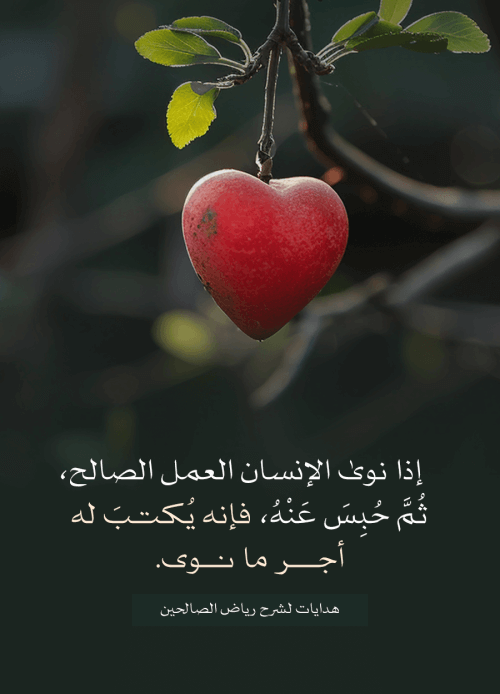
If someone intends to do a good deed but was prevented by a valid excuse, he shall gain the reward of his intention.
Riyadh Al-Salheen with explanation and benefits
Variation of reward for good deeds is based on sincerity and following of the Prophet’s guidance. The more a person is sincere to Allah, and the keener he is on following the Prophet (may Allah’s peace and blessings be upon him), the more perfect his worship will be, and consequently his reward will be bigger.
Riyadh Al-Salheen with explanation and benefits
People differ with regards to their acts of worship according to their intentions. The intentions of some people have reached the ultimate level of sincerity (to Allah) and keenness in following the Sunnah (of the Messenger of Allah) with regard to doing good and righteous deeds, while the intentions of others are below that.
Riyadh Al-Salheen with explanation and benefits
Anyone partaking a role with transgressors and wrongdoers will share their punishment because it is inclusive.
Riyadh Al-Salheen with explanation and benefits
If someone intends to do a good deed but was prevented by a valid excuse, he shall gain the reward of his intention.
Riyadh Al-Salheen with explanation and benefits
Actions are recompensed according to the intentions behind them, and the individual shall receive the reward of what he intended even if the outcome was contrary to his intention.
Riyadh Al-Salheen with explanation and benefits
There is not a single good deed intended sincerely to please Allah except that its doer will be raised in rank and status thereby, so that he would reap the full reward.
Riyadh Al-Salheen with explanation and benefits
Love and contentment is measured by good deeds and intentions because they are the criteria for Allah’s acceptance of the servant; perhaps a small deed reaps great reward because of the intention behind it and perhaps a big deed reaps little reward because of the intention behind it
Riyadh Al-Salheen with explanation and benefits
One of the proofs Allah supports the servant is the latter’s sincere endeavor to rectify his intention and purify his heart by good deeds.
هدايات لشرح رياض الصالحين