








Categories
Discover our diverse collection of categories covering multiple topics to meet your various interestsDa\'wa cards that highlight great meanings of the verses of the Holy Quran and the noble prophetic hadiths in a simple style and attractive display that helps the Muslim to have a deeper understanding of his religion in an easy way
﴿ ٱللَّهُ يَبۡسُطُ ٱلرِّزۡقَ لِمَن يَشَآءُ مِنۡ عِبَادِهِۦ وَيَقۡدِرُ لَهُۥٓۚ إِنَّ ٱللَّهَ بِكُلِّ شَيۡءٍ عَلِيمٞ ﴾
سورة العنكبوت
Allāh extends provision for whom He wills of His servants and restricts for him. Indeed Allāh is, of all things, Knowing.

﴿ وَمَا تَفَرَّقَ ٱلَّذِينَ أُوتُواْ ٱلۡكِتَٰبَ إِلَّا مِنۢ بَعۡدِ مَا جَآءَتۡهُمُ ٱلۡبَيِّنَةُ ﴾
سورة البينة
Yet those who were given the Scripture did not disagree[3] except after the clear proof came to them,
﴿ ۞ رَبِّ قَدۡ ءَاتَيۡتَنِي مِنَ ٱلۡمُلۡكِ وَعَلَّمۡتَنِي مِن تَأۡوِيلِ ٱلۡأَحَادِيثِۚ فَاطِرَ ٱلسَّمَٰوَٰتِ وَٱلۡأَرۡضِ أَنتَ وَلِيِّۦ فِي ٱلدُّنۡيَا وَٱلۡأٓخِرَةِۖ تَوَفَّنِي مُسۡلِمٗا وَأَلۡحِقۡنِي بِٱلصَّٰلِحِينَ ﴾
سورة يوسف
101. "My Lord! You have indeed bestowed on me of the sovereignty, and taught me something of the interpretation of dreams - the (Only) Creator of the heavens and the earth! You are my Walî (Protector, Helper, Supporter, Guardian, God, Lord.) in this world and in the Hereafter. Cause me to die as a Muslim (the one submitting to Your Will), and join me with the righteous."
﴿ إِنَّ ٱلَّذِينَ يُلۡحِدُونَ فِيٓ ءَايَٰتِنَا لَا يَخۡفَوۡنَ عَلَيۡنَآۗ أَفَمَن يُلۡقَىٰ فِي ٱلنَّارِ خَيۡرٌ أَم مَّن يَأۡتِيٓ ءَامِنٗا يَوۡمَ ٱلۡقِيَٰمَةِۚ ٱعۡمَلُواْ مَا شِئۡتُمۡ إِنَّهُۥ بِمَا تَعۡمَلُونَ بَصِيرٌ ﴾
سورة فصلت
40. Verily, those who turn away from Our Ayât (proofs, evidence, verses, lessons, signs, revelations, etc. by attacking, distorting and denying them) are not hidden from Us. Is he who is cast into the Fire better or he who comes secure on the Day of Resurrection? Do what you will. Verily He is All-Seer of what you do (this is a severe threat to the disbelievers[3]).
﴿ هُوَ ٱلَّذِي خَلَقَكُمۡ فَمِنكُمۡ كَافِرٞ وَمِنكُم مُّؤۡمِنٞۚ وَٱللَّهُ بِمَا تَعۡمَلُونَ بَصِيرٌ ﴾
سورة التغابن
2. He it is Who created you, then some of you are disbelievers and some of you are believers. And Allâh is All-Seer of what you do.
﴿ فَإِنَّكَ لَا تُسۡمِعُ ٱلۡمَوۡتَىٰ وَلَا تُسۡمِعُ ٱلصُّمَّ ٱلدُّعَآءَ إِذَا وَلَّوۡاْ مُدۡبِرِينَ ﴾
سورة الروم
You cannot make the dead hear, nor can you make the deaf hear the call when they turn their backs and walk away.
﴿ إِنَّ ٱلَّذِينَ يُؤۡذُونَ ٱللَّهَ وَرَسُولَهُۥ لَعَنَهُمُ ٱللَّهُ فِي ٱلدُّنۡيَا وَٱلۡأٓخِرَةِ وَأَعَدَّ لَهُمۡ عَذَابٗا مُّهِينٗا ﴾
سورة الأحزاب
57. Verily, those who annoy Allâh and His Messenger (صلى الله عليه وسلم)[12] Allâh has cursed them in this world, and in the Hereafter, and has prepared for them a humiliating torment.
﴿ كَمَثَلِ ٱلشَّيۡطَٰنِ إِذۡ قَالَ لِلۡإِنسَٰنِ ٱكۡفُرۡ فَلَمَّا كَفَرَ قَالَ إِنِّي بَرِيٓءٞ مِّنكَ إِنِّيٓ أَخَافُ ٱللَّهَ رَبَّ ٱلۡعَٰلَمِينَ ﴾
سورة الحشر
They are like Satan when he says to man, “Disbelieve,” then when he disbelieves, he says, “I have nothing to do with you. I surely fear Allah, the Lord of the worlds.”
﴿ بَلَىٰ قَٰدِرِينَ عَلَىٰٓ أَن نُّسَوِّيَ بَنَانَهُۥ ﴾
سورة القيامة
4. Yes, We are Able to put together in perfect order the tips of his fingers.[1]
Anas ibn Mālik (may Allah be pleased with him) reported: The Messenger of Allah (may Allah's peace and blessings be upon him) said: "Supplication between the Adhān (call to prayer) and the Iqāmah (second call to prayer) is not rejected."
Narrated by Abu Daoud & At-Termedhy & An-Nasa'i
The Prophet (may Allah's peace and blessings be upon him) pointed out the merit of supplication between the Adhān and the Iqāmah and that it is not rejected and is worthy to be answered, so supplicate Allah during such a time.
Abu Hurayrah (may Allah be pleased with him) reported: The Messenger of Allah (may Allah's peace and blessings be upon him) used to say: "O Allah, set right for me my religion that is the safeguard of my affairs, and set right for me my world wherein my living is, and set right for me my Hereafter wherein my return is, and make life an increase for me in every good, and make death a relief for me from every evil."
Narrated by Muslim
The Prophet (may Allah's peace and blessings be upon him) invoked Allah with a supplication in which he combined the principles of the noble morals that he was sent to perfect, namely the soundness of the religion, the worldly life, and the Hereafter. With such brief wording, he sought the soundness of these three comprehensive meanings. He started with the soundness of the religion that guarantees the soundness of the conditions of both abodes, as he said: (O Allah, set right for me my religion) by guiding me to fulfill its manners most perfectly and completely. (That is the safeguard of my affairs) and the protector of all my matters. If my religion is corrupted, my affairs will be corrupted, and I shall fail and lose. Given that the required soundness of the religion cannot be fulfilled except through the soundness of this worldly life, he said: (And set right for me my world) by granting me physical health, security, sustenance, a righteous wife, a virtuous offspring, and whatever I need, making it lawful and support for obeying You. Then he mentioned the reason behind asking Him to set it right, saying: (Wherein my living is), my residence, and my lifetime. (And set right for me my Hereafter, wherein my return is) to meet You, and this could be attained through righteous deeds and Allah's guidance of His slave to worship, sincerity, and a good end. The Prophet (may Allah's peace and blessings be upon him) mentioned the Hereafter after the world, since the first is the means of reforming the second. In other words, whoever remains upright in his worldly life in compliance with Allah's wish, his Hereafter will be set right for him, and he will be happy therein. (And make life) and longevity (an increase for me in every good) to increase my righteous deeds; (and make death) and hastening it (a relief for me from every evil), trial, adversity, and affliction caused by sins and negligence, a release from worldly hardships and sorrows, and attainment of comfort.
Abu Mūsa (may Allah be pleased with him) reported that the Prophet (may Allah's peace and blessings be upon him) used to invoke Allah with this supplication: "O Lord, forgive me my sin, my ignorance, my excess in all of my affairs, and whatever You are better aware of than me. O Allah, forgive me my sins, my deliberate sins, my ignorant sins, my humorous sins, and all of this I have committed. O Allah, forgive what I have done and what I have left undone, what I have committed secretly and what I have committed openly; You are the Advancer and You are the Delayer, and You have absolute power over everything."
Narrated by Bukhari & Muslim
The following is among the comprehensive supplications of the Prophet (may Allah's peace and blessings be upon him): "O Lord, forgive me my sin" and my misdeed, and "my ignorant sins" and what I committed unknowingly. "My excess in all of my affairs", my negligence, and my transgression. "And whatever You are better aware of than me," You know it, O Allah, whereas I forgot it. "O Allah, forgive me my sins, my deliberate sins," and the sins I committed deliberately and knowingly. "My seriousness, my humor," and what was done by way of joking and what I committed in both cases. "And all this I have committed," as it collected the mentioned sins and defects. "O Allah, forgive what I have done" in the past "and what I have left undone" in the future. "What I have committed secretly" and stealthily, "and what I have committed openly" and publicly. "You are the Advancer and You are the Delayer." You make whomever You will of Your creation proceed to Your mercy through Your guidance to what pleases You, and You delay whomever You will from this through forsaking him. None can bring forward what You have delayed, and none can delay what You have put forward. "And You have absolute power over everything", possessing the absolute ability and the perfect will, You do whatever You will.
Ibn ‘Umar (may Allah be pleased with him and his father) reported: The Messenger of Allah (may Allah's peace and blessings be upon him) never abandoned these supplications in the evening and the morning: "O Allah, I ask You for well-being in this world and the Hereafter. O Allah, I ask You for pardon and well-being in my religion, my worldly life, my family, and my wealth. O Allah, conceal my imperfection—or my imperfections—and secure my fears. O Allah, protect me from before me, from behind me, from my right, from my left, and from above me, and I seek refuge with Your greatness from being suddenly killed from beneath me."
Narrated by Abu Daoud & An-Nasa'i & Ibn Majah & Ahmad
The Prophet (may Allah's peace and blessings be upon him) never abandoned these supplications in the evening and the morning: (O Allah, I ask You for well-being) and freedom from diseases, misfortunes, worldly adversities, desires, and religious trials (in this world and the Hereafter), i.e., in this life and the next. (O Allah, I ask You for pardon) and the elimination and forgiveness of sins (and well-being) and freedom from defects (in my religion), namely Shirk (polytheism), religious innovations, and sins; (my worldly life), namely calamities, harm, and evils; (my family) my wives, children, and relatives; (and my wealth) and my properties and my work. (O Allah, conceal my imperfections) and my defects, flaws, and negligence and erase my sins (secure my fears), my dread, and my terror. (O Allah, protect me) and ward off distress and whatever is harmful away from me (from before me, from behind me, from my right, from my left, and from above me), asking Allah to protect him from all directions since adversities and misfortunes can affect and approach man only from one of these directions. (and I seek refuge with Your greatness from being suddenly killed) and unexpectedly taken and destroyed (from beneath me) by being swallowed up by the earth.
‘Ā’ishah, Mother of the Believers (may Allah be pleased with her), reported that the Messenger of Allah (may Allah's peace and blessings be upon him) taught her this supplication: "O Allah, I ask You for all that is good, the immediate and the deferred thereof, what I know and what I do not know. And I seek refuge with You from all that is evil, the immediate and the deferred thereof, what I know and what I do not know. O Allah, I ask You for the good that Your slave and Prophet asked You for, and I seek refuge with You from the evil that Your slave and Prophet sought refuge from. O Allah, I ask You for Paradise and what brings one closer to it of words or deeds, and I seek refuge with You from the Fire and from what brings one closer to it of words or deeds, and I ask You to make every decree that You have decreed for me good."
The Prophet (may Allah's peace and blessings be upon him) taught ‘Ā’ishah (may Allah be pleased with her) the comprehensive and concise supplication, which is made up of four supplications: First: A general supplication for everything good: (O Allah, I ask You for all that is good) as a whole, (the immediate) that is the nearest in time (and the deferred thereof) that belongs to a later time; (what I know) of what You taught me (and what I do not know) of what You have in Your Knowledge. This denotes entrusting one's affairs to Allah, the All-Knowing, the All-Aware, and the Most Subtle to choose for the Muslim what is best and most appropriate. (And I seek refuge), shelter, and protection (with You from all that is evil, the immediate and the deferred thereof, what I know and what I do not know). Second supplication: It is a protection for the Muslim against transgression in supplication. (O Allah, I ask You) and beg You (for the good that Your slave and Prophet asked You for) may Allah's peace and blessings be upon him, (and I seek refuge) shelter, and protection (with You from the evil that Your slave and Prophet sought refuge from) may Allah's peace and blessings be upon him. This is a supplication and request addressed to Allah to grant the supplicator what Prophet Muhammad (may Allah's peace and blessings be upon him) asked and requested for himself without enumerating the types he (may Allah's peace and blessings be upon him) supplicated for. Third supplication: The request to be admitted to Paradise and to be kept far from Hellfire, which is every Muslim's request and ultimate goal: (O Allah, I ask You for Paradise) and its attainment (and for what brings one closer to it of words or deeds) that are righteous and that please You, (and I seek refuge with You from the Fire), as there is no protection against evil deeds except through Your kindness (and from what brings one closer to it of words or deeds) from the sins that incur Your wrath. Fourth supplication: Supplicating for contentment with Allah's decree. (And I ask You to make every decree that You have decreed for me good) and every decree that Allah has decreed for me, make it good for me, which is a supplication for being granted contentment with Allah's decree.
‘Abdullah ibn ‘Umar (may Allah be pleased with him and his father) reported: The Messenger of Allah (may Allah's peace and blessings be upon him) used to supplicate, saying: "O Allah, I seek refuge with You from the removal of Your favor, the change of Your well-being, the suddenness of Your calamity, and all of Your wrath."
Narrated by Muslim
The Prophet (may Allah's peace and blessings be upon him) sought refuge from four things: First: (O Allah, I seek refuge with You from the removal of Your favor), the religious and the worldly, and to remain steadfast on Islam and keep away from falling into sins that eliminate blessings. Second: (The change of Your well-being) by replacing it with misfortune. So, I ask You to grant me continuous well-being and freedom from agonies and diseases. Third: (The suddenness of Your calamity) in the form of misfortune or affliction, as when affliction and punishment come all of a sudden and unexpectedly, there is no time for repentance and making amends, and this makes the adversity graver and more intense. Fourth: (And all of Your wrath) and the causes that incur Your wrath, as the one whom You are displeased with is, indeed, doomed and ruined. The Prophet (may Allah's peace and blessings be upon him) used the word "all" to include all the causes; words, deeds, and beliefs that lead to His wrath.
‘Abdullah ibn ‘Amr ibn al-‘Ās (may Allah be pleased with him and his father) reported that the Messenger of Allah (may Allah's peace and blessings be upon him) used to supplicate with these words: "O Allah, I seek refuge with You from the dominance of debt, the dominance of the enemy, and the gloat of the enemies."
Narrated by An-Nasa'i & Ahmad
The Prophet (may Allah's peace and blessings be upon him) sought refuge from several things, which are: First: (O Allah, I seek refuge), shelter, and protection (with You) not with anyone else (from the dominance of debt), its subjugation, grief, and distress, and I ask You for support to repay and settle it. Second: (The dominance of the enemy), his subjugation and overpowering, and I ask You to ward off his harm and grant me victory over him. Third: (And the gloat of the enemies) and their rejoicing at what befalls Muslims of misfortunes and calamities.
Abu Hurayrah (may Allah be pleased with him) reported that the Prophet (may Allah's peace and blessings be upon him): Upon reaching the morning, he used to say: "O Allah, by You we have reached the morning, and by You we have reached the evening; by You we live, and by You we die, and to You is the Resurrection." Upon reaching the evening, he would say: "By You we have reached the evening, and by You we have reached the morning, by You we live, and by You we die, and to You is the resurrection." He said: And another time: "And to You is the final destination.".
Upon reaching the morning, i.e., the early part of the day, with the break of dawn, the Prophet (may Allah's peace and blessings be upon him) used to say: (O Allah, by You we have reached the morning) enjoying Your protection, overwhelmed with Your Favor, preoccupied with remembering You, seeking help with Your name, encompassed by Your guidance, and proceeding with Your might and strength. (And by You we have reached the evening, by You we live, and by You we die), i.e., like the previous wording along with reciting it in the evening saying: O Allah, by You we have reached the evening. So, by Your name, the Bestower of Life, we live, and by Your name, the Bringer of Death, we die. (And to You is the Resurrection), the return to life after death, and the separation after assembly. We continue like this at all times and in all situations, and I will never stop or leave it. Upon reaching the evening, right after ‘Asr, he would say: (O Allah, by You we have reached the evening, and by You we have reached the morning, by You we live, and by You we die, and to You is the final destination), the return in this world, and the return in the Hereafter, as it is You Who give me life and it is You Who cause me to die.
Salmān (may Allah be pleased with him) reported: The Messenger of Allah (may Allah's peace and blessings be upon him) said: "Verily, your Lord is Bashful and Munificent. He is too Bashful of His slave to let him go empty-handed when raising his hands to Him."
Narrated by Abu Daoud & At-Termedhy & Ibn Majah
The Prophet (may Allah's peace and blessings be upon him) encourages raising the hands during supplication and informed that Allah Almighty is (Bashful), possessing great bashfulness, and does not withhold giving. He does for the slave what brings him joy and refrains from what harms him. (Munificent) as He gives without being asked, so how much more after being asked! He feels bashful of His believing slave to return his hands empty of His answer and disappointed after they have been raised in supplication.
Repenting to Allah Almighty is a cause for quitting sins and for contentment with the provision that Allah alloted for His servant.
Riyadh Al-Salheen with explanation and benefits
Facing affliction with patience and expectation of the reward from Allah raises one’s ranks and expiates his sins.
Riyadh Al-Salheen with explanation and benefits
The afflictions befalling the believer is a proof that Allah loves him and wills good for him.
Riyadh Al-Salheen with explanation and benefits
Anyone who bears a calamity patiently and awaits Allah’s reward, Allah, the Exalted, will compensate him with better than what he lost either in himself or his family.
Riyadh Al-Salheen with explanation and benefits
When the believer bears patiently and awaits Allah’s reward, Allah Almighty expiates his sins.
Riyadh Al-Salheen with explanation and benefits
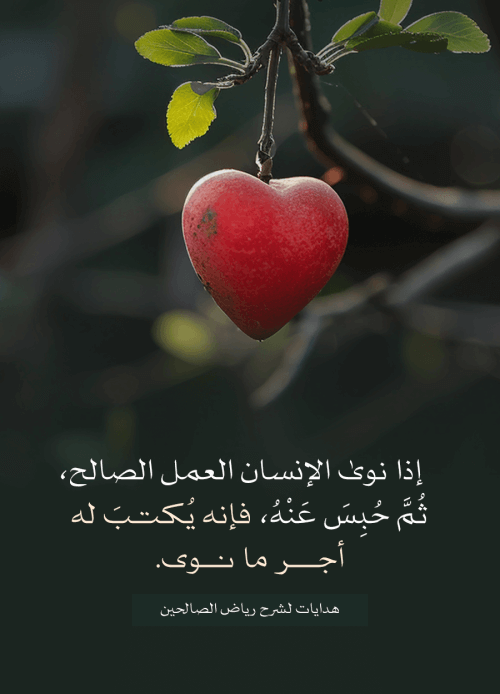
Truthfulness of the hearts is a cause to attain what is desired. Whoever intends to do a good deed will be rewarded for it even if he were unable to do it or failed to complete it.
Riyadh Al-Salheen with explanation and benefits
Thanking Allah for His blessings is one of the reasons for their permanence and increase.
Riyadh Al-Salheen with explanation and benefits
Once something is blessed, it becomes abundant even if it is little; and once something is stripped of blessings, it becomes little even if it is abundant.
Riyadh Al-Salheen with explanation and benefits
Taqwa is a [metaphorical] light helping the individual to discern between the truth and falsehood, the good and the harmful, and the [standard practice] of Sunnah from [religious] innovation.
Riyadh Al-Salheen with explanation and benefits