








Categories
Discover our diverse collection of categories covering multiple topics to meet your various interestsDa\'wa cards that highlight great meanings of the verses of the Holy Quran and the noble prophetic hadiths in a simple style and attractive display that helps the Muslim to have a deeper understanding of his religion in an easy way
﴿ يَوۡمَ نَدۡعُواْ كُلَّ أُنَاسِۭ بِإِمَٰمِهِمۡۖ فَمَنۡ أُوتِيَ كِتَٰبَهُۥ بِيَمِينِهِۦ فَأُوْلَٰٓئِكَ يَقۡرَءُونَ كِتَٰبَهُمۡ وَلَا يُظۡلَمُونَ فَتِيلٗا ﴾
سورة الإسراء
71. (And remember) the Day when We shall call together call human beings with their (respective) Imâm [their Prophets, or their records of good and bad deeds, or their Holy Books like the Qur’ân, the Taurât (Torah), the Injeel (Gospel), the leaders whom the people followed in this world.]. So whosoever is given his record in his right hand, such will read their records, and they will not be dealt with unjustly in the least.

﴿ وَمَا هُوَ بِٱلۡهَزۡلِ ﴾
سورة الطارق
14. And it is not a thing for amusement.
﴿ إِنَّ ٱلۡإِنسَٰنَ لَفِي خُسۡرٍ ﴾
سورة العصر
2. Verily, man is in loss,
﴿ وَلَا تَهِنُواْ فِي ٱبۡتِغَآءِ ٱلۡقَوۡمِۖ إِن تَكُونُواْ تَأۡلَمُونَ فَإِنَّهُمۡ يَأۡلَمُونَ كَمَا تَأۡلَمُونَۖ وَتَرۡجُونَ مِنَ ٱللَّهِ مَا لَا يَرۡجُونَۗ وَكَانَ ٱللَّهُ عَلِيمًا حَكِيمًا ﴾
سورة النساء
104. And don’t be weak in the pursuit of the enemy; if you are suffering (hardships) then surely, they (too) are suffering (hardships) as you are suffering, but you have a hope from Allâh (for the reward, i.e. Paradise) that for which they hope not; and Allâh is Ever All-Knowing, All-Wise.
﴿ لَّقَدۡ سَمِعَ ٱللَّهُ قَوۡلَ ٱلَّذِينَ قَالُوٓاْ إِنَّ ٱللَّهَ فَقِيرٞ وَنَحۡنُ أَغۡنِيَآءُۘ سَنَكۡتُبُ مَا قَالُواْ وَقَتۡلَهُمُ ٱلۡأَنۢبِيَآءَ بِغَيۡرِ حَقّٖ وَنَقُولُ ذُوقُواْ عَذَابَ ٱلۡحَرِيقِ ﴾
سورة آل عمران
181. Indeed, Allâh has heard the statement of those (Jews) who say: "Truly, Allâh is poor and we are rich!" We shall record what they have said and their killing of the Prophets unjustly, and We shall say: "Taste you the torment of the burning (Fire)."
﴿ وَلَا يَنفَعُكُمۡ نُصۡحِيٓ إِنۡ أَرَدتُّ أَنۡ أَنصَحَ لَكُمۡ إِن كَانَ ٱللَّهُ يُرِيدُ أَن يُغۡوِيَكُمۡۚ هُوَ رَبُّكُمۡ وَإِلَيۡهِ تُرۡجَعُونَ ﴾
سورة هود
Nor will my advice benefit you – no matter how hard I try – if Allah wills to leave you astray. He is your Lord, and to Him you will be returned.”
﴿ وَمَآ أَسۡـَٔلُكُمۡ عَلَيۡهِ مِنۡ أَجۡرٍۖ إِنۡ أَجۡرِيَ إِلَّا عَلَىٰ رَبِّ ٱلۡعَٰلَمِينَ ﴾
سورة الشعراء
And I do not ask you for it any payment. My payment is only from the Lord of the worlds.
﴿ فَلَمَّا دَخَلُواْ عَلَىٰ يُوسُفَ ءَاوَىٰٓ إِلَيۡهِ أَبَوَيۡهِ وَقَالَ ٱدۡخُلُواْ مِصۡرَ إِن شَآءَ ٱللَّهُ ءَامِنِينَ ﴾
سورة يوسف
And when they entered upon Joseph, he took his parents to himself [i.e., embraced them] and said, "Enter Egypt, Allāh willing, safe [and secure]."
﴿ كَلَّا لَوۡ تَعۡلَمُونَ عِلۡمَ ٱلۡيَقِينِ ﴾
سورة التكاثر
5. Nay! If you knew with a sure knowledge (the end result of piling up, you would not have been occupied yourselves in worldly things).
‘Abdullāh ibn ‘Umar (may Allah be pleased with him) reported that the Prophet (may Allah's peace and blessings be upon him) said: “Allah will fold the heavens on the Day of Judgment and then take them in His right hand and say: ‘I am the King. Where are the mighty ones? Where are the arrogant ones?’ Then, He will fold the seven earths and take them in His left (hand) and say: ‘I am the King. Where are the mighty ones? Where are the arrogant ones?’”
Narrated by Muslim
Ibn ‘Umar (may Allah be pleased with him) relates to us in this Hadīth that the Prophet (may Allah's peace and blessings be upon him) informed them that Allah, the Almighty, would fold up the seven heavens on the Day of Judgment and place them in His right hand and would fold up the seven earths and seize them with His left hand; and each time he folds one of these, He will call out the mighty and arrogant ones, belittling them and declaring that He is the true Owner of the dominion who never weakens or perishes. All others, rulers and ruled, just and unjust, will certainly perish and will stand humiliated in front of Him. He is not questioned about what He does, but they will be questioned.
Abu Mūsa al-Ash‘ari (may Allah be pleased with him) reported: Whenever someone with a need came to the Prophet (may Allah's peace and blessings be upon him) he would turn to his companions and say: "Intercede (for him) and you will be rewarded, and Allah will decide what He loves on the tongue of His Prophet." In another narration: "What he wishes."
Narrated by Bukhari & Muslim
This Hadīth sets a major principle and guides to a great benefit; it is that a believer should strive to help fulfill the need of others, whether his efforts bear fruit fully or partially or bear no fruit at all. One way to help people is to intercede on behalf of those who need things from the rulers or the dignitaries, or those who can fulfill their needs. Many people avoid to intercede for others if they are not sure whether their intercession would be accepted or not; hence, they miss much reward from Allah, and miss doing a favor to a fellow Muslim. Therefore, the Prophet (may Allah's peace and blessings be upon him) ordered his Companions to help the ones with need by interceding with him so that they receive their reward from Allah based on the Prophet's statement: "Intercede and you will receive reward." Good intercession is beloved to Allah; He says in the Quran: {Whoever intercedes for a good cause will have a reward therefrom} [Sūrat An-Nisā’: 85]. Along with hastening to receive the reward, the intercessor also hastens to do a favor to his Muslim brother, and that person will owe him. Striving to help people in good things that may or may not bear fruit is indeed an immediate goodness, and a way to train oneself to cooperate in righteousness and piety, and a start to intercede about things which are certain or likely to be fulfilled. The Prophet's statement: "And Allah will decide whatever He wishes on the tongue of His Prophet" means that Allah decrees what He willed in His eternal knowledge as to whether the interceded matter will take place or not. Hence, it is required to intercede and he will be rewarded for his intercession, whether the intercession is accepted or not.
Abu Mūsa al-Ash‘ari (may Allah be pleased with him) reported that the Prophet (may Allah's peace and blessings be upon him) said: "If Allah wills to show mercy to a people, He takes the soul of their prophet before them, thus making him a forerunner and an intercessor for them. Whereas, if He wills to destroy a people, He punishes them whilst their prophet is alive, witnessing their destruction, thus, consoling him by their destruction as they disbelieved in him and disobeyed his orders."
Narrated by Muslim
As indicated by the Hadīth, if Allah, the Almighty, wills good for a certain people, He causes their prophet to die before them, and thus he gets to Paradise ahead of them and becomes their intercessor. A similar meaning was expressed in another Hadīth, in which the Prophet (may Allah's peace and blessings be upon him) said: “I shall be there at the Basin before you.” In other words, I will be there before you so as to get the water for you. “And if He wills to destroy a people, He punishes them whilst their prophet is alive, witnessing their destruction.” This is similar to what had befallen the people of Prophet Nūh and other prophets (peace be upon them). It is as if Prophet Muhammad (may Allah's peace and blessings be upon him) wanted to tell them about the favor and kindness of their Lord who sent him as a source of mercy for this Muslim Ummah. In the Qur’an, He says: {And We have not sent you except as a mercy to the worlds} [Sūrat al-Anbiyā': 107] Allah, the Almighty, promised the Muslims that He would not punish them while the Prophet (may Allah's peace and blessings be upon him) was still alive among them, and He even bestowed more of His favor and bounty upon them. He says: {But Allah would not punish them while you are among them, and Allah would not punish them while they seek forgiveness.} [Sūrat al-Anfāl: 33]
Hudhayfah (may Allah be pleased with him) reported that the Prophet (may Allah's peace and blessings be upon him) said: "A slave of Allah whom Allah granted wealth will be brought before Him, and He will ask him: 'What did you do in the worldly life?' (Hudhayfah said: {And they will be able to hide nothing from Allah.} [Sūrat An-Nisā': 42]) He will say: 'O Lord! You gave me wealth and I used to enter into transactions with people. It was my nature to be lenient (to my debtors). I used to show leniency towards the solvent and give respite to the insolvent.' Allah, the Exalted, said: 'I am more entitled to that (action) than you. Pardon My slave.'" ‘Uqbah ibn ‘Āmir and Abu Mas‘ūd al-Ansāri (may Allah be pleased with both of them) said: "This is how we heard it from the lips of the Messenger of Allah (may Allah's peace and blessings be upon him)."
Narrated by Muslim
Hudhayfah (may Allah be pleased with him) reports that a man whom Allah granted wealth will be brought on the Day of Judgment, and his Lord will ask him about his wealth and what he did with it. Hudhayfah (may Allah be pleased with him) said: {And they will be able to hide nothing from Allah} [Sūrat An-Nisā': 42], as Allah, the Exalted, says: {On the Day when their tongues, their hands, and their legs or feet will bear witness against them as to what they used to do} [Sūrat An-Nūr: 24]. He will reply: "O Lord, You gave me wealth and I used to enter into transactions with people", i.e. I dealt with people through selling and lending, and I was characterized by leniency. Then he explained it by saying: "I used to show leniency towards the solvent", i.e. I was easy with them and would accept whatever they brought even if it was slightly less than what they owed. "And give respite to the insolvent", i.e. I was patient with those who were unable to pay on time, not demanding repayment and extending the loan period. Allah, the Exalted, will say: "I am more entitled to that than you", i.e. since you were lenient with My slaves and adopted My traits, then I am more entitled to give you respite and pardon you. "Pardon my slave", i.e. Allah will pardon him and forgive his sins because of his tolerance, leniency, and kindness towards His slaves. Indeed, {Is there any reward for good other than good?} [Sūrat Ar-Rahmān: 60] ‘Uqbah ibn ‘Āmir and Abu Mas‘ūd al-Ansāri (may Allah be pleased with both of them) said: "This is how we heard it from the lips of the Messenger of Allah (may Allah's peace and blessings be upon him)" i.e. they both heard this report from the Prophet (may Allah's peace and blessings be upon him) himself just as Hudhayfah said it, without any words added or left out.
Umm Thābit, Kabshah bint Thābit, sister of Hassān ibn Thābit, (may Allah be pleased with both of them) reported: The Messenger of Allah (may Allah's peace and blessings be upon him) visited me and drank from the mouth of a hanging waterskin while he was standing. So, I got up and cut off its mouth.
Narrated by Ibn Majah - Narrated by At-Termedhy - Narrated by Ahmad
Kabshah bint Thābit (may Allah be pleased with her) reported that the Messenger of Allah (may Allah's peace and blessings be upon him) once visited her and drank from the mouth of a hanging waterskin while he was in a standing posture. He did that (although he forbade drinking while standing) because this was the only way he could drink from it while it was hanging. So Kabshah got up to the waterskin and cut off its mouth in order to preserve the spot where the Messenger of Allah (may Allah's peace and blessings be upon him) put his mouth to seek blessing from it and to protect it from being handled in a disrespectful manner (given that the Prophet's mouth had touched it).
Abu Hurayrah (may Allah be pleased with him) reported that the Prophet (may Allah's peace and blessings be upon him) said: "The places that are dearest to Allah are the mosques, and the places that are most hateful to Allah are the markets."
Narrated by Muslim
This Hadīth shows that the most liked places and the best of them in Allah's sight are the mosques. In the mosques, the prayers are established, Allah is remembered, knowledge is sought, and the people are educated on their religion. In contrast, the most disliked places to Allah are the markets. In the markets, void talk, swearing, deceit, and lying are committed, and people are oblivious of mentioning Allah, the Almighty, there.
‘Ali ibn Rabī‘ah reported: I was there when a mount was brought to ‘Ali ibn Abi Tālib (may Allah be pleased with him) to ride on. When he put his foot in the stirrup, he said: "In the name of Allah". When he settled himself on its back, he recited: "Exalted is He who has subjected this to us, and we could not have otherwise subdued it. And indeed we, to our Lord, will surely return." He then recited: "Praise be to Allah" three times, and then: "Allah is the Greatest" three times. Then he said: "Exalted are You above any imperfection. I have wronged myself, so forgive me, for none but You can forgive sins" and then he laughed. It was asked: "O Commander of the Believers, what made you laugh?" He replied: "I saw the Prophet (may Allah's peace and blessings be upon him) doing as I have done then he laughed." I asked him: ”O Messenger of Allah, what made you laugh?” He said: “Your Lord, the Exalted, is pleased when His slave seeks His forgiveness; he (the slave) knows that none can forgive sins except Allah."
Narrated by At-Termedhy - Narrated by Abu Daoud - Narrated by Ahmad
‘Ali ibn Rabī‘ah, who was a leading Tābi‘i, reported that he was present when ‘Ali ibn Abi Tālib was brought his riding mount. When he put his foot in the stirrup, he said: “Bismillah”, meaning: I ride in the name of Allah. When he settled on its back, he said: “Exalted is He…”, praising Him for this great favor; subduing the animal and causing it to yield to let people ride it, safe from any evil it might cause them. “…who has subjected this to us”, meaning that He has made this animal subservient to us, and we would not have been able to subdue it otherwise. Then he said: “Praise be to Allah” three times and then: “Allah is the Greatest” three times. The repetition indicates the glory of Allah, and that the slave does not give Him His true right, even though he is enjoined to worship Him at all times, according to his ability. Then he said: “Exalted are You above any imperfection. I have wronged myself…”, meaning, I have wronged myself by not fulfilling Your due right upon me in expressing gratitude for this great favor, even through slight heedlessness, a passing thought, or a glance. “…so forgive me”, meaning, conceal my sins by not punishing me for them. “…for none but You can forgive sins”, meaning that this indicates admitting negligence, despite the abundant blessings of Allah upon him. “…and then he laughed. It was asked: ‘O Commander of the Believers, what made you laugh?’" In a verified version of Ash-Shamāil, the narration says: “So I asked”, instead of: “It was asked”. The reason he was asked was that nothing had (apparently) happened that would initiate laughter. It is noteworthy that in the question, addressing him as “O Commander of the Believers” preceded the question, due to the etiquette of speech. “He replied: ‘I saw the Prophet (may Allah's peace and blessings be upon him) doing as I have done…’, referring to the riding and saying the Dhikr. “Then he laughed. I asked him, ‘O Messenger of Allah, what made you laugh?’ He said: 'Your Lord, Glorious is He, is pleased.” When ‘Ali (may Allah be pleased with him) remembered this, it necessitated even more gratitude, so he laughed. He did not laugh only by way of imitation. “…hen His slave seeks His forgiveness; he (the slave) knows”, he says this because he is aware and not heedless of the fact that: “...none can forgive sins except Allah.”
Abu Hurayrah (may Allah be pleased with him) narrated directly from the Prophet (may Allah's peace and blessings be upon him) that he said: "Allah, Glorified and Exalted, laughs at two men, one of them kills the other, yet both enter Paradise. This one fights in the cause of Allah, so he gets killed. Then Allah forgives the killer, and becomes a Muslim and dies as a martyr."
Narrated by Bukhari & Muslim
This Hadīth indicates that Allah laughs at two men. Although one of them kills the other, both will enter Paradise. A Muslim fights in the cause of Allah to elevate the word of Allah, yet he gets killed by a disbeliever, so he enters Paradise. Later Allah accepts the repentance of the killer, so he accepts Islam. Then he fights in the cause of Allah and dies as a martyr.
‘Ā'ishah (may Allah be pleased with her) reported that the Prophet (may Allah's peace and blessings be upon him) said: "Angels were created from light, Jinn were created from a smokeless flame of fire, and Adam was created from what was described to you (in the Qur'an)."
Narrated by Muslim
The Prophet (may Allah's peace and blessings be upon him) informed us about the beginning of creation. He first mentioned that the angels were created from light, and for this reason they do not disobey Allah nor are they prevented by arrogance from worshiping Him. As for the jinn, they were created from fire, and for this reason many of them are characterized by recklessness, vanity, and hostility. As to Adam, he was created from "what was described to you", i.e. he was created from dust and clay. Dust became sticky clay then dry clay, like pottery, and Adam was created therefrom.
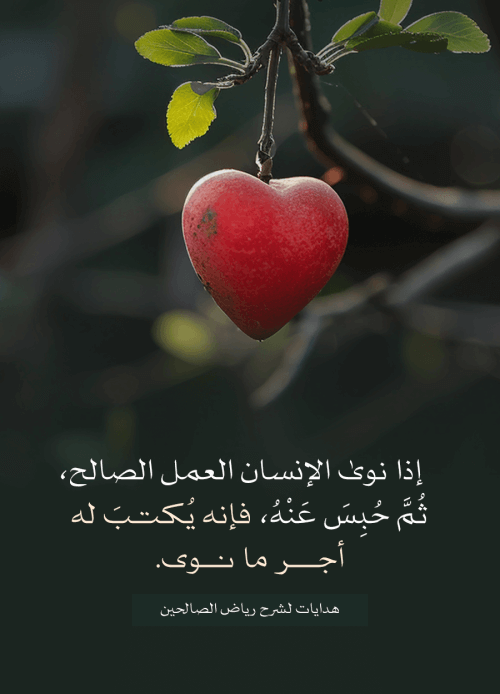
If someone intends to do a good deed but was prevented by a valid excuse, he shall gain the reward of his intention.
Riyadh Al-Salheen with explanation and benefits
Variation of reward for good deeds is based on sincerity and following of the Prophet’s guidance. The more a person is sincere to Allah, and the keener he is on following the Prophet (may Allah’s peace and blessings be upon him), the more perfect his worship will be, and consequently his reward will be bigger.
Riyadh Al-Salheen with explanation and benefits
People differ with regards to their acts of worship according to their intentions. The intentions of some people have reached the ultimate level of sincerity (to Allah) and keenness in following the Sunnah (of the Messenger of Allah) with regard to doing good and righteous deeds, while the intentions of others are below that.
Riyadh Al-Salheen with explanation and benefits
Anyone partaking a role with transgressors and wrongdoers will share their punishment because it is inclusive.
Riyadh Al-Salheen with explanation and benefits
If someone intends to do a good deed but was prevented by a valid excuse, he shall gain the reward of his intention.
Riyadh Al-Salheen with explanation and benefits
Actions are recompensed according to the intentions behind them, and the individual shall receive the reward of what he intended even if the outcome was contrary to his intention.
Riyadh Al-Salheen with explanation and benefits
There is not a single good deed intended sincerely to please Allah except that its doer will be raised in rank and status thereby, so that he would reap the full reward.
Riyadh Al-Salheen with explanation and benefits
Love and contentment is measured by good deeds and intentions because they are the criteria for Allah’s acceptance of the servant; perhaps a small deed reaps great reward because of the intention behind it and perhaps a big deed reaps little reward because of the intention behind it
Riyadh Al-Salheen with explanation and benefits
One of the proofs Allah supports the servant is the latter’s sincere endeavor to rectify his intention and purify his heart by good deeds.
هدايات لشرح رياض الصالحين