






Categories
Discover our diverse collection of categories covering multiple topics to meet your various interestsDa\'wa cards that highlight great meanings of the verses of the Holy Quran and the noble prophetic hadiths in a simple style and attractive display that helps the Muslim to have a deeper understanding of his religion in an easy way
﴿ وَٱتَّقُواْ ٱلنَّارَ ٱلَّتِيٓ أُعِدَّتۡ لِلۡكَٰفِرِينَ ﴾
سورة آل عمران
and fear the Fire prepared for the disbelievers.

﴿ فَأَصَابَهُمۡ سَيِّـَٔاتُ مَا عَمِلُواْ وَحَاقَ بِهِم مَّا كَانُواْ بِهِۦ يَسۡتَهۡزِءُونَ ﴾
سورة النحل
So they were struck by the evil consequences of what they did and were enveloped by what they used to ridicule.
﴿ إِلَّا مَن رَّحِمَ ٱللَّهُۚ إِنَّهُۥ هُوَ ٱلۡعَزِيزُ ٱلرَّحِيمُ ﴾
سورة الدخان
Except those [believers] on whom Allāh has mercy. Indeed, He is the Exalted in Might, the Merciful.
﴿ وَمِنَ ٱلنَّاسِ مَن يَشۡتَرِي لَهۡوَ ٱلۡحَدِيثِ لِيُضِلَّ عَن سَبِيلِ ٱللَّهِ بِغَيۡرِ عِلۡمٖ وَيَتَّخِذَهَا هُزُوًاۚ أُوْلَٰٓئِكَ لَهُمۡ عَذَابٞ مُّهِينٞ ﴾
سورة لقمان
There are some people who engage in a discourse of amusements[3] in order to lead people away from the way of Allah without knowledge, and to make a mockery of it. For such there will be a humiliating punishment.
﴿ قَالُواْ نَعۡبُدُ أَصۡنَامٗا فَنَظَلُّ لَهَا عَٰكِفِينَ ﴾
سورة الشعراء
They said, "We worship idols and remain to them devoted."
﴿ هُمُ ٱلَّذِينَ كَفَرُواْ وَصَدُّوكُمۡ عَنِ ٱلۡمَسۡجِدِ ٱلۡحَرَامِ وَٱلۡهَدۡيَ مَعۡكُوفًا أَن يَبۡلُغَ مَحِلَّهُۥۚ وَلَوۡلَا رِجَالٞ مُّؤۡمِنُونَ وَنِسَآءٞ مُّؤۡمِنَٰتٞ لَّمۡ تَعۡلَمُوهُمۡ أَن تَطَـُٔوهُمۡ فَتُصِيبَكُم مِّنۡهُم مَّعَرَّةُۢ بِغَيۡرِ عِلۡمٖۖ لِّيُدۡخِلَ ٱللَّهُ فِي رَحۡمَتِهِۦ مَن يَشَآءُۚ لَوۡ تَزَيَّلُواْ لَعَذَّبۡنَا ٱلَّذِينَ كَفَرُواْ مِنۡهُمۡ عَذَابًا أَلِيمًا ﴾
سورة الفتح
They are the ones who disbelieved and obstructed you from al-Masjid al-Ḥarām while the offering[1516] was prevented from reaching its place of sacrifice. And if not for believing men and believing women whom you did not know - that you might trample [i.e., kill] them and there would befall you because of them dishonor without [your] knowledge - [you would have been permitted to enter Makkah]. [This was so] that Allāh might admit to His mercy whom He willed. If they had been apart [from them], We would have punished those who disbelieved among them with painful punishment
﴿ رَبَّنَآ إِنَّكَ جَامِعُ ٱلنَّاسِ لِيَوۡمٖ لَّا رَيۡبَ فِيهِۚ إِنَّ ٱللَّهَ لَا يُخۡلِفُ ٱلۡمِيعَادَ ﴾
سورة آل عمران
9. "Our Lord! Verily, it is You Who will gather mankind together on the Day about which there is no doubt. Verily, Allâh never breaks His Promise".
﴿ فَٱنتَقَمۡنَا مِنۡهُمۡۖ فَٱنظُرۡ كَيۡفَ كَانَ عَٰقِبَةُ ٱلۡمُكَذِّبِينَ ﴾
سورة الزخرف
So We took retribution from them; then see how was the end of the deniers.
﴿ فَلَعَلَّكَ بَٰخِعٞ نَّفۡسَكَ عَلَىٰٓ ءَاثَٰرِهِمۡ إِن لَّمۡ يُؤۡمِنُواْ بِهَٰذَا ٱلۡحَدِيثِ أَسَفًا ﴾
سورة الكهف
Perhaps you will grieve yourself to death [O Prophet] over them[5] if they do not believe in this message[6].
‘Ā’ishah (may Allah be pleased with her) reported that she asked the Messenger of Allah (may Allah's peace and blessings be upon him) about the plague. He told her that it was a torment that Allah would send upon whom He willed. Then Allah made it a mercy for the believers, so anyone in an area afflicted with plague who stays therein patiently hoping for Allah's reward and believing that nothing will befall him except what Allah has foreordained for him will get a reward similar to that of a martyr.
Narrated by Bukhari
‘Ā'ishah asked the Prophet (may Allah’s peace and blessings be upon him) about the plague, and he informed her that the plague was a torment that Allah, the Exalted, sends upon those He willed of His slaves. Whether it is plague itself or any similar epidemic, such as cholera, this plague is a torment that Allah sends down. However, the plague is mercy for the believer if it broke out where he resides and he stayed there, patiently seeking Allah’s reward and knowing that nothing would harm him except what Allah had decreed for him. If he does so, Allah gives him the reward of a martyr. Therefore, in a Sahīh Hadīth reported by ‘Abdur-Rahmān ibn ‘Awf (may Allah be pleased with him), the Prophet (may Allah’s peace and blessings be upon him) said: "If you know that a plague is in a land, do not go there; and if it occurs in a land where you are, do not run from it." So if the plague occurs in a place, one must not go to that place, because going there means exposing oneself to destruction. However, if the plague occurs in a place where one is already in, then he must not leave the place. Escaping will not save a person from his destiny; there is no escape from the decree of Allah except to the decree of Allah. Why the martyr's reward? It is because life is so precious, and the outbreak of a plague urges a person to run for his life. So, if he stays with patience, seeking reward from Allah, and believing that nothing will befall him except what Allah had decreed for him, and then he dies of the plague, he will get the same reward of a martyr as a favor from Allah in return for his patience and good expectation of Allah.
Abu Hurayrah (may Allah be pleased with him) reported that the Messenger of Allah (may Allah's peace and blessings be upon him) said: "When one of you arrives at a gathering, he should say the greeting of Salām. He should also do so when he wants to depart, for the first greeting is not more meritorious than the last."
An-Nasaa’i
This Hadīth shows one of the etiquettes of greeting. When one enters a place where others are sitting, one should greet them with the Salām greeting. The same should be done when leaving the session, as the Prophet (may Allah's peace and blessings be upon him) said: The first time (of greeting) is not more meritorious than the second. This means that just as a person greets with the Salām when he comes in, he should do so when he leaves. Similarly, when one enters a mosque, one should send peace and blessings upon the Prophet (may Allah's peace and blessings be upon him) and so should one do when leaving the mosque. The first greeting conveys to the congregation that they will be safe from any possible harm on the part of the person who is coming in. Likewise, the second greeting tells them that they will be safe from his evil when he goes away from them. This is an aspect of the perfection of the Shariah: It applies the same ruling of greeting whether the person is coming or leaving. Indeed, the Shariah is from the All-Wise, the All-Knowing.
Jābir ibn Samurah (may Allah be pleased with him) reported: When we went to the Prophet (may Allah's peace and blessings be upon him) one would sit wherever there was room.
Narrated by At-Termedhy - Narrated by Abu Daoud - Narrated by Ahmad
This Hadīth shows the politeness of the Companions of the Prophet (may Allah's peace and blessings be upon him). They would sit in the Prophet's gathering wherever they could find a place, whether close to or far from the front. This is how one should behave when he enters upon a group sitting together. He should not proceed forward unless someone gives him his place or there is room for him in the front. That a person makes his way through a group that is sitting, as if he impels them to give way to him so that he sits in the front, is behavior that goes against the practice of the Prophet (may Allah's peace and blessings be upon him) and his Companions. Moreover, it indicates the person's arrogance and conceit.
Abu Hurayrah (may Allah be pleased with him) reported that the Prophet (may Allah's peace and blessings be upon him) said: "Whoever visits a sick person or a brother of his for Allah's sake, a caller calls out: 'May you be glad, may your footsteps be blessed, and may you dwell a home in Paradise!'"
Narrated by Ibn Majah - Narrated by At-Termedhy - Narrated by Ahmad
Anyone who goes to visit a sick person or visits one of his brothers for the sake of Allah, an angel calls out from the heavens and says: "You have been purified of your sins and been made glad for the abundant reward that Allah has for you, and have owned a palace in Paradise to live in."
Abu Sa‘īd al-Khudri (may Allah be pleased with him) reported: The Prophet (may Allah's peace and blessings be upon him) said: "Take no companion except a believer and let no one eat your food except an Allah-fearing person.’"
Narrated by At-Termedhy - Narrated by Abu Daoud - Narrated by Ahmad
This Hadīth urges Muslims to associate with good people. This requires refraining from accompanying the disbelievers and the hypocrites, because their companionship affects one's religiousness. The 'believer' in this Hadīth refers to any number of believers. The necessity of seeking the company of the righteous was confirmed even more by “and let no one eat your food except an Allah-fearing person,” meaning: a pious person who puts his energy in worshiping Allah. Therefore only faithful and righteous people should be invited to eat.
Hudhayfah ibn al-Yamān (may Allah be pleased with him) reported: When we attended a meal with the Messenger of Allah (may Allah's peace and blessings be upon him), we would not extend our hands until the Messenger of Allah (may Allah's peace and blessings be upon him) would start and extend his hand. Once we attended a meal with him and a little girl came in rushing as if she was being pushed forward. She was about to put her hand into the food when the Messenger of Allah (may Allah's peace and blessings be upon him) caught her hand. Then a Bedouin came in rushing as if he was being pushed forward. he caught his hand too. Then the Messenger of Allah (may Allah's peace and blessings be upon him) said: 'Verily, the devil can eat from any food upon which the name of Allah is not mentioned. He brought this little girl to be able to eat, but I caught her hand. Then he brought this Bedouin to be able to eat, but I caught his hand too. By the One in whose Hand my soul is! His hand is in my grasp along with their hands." Then he mentioned the name of Allah, the Almighty, and ate.
Narrated by Muslim
One day, Hudhayfah attended a meal with the Messenger of Allah (may Allah's peace and blessings be upon him) and when they started to eat, or when food was served, a little girl came "as if she was being pushed forward" i.e. as if she was running, and she wanted to extend her hand to the food before mentioning Allah's Name. So the Prophet (may Allah's peace and blessings be upon him) held her hand back. "Then a Bedouin also came as if he was being pushed forward" and extended his hand to the food. So, the Prophet (may Allah's peace and blessings be upon him) held his hand back. Then the Prophet (may Allah's peace and blessings be upon him) said that the young girl and the Bedouin were brought by the devil. That is he whispered to them and urged them to come in order to find a way to the food through them, in case they ate without mentioning Allah's name. The two of them could be excused due to their ignorance – the girl for her young age, and the man for being a Bedouin. However, the devil brought them because if they had eaten without mentioning Allah's Name, he would have shared the food with them. Then the Prophet (may Allah's peace and blessings be upon him) swore that the devil's hand was with their two hands; all in the hand of the Prophet's hand.
Abu Hurayrah (may Allah be pleased with him) reported that the Prophet (may Allah's peace and blessings be upon him) said: "When the end of time draws near, the dream of a believer can hardly be false, and the dream of a believer is one part from forty-six parts of prophet-hood." In another narration, the Prophet (may Allah's peace and blessings be upon him) said: "Those of you who have the most truthful dreams are those who are the most truthful in speech."
Narrated by Bukhari & Muslim
The dreams of believer at the end of time are true. It may be a dream about something that is happening in real life, or something that is going to happen, and then it happens exactly as in the dream. So, such a dream is considered like prophetic revelation in the truthfulness of its content or indication. "The dream of a believer is one part from forty-six parts of prophet-hood", i.e. from the parts of prophetic knowledge, considering that it includes information about the unseen. Prophet-hood is gone but its knowledge remains. The number forty six was specified because the age of the Prophet (may Allah's peace and blessings be upon him) in the soundest narrations was sixty-three at the time of his death. His prophetic mission lasted for twenty-three years, as he was sent with the message of Islam at the age of forty. For six months before the start of his mission, he used to see good dreams (visions), which would come true as clear as daylight. Then he saw the angel (Jibrīl) while awake. So, the ratio of the period of revelation received in dreams (six months) to the duration of his prophet-hood (twenty-three years) is one half to twenty three, which is equal to one part to forty six parts. His statement: "Those of you who have the most truthful dreams are those who are the most truthful in speech", means that if the person is truthful in his speech and close to Allah, then his dreams are mostly closest to being true. This is why he specifically mentioned the righteous in the narration of Al-Bukhāri: "A good dream comes from a righteous man." As for the one who is not truthful in his speech and commits sins openly and secretly, then his dreams are mostly the result of the devil manipulating his mind. Ibn al-Qayyim (may Allah have mercy upon him) said: "Whoever wishes to have truthful dreams, then he should be truthful and eat from lawful earnings while observing Allah's commands and prohibitions, and let him go to sleep in a state of purification and face the Qiblah and say Dhikr until he falls asleep. If he does so, his dreams will hardly ever be false.”
Abu Sa‘īd al-Khudri (may Allah be pleased with him) reported that the Prophet (may Allah's peace and blessings be upon him) said: "When the son of Adam gets up in the morning, all of his body organs humble themselves before the tongue, and say: 'Fear Allah concerning us! For indeed, we are only as you are (our condition depends upon yours); if you are upright, we shall be upright, and if you are crooked, we shall be crooked.’"
Narrated by At-Termedhy
Meaning of the Hadīth: All body organs submit and humble themselves before the tongue, i.e. they are subordinate to the tongue. That is why when one gets up in the morning, they say: “Fear Allah concerning us! For indeed, we are only as you are…” The tongue is the most dangerous organ. If it is upright, all other organs will be upright and the rest of one's deeds will be good. However, if the tongue is crooked, all of the organs will be crooked and the rest of one's deeds will be evil. Anas (may Allah be pleased with him) reported that the Prophet (may Allah's peace and blessings be upon him) said: "A slave’s faith will not be upright unless his heart is upright, and his heart will not be upright unless his tongue is upright." This chapter includes many Hadīths that indicate the danger of the tongue. It is either a source of happiness or a reason for punishment. If one subjugates it to the obedience of Allah, then it will be a source of happiness for him in this world and the Hereafter. However, if he lets it loose in that which does not please Allah, the Exalted, it will be a reason for regret in this world and the Hereafter.
‘Imrān ibn al-Husayn (may Allah be pleased with him) reported: A man came to the Prophet (may Allah's peace and blessings be upon him) and said: "Assalāmu ‘alaykum (Peace be upon you)." The Prophet responded to his greeting and the man sat down. The Prophet (may Allah's peace and blessings be upon him) said: ‘Ten.’ Then another man came and said: "Assalāmu ‘alaykum wa rahmatullāh (May the peace and mercy of Allah be upon you)." The Prophet replied to his greeting and the man sat down. Then another man came and said: "Assalāmu ‘alaykum wa rahmatullāh wa barakātuh (May the peace, mercy, and blessings of Allah be upon you)." The Prophet replied to his greeting and the man sat down. The Prophet (may Allah's peace and blessings be upon him) said: ‘Thirty.'"
Narrated by At-Termedhy - Narrated by Abu Daoud - Narrated by Ahmad - Ad-Daarimi
A man came to the Prophet (may Allah's peace and blessings be upon him) and said: "Assalāmu ‘alaykum (Peace be upon you)." The Prophet responded to him and the man sat down. Then the Prophet (may Allah's peace and blessings be upon him) said that that man had obtained ten good deeds. This is the reward earned by anyone says this phrase of the greeting of peace. And Allah may still multiply this if He so wills. Then, someone else came and said: "Assalāmu ‘alaykum wa rahmatullāh (May the peace and mercy of Allah be upon you)." The Prophet responded to his greeting and the man sat down. Then the Prophet (may Allah's peace and blessings be upon him) said that this man had gained twenty good deeds, as his greeting was longer than the previous one by saying: "wa rahmatullah (and the mercy of Allah)". Then, a third man came and said: "Assalāmu ‘alaykum wa rahmatullāh wa barakātuh (May the peace, mercy, and blessings of Allah be upon you)." The Prophet (may Allah's peace and blessings be upon him) responded to him and the man sat down. Then, the Prophet (may Allah's peace and blessings be upon him) said that he had gained thirty good deeds. This last one is the most complete phrase of the Islamic greeting of peace.
If someone intends to do a good deed but was prevented by a valid excuse, he shall gain the reward of his intention.
Riyadh Al-Salheen with explanation and benefits
Variation of reward for good deeds is based on sincerity and following of the Prophet’s guidance. The more a person is sincere to Allah, and the keener he is on following the Prophet (may Allah’s peace and blessings be upon him), the more perfect his worship will be, and consequently his reward will be bigger.
Riyadh Al-Salheen with explanation and benefits
People differ with regards to their acts of worship according to their intentions. The intentions of some people have reached the ultimate level of sincerity (to Allah) and keenness in following the Sunnah (of the Messenger of Allah) with regard to doing good and righteous deeds, while the intentions of others are below that.
Riyadh Al-Salheen with explanation and benefits
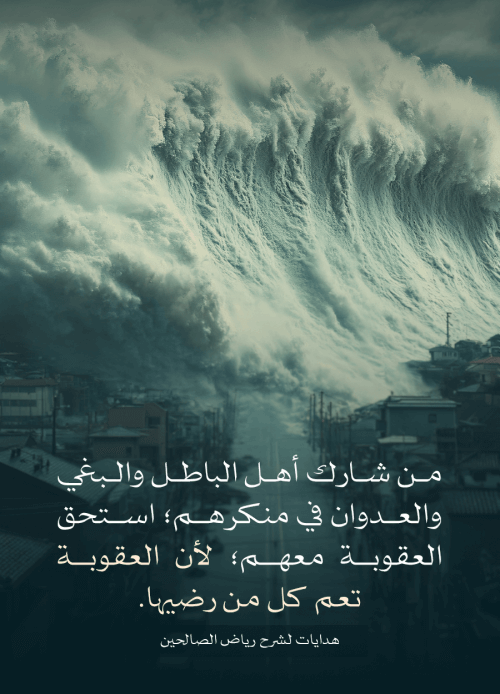
Anyone partaking a role with transgressors and wrongdoers will share their punishment because it is inclusive.
Riyadh Al-Salheen with explanation and benefits
If someone intends to do a good deed but was prevented by a valid excuse, he shall gain the reward of his intention.
Riyadh Al-Salheen with explanation and benefits
Actions are recompensed according to the intentions behind them, and the individual shall receive the reward of what he intended even if the outcome was contrary to his intention.
Riyadh Al-Salheen with explanation and benefits
There is not a single good deed intended sincerely to please Allah except that its doer will be raised in rank and status thereby, so that he would reap the full reward.
Riyadh Al-Salheen with explanation and benefits
Love and contentment is measured by good deeds and intentions because they are the criteria for Allah’s acceptance of the servant; perhaps a small deed reaps great reward because of the intention behind it and perhaps a big deed reaps little reward because of the intention behind it
Riyadh Al-Salheen with explanation and benefits
One of the proofs Allah supports the servant is the latter’s sincere endeavor to rectify his intention and purify his heart by good deeds.
هدايات لشرح رياض الصالحين