



Categories
Discover our diverse collection of categories covering multiple topics to meet your various interestsDa\'wa cards that highlight great meanings of the verses of the Holy Quran and the noble prophetic hadiths in a simple style and attractive display that helps the Muslim to have a deeper understanding of his religion in an easy way
﴿ فِيهِنَّ قَٰصِرَٰتُ ٱلطَّرۡفِ لَمۡ يَطۡمِثۡهُنَّ إِنسٞ قَبۡلَهُمۡ وَلَا جَآنّٞ ﴾
سورة الرحمن
In them there will be maidens of restrained gaze[14], untouched[15] before them by any man or jinn.

﴿ وَلَمَّا جَآءَ أَمۡرُنَا نَجَّيۡنَا هُودٗا وَٱلَّذِينَ ءَامَنُواْ مَعَهُۥ بِرَحۡمَةٖ مِّنَّا وَنَجَّيۡنَٰهُم مِّنۡ عَذَابٍ غَلِيظٖ ﴾
سورة هود
And when Our command came, We saved Hūd and those who believed with him, by mercy from Us; and We saved them from a harsh punishment.
﴿ وَأَمَّا بِنِعۡمَةِ رَبِّكَ فَحَدِّثۡ ﴾
سورة الضحى
11. And proclaim the Grace of your Lord (i.e. the Prophethood and all other Graces).
﴿ وَلَقَدۡ كَذَّبَ ٱلَّذِينَ مِن قَبۡلِهِمۡ فَكَيۡفَ كَانَ نَكِيرِ ﴾
سورة الملك
Those who came before them rejected [the messengers]; then how severe was My response!
﴿ إِذۡ يُوحِي رَبُّكَ إِلَى ٱلۡمَلَٰٓئِكَةِ أَنِّي مَعَكُمۡ فَثَبِّتُواْ ٱلَّذِينَ ءَامَنُواْۚ سَأُلۡقِي فِي قُلُوبِ ٱلَّذِينَ كَفَرُواْ ٱلرُّعۡبَ فَٱضۡرِبُواْ فَوۡقَ ٱلۡأَعۡنَاقِ وَٱضۡرِبُواْ مِنۡهُمۡ كُلَّ بَنَانٖ ﴾
سورة الأنفال
[Remember] when your Lord inspired to the angels, "I am with you, so strengthen those who have believed. I will cast terror into the hearts of those who disbelieved, so strike [them] upon the necks and strike from them every fingertip."[439]
﴿ ۞ وَإِذۡ قَالَ إِبۡرَٰهِيمُ لِأَبِيهِ ءَازَرَ أَتَتَّخِذُ أَصۡنَامًا ءَالِهَةً إِنِّيٓ أَرَىٰكَ وَقَوۡمَكَ فِي ضَلَٰلٖ مُّبِينٖ ﴾
سورة الأنعام
74. And (remember) when Ibrâhîm (Abraham) said to his father Âzar: "Do you take idols as âlihah (gods)? Verily, I see you and your people in manifest error.[8]"
﴿ وَمَا يُغۡنِي عَنۡهُ مَالُهُۥٓ إِذَا تَرَدَّىٰٓ ﴾
سورة الليل
And what will his wealth avail him when he falls?[1938]
﴿ وَأَنزَلۡنَا مِنَ ٱلۡمُعۡصِرَٰتِ مَآءٗ ثَجَّاجٗا ﴾
سورة النبأ
And sent down from the rain clouds pouring water
﴿ ۞ قُلۡ إِنَّمَآ أَعِظُكُم بِوَٰحِدَةٍۖ أَن تَقُومُواْ لِلَّهِ مَثۡنَىٰ وَفُرَٰدَىٰ ثُمَّ تَتَفَكَّرُواْۚ مَا بِصَاحِبِكُم مِّن جِنَّةٍۚ إِنۡ هُوَ إِلَّا نَذِيرٞ لَّكُم بَيۡنَ يَدَيۡ عَذَابٖ شَدِيدٖ ﴾
سورة سبأ
46. Say (to them O Muhammad صلى الله عليه وسلم): "I exhort you to one (thing) only: that you stand up for Allâh’s sake in pairs and singly, and reflect (within yourselves the life history of the Prophet صلى الله عليه وسلم): there is no madness in your companion (Muhammad صلى الله عليه وسلم). He is only a warner to you in face of a severe torment."
Abu Ayyūb (may Allah be pleased with him) reported: The Prophet (may Allah's peace and blessings be upon him) went out after the sun had set. He heard a sound and then said: "The Jews are being tormented in their graves."
Narrated by Bukhari & Muslim
The Prophet (may Allah's peace and blessings be upon him) went out after the sun had set. He heard the voice of the Jews while being tormented. He said that this was the voice of the Jews while being tormented in their graves.
Abu Hurayrah (may Allah be pleased with him) reported: The Messenger of Allah (may Allah's peace and blessings be upon him) said: "When the deceased – or one of you – is buried, there come to him two black and blue angels; one of whom is called Munkar and the other Nakīr. They say: 'What did you say about this man?' So, he says what he used to say about him: 'He is the slave of Allah and His Messenger. I bear witness that there is no god but Allah and that Muhammad is His slave and Messenger.' They say: 'We knew that you would say that.' Then his grave is made spacious for him, seventy cubits by seventy, then it is illuminated for him. Then it is said to him: 'Sleep,' and he says: 'May I go back to my family and tell them?' They say: 'Sleep like the bridegroom who will be woken by none but the dearest of his family to him,' until Allah raises him from that resting place of his. But if he is a hypocrite he says: 'I heard the people say something so I said something like what they said. I do not know.' They say: 'We knew that you would say that.' Then it is said to the earth: 'Tighten your sides around him,' so it tightens its sides around him until his ribs interlock, and he continues to be tormented therein until Allah raises him from that resting place of his.'"
Narrated by At-Termedhy
When the deceased is buried, two black and blue angels come to him; one named Munkar and the other Nakīr. They say to him: What did you use to say about this man? They mean the Prophet (may Allah's peace and blessings be upon him). He says: He is the slave of Allah and His Messenger; I bear witness that there is no god but Allah, and that Muhammad is His slave and messenger. They say: We knew that you would say that; then his grave is widened for him seventy cubits by seventy, then it is illuminated for him. Then it is said to him: Sleep; and he will say: I wish to return to my family and inform them of my pleasant condition so that they would be happy and not grieve over me. They will say: Sleep like the sleep of a bridegroom who will not be awakened except by the most beloved of his family to him. Then, he will sleep peacefully until Allah resurrects him on the Day of Resurrection. On the other hand, if the deceased is a hypocrite he will say: I heard people saying something, i.e. that Muhammad is the Messenger of Allah, so I said as they were saying: and I do not really know if he was a prophet or not. They will say: We knew that you would say that; then it will be said to the earth: gather together and tighten around him. Then its parts will gather around him tightly until his ribs will be no longer in the normal arranged state as they used to be due to the severity of the pressure and the squeezing of his body parts, thereby each of his two sides will cross over the other. He will continue to be tormented in this condition until Allah, the Exalted, resurrects him on the Day of Resurrection.
‘Awf ibn Mālik (may Allah be pleased with him) reported: I went to the Prophet (may Allah's peace and blessings be upon him) during the battle of Tabūk, while he was sitting in a leather tent. He said: "Count six signs that indicate the approach of the Hour: my death; the conquest of Jerusalem; a plague that will afflict you (and kill you in great numbers) as the plague that afflicts sheep; the increase of money to such an extent that even if one is given one hundred dinars, he will not be satisfied; an affliction which no Arab house will escape; and a truce between you and Banu al-Asfar, who will betray you and march on you under eighty flags. Under each flag will be twelve thousand soldiers."
Narrated by Bukhari
‘Awf ibn Mālik went to the Prophet (may Allah's peace and blessings be upon him) during the battle of Tabūk, while he was sitting in a leather tent. So the Prophet (may Allah's peace and blessings be upon him) said: "Count six signs that indicate the approach of the Hour: my death, the conquest of Jerusalem." Jerusalem was conquered during the reign of ‘Umar ibn al-Khattāb. Then the Prophet spoke of a sweeping plague and increase of money. It is said there was a surplus of money during the time of ‘Uthmān because of the conquests. The Prophet further spoke of a great trial that would enter each Arab house. This was probably the assassination of ‘Uthmān and the subsequent tribulations. Then he spoke of a truce between the Muslims and the Romans. However, the Romans will betray the truce and attack the Muslims under eighty flags. Under each flag will be twelve thousand soldiers, totaling 960,000.
Abu Hurayrah (may Allah be pleased with him) reported that the Prophet (may Allah's peace and blessings be upon him) said: "The Hour will not be established until a fire comes out of the land of Hejaz and throws light on the necks of camels in Busra."
Narrated by Bukhari & Muslim
The Hour will not be established until a fire comes out of Makkah, Madīnah, and the surrounding area. It will illuminate the necks of camels in the city of Busra in Sham. In the year 654 A.H., a fire came out in Madīnah, and it was a great fire that came out from the eastern side of Madīnah behind Al-Harrah. All the people of the Levant and all other lands learned about that fire. Contemporary scholars at that time, like An-Nawawi, Al-Qurtubi, and Abu Shāmah, mentioned it in their books.
Abu Nadrah reported: We were in the company of Jābir ibn ‘Abdullāh and he said: "It may soon happen that the people of Iraq may not send their Qiffīz and dirhams (their measures of food stuff and their money)." We said: "Who would be responsible for it?" He said: "The non-Arabs would prevent them." He then said: " It may soon happen that the people of Syria may not send their dinars and Mudds." We said: "Who would be responsible for it?" He said this prevention would be made by the Romans." He (Jābir ibn Abdullāh) kept quiet for a while and then reported that the Messenger of Allah (may Allah's peace and blessings be upon him) said: "There would be a caliph in the last (period) of my Ummah who would freely give handfuls of wealth to the people without counting it." I (the reporter) asked Abu Nadrah and Abu Al-‘Alā' if they refer to ‘Umar ibn ‘Abd al-‘Azīz, and they both answered in the negative.
Narrated by Muslim
The Prophet (may Allah's peace and blessings be upon him) informs that Muslims will conquer Iraq, and a certain measure and weight will be levied on properties of its people to be given to the Muslims. This amount levied on people will be prevented at the end of time due to invasion of these lands by the non-Arab disbelievers. The disbelievers will prevent it from reaching the Muslims. The Prophet also informs that the Muslims will also conquer the Levant, and a certain measure and weight will be levied on properties of its people to be given to the Muslims. This amount levied on people will be prevented at the end of time due to invasion of these lands by the Romans. The Romans will prevent it from reaching the Muslims as well. Then the Prophet (may Allah's peace and blessings be upon him) talked about a caliph emerging in the last periods of the Muslim Ummah who would freely give handfuls of wealth to the people without counting it due to its abundance resulting from expansion of his conquests. This caliph will throw money to people as he throws dust away from his hands. The narrator mentioned that when he asked some scholars of the Tābi‘is if this caliph was ‘Umar ibn ‘Abd al-‘Azīz, and they answered in the negative.
Abu Hurayrah (may Allah be pleased with him) reported that the Messenger of Allah (may Allah's peace and blessings be upon him) said: "The Hour will not be established until you fight the Turks, who have small eyes, red faces, and flat noses. Their faces look like hammered shields. Again, the Hour will not be established until you fight people wearing shoes made of hair."
Narrated by Bukhari & Muslim
Before the advent of the Hour, the Muslims will fight the Turks, who are distinguished by their small eyes; white reddish faces, because of the cold weather; and short, flat noses. Their faces resemble a shield for being broad and round and seem hammered for being plump and fleshy. And before the advent of the Hour, the Muslims will fight people who wear shoes made of hair. They are the same Turks who were previously mentioned, but they are mentioned with a different description here.
Abu Hurayrah (may Allah be pleased with him) reported: The Messenger of Allah (may Allah's peace and blessings be upon him) said: "The Hour will not appear until you fight the non-Arab Khudh and Kirman. They are red faced, flat nosed, and small eyed. Their faces are like shields coated with leather and their shoes are made of hair."
Narrated by Bukhari & Muslim
The Hour will not appear until the Muslims fight the people of Khudh and Kirman from the non-Arab lands. They are described as having white reddish faces, due to the effect of the cold on their bodies. Their noses are flat and their eyes are small. Their faces are like flat round shields “coated with leather,” to indicate their chubbiness and they walk in shoes made of hair.
Khālid ibn ‘Urfutah (may Allah be pleased with him) reported: The Messenger of Allah (may Allah's peace and blessings be upon him) said to me: "O Khālid, after me, events, trials, and divergence will occur. So if you can be the servant of Allah who is killed, and not the one killing, then do so."
Narrated by Ahmad
The Prophet (may Allah's peace and blessings be upon him) told Khālid ibn ‘Urfutah that there will be differences, wars, and trials in the future. For example, the Muslim Ummah will not have a ruler at all, or there will be a leader for each territory. Therefore, dissensions and wars will arise among them. The Prophet (may Allah's peace and blessings be upon him) ordered Khālid to isolate himself from such temptations and not engage in them; to be killed unjustly would be better for him than to kill a Muslim. In this case, it is recommended to confine oneself to one's house or to completely move from the affected country. However, there is a proof that one may defend oneself, one's family, and one's property at times of tribulation. He is to be excused for killing or being killed, unless corruption and conflicts arise from that. If the Muslims are united around an Imām, regardless of whether he is just or despotic, and a group of people rebel against him, and they have some power and want to create dissension, then the Imām should communicate with them. If they refuse to obey him and scared the Muslims, then the Imām should fight them so as to restrain their evil. The people should side with the Imām in fighting those rebels until they come back in conciliation, return to Allah's commands, and obey the leadership. This applies to oppressors as well as those who rebel against the ruler and leave his obedience.
Abu Burdah ibn Abi Mūsa (may Allah be pleased with him) reported: Abu Mūsa was in such severe pain that he lost consciousness while his head was in the lap of a woman from his family, and he was unable to respond to her in any way. Upon regaining his consciousness, he said: I dissociate myself from whoever the Messenger of Allah (may Allah's peace and blessings be upon him) dissociated himself from. Verily, the Messenger of Allah (may Allah's peace and blessings be upon him) disavowed the Sāliqah (wailing woman), the Hāliqah (shaving woman), and the Shāqqah (woman tearing garment).
Narrated by Bukhari & Muslim
Abu Burdah (may Allah be pleased with him) narrated that his father, Abu Mūsa al-Ash‘ari (may Allah be pleased with him), got severely sick and lost consciousness. His head was in the lap of a woman from his family, so she screamed and wailed, but he could not respond to her because of being unconscious. When he regained his consciousness, he said that: He dissociates himself from whoever the Messenger of Allah (may Allah's peace and blessings be upon him) dissociated himself from, and he (may Allah's peace and blessings be upon him) dissociated himself from the: Sāliqah: a woman who raises her voice in wailing upon calamity. Hāliqah: a woman who shaves her hair upon calamity. Shāqqah: a woman who tears her garment upon calamity. This is because they are from the practices of the pre-Islamic era of ignorance. Instead, one is commanded to be patient in times of calamity and to seek reward from Allah for it.
If someone intends to do a good deed but was prevented by a valid excuse, he shall gain the reward of his intention.
Riyadh Al-Salheen with explanation and benefits
Variation of reward for good deeds is based on sincerity and following of the Prophet’s guidance. The more a person is sincere to Allah, and the keener he is on following the Prophet (may Allah’s peace and blessings be upon him), the more perfect his worship will be, and consequently his reward will be bigger.
Riyadh Al-Salheen with explanation and benefits
People differ with regards to their acts of worship according to their intentions. The intentions of some people have reached the ultimate level of sincerity (to Allah) and keenness in following the Sunnah (of the Messenger of Allah) with regard to doing good and righteous deeds, while the intentions of others are below that.
Riyadh Al-Salheen with explanation and benefits
Anyone partaking a role with transgressors and wrongdoers will share their punishment because it is inclusive.
Riyadh Al-Salheen with explanation and benefits
If someone intends to do a good deed but was prevented by a valid excuse, he shall gain the reward of his intention.
Riyadh Al-Salheen with explanation and benefits
Actions are recompensed according to the intentions behind them, and the individual shall receive the reward of what he intended even if the outcome was contrary to his intention.
Riyadh Al-Salheen with explanation and benefits
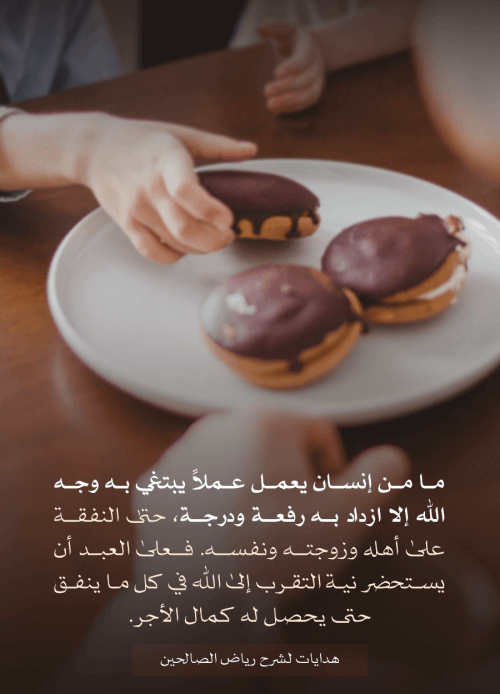
There is not a single good deed intended sincerely to please Allah except that its doer will be raised in rank and status thereby, so that he would reap the full reward.
Riyadh Al-Salheen with explanation and benefits
Love and contentment is measured by good deeds and intentions because they are the criteria for Allah’s acceptance of the servant; perhaps a small deed reaps great reward because of the intention behind it and perhaps a big deed reaps little reward because of the intention behind it
Riyadh Al-Salheen with explanation and benefits
One of the proofs Allah supports the servant is the latter’s sincere endeavor to rectify his intention and purify his heart by good deeds.
هدايات لشرح رياض الصالحين