








Categories
Discover our diverse collection of categories covering multiple topics to meet your various interestsDa\'wa cards that highlight great meanings of the verses of the Holy Quran and the noble prophetic hadiths in a simple style and attractive display that helps the Muslim to have a deeper understanding of his religion in an easy way
﴿ ٱلصَّٰبِرِينَ وَٱلصَّٰدِقِينَ وَٱلۡقَٰنِتِينَ وَٱلۡمُنفِقِينَ وَٱلۡمُسۡتَغۡفِرِينَ بِٱلۡأَسۡحَارِ ﴾
سورة آل عمران
The patient, the true, the obedient, those who spend [in the way of Allāh], and those who seek forgiveness before dawn.

﴿ فَقُلۡنَا يَٰٓـَٔادَمُ إِنَّ هَٰذَا عَدُوّٞ لَّكَ وَلِزَوۡجِكَ فَلَا يُخۡرِجَنَّكُمَا مِنَ ٱلۡجَنَّةِ فَتَشۡقَىٰٓ ﴾
سورة طه
117. Then We said: "O Adam! Verily, this is an enemy to you and to your wife. So let him not get you both out of Paradise, so that you will be distressed.
﴿ قَالَ أَلۡقُواْۖ فَلَمَّآ أَلۡقَوۡاْ سَحَرُوٓاْ أَعۡيُنَ ٱلنَّاسِ وَٱسۡتَرۡهَبُوهُمۡ وَجَآءُو بِسِحۡرٍ عَظِيمٖ ﴾
سورة الأعراف
116. He [Mûsâ (Moses)] said: "Throw you (first)." So when they threw, they bewitched the eyes of the people, and struck terror into them, and they displayed a great magic.
﴿ وَبِٱلَّيۡلِۚ أَفَلَا تَعۡقِلُونَ ﴾
سورة الصافات
138. And at night; will you not then reflect?
﴿ وَقَلِيلٞ مِّنَ ٱلۡأٓخِرِينَ ﴾
سورة الواقعة
and a few from the later generations.
﴿ وَمَا تَفَرَّقُوٓاْ إِلَّا مِنۢ بَعۡدِ مَا جَآءَهُمُ ٱلۡعِلۡمُ بَغۡيَۢا بَيۡنَهُمۡۚ وَلَوۡلَا كَلِمَةٞ سَبَقَتۡ مِن رَّبِّكَ إِلَىٰٓ أَجَلٖ مُّسَمّٗى لَّقُضِيَ بَيۡنَهُمۡۚ وَإِنَّ ٱلَّذِينَ أُورِثُواْ ٱلۡكِتَٰبَ مِنۢ بَعۡدِهِمۡ لَفِي شَكّٖ مِّنۡهُ مُرِيبٖ ﴾
سورة الشورى
And they did not become divided until after knowledge had come to them - out of jealous animosity between themselves. And if not for a word[1413] that preceded from your Lord [postponing the penalty] until a specified time, it would have been concluded between them. And indeed, those who were granted inheritance of the Scripture after them are, concerning it, in disquieting doubt.
﴿ يَٰٓأَيُّهَا ٱلَّذِينَ ءَامَنُواْ لَا تَتَّخِذُواْ بِطَانَةٗ مِّن دُونِكُمۡ لَا يَأۡلُونَكُمۡ خَبَالٗا وَدُّواْ مَا عَنِتُّمۡ قَدۡ بَدَتِ ٱلۡبَغۡضَآءُ مِنۡ أَفۡوَٰهِهِمۡ وَمَا تُخۡفِي صُدُورُهُمۡ أَكۡبَرُۚ قَدۡ بَيَّنَّا لَكُمُ ٱلۡأٓيَٰتِۖ إِن كُنتُمۡ تَعۡقِلُونَ ﴾
سورة آل عمران
O you who believe, do not take as close friends those from other than yourselves; they spare no effort to ruin you; they wish to see you suffer. Hatred has appeared from their mouths[55], but what their hearts conceal is even greater. We have made the verses clear to you, if only you understand.
﴿ إِنَّ ٱلَّذِينَ كَفَرُواْ يُنفِقُونَ أَمۡوَٰلَهُمۡ لِيَصُدُّواْ عَن سَبِيلِ ٱللَّهِۚ فَسَيُنفِقُونَهَا ثُمَّ تَكُونُ عَلَيۡهِمۡ حَسۡرَةٗ ثُمَّ يُغۡلَبُونَۗ وَٱلَّذِينَ كَفَرُوٓاْ إِلَىٰ جَهَنَّمَ يُحۡشَرُونَ ﴾
سورة الأنفال
36. Verily, those who disbelieve spend their wealth to hinder (men) from the Path of Allâh, and so will they continue to spend it; but in the end it will become an anguish for them. Then they will be overcome. And those who disbelieve will be gathered unto Hell.
﴿ بَلِ ٱلۡإِنسَٰنُ عَلَىٰ نَفۡسِهِۦ بَصِيرَةٞ ﴾
سورة القيامة
Rather, man, against himself, will be a witness,[1804]
‘Ā’ishah (may Allah be pleased with her) reported that during the days of Mina, Abu Bakr came to her while there where two girls with her; they were beating drums, and the Prophet (may Allah's peace and blessings be upon him) was covering himself with his garment (while he was lying down). Abu Bakr rebuked the two girls, but the Prophet uncovered his face and said: "O Abu Bakr, leave them, for these are the days of Eid." Those were the days of Mina, ‘Ā’ishah added: "I was being screened by the Prophet while I was watching the Ethiopians playing in the Mosque." ‘Umar rebuked them, but the Prophet (may Allah's peace and blessings be upon him) said: "Leave them, O Banu Arfida, play; it is safe."
Narrated by Bukhari & Muslim
This Hadīth displays the ease and kindness of this religion. It shows how its methodology contradicts that of extremists, who believe the religion to be harsh and violent. This Hadīth proves the permissibility of beating the drum and singing on the days of Eid based on the actions of the two girls in the presence of Prophet Muhammad (may Allah's peace and blessings be upon him) besides his reprimand to the one who reprimanded the two girls. The same goes for playing with spears and the likes. Ethiopians naturally love playing and beating drums. So the Prophet (may Allah's peace and blessings be upon him) allowed them to do what they wanted in the mosque, targeting to (clarify) a state policy. It is asserted in some of the Hadīth's wordings. This policy includes: 1. Announcing to non-Muslim groups who are afraid to embrace Islam because they assume that it is harsh and violent that Islam is a religion of kindness, peace, and pardon, especially amongst sects like the Jews, who are remote from it and prevent people from it. For this reason, some narrations of the Hadīth report that ‘Umar reprimanded the Ethiopians, but the Prophet (may Allah's peace and blessings be upon him) said: "Leave them alone, so that the Jews will know that there is ease in our religion and that I was sent with the pure and kind religion." 2. They played on the day of Eid, which are days of happiness and pleasure and indulging oneself with permissible practices. 3. It is a manly game featuring enthusiasm and courage.
Abu Hurayrah (may Allah be pleased with him) reported that he heard the Prophet (may Allah's peace and blessings be upon him) say: ''There were three (men) from the Children of Israel: a leper, a bald-headed, and a blind. Allah wanted to test them, so He sent to them an angel. The angel went to the leper and said: 'Which thing do you like most?' He said: 'A good color, fine skin, and to get rid of what makes me disgusting in the eyes of people.' He wiped over his body, so his illness went away and he was given a good color and fine skin. He (the angel) said: 'Which wealth do you like most?' He said: 'Camels, or cows (the sub-narrator Is'hāq was in doubt).' So he was given a she-camel in an advanced stage of pregnancy, and he (the angel) said: 'May Allah bless it for you.' Then he went to the bald-headed man and said: 'Which thing do you like most?' He said: 'Good hair, and to get rid of what makes me disgusting in the eyes of people.' He wiped over his head, so his condition went away and he was given good hair. Then the angel said: 'Which wealth do you like most?' He said: 'Cows or camels.' So, he was given a pregnant cow and the angel said: 'May Allah bless it for you.' Then he went to the blind man and said: 'Which thing do you like most?' He said: 'That Allah restores to me my eyesight so that I can see people.' He wiped over his eyes, so Allah restored to him his eyesight. Then the angel said: 'Which wealth do you like most?' He said: 'Sheep.' So he was given a pregnant ewe. The three then had offspring from the ones given to them: one had a valley of camels, the second a valley of cows, and the third a valley of sheep. Later, the angel went to the leper in his (past) appearance and said: 'I am a poor person, and I am running out of provision in my journey, so I cannot reach my destination except with the help of Allah and then your favor. I ask you by the One Who gave you good color, fine skin and wealth to give me one camel to carry me in my journey.' He said: 'I have many rights to fulfill.' Thereupon, he (the angel) said: 'It seems to me that I know you. Were you not a leper whom people found disgusting, and a poor man then Allah gave you wealth?' He said: 'I have inherited this wealth from my forefathers.' Thereupon, the angel said: 'If you are lying, may Allah change you to your past condition.' He then went in his (past) appearance to the bald-headed man and said to him the same as what he had said to the leper, and he replied to him in the same way the leper did. So, the angel said: 'If you are lying, may Allah change you to your past condition.' Then he went in his (past) appearance to the blind man and said: 'I am a poor man and a wayfarer. My provisions have run short in my journey, and today there is no way to reach my destination except with the help of Allah and then with your help. So, I ask you by the One Who restored to you your eyesight to give me one sheep by which I should be able to make provisions for the journey.' The man said: 'I was blind and Allah restored to me my eyesight. You may take whatever you like and leave whatever you like. By Allah, I shall not stand in your way today for what you take in the name of Allah.' Thereupon, the angel said: 'Keep your property. The fact is that the three of you were put to test. Now, Allah is pleased with you and is displeased with your two companions.'"
Narrated by Bukhari & Muslim
The Prophet (may Allah's peace and blessings be upon him) tells the story of three men from the Children of Israel. They were poor and each had a physical defect: one was a leper with bad skin and abnormal skin color, the second was bald-headed with all or most of the hair on his head gone, and the third was blind. Allah, the Almighty, wanted to test their faith and gratitude so He sent to them an angel in the form of a man. The angel went to the leper first, for his condition was the most loathsome, repulsive, and serious. He asked him which thing he liked most. The leper said: good color and good skin and to be rid of what made people avoid me. He did not only ask for good color but wanted his leprosy to be gone completely, for with this disease one has very rough and wrinkled skin, which makes it uglier and makes him feel more ashamed of it. Then, the angel asked him which wealth he liked most. The leper said: camels or cows. The sub-narrator was uncertain if he had heard it 'camels' or 'cows'. However, it is most probable that it was 'camels,' for the text later mentions that the leper was given a she-camel that was ten-months pregnant. A gift like this was very precious. The angel prayed that Allah bless the she-camel for the leper. The prayer was answered, as shown later in the Hadīth. Then the angel went to the bald man and asked him what thing he liked most. The bald man said that he liked to have good hair and that his baldness be cured, for people detested him because of it. The angel wiped over his head or his whole body (the first is more likely), so the baldness was gone. The man was given good hair. The angel then asked him which wealth he liked most, and he said that it was cows. So, he was given a pregnant cow. The angel prayed that the cow be blessed for him. The prayer was answered, as shown later in the Hadīth. Then the angel went to the blind man and asked him which thing he liked most. The blind man said: it is that Allah would restore to me my eyesight. So, the angel passed his hand over the man's eyes or over his whole body (the first is more likely). So, Allah restored to the man his eyesight. Then the angel asked him which wealth he liked most, and he said that it was sheep. So he was given a ewe with a little lamb, or a pregnant ewe (as per another narration). The three men took care of their animal gifts, which produced many offspring. The first had a valley filled with camels, the second had a valley filled with cows, and the third had a valley filled with sheep. Later on, the angel came to the leper in his past image, wearing worn-out clothes. He told him that he was a poor man who ran out of provision in his travel, and that he could not reach his destination except with the help of Allah, then with the man's favor. The angel was implicitly referring to the man's wealth, as it was apparent that he was rich. He asked him by Allah who gave him a good color, fine skin, and wealth after his past miserable condition of poverty and illness, for a he-camel to ride in his travel. The leper said: I have many debts to settle, and I do not have anything extra to give you, so go ask someone else. The angel said: It seems to me that I know you. Were you not a leper whom people found detestable but Allah granted you recovery, and you were poor but Allah gave you wealth? The man said that he inherited his wealth from his father and grandfather. In other words, he denied his miserable past and claimed that he grew up in good conditions, which is absolute denial of Allah's favors upon Him and ungratefulness to Him, prompted by his miserliness. Thereupon, the angel prayed that if the man was lying that Allah restores him to his former condition. Then the angel went to the bald man in the image in which people used to detest him for. The bald man responded to the angel in the same way the leper had done. Although the angel went to him looking like him before recovery and wealth, and although he received such recovery and wealth at his hands, he denied knowing him and even boasted that he inherited the wealth from his father. So, in addition to being a liar, he reached an extent of wickedness and foolishness that others have not reached. Therefore, the angel prayed that if the man was lying that Allah restores him to his former condition. Then the angel went to the blind man in the form of a blind man. He told him that he was a poor man and a wayfarer who was on a journey and ran out of provision. He also told him that he could not reach his destination except with the help of Allah then with his help. He asked him by Allah Who restored to him his eyesight to give him one sheep as a provision for his journey. The man, aware of Allah's favor upon him and his transformation from misery to a good life, said: Indeed I was blind and Allah restored my eyesight. So, take from his sheep whatever you wish to take and leave whatever you wish to leave, and I will not ask you to return anything that you take. The angel told him: Keep your property. The three of you were being tested. Allah, the All-Knowing of all matters, was testing you so that you would be rewarded based on what you did, not based on His foreknowledge of your actions and fate. Verily, you have earned Allah's pleasure, while your companions; the leper and the bald man, have incurred His wrath.
‘Ā'ishah (may Allah be pleased with her) reported: The Prophet (may Allah's peace and blessings be upon him) did not take a second wife until Khadījah died.
Narrated by Muslim
The Prophet (may Allah's peace and blessings be upon him) did not get married while Khadījah bint Khuwaylid (may Allah be please with her) was his wife until after she died. This attitude implies how much the Prophet (may Allah's peace and blessings be upon him) cherished Khadījah, his first wife.
‘Ā'ishah (may Allah be pleased with her) reported: The Messenger of Allah (may Allah's peace and blessings be upon him) said to me: "I know it when you are pleased with me or angry with me." I said: "Whence do you know that?" He said: "When you are pleased with me, you say: 'No, by the Lord of Muhammad,' but when you are angry with me, you say: 'No, by the Lord of Ibrahīm.'" Thereupon I said: "Yes, by Allah, O Messenger of Allah; I only forsake your name."
Narrated by Bukhari & Muslim
‘Ā'ishah (may Allah be pleased with her) said that the Messenger of Allah (may Allah's peace and blessings be upon him) told her that he knew it when she was pleased with him or angry with him. She asked him how he knew that and he replied: "When you are pleased with me, you say: 'No, by the Lord of Muhammad,' so you mention my name in your oath. But when you are angry with me because of one of the worldly aspects of our marital life, you say: 'No, by the Lord of Ibrahīm.' So you drop my name and mention, instead, the name of Ibrahīm. Thereupon, she said that it was true; she only refrained from mentioning his name for the duration of her anger, but her love for him was always firm in her heart.
‘Abdullāh ibn ‘Umar (may Allah be pleased with him) reported that ‘Umar, when his daughter Hafsah became a widow, said: "I met ‘Uthmān ibn ‘Affān (may Allah be pleased with him) and offered Hafsah for marriage to him. I said: 'If you wish, I shall give you Hafsah bint ‘Umar in marriage.' ‘Uthmān said: 'I shall think over the matter.' I waited for a few days and then ‘Uthmān met me and said: 'It occurred to me that I should not marry at present.' Then I met Abu Bakr (may Allah be pleased with him) and said to him: 'If you wish, I shall marry Hafsah bint ‘Umar to you.' Abu Bakr remained silent and did not give me any reply! I was more upset with him than with ‘Uthmān. A few days later, the Prophet (may Allah's peace and blessings be upon him) asked for her hand in marriage and I married her to him. Thereafter, I met Abu Bakr who said: 'Perhaps you were angry with me when you offered Hafsah to me and I said nothing in reply?' I said: 'Yes, that is so.' He said: 'Nothing stopped me from responding to your offer except that I knew that the Prophet (may Allah's peace and blessings be upon him) had mentioned her, and I could not disclose the secret of the Messenger of Allah (may Allah's peace and blessings be upon him). Had the Prophet (may Allah's peace and blessings be upon him) not proposed to her, I would have accepted (to marry) her.'"
Narrated by Bukhari
In this Hadīth, ‘Abdullāh ibn ‘Umar (may Allah be pleased with him) quotes from his father, ‘Umar, his account of what he did when his daughter Hafsah became a widow after the death of her husband Khunays ibn Hudhāfah As-Sahmi. Khunays was the brother of ‘Abdullāh ibn Hudhāfah, and he was one of the Prophet's Companions. He died in Madīnah as a result of an injury that he sustained in the battle of Uhud. He was one of the first people to embrace Islam, and he made Hijrah to Abyssinia. ‘Umar said: "I met with ‘Uthmān ibn ‘Affān (i.e. after the death of his wife Ruqayyah, daughter of the Messenger of Allah, may Allah’s peace and blessings be upon him), and I offered Hafsah to him in marriage." This indicates the permissibility of offering a person’s daughter in marriage to a righteous man of good character and religion, and that there is no shame in doing so. Al-Bukhāri (may Allah have mercy upon him) entitled a chapter in his Sahīh: Permissiblity of offering one's daughter or sister in marriage to a righteous man. ‘Umar said to ‘Uthmān: "If you wish, I shall give you Hafsah, daughter of ‘Umar, in marriage." He used a conditional clause because it gives the addressee freedom of choice, and this is a good manner of speech that encourages the addressee to accept. ‘Umar was also keen on attributing his daughter to himself as if adding: "and you know ‘Umar's status and his good companionship." ‘Uthmān's reply was that he would think about it; i.e. he would consider whether he should marry then or delay it. ‘Umar then said that he waited a few days and then saw ‘Uthmān, who told him that he had decided not to marry 'at present'. He said 'at present' so that his answer would not be misunderstood to mean that he had chosen to remain celibate and never get married, which is forbidden in Islam. ‘Umar then met Abu Bakr As-Siddīq (may Allah be pleased with him) and said to him: "If you wish, I shall marry Hafsah, daughter of ‘Umar, to you." Abu Bakr was silent, but it was for a very specific reason. His silence made ‘Umar angry, more so than when ‘Uthmān refused his daughter since at least ‘Uthmān gave him a reply while Abu Bakr did not say a word. A few days later, the Prophet (may Allah's peace and blessings be upon him) proposed to marry Hafsah, and ‘Umar accepted and married her off to him. After the marriage had taken place, with the reason for Abu Bakr's silence no longer existing, Abu Bakr offered his apology to ‘Umar to remove any hard feelings between them. He said: "'Perhaps you were angry with me when you offered Hafsah to me and I said nothing in reply?" He used the word 'perhaps' because, knowing ‘Umar's good character, he should not be angry with him for that, but it is also possible that he was angry as a natural reaction. ‘Umar replied truthfully, saying that he was indeed angry at his silence. Abu Bakr told him that nothing had prevented him from responding except that he had heard the Prophet (may Allah's peace and blessings be upon him) mentioning her; i.e. expressing his desire to marry her. It is possible that the Prophet mentioned his desire to marry Hafsah in the presence of Abu Bakr alone, so Abu Bakr considered this to be a secret that must not be disclosed. That is the reason why he said: "and I could not disclose the secret of the Messenger of Allah," i.e. share with anyone else what he told me in confidence. He added that if the Prophet had refrained from marrying her, he would have accepted her, because it is forbidden to propose to a woman whom the Prophet had expressed his desire to marry. This Hadīth teaches Muslims the obligation to keep the secret keenly and not to say what might lead to disclosing any part of it.
Anas ibn Mālik (may Allah be pleased with him) reported: Zayd ibn Hārithah came to the Prophet (may Allah's peace and blessings be upon him) complaining (about his wife). The Prophet (may Allah's peace and blessings be upon him) kept on saying to him: "Fear Allah and keep your wife." Anas said: "If the Messenger of Allah (may Allah's peace and blessings be upon him) were to conceal anything (of the Qur'an), he would have concealed this (verse)." Then Anas said: "Zaynab used to boast before the Prophet's wives and say: 'You were given in marriage by your families, while I was given in marriage by Allah, the Almighty, from above seven Heavens.'" Thābit narrated that the Qur'anic verse: {while you concealed within yourself that which Allah is to disclose, and you feared the people} [Sūrat al-Ahzāb: 37] was revealed in connection to the story of Zaynab bint Jahsh and Zayd ibn Hārithah (may Allah be pleased with both of them).
Narrated by Bukhari
Zayd ibn Hārithah (may Allah be pleased with him) came to the Messenger of Allah (may Allah's peace and blessings be upon him) complaining about his wife Zaynab bint Jahsh (may Allah be pleased with her) and consulting him about divorcing her. Allah, the Almighty, had revealed to His Messenger that he would eventually marry Zaynab. This was revealed to him before Zayd divorced her. When Zayd came complaining about her to the Prophet and consulting him about divorcing her, the Prophet (may Allah's peace and blessings be upon him) said to him: "Fear Allah, O Zayd, and keep your wife." Allah, the Almighty, reproached him for that in the Qur'anic verse: {And remember (O Muhammad) when you said to the one on whom Allah bestowed favor and you bestowed favor, "Keep your wife and fear Allah," while you concealed within yourself that which Allah is to disclose. And you feared the people, while Allah has more right that you fear Him. So when Zayd had no longer any need for her, We married her to you in order that there not be upon the believers any discomfort concerning the wives of their adopted sons when they no longer have need of them. And ever is the command of Allah accomplished.} [Sūrat al-Ahzāb: 37] What the Prophet (may Allah's peace and blessings be upon him) concealed within himself was dislike to marry her in fear of the people's expected disapproval of him marrying the ex-wife of his adopted son (adoption was legitimate among the Arabs before the advent of Islam). The statement of Anas: "If the Messenger of Allah (may Allah's peace and blessings be upon him) were to conceal anything (of the Qur'an), he would have concealed this (verse)”, means that were he enabled to conceal anything from the revelation that he receives - which was definitely impermissible for him to do - then he would have concealed this verse; however, it was impossible for him to do so. This verse is among the greatest proofs of the truthfulness of the Prophet (may Allah's peace and blessings be upon him) as Allah, the Almighty, informed us about what the Prophet felt of fearing the people's reaction. The Prophet conveyed this verse just as Allah, the Almighty, revealed it, even though it included Allah's reproach to him. This is contrary to what a liar would do; he would avoid everything that might blemish his character. The same can be said of the verse: {He frowned and turned away. Because the blind man came unto him.} [Sūrat ‘Abasa: 1-2], and similar verses in the Qur'an. The statement of Anas: "Zaynab used to boast before the wives of the Prophet (may Allah's peace and blessings be upon him)" means that she used to say that her marriage to the Prophet (may Allah's peace and blessings be upon him) was ordained by Allah, and that this is a great virtue in which none of the Prophet’s wives is equal to her. She used to say to them: "Your families have given you in marriage, while I was given in marriage by Allah, the Almighty, from above seven heavens." This part of the Hadīth establishes Allah’s presence above the heavens and how it is acknowledged by the believers. It is axiomatic to all Muslims. Rather, it is axiomatic to all the creation except the ones whose natural disposition has been altered. It is one of the attributes of Allah that is known through texts, intellect, and natural disposition of everyone whose natural disposition has not deviated from its original sound state. The meaning of "I was given in marriage by Allah" is that Allah ordered His Messenger to marry her in the verse: {So when Zayd had no longer any need for her, We married her to you.} It is as if Allah, the Almighty, was her guardian who concluded her marriage contract to the Prophet (may Allah's peace and blessings be upon him).
‘Ā'ishah (may Allah be pleased with her) reported: I never felt jealous of any of the Prophet's wives except for Khadījah although I did not (have the privilege to) see her. She further added that whenever the Messenger of Allah (may Allah's peace and blessings be upon him) slaughters a sheep, he says: "Send some of it to the companions of Khadījah." She said: "But one day I annoyed him and said: (It is) Khadījah (only that you mention often)!" Thereupon the Messenger of Allah (may Allah's peace and blessings be upon her) said: "My love of her has been planted in my heart (by Allah)."
Narrated by Muslim
‘Ā'ishah (may Allah be pleased with her) informs that she did not feel jealous of any of the Prophet's wives except Khadījah, may Allah be pleased with her although Khadījah had died before the Prophet (may Allah's peace and blessings be upon him) married ‘Ā'ishah. Whenever the Messenger of Allah (may Allah's peace and blessings be upon him) slaughtered a sheep, he would send some of it to Khadījah's friends. ‘Ā'ishah angered the Prophet (may Allah's peace and blessings be upon him) one day by telling him that he mentions Khadījah very often, but he replied that Allah has made him to love her in this way.
Anas (may Allah be pleased with him) reported: The Prophet (may Allah's peace and blessings be upon him) would approach all of his wives and then take one ritual bath.
Narrated by Bukhari & Muslim
This Hadīth tells about the Prophet's good treatment to his wives. He would have sexual intercourse with all of them during one night so as to please them all. Meanwhile, he would have only one ritual bath, because washing is not obligatory between two incidents of sexual intercourse, whether it takes place with the same wife or another one, as indicated by the Hadīth.
Anas ibn Mālik (may Allah be pleased with him) reported: Jibrīl came to the Messenger of Allah (may Allah's peace and blessings be upon him) while he was playing with his playmates. He took hold of him, laid him on the ground, split open his chest, took the heart out and then extracted a blood clot out of it and said: "That was the devil's share in you." Then he washed it with Zamzam water in a golden basin and then joined the wounded parts together after he restored the heart to its place. The boys came running to his mother, i.e. his wet nurse, and said: "Muhammad has been killed." They rushed to him and found his color was changed. Anas said: "I used to see the scar of this stitching on his chest."
Narrated by Muslim
Jibrīl came to the Prophet (may Allah's peace and blessings be upon him) when he was a little child playing with his mates. He put him on his back on the ground, slit his heart and took out of it a clot of thick blood, which is the source of evils and sins in the heart. Jibrīl said that this would have been the devil's share in the Prophet if such a clot of blood had remained in him. Then, he washed his heart with Zamzam water in a golden basin. Then he fixed the split, put the heart back in its place, and stitched the wound. Children who were playing with the Prophet (may Allah's peace and blessings be upon him) rushed to his wet nurse Halīmah and told her that Muhammad was killed. They went to his place and found him pale. Anas, who narrated this Hadīth, did not witness the incident himself. Yet, he must have heard it from a trustworthy Companion or through continuous chain of narrators. Anas said that he used to see the scar of stitching visible on the Prophet's chest. This is another proof that splitting the chest was physical, not spiritual. One should take this Hadīth and similar ones at face value without interpreting them metaphorically. There is no need for a metaphorical interpretation, for the Hadīth is a report from the truthful Messenger about the power of Allah, the Omnipotent.
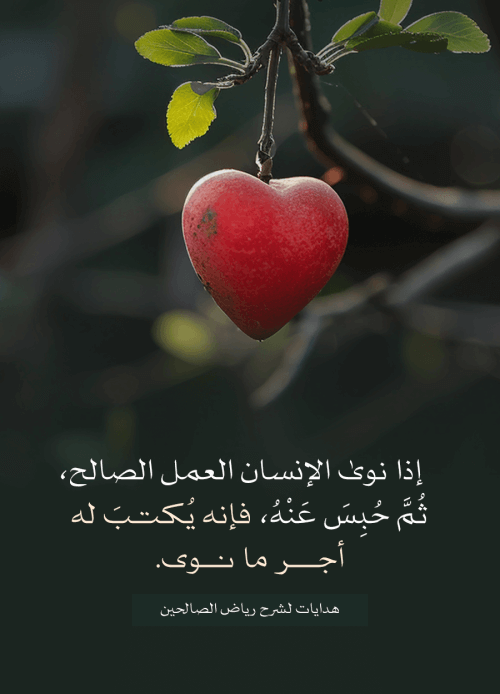
If someone intends to do a good deed but was prevented by a valid excuse, he shall gain the reward of his intention.
Riyadh Al-Salheen with explanation and benefits
Variation of reward for good deeds is based on sincerity and following of the Prophet’s guidance. The more a person is sincere to Allah, and the keener he is on following the Prophet (may Allah’s peace and blessings be upon him), the more perfect his worship will be, and consequently his reward will be bigger.
Riyadh Al-Salheen with explanation and benefits
People differ with regards to their acts of worship according to their intentions. The intentions of some people have reached the ultimate level of sincerity (to Allah) and keenness in following the Sunnah (of the Messenger of Allah) with regard to doing good and righteous deeds, while the intentions of others are below that.
Riyadh Al-Salheen with explanation and benefits
Anyone partaking a role with transgressors and wrongdoers will share their punishment because it is inclusive.
Riyadh Al-Salheen with explanation and benefits
If someone intends to do a good deed but was prevented by a valid excuse, he shall gain the reward of his intention.
Riyadh Al-Salheen with explanation and benefits
Actions are recompensed according to the intentions behind them, and the individual shall receive the reward of what he intended even if the outcome was contrary to his intention.
Riyadh Al-Salheen with explanation and benefits
There is not a single good deed intended sincerely to please Allah except that its doer will be raised in rank and status thereby, so that he would reap the full reward.
Riyadh Al-Salheen with explanation and benefits
Love and contentment is measured by good deeds and intentions because they are the criteria for Allah’s acceptance of the servant; perhaps a small deed reaps great reward because of the intention behind it and perhaps a big deed reaps little reward because of the intention behind it
Riyadh Al-Salheen with explanation and benefits
One of the proofs Allah supports the servant is the latter’s sincere endeavor to rectify his intention and purify his heart by good deeds.
هدايات لشرح رياض الصالحين