








Categories
Discover our diverse collection of categories covering multiple topics to meet your various interestsDa\'wa cards that highlight great meanings of the verses of the Holy Quran and the noble prophetic hadiths in a simple style and attractive display that helps the Muslim to have a deeper understanding of his religion in an easy way
﴿ إِلَّا ٱلَّذِينَ صَبَرُواْ وَعَمِلُواْ ٱلصَّٰلِحَٰتِ أُوْلَٰٓئِكَ لَهُم مَّغۡفِرَةٞ وَأَجۡرٞ كَبِيرٞ ﴾
سورة هود
except those who are patient and do righteous deeds; it is they who will have forgiveness and a great reward.

﴿ قَالُوٓاْ إِنَّا كُنَّا قَبۡلُ فِيٓ أَهۡلِنَا مُشۡفِقِينَ ﴾
سورة الطور
They will say, "Indeed, we were previously among our people fearful [of displeasing Allāh].
﴿ وَتُحِبُّونَ ٱلۡمَالَ حُبّٗا جَمّٗا ﴾
سورة الفجر
20. And you love wealth with much love.
﴿ كَذَٰلِكَ نَسۡلُكُهُۥ فِي قُلُوبِ ٱلۡمُجۡرِمِينَ ﴾
سورة الحجر
This is how We let this [denial] enter the hearts of the wicked[7].
﴿ خُلِقَ ٱلۡإِنسَٰنُ مِنۡ عَجَلٖۚ سَأُوْرِيكُمۡ ءَايَٰتِي فَلَا تَسۡتَعۡجِلُونِ ﴾
سورة الأنبياء
Man is created of haste. I will show you My signs, so do not ask Me to hasten them.
﴿ وَقَالَ فِرۡعَوۡنُ ٱئۡتُونِي بِكُلِّ سَٰحِرٍ عَلِيمٖ ﴾
سورة يونس
79. And Fir‘aun (Pharaoh) said: "Bring me every well-versed sorcerer."
﴿ وَإِذَا حُشِرَ ٱلنَّاسُ كَانُواْ لَهُمۡ أَعۡدَآءٗ وَكَانُواْ بِعِبَادَتِهِمۡ كَٰفِرِينَ ﴾
سورة الأحقاف
When such people are gathered, they will become their enemies and will reject their worship.
﴿ وَمَا مَنَعَ ٱلنَّاسَ أَن يُؤۡمِنُوٓاْ إِذۡ جَآءَهُمُ ٱلۡهُدَىٰٓ إِلَّآ أَن قَالُوٓاْ أَبَعَثَ ٱللَّهُ بَشَرٗا رَّسُولٗا ﴾
سورة الإسراء
Nothing prevented people from believing when guidance came to them except that they said, “Has Allah sent a human as a messenger?”
﴿ لَقَدۡ أَخَذۡنَا مِيثَٰقَ بَنِيٓ إِسۡرَٰٓءِيلَ وَأَرۡسَلۡنَآ إِلَيۡهِمۡ رُسُلٗاۖ كُلَّمَا جَآءَهُمۡ رَسُولُۢ بِمَا لَا تَهۡوَىٰٓ أَنفُسُهُمۡ فَرِيقٗا كَذَّبُواْ وَفَرِيقٗا يَقۡتُلُونَ ﴾
سورة المائدة
We had already taken the covenant of the Children of Israel and had sent to them messengers. Whenever there came to them a messenger with what their souls did not desire, a party [of messengers] they denied, and another party they killed.
Abu Hurayrah (may Allah be pleased with him) reported that the Messenger of Allah (may Allah's peace and blessings be upon him) said: "Of the people who live the best kind of life is the man who holds the reins of his horse (ever ready to march) in the way of Allah, flies on its back whenever he hears the war cry or the command to face the enemy; he flies to it seeking martyrdom or death at places where it is expected. Or a man who lives with some sheep at a hill-top or in a valley, performs prayer regularly, gives Zakah and worships his Lord until death comes to him. He does not mix with people except for a good cause.”
Narrated by Muslim
This Hadīth explains that one of the best ways of living is that of a man who is holding on to his horse's reins, i.e. ready to march in the cause of Allah. He gallops on its back whenever he hears the cry for war or the command to fight. He seeks thereby to be killed where death is expected out of his intense desire to become a martyr. The Hadīth also indicates that withdrawing and secluding oneself from the people is a good thing, and whoever is in a remote place, such as a valley or mountain pass, secluded from the people and worshiping Allah and mixing with people only when necessary for a good cause, then this is good for him.
Abu Sa‘īd al-Khudri (may Allah be pleased with him) reported that the Messenger of Allah (may Allah's peace and blessings be upon him) dispatched a force to Banu Lahyān and said: "Let one of every two men proceed (to join the military force), and both will share the reward." Another narration reads: "Let one of every two men go out (to join the military force)." Then, he said to those who stayed behind: "Anyone among you stays behind and takes good care of the family and property of a warrior (in the cause of Allah) will receive half the reward of the warrior."
Narrated by Muslim
The Hadīth of Abu Sa‘īd al-Khudri (may Allah be pleased with him) shows that the Messenger of Allah (may Allah's peace and blessings be upon him) wanted to dispatch an army to Banu Lahyān, who were one of the most famous clans of the tribe of Hudhayl. Scholars agreed that Banu Lahyan were disbelievers at that time, so the Prophet dispatched an army to invade them, saying to that army: Let one of every two men proceed to join the military force, which means half the men of every tribe should go. He stated that both the worrier and the one who stays behind to take care of the worrier's family and property will share the reward. This is confirmed in a previous Hadīth that reads: "Anyone stays behind a warrior in the cause of Allah has indeed participated in the raid," and the other explicit Hadīth narrated by Imām Muslim that reads: "Anyone among you stays behind and takes good care of the family and property of a warrior in the cause of Allah will receive half the reward of the warrior". This means that the Prophet (may Allah's peace and blessings be upon him) ordered that one of every two should join the army and the other should stay behind to look after the warrior's family and receive half the reward of the warrior. The other half would be for the warrior himself.
‘Abdullāh ibn ‘Amr ibn al-‘Ās (may Allah be pleased with him) reported that the Prophet (may Allah's peace and blessings be upon him) said: “No invading group or detachment sets out to fight in the cause of Allah and gets its share of the booty and returns safe and sound, but it has been given two-thirds of its reward in this world. On the other hand, no invading group or detachment returns defeated and injured but it will receive its full reward in the Hereafter.”
Narrated by Muslim
There are two possible interpretations of this Hadīth: First: The reward of any detachment, which fought the enemy and was safe and received its share of the booty, is less than the reward of another detachment that was injured and took no booty. This interpretation is favored by An-Nawawi (may Allah have mercy upon him). Second: The Hadīth is a proof that the war booty is lawful and does not reduce the reward. Simply, part of the reward is received in this world instead of the Hereafter, and both teams shall receive equal rewards. The victorious one, however, receives two thirds of its reward in advance in this world, but their overall reward is equal. In the Hereafter, Allah compensates those who missed the booty with an amount equal to what they missed, and Allah multiplies the reward for whomever He likes. This is the interpretation of Ibn ‘Abd al-Barr (may Allah have mercy upon him).
Abu Umāmah (may Allah be pleased with him) reported that the Prophet (may Allah's peace and blessings be upon him) said: "If anyone does not fight in the cause of Allah, equip a warrior in the cause of Allah, or stay behind to look after a warrior's family, Allah shall afflict him with a calamity before the Day of Judgment."
Narrated by Abu Daoud
This Hadīth urges Muslims to fight in the cause of Allah. It also stresses Allah's severe punishment in this world before the Hereafter inflicted on the one who abandons fighting in the cause of Allah, or abandons aiding the warriors fighting in the cause of Allah with his wealth, or abandons helping the warriors' families by looking after them in their absence. Anyone abandons these actions will suffer severe calamities for not supporting the religion of Allah properly.
Abu Hurayrah (may Allah be pleased with him) reported: The Messenger of Allah (may Allah's peace and blessings be upon him) sent us out on an expedition and said: "If you find so-and-so and so-and-so", referring to two men from Quraysh whom he named, "then burn them with fire." Then, when we were set to go out, the Messenger of Allah (may Allah's peace and blessings be upon him) said: "I commanded you to burn so-and-so and so-and-so, but no one punishes with fire except Allah. So if you find them, kill them."
Narrated by Bukhari
In this Hadīth, Abu Hurayrah (may Allah be pleased with him) tells that the Messenger of Allah (may Allah's peace and blessings be upon him) sent them out in an army to fight the enemy. He ordered them to burn two individuals from Quraysh, whom he named, whenever they spot them. Then he said to them when they came to bid him farewell before their journey: I commanded you to burn so-and-so and so-and-so, but no one punishes with fire except Allah, so when you seize them, kill them.
Buraydah (may Allah be pleased with him) reported that the Messenger of Allah (may Allah's peace and blessings be upon him) said: "The sanctity of the wives of the Mujāhids for those who stay behind is like the sanctity of their own mothers. Any man, of those who stay behind, who looks after the family of a Mujāhid and betrays his trust will be made to stand on the Day of Judgment before the Mujāhid who will take away from his good deeds as much as he likes until he is satisfied." Then, the Messenger of Allah (may Allah's peace and blessings be upon him) turned to us and asked: "So what do you think (will he leave anything)?”
Narrated by Muslim
The basic principle is that a woman is unlawful to her non-Mahram males, and the unlawfulness is emphasized regarding the wives of those who have set out to fight for the sake of Allah and left their wives behind, and entrusted them to the men who did not go out for Jihad. It is obligatory for those men to be cautious lest they should violate those wives' honor, by being alone with them, gazing at them, or speaking lewdly to them. These wives are as unlawful for them (to marry) as their mothers. This is because the Mujāhids have entrusted their families to the care of those men, and, therefore, the Prophet (may Allah's peace and blessings be upon him) advised that it is the duty of each of those men to do his duty towards them and not betray the Mujāhid's trust by looking at his wife or attempting any indecent behavior or by being negligent in looking after their affairs, doing what is good for them, and warding harm off them. "Anyone who stays behind looking after the family of a Mujāhid and betrays his trust will be made to stand on the Day of Judgment before the Mujāhid who will take away from his good deeds as much as he likes until he is satisfied." This means: Whoever dares to violate the honor of the wives of Mujāhids in their absence, and betrays them with regards to their wives, then Allah will enable the Mujāhid over him on the Day of Judgment whereby the Mujāhid will take from his good deeds as much as he wants until he is satisfied and pleased. Then the Prophet (may Allah's peace and blessings be upon him) said: "So what do you think (will he leave anything)?" i.e. How do you think the Mujāhid would take advantage of this chance of acquiring a large amount of good deeds? In other words, nothing will remain, as he will take all of that man's good deeds.
It was reported about ‘Abdullāh ibn Abi Awfa that he was asked (by Muhammad ibn Abi Mujāhid): "Were you people setting aside one-fifth of the spoils of war – meaning the food – during the time of the Messenger of Allah (may Allah's peace and blessings be upon him)?" He replied: "We got some food on the Day of Khaybar. A man would come and take the amount he needed from it then go away."
Narrated by Abu Daoud
According to this Hadīth, if a Muslim fighter needs to eat from the food seized as spoils of war, he may do so but without storing any of it. Rather, he eats as much as he needs and leaves the rest. Keeping food beyond his need in reserve is considered unlawful appropriation of the spoils of war, but eating his need of it is not appropriation. This forbiddance only applies to what he takes exclusively for himself apart from his fellow fighters. As to what he shares with them of food and fruit, there is no harm on him in taking his lawful share from it.
‘Amr ibn Shu‘ayb reported from his father that his grandfather said: "The Messenger of Allah (may Allah’s peace and blessings be upon him) said: 'Muslims are like one hand against all those who are outside the community. Their blood and wealth are equal (in terms of inviolability). The protection granted by the lowest of them in status is to be honored by all Muslims, and Muslims return (the spoils of war) to the farthest of them.'"
Narrated by Ibn Majah
This Hadīth indicates that all Muslims must preserve unity of word and stance as a united front in the face of their enemies. They should never be disunited or let each other down, since they are one community with one stance against their enemies. Allah, the Almighty, says: {And hold firmly to the rope of Allah all together and do not become divided} [Sūrat Āl-‘Imrān:103]. Allah also says: {and do not dispute and [thus] lose courage and [then] your strength would depart} [Sūrat al-Anfāl: 46]. Moreover, this Hadīth states that bloods of Muslims and believers are equal in terms of blood money and retribution, and that none of them is superior to the other because of lineage, race, or school of thought. They are all equal regarding this right and duty. According to the Hadīth, protection granted by a Muslim to a disbeliever is binding on all Muslims, who must respect this pledge of protection and never breach it. Finally, the Hadīth states that in the distribution of the spoils of war, seized by a detachment with the support of the army, not only the actual captors (soldiers of a detachment) but also the joint captors (the whole army) are entitled to share. Likewise, when spoils of war end up in the Muslim treasury, they must be distributed to all Muslims whether they directly participated in seizing them or not.
Anas ibn Mālik and ‘Uthmān ibn Abu Sulaymān (may Allah be pleased with both of them) reported: The Prophet (may Allah's peace and blessings be upon him) sent Khālid ibn al-Walīd to Ukaydir of Dūmah. He (Ukaydir) was seized and brought to the Prophet (may Allah's peace and blessings be upon him) who spared his life and made a peace treaty with him on condition that they should pay Jizyah.
Narrated by Abu Daoud
During the battle of Tabūk, the Prophet (may Allah's peace and blessings be upon him) sent Khālid ibn al-Walīd (may Allah be pleased with him) as a commander of a detachment to Ukaydir of Dūmat al-Jandal. Khālid (may Allah be pleased with him) took Ukaydir as a captive, conquered his fort, and brought him to the Prophet (may Allah's peace and blessings be upon him) in Madīnah. The Prophet (may Allah's peace and blessings be upon him) allowed him to return to his country, and imposed on him the Jizyah, despite the fact that he was an Arab. This Hadīth proves that the Prophet (may Allah's peace and blessings be upon him) did not coerce Ukaydir into embracing Islam.
A successful servant of Allah is he who chooses to do the most pious deeds bound to raise his rank on the Day of Judgment.
Riyadh Al-Salheen with explanation and benefits
Allah suffices anyone who relies on Him because He does not disappoint those hopeful of Him.
Riyadh Al-Salheen with explanation and benefits
Anyone doing good deeds will reap its fruits even if they were few; so, the individual should never look down upon any good deed.
Riyadh Al-Salheen with explanation and benefits
It shows that whoever is sincere in his worship, Allah Almighty will guide him to more of it.
Riyadh Al-Salheen with explanation and benefits
It shows that the prohibited lusts are doors to hellfire; and it means following one’s desires that violate the Sharia
Riyadh Al-Salheen with explanation and benefits
Arduous deeds lead to honor and admission to Paradise.
Riyadh Al-Salheen with explanation and benefits
Aging should inspire self-admonition because one becomes close to meeting Allah Almighty.
Riyadh Al-Salheen with explanation and benefits
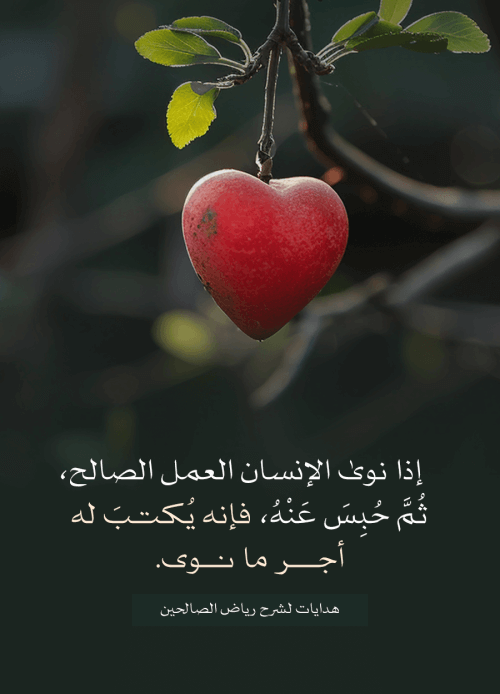
Sincerity and honesty are the criteria for deeds that, once fulfilled, the doer will obtain the designated reward.
Riyadh Al-Salheen with explanation and benefits
The greater the benefit extending beyond limited individuals, the greater the reward and the effect.
Riyadh Al-Salheen with explanation and benefits