








Categories
Discover our diverse collection of categories covering multiple topics to meet your various interestsDa\'wa cards that highlight great meanings of the verses of the Holy Quran and the noble prophetic hadiths in a simple style and attractive display that helps the Muslim to have a deeper understanding of his religion in an easy way
﴿ وَلَقَدۡ بَوَّأۡنَا بَنِيٓ إِسۡرَٰٓءِيلَ مُبَوَّأَ صِدۡقٖ وَرَزَقۡنَٰهُم مِّنَ ٱلطَّيِّبَٰتِ فَمَا ٱخۡتَلَفُواْ حَتَّىٰ جَآءَهُمُ ٱلۡعِلۡمُۚ إِنَّ رَبَّكَ يَقۡضِي بَيۡنَهُمۡ يَوۡمَ ٱلۡقِيَٰمَةِ فِيمَا كَانُواْ فِيهِ يَخۡتَلِفُونَ ﴾
سورة يونس
And We had certainly settled the Children of Israel in an agreeable settlement and provided them with good things. And they did not differ until [after] knowledge had come to them. Indeed, your Lord will judge between them on the Day of Resurrection concerning that over which they used to differ.

﴿ فَلَمَّآ أَنۡ أَرَادَ أَن يَبۡطِشَ بِٱلَّذِي هُوَ عَدُوّٞ لَّهُمَا قَالَ يَٰمُوسَىٰٓ أَتُرِيدُ أَن تَقۡتُلَنِي كَمَا قَتَلۡتَ نَفۡسَۢا بِٱلۡأَمۡسِۖ إِن تُرِيدُ إِلَّآ أَن تَكُونَ جَبَّارٗا فِي ٱلۡأَرۡضِ وَمَا تُرِيدُ أَن تَكُونَ مِنَ ٱلۡمُصۡلِحِينَ ﴾
سورة القصص
When he was about to strike the one who was an enemy to both of them, he[10] said, “O Moses, do you want to kill me as you killed that person yesterday? You only want to be a tyrant in the land, and you do not want to be one of those who put things right!”
﴿ وَمِن دُونِهِمَا جَنَّتَانِ ﴾
سورة الرحمن
And below them both [in excellence] are two [other] gardens -
﴿ خَلَقَ ٱلسَّمَٰوَٰتِ وَٱلۡأَرۡضَ بِٱلۡحَقِّۚ تَعَٰلَىٰ عَمَّا يُشۡرِكُونَ ﴾
سورة النحل
He created the heavens and earth in truth. High is He above what they associate with Him.
﴿ أَوَلَمۡ يَرَوۡاْ أَنَّا نَسُوقُ ٱلۡمَآءَ إِلَى ٱلۡأَرۡضِ ٱلۡجُرُزِ فَنُخۡرِجُ بِهِۦ زَرۡعٗا تَأۡكُلُ مِنۡهُ أَنۡعَٰمُهُمۡ وَأَنفُسُهُمۡۚ أَفَلَا يُبۡصِرُونَ ﴾
سورة السجدة
27. Have they not seen how We drive water to the dry land that has no vegetation, and therewith bring forth crops providing food for their cattle and themselves? Will they not then see?
﴿ عَلِمَتۡ نَفۡسٞ مَّآ أَحۡضَرَتۡ ﴾
سورة التكوير
A soul will [then] know what it has brought [with it].[1869]
﴿ عَمَّ يَتَسَآءَلُونَ ﴾
سورة النبأ
1. What are they asking (one another) about?
﴿ قَالَ سَتَجِدُنِيٓ إِن شَآءَ ٱللَّهُ صَابِرٗا وَلَآ أَعۡصِي لَكَ أَمۡرٗا ﴾
سورة الكهف
Moses said, “You will find me patient, if Allah wills; and I will not disobey any of your orders.”
﴿ إِن يَدۡعُونَ مِن دُونِهِۦٓ إِلَّآ إِنَٰثٗا وَإِن يَدۡعُونَ إِلَّا شَيۡطَٰنٗا مَّرِيدٗا ﴾
سورة النساء
They call upon none besides Him except female [idols][85]; they call upon none but a rebellious Satan[86]
Khaythamah reported: A household manager of ‘Abdullāh ibn ‘Amr came in while we were sitting with him. Ibn ‘Amr said: "Did you give the slaves their sustenance?" He said: 'No.' Upon this ‘Abdullāh said: "Go and give them, for the Messenger of Allah (may Allah’s peace and blessings be upon him) said: 'One will be committing a great sin if he withholds sustenance from those whom he should provide for.'"
Narrated by Muslim
In this Hadīth, ‘Abdullāh ibn ‘Amr (may Allah be pleased with him) demonstrates the great responsibility one bears towards those whom he is responsible to provide for. When he knew that his household manager did not provide the slaves with their sustenance, he mentioned the Hadīth of the Prophet (may Allah's peace and blessings be upon him) in which he stated that neglecting and forsaking one’s dependents because of his niggardliness and stinginess is a serious sin.
Anas ibn Mālik (may Allah be pleased with him) reported directly that the Prophet (may Allah's peace and blessings be upon him) forbade the use of saffron by men.
Narrated by Bukhari & Muslim
The Prophet (may Allah's peace and blessings be upon him) forbade men to dye their bodies or clothes with saffron, because saffron was a perfume of the women, So, men were forbidden to use it; to prevent resemblance between both genders.
Ibn ‘Abbās (may Allah be pleased with him) reported regarding the story of Barīrah and her husband: The Prophet (may Allah's peace and blessings be upon him) said to her: "If you would take him back?" She said: "O Messenger of Allah, are you ordering me to do so?" He replied: "I am just interceding." So she said: "I have no need for him."
Narrated by Bukhari
Barīrah's husband was a slave named Mugīth, and Barīrah used to serve ‘Ā’ishah (may Allah be pleased with her) before she purchased her, then after ‘Ā’ishah freed her from slavery, she was given the choice whether to stay married to Mugīth or to separate from him (because she had become a free woman while he was still a slave). Barīrah chose to leave him. After this separation, Mugīth used to chase her through the roads of Madīnah crying with his tears flowing down his beard, perchance she would reconsider and go back to him. This was because of his extreme love for her. The Prophet (may Allah's peace and blessings be upon him) said to Barīrah: "If you would go back to him, you will receive reward (from Allah) for it." She said: "O Messenger of Allah, are you ordering me to go back to him?" He said: "I am only interceding on his behalf." So she said: "I have no desire or need to go back to him."
Sa‘d ibn Abi Waqqās (may Allah be pleased with him) reported: ‘Umar once asked permission to see the Messenger (may Allah's peace and blessings be upon him) while he was hosting some women from Quraysh who were talking loudly to him and asking more from him. When ‘Umar asked permission to enter, the women hurried to screen themselves. Allah's Messenger (may Allah's peace and blessings be upon him) allowed ‘Umar in while he was smiling. Therefore, ‘Umar commented: "O Allah's Messenger, may Allah always make you happy!" The Messenger (may Allah's peace and blessings be upon him) said: "I am astonished at these women who were with me. As soon as they heard your voice, they hastened to screen themselves." ‘Umar said: "O Messenger of Allah, you are worthier of their awe!" Then he addressed them (those women) saying: "O enemies of yourselves, do you fear me and not the Messenger of Allah?" They replied: "Yes, for you are tougher and harsher than the Messenger." On that, the Messenger (may Allah's peace and blessings be upon him) said: "By the One in Whose hand my soul is, whenever the devil sees you walking on a path, he follows a path other than yours."
Narrated by Bukhari & Muslim
‘Umar ibn al-Khattāb (may Allah be pleased with him) asked permission to see the Messenger of Allah (may Allah's peace and blessings be upon him) when some women from Quraysh were talking in a loud voice with the Prophet and asking for more responses or more financial support from him. When ‘Umar asked permission to come in, they heard his voice, so they hurried to screen themselves. The Prophet allowed him in, laughing at the women's reaction. Therefore, ‘Umar prayed that Allah would perpetuate the Prophet's happiness, inquiring about the reason for his laughing. The Prophet told him that he laughed at the women's reaction to hearing ‘Umar's voice. Before he came in, they were speaking loudly, but when he entered, they hastened to hide, in awe of him. So ‘Umar said that the Prophet was worthier of such respect and awe and addressed these women with that they were enemies of themselves, wondering how they could act thus in awe of him but not of the Prophet. They answered that they did so because ‘Umar was tough and harsh, unlike the Prophet (may Allah's peace and blessings be upon him). Thereupon, the Prophet swore that whenever the devil saw ‘Umar walking on a specific path, he would escape that path and take a different one.
Ibn ‘Abbās (may Allah be pleased with him) reported: A man came to the Prophet (may Allah's peace and blessings be upon him) and said: "My wife does not object if anyone touches her." He said: "Divorce her." The man said: "I am afraid that I will miss her." The Prophet (may Allah's peace and blessings be upon him) said: "Then enjoy her."
An-Nasaa’i - Narrated by Abu Daoud
The Hadīth indicates that a Companion came to the Prophet (may Allah's peace and blessings be upon him) seeking advice concerning his wife. The man told the Prophet (may Allah's peace and blessings be upon him) that his wife did not object if anyone touched her. The scholars had a great difference of opinion over the meaning of this statement. The preponderant opinion is that the woman did not avoid men and did not object to a person who touched her seeking thereby to enjoy her, or that she did not keep away from men and was not reserved in speech to them and did not screen herself from them such that they would touch her body, or they would shake hands with her and she would not avoid that. This does not mean that she would consent to adultery, because the Prophet (may Allah's peace and blessings be upon him) would not approve the man’s marriage to an adulteress. Therefore, the Prophet (may Allah's peace and blessings be upon him) firstly advised the man to part with her, out of sympathy for him to stay with such a woman. However, the man informed the Prophet (may Allah's peace and blessings be upon him) about his deep love for his wife and his fear that he would miss her if he were to leave her. Then the Prophet (may Allah's peace and blessings be upon him) felt that it was beneficial in this situation for the man to remain with his wife, for fear of the harm that would be caused by separation. Therefore, averting greater harm by engaging in an issue with lesser harm is a necessity. Moreover, the woman could probably reform in the future. Allah, the Exalted, knows best.
Yūsuf ibn ‘Abdullāh ibn Salām (may Allah be pleased with him) reported: The Messenger of Allah (may Allah’s peace and blessings be upon him) named me Yūsuf and seated me on his lap.
Narrated by Ahmad
In this Hadīth, Yūsuf ibn ‘Abdullāh ibn Salām (may Allah be pleased with him) tells that the Messenger of Allah (may Allah’s peace and blessings be upon him) was the one who named him Yūsuf, and he seated him on his lap. This Hadīth demonstrates the noble morals of the Prophet (may Allah's peace and blessings be upon him) and his modesty and mercy with little children.
Abu Hurayrah (may Allah be pleased with him) reported that the Prophet (may Allah's peace and blessings be upon him) said: "Allah, the Exalted, said: 'My reward shall be nothing less than Paradise for My faithful servant who, if I take the life of his beloved one from the inhabitants of the world, he bears it patiently in expectation of My reward.'"
Narrated by Bukhari
In this Qudsi Hadīth, the Prophet (may Allah's peace and blessings be upon him) says that any believer who is tested with losing his beloved one, whether a relative, such as one's child, parent, sibling, uncle, or one's friend, and he is patient with his loss, seeking reward from Allah, then the reward for it is nothing less than Paradise.
‘Abdullāh ibn ‘Amr ibn al-‘Ās (may Allah be pleased with him) reported: A man came to the Prophet (may Allah's peace and blessings be upon him) and said: "I pledge allegiance to you to immigrate and fight for Allah's cause seeking Allah's reward." He said: "Is either of your parents alive?" He replied: "Yes, both of them." The Prophet (may Allah's peace and blessings be upon him) asked him: "Do you seek reward from Allah?" He replied: 'Yes.' The Prophet (may Allah's peace and blessings be upon him) said: "Then return to your parents and accompany them in a best way" [Al-Bukhāri and Muslim]. This is the wording in Sahīh Muslim. In another narration: "A man came to the Prophet seeking his permission to fight in Allah's cause, so the Prophet asked him: 'Are your parents alive?' He said: 'Yes.' The Prophet (may Allah's peace and blessings be upon him) said: 'Then strive in serving them.'"
Narrated by Bukhari & Muslim
A man came to the Prophet (may Allah's peace and blessings be upon him) and informed him about his interest and love for fighting and immigration in the cause of Allah. The man had left behind his parents. In another narration by Abu Dawūd: "He left behind his parents crying", out of their fear of him being killed. The man was waiting for the Prophet to approve his proposal. So the Prophet asked him: "Are either of your parents alive?" He said: "Yes, both of them are alive." The Prophet (may Allah's peace and blessings be upon him) said: "Do you seek reward from Allah?" He replied: 'Yes.' The Prophet (may Allah's peace and blessings be upon him) said: "Then return to your parents and be the best and kindest companion for them." In the narration by Abu Dawūd: "Go back to them and make them laugh just as you made them cry." The Prophet (may Allah's peace and blessings be upon him) guided the man to what is worthier and more obligatory on him, which is returning to his parents and giving them his best companionship. Serving the parents, obeying them, and seeking to please them is part of striving in the cause of Allah. In a narration by Al-Bukhāri and Muslim: "... then strive in their service ." The Prophet (may Allah's peace and blessings be upon him) explicitly stated in another Hadīth that dutifulness to parents, obeying them, and kindness to them is better than fighting in the cause of Allah, as in the narration reported by Ibn ‘Umar (may Allah be pleased with him) where he said: "A man came to the Messenger of Allah (may Allah's peace and blessings be upon him) and asked him about the best deeds. He said: 'Prayer.' The man asked: 'Then what?' He said: 'Jihad.' The man said: 'I have parents (meaning, my parents are still alive).' The Prophet (may Allah's peace and blessings be upon him) said: 'Your kindness to your parents is better'" [Ibn Hibbān]. This Hadīth indicates that dutifulness to the parents is better than Jihad, except at times when Jihad becomes an individual obligation. In this case, it takes precedence over obedience to the parents.
Thawbān (may Allah be pleased with him) reported: The Messenger of Allah (may Allah's peace and blessings be upon him) said: "The best dinar a man spends is a dinar that he spends on his dependents, and a dinar that a man spends on his mount in the cause of Allah, and a dinar that he spends on his companions in the cause of Allah." Abu Qilābah said: He began with the dependents. Then Abu Qilābah said: No man is greater in reward than a man who spends on young dependents, by virtue of whom Allah makes them chaste, or brings them benefit and enriches them.
Narrated by Muslim
The Prophet (may Allah's peace and blessings be upon him) clarified some forms of spending and put them in order according to the most obligatory ones in case numerous channels of spending crowd together, starting with the most important and then the next in importance. He stated that the money that brings one the highest reward for spending is the money that a Muslim spends on his dependents, like his wife and children, followed by spending on the mount that is prepared for war in the cause of Allah, then spending on one's friends and companions if they are fighters in the cause of Allah.
The path of Allah is one whereas the paths of the devil are many; and a truly guided individual is he whom Allah Almighty guided to His path. Allah Almighty said: {This is My straight path; follow it and do not follow other ways, lest they lead you away from His way.} [Surat al-An‘ām: 153]
Riyadh Al-Salheen with explanation and benefits
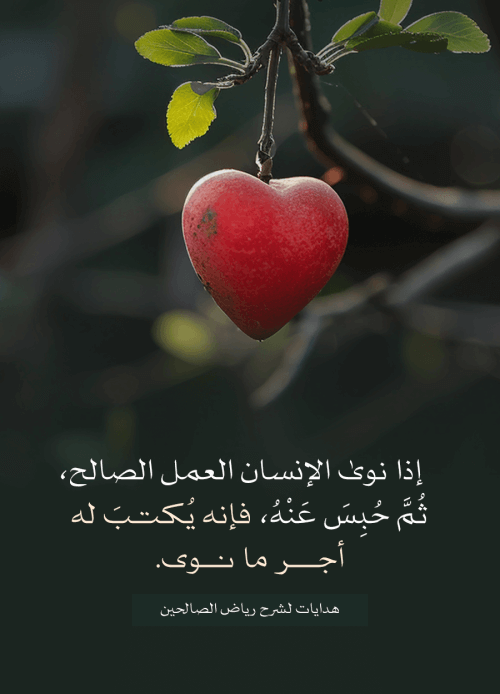
Waiting to do a good deed is in itself a good deed.
Riyadh Al-Salheen with explanation and benefits
Good intention leads its holder to good things.
Riyadh Al-Salheen with explanation and benefits
One of the manifestations of Allah’s mercy is that He uses justice to recompense the sinner but uses His grace and bounty to recompense the good-doer.
Riyadh Al-Salheen with explanation and benefits
Sincerity is one of the means to alleviate adversity because each one of them said: “O Allah! If I did that for Your sake only, then relieve us from the distress we are in.”
Riyadh Al-Salheen with explanation and benefits
Good deeds are means to alleviating adversity.
Riyadh Al-Salheen with explanation and benefits
“The righteousness of the heart results from the righteousness of deeds, and the righteousness of deeds results from the righteousness of intention.”
Riyadh Al-Salheen with explanation and benefits
Repentance is a cause for success, which is why a true successful person is the one seeking and committing to a means leading to success.
Riyadh Al-Salheen with explanation and benefits
Hastening to repentance is one of the causes to earning the pleasure of Allah with His servant.
Riyadh Al-Salheen with explanation and benefits