








Categories
Discover our diverse collection of categories covering multiple topics to meet your various interestsDa\'wa cards that highlight great meanings of the verses of the Holy Quran and the noble prophetic hadiths in a simple style and attractive display that helps the Muslim to have a deeper understanding of his religion in an easy way
﴿ يَٰٓأُخۡتَ هَٰرُونَ مَا كَانَ أَبُوكِ ٱمۡرَأَ سَوۡءٖ وَمَا كَانَتۡ أُمُّكِ بَغِيّٗا ﴾
سورة مريم
28. "O sister (i.e. the like) of Hârûn (Aaron)[2]! Your father was not a man who used to commit adultery, nor your mother was an unchaste woman."

﴿ ۞ يَسۡـَٔلُونَكَ عَنِ ٱلۡخَمۡرِ وَٱلۡمَيۡسِرِۖ قُلۡ فِيهِمَآ إِثۡمٞ كَبِيرٞ وَمَنَٰفِعُ لِلنَّاسِ وَإِثۡمُهُمَآ أَكۡبَرُ مِن نَّفۡعِهِمَاۗ وَيَسۡـَٔلُونَكَ مَاذَا يُنفِقُونَۖ قُلِ ٱلۡعَفۡوَۗ كَذَٰلِكَ يُبَيِّنُ ٱللَّهُ لَكُمُ ٱلۡأٓيَٰتِ لَعَلَّكُمۡ تَتَفَكَّرُونَ ﴾
سورة البقرة
219. They ask you (O Muhammad صلى الله عليه وسلم) concerning alcoholic drink and gambling.[54] Say: "In them is a great sin, and (some) benefit for men, but the sin of them is greater than their benefit." And they ask you what they ought to spend. Say: "That which is beyond your needs." Thus Allâh makes clear to you His Laws in order that you may give thought." [55]
﴿ يَٰٓأَيُّهَا ٱلنَّبِيُّ جَٰهِدِ ٱلۡكُفَّارَ وَٱلۡمُنَٰفِقِينَ وَٱغۡلُظۡ عَلَيۡهِمۡۚ وَمَأۡوَىٰهُمۡ جَهَنَّمُۖ وَبِئۡسَ ٱلۡمَصِيرُ ﴾
سورة التحريم
O Prophet, strive against the disbelievers and the hypocrites and be harsh upon them. And their refuge is Hell, and wretched is the destination.
﴿ فَأَمَّا ٱلَّذِينَ ءَامَنُواْ بِٱللَّهِ وَٱعۡتَصَمُواْ بِهِۦ فَسَيُدۡخِلُهُمۡ فِي رَحۡمَةٖ مِّنۡهُ وَفَضۡلٖ وَيَهۡدِيهِمۡ إِلَيۡهِ صِرَٰطٗا مُّسۡتَقِيمٗا ﴾
سورة النساء
So those who believe in Allāh and hold fast to Him - He will admit them to mercy from Himself and bounty and guide them to Himself on a straight path.
﴿ فَسَتَذۡكُرُونَ مَآ أَقُولُ لَكُمۡۚ وَأُفَوِّضُ أَمۡرِيٓ إِلَى ٱللَّهِۚ إِنَّ ٱللَّهَ بَصِيرُۢ بِٱلۡعِبَادِ ﴾
سورة غافر
And you will remember what I [now] say to you, and I entrust my affair to Allāh. Indeed, Allāh is Seeing of [His] servants."
﴿ أَمَّن يَهۡدِيكُمۡ فِي ظُلُمَٰتِ ٱلۡبَرِّ وَٱلۡبَحۡرِ وَمَن يُرۡسِلُ ٱلرِّيَٰحَ بُشۡرَۢا بَيۡنَ يَدَيۡ رَحۡمَتِهِۦٓۗ أَءِلَٰهٞ مَّعَ ٱللَّهِۚ تَعَٰلَى ٱللَّهُ عَمَّا يُشۡرِكُونَ ﴾
سورة النمل
63. Is not He (better than your gods) Who guides you in the darkness of the land and the sea, and Who sends the winds as heralds of glad tidings, going before His Mercy (rain)? Is there any ilâh (god) with Allâh? High Exalted be Allâh above all that they associate as partners (to Him)!
﴿ ٱلَّذِي يَصۡلَى ٱلنَّارَ ٱلۡكُبۡرَىٰ ﴾
سورة الأعلى
12. Who will enter the great Fire (and will be made to taste its burning).
﴿ وَلَقَدۡ ءَاتَيۡنَا دَاوُۥدَ وَسُلَيۡمَٰنَ عِلۡمٗاۖ وَقَالَا ٱلۡحَمۡدُ لِلَّهِ ٱلَّذِي فَضَّلَنَا عَلَىٰ كَثِيرٖ مِّنۡ عِبَادِهِ ٱلۡمُؤۡمِنِينَ ﴾
سورة النمل
15. And indeed We gave knowledge to Dâwûd (David) and Sulaimân (Solomon), and they both said: "All the praises and thanks be to Allâh, Who has preferred us above many of His believing slaves!"
﴿ وَكَذَٰلِكَ حَقَّتۡ كَلِمَتُ رَبِّكَ عَلَى ٱلَّذِينَ كَفَرُوٓاْ أَنَّهُمۡ أَصۡحَٰبُ ٱلنَّارِ ﴾
سورة غافر
Thus the decree of your Lord was passed against those who disbelieve, that they will be the people of the Fire.
‘Amr ibn ‘Awf al-Ansāri (may Allah be pleased with him) reported that the Messenger of Allah (may Allah's peace and blessings be upon him) sent Abu ‘Ubaydah ibn al-Jarrāh to Bahrain to collect the Jizyah (yearly tax), and he returned from Bahrain with money. The Ansār heard the news of Abu ‘Ubaydah's return and they gathered for the Fajr prayer with the Messenger of Allah (may Allah's peace and blessings be upon him). After he had prayed and left, the Ansār presented themselves before him. When he saw them, he smiled and said: "I believe you heard that Abu ‘Ubaydah has returned from Bahrain with something." They replied: "Yes, O Messenger of Allah." The Prophet (may Allah's peace and blessings be upon him) said: "Rejoice, and hope for that which will please you. By Allah, it is not poverty that I fear for you. What I fear for you is that the world expands (with lots of wealth) for you just as it did for the people before you. Then you will compete as they competed, then it will destroy you just as it destroyed them."
Narrated by Bukhari & Muslim
The Prophet (may Allah's peace and blessings be upon him) sent Abu ‘Ubaydah (may Allah be pleased with him) to Bahrain to collect the tax from them. When he returned to Madīnah and the Ansār heard about his return, they went to the Prophet and gathered waiting for him at the Fajr prayer. After the Prophet prayed and started to leave, the Ansār presented themselves to him and he smiled because he knew they wanted some of the money. He said to them: "Perhaps you've heard that Abu ‘Ubaydah has returned?" They said: "Yes, O Messenger of Allah," meaning we have come to receive our share of the money. So the Prophet gave them glad tidings that made them happy. He informed them that he does not fear poverty for them, because most of the time the impoverished person is closer to the truth than the wealthy one. Rather, he feared for them that the pleasures of the worldly life would be given to them, and then they would compete among themselves to attain them. A person in such a state (of competition) is never satisfied with what he has and he always wants more and more by any means. He does not care whether he acquires it through lawful or unlawful means. There is no doubt that this is a type of dispraised competition which attaches the person to this world and distances him from the Hereafter (and remembrance of it). So, as a result, the person is destroyed just as the previous nations were destroyed for the same reason.
Anas (may Allah be pleased with him) reported that the Messenger of Allah (may Allah's peace and blessings be upon him) used to leave fasting in a certain month until we would think that he has not fasted at all that month; and he used to fast in another month so much that we would think he has not stopped fasting at all in that month. If one wished to see him praying at night, one could see him (in that state), and if one wished to see him sleeping at night, one could see him (in that state) too.
Narrated by Bukhari
The meaning of the Hadīth: Anas (may Allah be pleased with him) informs about the condition of the Prophet (may Allah's peace and blessings be upon him) regarding fasting and praying at night. He said that he used to leave fasting in a certain month until a person would think that he has not fasted any day of that month; for not fasting for many days. Conversely, he used to fast in a certain month so many days that one would think that he has not broken his fast at all in that month; for his consistent fasting for many days. Likewise, he has not committed himself to pray at a certain time at night. Rather, he used to pray at the beginning of the night sometimes, other times in the middle, and other at the last part of it; such that if you wished to see him praying at night, you would be able to. And if you wished to see him sleeping at night, you would be able to as well. Therefore, his deeds were moderate between excess and negligence.
Jābir ibn ‘Abdullāh (may Allah be pleased with him) reported that the Messenger of Allah (may Allah's peace and blessings be upon him) never said: "No" to anyone who asked him for something. Anas ibn Mālik (may Allah be pleased with him) reported: Never was the Messenger of Allah (may Allah's peace and blessings be upon him) asked for anything by someone who was about to accept Islam but that he gave it to them. A man came to him and asked for alms, so he gave him a number of sheep (so large that they filled the space) between two mountains. So the man returned to his people and told them: "O my people, embrace Islam, for Muhammad gives lavishly like someone who does not fear any poverty." Some people would embrace Islam only for worldly gains, but Islam soon became dearer to them than the whole world and all what is in it.
Narrated by Bukhari & Muslim
Hadīth explanation: The Prophet (may Allah's peace and blessings be upon him) would never say 'no' to anyone who asked him for worldly provisions. Rather, if he had what he was asked for, he would give it to him. If he didn’t have it he would say kind words to him, in compliance with Allah's command: {And as for the beggar, do not scold him} [Sūrat Ad-Duha: 10]. Anas (may Allah be pleased with him) reported that the Prophet (may Allah's peace and blessings be upon him) was very merciful, and no one came to him asking for something except that he promised to give him and carried out that promise if he had something to give." Abu Hurayrah (may Allah be pleased with him) reported: A man came to the Prophet (may Allah's peace and blessings be upon him) so he sent a messenger to his wives (to bring something for the man to eat), but they said that they had nothing except water. Thereupon, he said: "Who will take this (man) as a guest?" In another narration, Sahl ibn Sa‘d (may Allah be pleased with him) reported: A woman brought a cloak to the Prophet and said: "O Messenger of Allah, I have knitted this with my own hands for you to wear." So the Prophet took it and he was in need of it, and he came out to us wearing it. A man said: "O Messenger of Allah, give it to me to wear." The Prophet (may Allah's peace and blessings be upon him) said: 'Yes', and sat with us. Later when he returned home, he folded the cloak and sent it to the man. The people said to the man: "It was not good of you to ask him for it when you know that he never turns down anyone's request." The man said: "By Allah, I only asked him for it so that it would be my shroud when I die." And it was (indeed) his shroud when he died. These are examples of how the Prophet (may Allah's peace and blessings be upon him) was with anyone who asked him for something. If he had something to give, he would give it, even if it belonged to him or he needed it. If he did not have anything to give, he would apologize or promise to give him later, or he would ask his Companions if one of them could give him. This is an indication of his great generosity, munificence, and excellent manners.
Ibn ‘Umar (may Allah be pleased with him) reported: When the illness of the Messenger of Allah (may Allah's peace and blessings be upon him) intensified, he was asked about leading the prayer and he said: "Order Abu Bakr to lead the people in prayer." Upon that, ‘Ā'ishah (may Allah be pleased with her) said: "Abu Bakr is a soft-hearted man; he is overcome by weeping when he recites the Qur’an." So the Messenger of Allah repeated: "Order him to lead the prayer." In another narration: ‘Ā'ishah (may Allah be pleased with her) said: "If Abu Bakr stands in your place, the people will not hear his recitation of the Qur’an on account of (his) weeping.”
Narrated by Bukhari & Muslim
When the last illness of the Messenger of Allah (may Allah's peace and blessings be upon him) became more intense, he was not able to lead the people in prayer, so he ordered those who were with him to tell Abu Bakr (may Allah be pleased with him) to lead the prayer. Abu Bakr used to weep much whenever he recited the Qur’an, so ‘Ā'ishah (may Allah be pleased with her) made an excuse for him on account of his weeping. However, in the Hadīth mentioned here, her real intention was not that Abu Bakr should not lead the prayer because of his weeping while reciting the Qur'an; rather, she feared that people would regard her father, Abu Bakr, as a bad omen for taking the place of the Prophet in leading the prayer (i.e. heralding his imminent death). So she did not show what she was hiding in her heart. In a narration in Sahīh Muslim, ‘Ā'ishah said: "By Allah, there is nothing disturbing in it for me but the idea that people may see a bad omen in the first person to take the place of the Messenger of Allah (may Allah's peace and blessings be upon him)." She said: "I tried to dissuade him twice or thrice (from appointing my father as Imām in prayer), but he ordered Abu Bakr to lead the people in prayer and said: 'You women are like the women who surrounded Yūsuf.'" He intended by saying "the women who surrounded Yūsuf" that they are like those women in the story of Prophet Yūsuf in showing outwardly what was contrary to what is in their hearts. Although he used the plural form, he intended only one woman, which is ‘Ā'ishah, just as he intended by saying "those women who surrounded Yūsuf" only one woman, which is Zulaykha, wife of the ruler of Egypt at the time of Yūsuf. The aspect of similarity between the two women is that Zulaykha invited the women and outwardly showed them hospitality, but her inward intention behind inviting them was to make them look at the beauty of Yūsuf so that they would excuse her for loving him. Likewise, ‘Ā'ishah outwardly expressed that the reason she wanted her father to be exempted from leading the prayer was that the worshipers would not hear his recitation of the Qur’an because of his weeping, whereas her real intention was her fear that people would find a bad omen in him, as explicitly mentioned in other narrations of the Hadīth, where she said: "... the only reason that I argued with him (about this matter) was that I did not feel in my heart that after him (the Prophet) the people would ever love a man who had taken his place.”
Anas ibn Mālik (may Allah be pleased with him) reported: The Messenger of Allah (may Allah's peace and blessings be upon him) was brought milk mixed with water. A Bedouin was sitting on his right and Abu Bakr (may Allah be pleased with him) was sitting on his left. He drank then gave it to the Bedouin and said: "The one on the right (first) then again the one on the right."
Narrated by Bukhari & Muslim
The Prophet (may Allah's peace and blessings be upon him) was brought milk mixed with water. On his right side there was a Bedouin and on his left side there was Abu Bakr. The Prophet (may Allah's peace and blessings be upon him) drank from the milk then gave it to the Bedouin, who took it and drank. Although Abu Bakr has more merit than the Bedouin, the Prophet (may Allah's peace and blessings be upon him) gave the Bedouin preference over him because he was on his right, then he said: "The one on the right then again the one on the right," meaning, start with the one on your right side then again the one on his right side and so on.
Jābir (may Allah be pleased with him) reported that on the day of the Conquest of Makkah, the Messenger of Allah (may Allah's peace and blessings be upon him) entered (Makkah) while wearing a black turban. Abu Sa‘īd ‘Amr ibn Hurayth (may Allah be pleased with him) reported: I saw the Messenger of Allah (may Allah's peace and blessings be upon him) wearing a black turban with its ends hanging loose between his shoulders. In another narration: "The Messenger of Allah (may Allah's peace and blessings be upon him) gave a sermon while wearing a black turban."
Muslim with its two versions
The Hadīth reported by Jābir (may Allah be pleased with him) states that the Prophet (may Allah's peace and blessings be upon him) entered Makkah on the day of its conquest wearing a black turban. This indicates that it is permissible to wear black clothing. The second narration reporting that the Prophet gave a sermon while wearing a black turban shows the permissibility of wearing black clothes when delivering a sermon. However, wearing white clothing is better as reported in a Sahīh Hadīth: "The best of your clothing is the white ones." Wearing black clothes by sermon givers is permissible, but white is better. That is the Prophet's wearing a black turban in this Hadīth just shows that it is permissible. As for the other Hadīth reported by ‘Amr ibn Hurayth, saying: "I saw the Messenger of Allah (may Allah's peace and blessings be upon him) wearing a black turban with its ends hanging loose between his shoulders," it indicates the permissibility of wearing a black turban and letting its ends hang down between the shoulders.
Anas ibn Mālik (may Allah be pleased with him) reported that the Messenger of Allah (may Allah's peace and blessings be upon him) used to breathe three times in the course of a drink.
Narrated by Bukhari & Muslim
The Messenger of Allah (may Allah's peace and blessings be upon him) used to breathe three times in the course of a drink. He would drink one time and take the container away from his mouth. He would then drink for a second and take it away, and he would do the same for a third time. He did not breathe into the container.
‘Ā'ishah (may Allah be pleased with her) reported that the Messenger of Allah (may Allah's peace and blessings be upon him) would give up a deed, even though he liked to perform it, for fear that people would follow him and perform it, and it would thus become obligatory for them.
Narrated by Bukhari & Muslim
The Prophet (may Allah's peace and blessings be upon him) would give up a deed, despite his love to perform it, lest people would do it as well, and therefore the deed would be made obligatory for them. The people would thus be put in a real hardship, and the Prophet (may Allah's peace and blessings be upon him) did not like to put them into hardships.
Jābir (may Allah be pleased with him) reported that the Prophet (may Allah's peace and blessings be upon him) bought a camel from him, and he weighed out (the price) and paid him more than his due.
Narrated by Bukhari & Muslim
There is a story behind this Hadīth, and it is mentioned here in brief. The Prophet (may Allah's peace and blessings be upon him) bought a camel from Jābir (may Allah be pleased with him). "And he weighed out for him," meaning: the Prophet (may Allah's peace and blessings be upon him) weighed the price of the camel. This is said figuratively, since the one who did the weighing in the Hadīth was Bilāl (may Allah be pleased with him) upon orders from the Prophet (may Allah's peace and blessings be upon him) as stated in the original Hadīth: "So he ordered Bilāl to weigh for me an Uqiyyah (unit of weight) and he weighed it for me, giving me more than its price." That means he paid Jābir (may Allah be pleased with him) more than his due. They used to deal with money by weight not by units, although sometimes they used it by units, but mostly by weight.
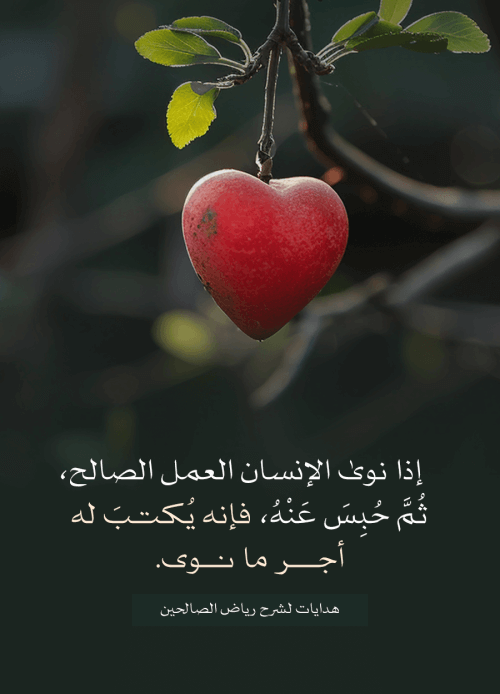
If someone intends to do a good deed but was prevented by a valid excuse, he shall gain the reward of his intention.
Riyadh Al-Salheen with explanation and benefits
Variation of reward for good deeds is based on sincerity and following of the Prophet’s guidance. The more a person is sincere to Allah, and the keener he is on following the Prophet (may Allah’s peace and blessings be upon him), the more perfect his worship will be, and consequently his reward will be bigger.
Riyadh Al-Salheen with explanation and benefits
People differ with regards to their acts of worship according to their intentions. The intentions of some people have reached the ultimate level of sincerity (to Allah) and keenness in following the Sunnah (of the Messenger of Allah) with regard to doing good and righteous deeds, while the intentions of others are below that.
Riyadh Al-Salheen with explanation and benefits
Anyone partaking a role with transgressors and wrongdoers will share their punishment because it is inclusive.
Riyadh Al-Salheen with explanation and benefits
If someone intends to do a good deed but was prevented by a valid excuse, he shall gain the reward of his intention.
Riyadh Al-Salheen with explanation and benefits
Actions are recompensed according to the intentions behind them, and the individual shall receive the reward of what he intended even if the outcome was contrary to his intention.
Riyadh Al-Salheen with explanation and benefits
There is not a single good deed intended sincerely to please Allah except that its doer will be raised in rank and status thereby, so that he would reap the full reward.
Riyadh Al-Salheen with explanation and benefits
Love and contentment is measured by good deeds and intentions because they are the criteria for Allah’s acceptance of the servant; perhaps a small deed reaps great reward because of the intention behind it and perhaps a big deed reaps little reward because of the intention behind it
Riyadh Al-Salheen with explanation and benefits
One of the proofs Allah supports the servant is the latter’s sincere endeavor to rectify his intention and purify his heart by good deeds.
هدايات لشرح رياض الصالحين