








Categories
Discover our diverse collection of categories covering multiple topics to meet your various interestsDa\'wa cards that highlight great meanings of the verses of the Holy Quran and the noble prophetic hadiths in a simple style and attractive display that helps the Muslim to have a deeper understanding of his religion in an easy way
﴿ فَلَعَلَّكَ بَٰخِعٞ نَّفۡسَكَ عَلَىٰٓ ءَاثَٰرِهِمۡ إِن لَّمۡ يُؤۡمِنُواْ بِهَٰذَا ٱلۡحَدِيثِ أَسَفًا ﴾
سورة الكهف
Perhaps you will grieve yourself to death [O Prophet] over them[5] if they do not believe in this message[6].
﴿ فَأَتۡبَعُوهُم مُّشۡرِقِينَ ﴾
سورة الشعراء
They pursued them at sunrise.
﴿ إِنَّا خَلَقۡنَا ٱلۡإِنسَٰنَ مِن نُّطۡفَةٍ أَمۡشَاجٖ نَّبۡتَلِيهِ فَجَعَلۡنَٰهُ سَمِيعَۢا بَصِيرًا ﴾
سورة الإنسان
Indeed, We created man from a drop of mixed fluids[2], in order to test him. So We gave him hearing and sight.
﴿ قَدِ ٱفۡتَرَيۡنَا عَلَى ٱللَّهِ كَذِبًا إِنۡ عُدۡنَا فِي مِلَّتِكُم بَعۡدَ إِذۡ نَجَّىٰنَا ٱللَّهُ مِنۡهَاۚ وَمَا يَكُونُ لَنَآ أَن نَّعُودَ فِيهَآ إِلَّآ أَن يَشَآءَ ٱللَّهُ رَبُّنَاۚ وَسِعَ رَبُّنَا كُلَّ شَيۡءٍ عِلۡمًاۚ عَلَى ٱللَّهِ تَوَكَّلۡنَاۚ رَبَّنَا ٱفۡتَحۡ بَيۡنَنَا وَبَيۡنَ قَوۡمِنَا بِٱلۡحَقِّ وَأَنتَ خَيۡرُ ٱلۡفَٰتِحِينَ ﴾
سورة الأعراف
We would be fabricating lies against Allah if we were to return to your faith after Allah has saved us from it. We will not return to it unless Our Lord Allah so wills. Our Lord has full knowledge of everything. In Allah we put our trust. Our Lord, judge between us and our people with truth, for You are the Best of the Judges.”
﴿ أَلَمۡ تَرَ كَيۡفَ ضَرَبَ ٱللَّهُ مَثَلٗا كَلِمَةٗ طَيِّبَةٗ كَشَجَرَةٖ طَيِّبَةٍ أَصۡلُهَا ثَابِتٞ وَفَرۡعُهَا فِي ٱلسَّمَآءِ ﴾
سورة إبراهيم
24. See you not how Allâh sets forth a parable? A goodly word as a goodly tree, whose root is firmly fixed, and its branches (reach) to the sky (i.e. very high).
﴿ وَإِذۡ بَوَّأۡنَا لِإِبۡرَٰهِيمَ مَكَانَ ٱلۡبَيۡتِ أَن لَّا تُشۡرِكۡ بِي شَيۡـٔٗا وَطَهِّرۡ بَيۡتِيَ لِلطَّآئِفِينَ وَٱلۡقَآئِمِينَ وَٱلرُّكَّعِ ٱلسُّجُودِ ﴾
سورة الحج
And [mention, O Muḥammad], when We designated for Abraham the site of the House, [saying], "Do not associate anything with Me and purify My House for those who perform ṭawāf[923] and those who stand [in prayer] and those who bow and prostrate.
﴿ وَلَوۡ دُخِلَتۡ عَلَيۡهِم مِّنۡ أَقۡطَارِهَا ثُمَّ سُئِلُواْ ٱلۡفِتۡنَةَ لَأٓتَوۡهَا وَمَا تَلَبَّثُواْ بِهَآ إِلَّا يَسِيرٗا ﴾
سورة الأحزاب
If the enemy were to enter the town upon them[12] from all sides, and they were asked to abandon faith, they would have done it and would not have shown hesitation in it except a little.
﴿ وَمَن فِي ٱلۡأَرۡضِ جَمِيعٗا ثُمَّ يُنجِيهِ ﴾
سورة المعارج
And whoever is on earth entirely [so] then it could save him.
﴿ قُلۡ إِنَّ رَبِّي يَقۡذِفُ بِٱلۡحَقِّ عَلَّٰمُ ٱلۡغُيُوبِ ﴾
سورة سبأ
Say, “My Lord hurls the Truth [against falsehood], and He is the All-Knower of the unseen.”
﴿ قُلۡ يَوۡمَ ٱلۡفَتۡحِ لَا يَنفَعُ ٱلَّذِينَ كَفَرُوٓاْ إِيمَٰنُهُمۡ وَلَا هُمۡ يُنظَرُونَ ﴾
سورة السجدة
29. Say: "On the Day of Al-Fath (Decision), no profit will it be to those who disbelieve if they (then) believe! Nor will they be granted a respite."
An-Nu‘mān ibn Bashīr (may Allah be pleased with him) reported that ‘Umar ibn al-Khattāb (may Allah be pleased with him) mentioned what the people had gained of worldly pleasures and said: "I saw how the Messenger of Allah (may Allah’s peace and blessings be upon him) would pass a whole day writhing (from hunger), not even finding bad dates to fill his stomach with."
Narrated by Muslim
‘Umar (may Allah be pleased with him) mentioned what the people achieved of worldly pleasures when Allah granted them victory in their conquests, and what they accumulated of spoils. So he said that he had seen the Messenger of Allah (may Allah's peace and blessings be upon him) twisting from hunger without finding anything with which to fill his stomach, not even bad dates.
‘Abdullāh ibn ‘Amr ibn al-‘Ās (may Allah be pleased with him) reported that the Prophet (may Allah's peace and blessings be upon him) said: "Successful is the one who enters Islam and is provided with mere subsistence and Allah makes him content with what He has given him." Abu Muhammad Fadalah ibn ‘Ubayd al-Ansāri (may Allah be pleased with him) reported that he heard the Messenger (may Allah's peace and blessings be upon him) say: "Blissful is the one who is guided to Islam and possesses mere subsistence and shows contentment."
Narrated by At-Termedhy - Narrated by Ahmad - Narrated by Muslim
Tūba, a tree in Paradise, is glad tidings for one who has been guided to Islam and his provisions are barely sufficient for him, not less to keep him distracted or more to make him transgress. It is a complete favor by Allah, the Almighty, when He endows us with sustenance that both suffices us and prevents us from transgression.
Anas (may Allah be pleased with him) reported: Al-‘Adbā', the Prophet's she-camel, was never outrun, or could hardly be outrun. It so happened that a Bedouin came riding atop a young camel of his, and it outran Al-‘Adbā'. This incident was so hard upon the Muslims, until he (the Prophet) came to know it and so he said: "It is the law of Allah that nothing rises high of the worldly life except that He brings it down."
Al-Bukhari with a similar wording
The Hadīth indicates that the Companions (may Allah be pleased with him) believed that al-‘Adbā', the she-camel of the Prophet (may Allah's peace and blessings be upon him) could not be outrun, or could hardly be outrun. When a Bedouin came riding atop of his young camel and it outran Al-‘Adbā, this was so distressing for the Companions (may Allah be pleased with them). On knowing how they felt, the Prophet (may Allah's peace and blessings be upon him) said: "It is the law of Allah that nothing rises high of the worldly life except that He brings it down." This means that any prominence in this world must eventually revert to a decline. If this prominence is accompanied by excessive self-esteem and leaves its traces on the souls, then the decline will be even faster, because, in this case, it is a punishment. If it is not accompanied by anything of the aforementioned, it still must be subject to deterioration and decline. "Of the worldly life" indicates that what is elevated of the Hereafter matters is not brought down by Allah, as He says (what means): {Allah will exalt in degree those of you who believe, and those who have been granted knowledge} [Sūrat al-Mujādilah: 11]. Those people mentioned in the verse will not be lowered by Allah, Exalted and Glorified, as long as they are characterized by having knowledge and faith. In no way shall Allah degrade them, instead, He raises their repute, and will raise their ranks in the Hereafter.
‘Abdullāh ibn Mas‘ūd (may Allah be pleased with him) reported that the Prophet (may Allah's peace and blessings be upon him) said: "Do not crave for property lest you should become consumed with desire for worldly life."
Narrated by At-Termedhy - Narrated by Ahmad
The Prophet (may Allah's peace and blessings be upon him) warned against preoccupation with this life, and against craving for wealth through trade, industry, and real estate, since this distracts one totally from the affairs of the Hereafter, which humans were originally created for.
Al-Miqdām ibn Ma‘di Karib (may Allah be pleased with him) reported: I heard the Messenger of Allah (may Allah's peace and blessings be upon him) say: "The son of Adam does not fill any vessel worse than his stomach. It is enough for the son of Adam to eat a few mouthfuls to straighten his back, but if he must (fill his stomach), then one third for his food, one third for his drink, and one third for his breath."
Narrated by Ibn Majah - Narrated by At-Termedhy - Narrated by Ahmad
The noble Prophet (may Allah's peace and blessings be upon him) guides us to one of the principles of medicine, which is the precaution that man should take to maintain his health by minimizing the amount of food he consumes. One should eat only the amount sufficient to keep him alive and provide him with strength to carry out his essential tasks. The worst vessel to fill is the stomach due to the innumerable fatal illnesses caused by satiation that appear sooner or later, whether internally or externally. Also, the Messenger of Allah (may Allah's peace and blessings be upon him) said that if one must fill his stomach, then he should let his food fill its one third only, his drink another third, and the remaining third for his breath, so that he would not suffer constriction and harm and feel too lazy to fulfill what Allah has made obligatory on him in terms of his religious and worldly affairs.
Ibn Mas‘ūd (may Allah be pleased with him) reported: A man kissed a woman (unlawfully), so he came to the Prophet (may Allah's peace and blessings be upon him) and told him of what he did. Thereupon Allah, the Almighty revealed the verse: {And establish prayer at the two ends of the day and at the approach of the night. Indeed, good deeds do away with misdeeds.} [Sūrat Hūd: 114]. The man said: "O Messenger of Allah, is this (verse) for me?" He replied: "For everybody of my Ummah, all of them."
Narrated by Bukhari & Muslim
Ibn Mas‘ūd (may Allah be pleased with him) recounts an incident about a man from the Companions of the Prophet (may Allah's peace and blessings be upon him) who was called Abu al-Yusr. This man kissed a woman unlawfully then regretted what he did, so he went to the Prophet (may Allah's peace and blessings be upon him) and told him about it. Consequently Allah, the Exalted, revealed a verse that addressed his situation: {And establish prayer at the two ends of the day}, meaning perform the daytime prayers, which are Fajr, Zhuhr, and ‘Asr; {and at the approach of the night}, meaning perform as well the two evening prayers, which are Maghrib and ‘Ishā’; {Indeed, good deeds do away with misdeeds}, meaning that these five prayers are expiation for minor sins, such as the one that he had committed. So the man asked: "Is this for me only?", meaning if this expiation through prayer is specific to his case or applies to all people in general. The Prophet (may Allah's peace and blessings be upon him) replied: "This is for everybody of my Ummah, all of them" meaning that performing these five prayers is expiation for any Muslim who did something similar to what he had done. Abu al-Yusr himself narrated this story in detail. He said: "A woman came to me to buy some dates, so I told her that I had better quality dates at home. She came into the house with me and I approached her and kissed her. I later went to Abu Bakr and related this incident to him and his reply was for me to conceal my sin and ask Allah to forgive me without telling anyone. I was impatient so I went to ‘Umar and related it to him, and he told me to conceal my sin and ask Allah to forgive me without telling anyone. (Again) I was impatient so I went to the Messenger of Allah (may Allah's peace and blessings be upon him) and I told him what I had done. He said: 'Is this how you look after the wife of a man who has set out in the cause of Allah?' "At that moment Abu al-Yusr wished that he had just embraced Islam (because acceptance of Islam eliminates all previous sins). He was utterly desperate and started to believe that he must be from the people of the Hellfire. He continues his account: "The Prophet (may Allah's peace and blessings be upon him) then bowed his head down in silence for some time until Allah revealed to him the following verse: {And establish prayer at the two ends of the day and at the approach of the night. Indeed, good deeds do away with misdeeds. That is a reminder for those who remember} [Sūrat Hūd: 114]. The Messenger of Allah recited it to me, so his Companions asked him: 'O Messenger of Allah, is it (this verse) for this man in particular or for all people in general?' He replied: 'For all people in general.'" [At-Tirmidhi; classified as Hasan by Al-Albāni] In another Hadīth, the Prophet (may Allah's peace and blessings be upon him) said: "There is not a Muslim who commits a sin, then he makes ablution and prays two Rak‘ahs, then asks Allah to forgive him for that sin, except that he will be forgiven." Then he recited these two verses: {And whoever does something wrong or wrongs himself but then seeks forgiveness of Allah will find Allah Forgiving and Merciful} [Sūrat An-Nisā’: 110], and: {And those who, when they commit an immorality or wrong themselves [by transgression], remember Allah and seek forgiveness for their sins - and who can forgive sins except Allah? - and they do not persist in what they have done while they know} [Sūrat Āl-‘Imrān: 135] [Ahmad; classified as Sahīh by Ahmad Shākir]. These revelations are certainly an indication of Allah's vast mercy upon His servants by making the five daily prayers and the voluntary prayers expiation for their sins. Otherwise everyone would be doomed (because of their many sins).
Anas (may Allah be pleased with him) reported: A man came to the Prophet (may Allah's peace and blessings be upon him) and said: "O Messenger of Allah, I committed a sin liable to a legal punishment, so inflict it upon me." As the time of the prayer came, he offered the prayer along with the Messenger of Allah (may Allah’s peace and blessings be upon him. When the prayer was over, he said: "O Messenger of Allah, I committed a sin liable to a legal punishment, so apply the Book of Allah to me." He asked: "Have you offered the prayer with us?’ He said: 'Yes.’ He said: "You have been forgiven."
Narrated by Bukhari & Muslim
A man came and said: “O Messenger of Allah, I did something that entails the imposition of a legal punishment.” Anas (may Allah be pleased with him) said: “He did not ask about it”, meaning: the sin that entailed the legal punishment, because, as believed by some, he already came to know through divine revelation about the sin committed by this man as well as that he was forgiven. “As the time of the prayer came, he offered the prayer along with the Messenger of Allah (may Allah’s peace and blessings be upon him). The prayer here refers to one of the obligatory prayers or the ‘Asr prayer in particular. After finishing the prayer, the man got up and said: “O Messenger of Allah, I committed a sin liable to a legal punishment, so apply the Book of Allah to me”, meaning: the relevant divine ruling based on the Qur’an and the Sunnah. In other words, apply to me whatever is applicable in my case, be it a legal punishment or something else. Thereupon, the Prophet, may Allah's peace and blessings be upon, asked: “Have you not offered the prayer with us?” As the man replied in the affirmative, the Prophet (may Allah's peace and blessings be upon him) said: “Indeed, Allah has forgiven your sin – or pardoned your legal punishment.” The sub-narrator was doubtful about it. The legal punishment, here, may involve a discretionary penalty or something else, but it does not refer to such prescribed punishments as applicable in the cases of adultery and drinking alcohol, for example. The Prophet (may Allah's peace and blessings be upon him) did not ask the man about the specific sin he had committed, for he had learned about some excuse for him, and so he wanted to spare him the due punishment; and if he had asked him about it, he would necessarily have imposed the punishment on him, even if he had repented. Indeed, repentance does not cancel out the prescribed punishments, except in the case of highway robbery, based on the relevant verse, and the commission of adultery by a non-Muslim living in the Muslim land, should he embrace Islam. Anyway, the Hadīth does not explicitly mention that prayer expiated a major sin. Even if this was the case, it should be subject to allegorical interpretation given the previously cited consensus on the contrary.
‘Abdullāh ibn ‘Umar (may Allah be pleased with him) reported that the Prophet (may Allah's peace and blessings be upon him) stood up after stoning Al-Aslami and said: "Avoid these filthy practices which Allah has prohibited. The one who commits any of these deeds should conceal himself with Allah's veil (he should not speak about them) and repent to Allah, for if anyone exposes his hidden sins (to us), we shall inflict the punishment prescribed by Allah, the Almighty, on him."
Al-Bayhaqi - Al-Haakim
In this Hadīth, Ibn ‘Umar (may Allah be pleased with him) reports that the Prophet (may Allah's peace and blessings be upon him) stood up after stoning Mā‘iz ibn Mālik al-Aslami (may Allah be pleased with him) and he delivered a speech to the people and warned them against committing the immorality of unlawful sexual intercourse. Moreover, he stated that whoever commits unlawful sexual intercourse should not disgrace himself by exposing what he has done. Rather, he should screen himself with Allah’s veil, and he should hasten to repent, and Allah forgives those who repent. This is better for the offender than informing the ruler about his deeds, because the Prophet (may Allah's peace and blessings be upon him) stated that whoever exposes his sins and deeds, he will inflict the punishment prescribed by Allah in His Book upon him.
Abu Sa‘īd al-Khudri (may Allah be pleased with him) reported that the Prophet (may Allah's peace and blessings be upon him) said: “Among those who lived before you, there was a man who had killed ninety-nine people. He asked about the most knowledgeable person on earth and was guided to a monk. When he went to him, he informed him that he had killed ninety-nine people and asked if his repentance could be accepted. The monk replied in the negative, so the man killed him and made him the hundredth. After that, the man once again asked about the most knowledgeable person on earth and was guided to a scholar. He informed him of his hundred murders and asked if there was a chance for his repentance to be accepted. The scholar replied in the affirmative and said: 'Who can place a barrier between him and the repentance?' He advised him to travel to a certain land where people were worshiping Allah, the Almighty, and asked him to join them in their worship and not to return to his land, which was an evil land. The man listened to the scholar’s advice and set out from his land, when he reached the middle of the way death approached him. The angels of mercy and the angels of torment disputed over the man. The angels of mercy said: 'He came with a repenting heart to Allah, the Almighty.' The angels of torment said: 'He has never done anything good in his life.' Another angel then came in the form of a human being and they agreed to take him as an arbitrator. He said: 'Measure the distance between the man and the two lands and see to which one he is closer.' They did that and found him closer to the land he was traveling to, so the angels of mercy took his soul.” Another authentic narration reads: “He was one span closer to the land of piety, so he was considered one of its people.” The wording of another authentic narration reads: “Allah, the Almighty, ordered this land (evil place) to go far away and the other land (good place) to get closer and on measuring the distances, he was found one span closer to the village to which he intended to go and so he was forgiven.” Another narration reads: “He directed his chest towards it (the village he intended to go to).”
Narrated by Bukhari & Muslim
The Prophet (may Allah's peace and blessings be upon him) said that among those nations that lived before there was a man who had killed ninety-nine people. He regretted what he had done and asked to be guided to the most knowledgeable of people to see if his repentance could be accepted. He found a worshiper, with little knowledge, who felt that the man’s sin was too serious to be forgiven, so told him: Your repentance is not going to be accepted. The man got angry and killed the monk. Then, he once again asked of the most knowledgeable of people. He found a scholar who assured him that no one could stand between him and repentance. Moreover, he advised him to travel to a certain village, where people were devoted to worshiping Allah, and to leave his own village, which apparently was a land of disbelief. The man listened to the scholar’s advice and started his journey to the of believers, when he was in the middle of the way, death approached him. Here, a dispute arose between the angels of mercy and the angels of punishment. Allah sent them another angel to settle that dispute. He suggested measuring the distance between the man and both villages and if he was found closer to the land of disbelief, then his soul should be taken by the angels of punishment. and if he was found closer to the land of faith, then the angels of mercy should take his soul. Finally, the man was found one span closer to the land of faith and thus his soul was taken by the angels of mercy.
‘Abdur-Rahmān ibn ‘Abdullāh ibn Ka‘b ibn Mālik reported that (his father) ‘Abdullāh ibn Ka‘b ibn Mālik, who was Ka‘b's guide from among his sons when Ka‘b turned blind, said: I heard Ka‘b ibn Mālik relating a Hadīth in which he mentioned his story when he remained behind after the departure of the Messenger of Allah (may Allah's peace and blessings be upon him) for the battle of Tabūk. Ka‘b said: "I did not miss any battle with the Messenger of Allah (may Allah's peace and blessings be upon him) except the battle of Tabūk. In fact, I did not take part in the battle of Badr, but none who failed to take part in it was blamed, for Allah's Messenger (may Allah's peace and blessings be upon him) had gone out to meet the caravans of the Quraysh. But Allah caused them (the Muslims) to meet their enemy unexpectedly (without prior planning). I witnessed the night of the ‘Aqabah pledge of allegiance with the Prophet (may Allah's peace and blessings be upon him) when we jointly agreed to support Islam with all our efforts. It would not please me to have attended the battle of Badr instead of the ‘Aqabah pledge, although Badr is more notable than it among the people. As for my state at the time when I remained behind after the Messenger of Allah (may Allah's peace and blessings be upon him) had departed for the battle of Tabūk, I had never been stronger nor wealthier than I was at the time when I remained behind in that battle. By Allah, I had never been in possession of two she-camels until the time of the battle. The Messenger of Allah (may Allah's peace and blessings be upon him) used to conceal his intention to embark upon a battle by making reference to other battles, until that battle (Tabūk). The Messenger of Allah (may Allah's peace and blessings be upon him) conducted that battle during a season of extreme heat, undertaking a lengthy journey through desert terrain. In addition, the enemy was great in number. Thus, the Prophet (may Allah's peace and blessings be upon him) clarified the matter to the Muslims, in order that they would prepare themselves properly for the battle, and he informed them of the intended destination. The Messenger of Allah (may Allah's peace and blessings be upon him) was accompanied by a considerable number of Muslims, whose names could not be recorded in a register." Ka‘b continued: "Any individual who wished to remain behind would assume that his absence would pass unnoticed, unless it was revealed by Allah by means of divine revelation. The Messenger of Allah (may Allah's peace and blessings be upon him) undertook that battle during a season wherein the fruit had ripened and the shade had become pleasant. The Messenger of Allah (may Allah's peace and blessings be upon him) and the Muslims equipped themselves with the necessary provisions. I too went out in the morning in order to prepare myself; however, I returned without accomplishing anything and said to myself I am capable of it. In this manner, I continued to postpone my preparations until the departure of the Messenger of Allah (may Allah's peace and blessings be upon him) and the Muslims with him while I had not prepared what I needed to join them. I said to myself I would prepare myself a day or two after his departure then catch up with them. Again, I did not accomplish anything until they were far and the battle was over. I intended to depart and catch up with them, and I wish I did, but I was not destined for it. I would go out amongst the people after the departure of the Messenger of Allah (may Allah’s peace and blessings be upon him) and it would make me sad to see no men around except one who was suspected of being a hypocrite, or a weak man whom Allah had excused from participation in battle. The Messenger of Allah (may Allah's peace and blessings be upon him) did not remember me until he reached Tabūk. He was sitting amongst his people in Tabūk and asked: 'What happened to Ka‘b ibn Mālik?' A man from the tribe of Banu Salimah responded: 'O Messenger of Allah, he was prevented by his preoccupation with his fine clothes and his self-admiration.' Mu‘ādh ibn Jabal said: 'What an evil statement you have made! By Allah, O Messenger of Allah, we do not know about him save what is good.' The Messenger of Allah (may Allah's peace and blessings be upon him) remained silent.” Ka‘b ibn Mālik continued: “When I learned that the Messenger of Allah (may Allah's peace and blessings be upon him) had started his journey back from Tabūk, I was consumed by distress, and thought, therefore, of inventing lies. I asked myself: With what can I avoid his anger tomorrow? I sought assistance from every individual of sound mind and judgment from my family. When it was mentioned that the arrival of the Messenger of Allah (may Allah's peace and blessings be upon him) was imminent, the false excuses vanished from my mind. I knew that I could not pass safely from this situation by whatever lie I can come up with. I, therefore, resolved upon speaking the truth. The Messenger of Allah (may Allah's peace and blessings be upon him) arrived the following morning. It was his practice when he returned from a journey that he would proceed towards the mosque and perform a two-Rak‘ah prayer therein and then sit amongst the people. After those matters had taken place, those who lagged behind approached him. They started to present their excuses and take oaths to that effect. There were some and eighty men in number. The Messenger of Allah (may Allah's peace and blessings be upon him) accepted their apparent attitude and their pledge of allegiance, sought forgiveness for them, and he entrusted to Allah their secret affairs. Thereafter, I approached him, and when I greeted him, he smiled like one who is angry. Then he said: 'Come forward.' I approached him walking until I was sitting before him. Then he said: 'What prevented you from accompanying us? Had you not purchased a riding animal?' I responded: 'Yes, I did. By Allah, if I was in the presence of any other man from amongst the inhabitants of this world, I am sure that I would avoid His wrath by presenting an excuse, for I have been granted the ability to speak in an eloquently persuasive manner. However, I am aware that if I utter a lie today in order to seek your pleasure, certainly Allah will cause you to become angry with me in the future. Alternatively, if I tell you the truth, thereby causing you to become angry, I may hope for a good consequence from Allah, Exalted and Glorified. No, By Allah, I have no excuse to present. By Allah, I had never before been stronger nor wealthier than the time I failed to accompany you.' The Messenger of Allah (may Allah's peace and blessings be upon him) said: 'As for this man, he has spoken the truth. So, stand up (and leave) until Allah gives a judgment concerning you.' I stood up, and a group of men from the tribe of Banu Salimah came along and followed me. They addressed me: 'By Allah! We have not known you to commit a misdeed before that. Verily you did wrong when you failed to find an excuse for yourself before the Messenger of Allah (may Allah's peace and blessings be upon him) like the other absentees who excused themselves. It would have sufficed you against your sin that the Messenger of Allah would seek forgiveness for you.' They continued to reprimand me until I desired to return to the Messenger of Allah (may Allah's peace and blessings be upon him) and speak contrary to what I had said to him before. Then I asked them: 'Is there any other individual in a similar position?' They responded: 'Yes, there are two men who uttered the same statement as you, and both received the same directive as you did. 'I asked: 'Who are these two men?' They answered: 'Murārah ibn Ar-Rabī‘ and Hilāl ibn Umayyah al-Wāqifi.' They mentioned two virtuous men who had participated in the battle of Badr and were good examples to be followed. After they had mentioned these two men, I remained steadfast upon my original statement. Thereafter, the Messenger of Allah (may Allah's peace and blessings be upon him) prohibited the Muslims from speaking to us - namely the three individuals from amongst the Muslims who failed to join him for the battle. As a consequence, the people avoided us and changed the way they treated us, until the land wherein I lived seemed strange; not one which I was familiar with. We remained in that state for the length of fifty nights. As for my two companions, they committed themselves to their houses and stayed therein, weeping. However, I was the youngest and most enduring of the three, I would therefore leave my house to perform prayer with the Muslims. I would wander around the markets, yet no one would speak to me. I would approach the Messenger of Allah (may Allah's peace and blessings be upon him) and offer the greeting of peace to him whilst he was sitting amidst his gathering after having performed the prayer. I would ask myself: Did his lips move with returning the greeting or not? Thereafter, I would perform the prayer close by him and look at him stealthily. When I was engaged with the prayer, he would turn towards me. However, when I looked in his direction, he would turn his face away from me. When this period of estrangement became too long, I set out to walk until I climbed over the wall of Abu Qatādah's garden. He was my cousin and the most beloved person to me. I offered the greeting of peace to him, and, by Allah, he did not return the greeting to me. Hence, I said: 'O Abu Qatādah, I adjure you by Allah, do you not know that I love Allah and His Messenger?' He remained silent. I appealed to him by Allah a second time, but he remained silent. Then in the third time he replied: 'Allah and His Messenger know best.' Thereupon, tears flowed from my eyes. I turned away and climbed over the wall." He continued: "While I was walking in the market of Madīnah, I saw a Christian farmer from amongst the farmers of Sham (Greater Syria), who had traveled to Madīnah to sell their produce. He said: 'Who shall direct me to Ka‘b ibn Mālik?' The people pointed towards me, so he approached me and handed me a letter from the King of Ghassān. As I was a scribe, I could read the letter in which it was written: 'It has come to our knowledge that your companion has forsaken you. Verily, God has not rendered this world for you as a dwelling of disgrace and degradation, nor one of loss and destitution. So join us and we shall bestow upon you comfort and consolation.' Upon reading the letter I said to myself: This too is a trial. I went toward the oven and burnt it therein. When a period of forty out of fifty nights had passed, the messenger of the Messenger of Allah (may Allah's peace and blessings be upon him) approached me and said: 'The Messenger of Allah (may Allah's peace and blessings be upon him) commands you to stay away from your wife.' I said: 'Should I divorce her, or what should I do?' He responded: 'No, just stay away from her and do not approach her.' He issued a similar directive concerning my two companions. Hence, I said to my wife: 'Go to your parents and remain with them until Allah passes judgment on this matter.' The wife of Hilāl ibn Umayyah came to the Messenger of Allah (may Allah's peace and blessings be upon him) and said: 'O Messenger of Allah, verily Hilāl ibn Umayyah is an old man who is incapable of taking care of himself, and he does not have a servant. Would you object if I serve him?' He replied: 'No, but he must not approach you.' She said: 'By Allah, he has no desire for any matter. By Allah, he has not ceased to weep from the day this matter started until this time now.' Some of my family members asked me: 'Why don’t you seek permission from the Messenger of Allah (may Allah's peace and blessings be upon him) concerning your wife, as he has granted permission for the wife of Hilāl ibn Umayyah to serve him?' I said: 'By Allah, I shall not seek permission from the Messenger of Allah (may Allah's peace and blessings be upon him) concerning her. I do not know what the Messenger of Allah (may Allah's peace and blessings be upon him) would say if I sought his permission in relation to her while I am still a young man.' I remained in that state for an additional ten nights, until fifty nights had passed from the time the Prophet (may Allah's peace and blessings be upon him) had prohibited the people from speaking to us. On the morning of the fiftieth night, I performed the Fajr prayer on the roof of one of our houses. While I was in the state that Allah described in His Book: feeling that my soul had become contracted, and the earth had contracted for me despite its vastness, all of a sudden, I heard a loud voice coming from the direction of Mount Sal‘. Somebody shouted at the top of his voice: 'O Ka‘b ibn Mālik, Rejoice!' I prostrated myself upon the ground, realizing that relief from this trial had finally arrived. The Messenger of Allah (may Allah's peace and blessings be upon him) told the people that Allah accepted our repentance. After the Fajr prayer, the people proceeded forth to congratulate us, and carriers of the good news rushed toward my two companions. A horseman raced towards me in order to congratulate me and a messenger from the tribe of Aslam raced towards the mountain and got over it in order to make the announcement. I heard his voice before that of the horseman. When the man whose voice I had heard approached me to convey the glad tidings, I took off my two garments and clothed him in them. By Allah, on that day I was not in possession of any other garments, so I borrowed two garments and put them on then I headed to the Messenger of Allah (may Allah's peace and blessings be upon him). People started receiving me in groups, congratulating me for the acceptance of my repentance. They said: 'We congratulate you for Allah's acceptance of your repentance.' When I entered the mosque, the Messenger of Allah (may Allah's peace and blessings be upon him) was sitting surrounded by people. Talhah ibn ‘Ubaydullāh hastened towards me. He shook my hand and congratulated me. By Allah, no one from amongst the Muhājirūn stood in order to greet me save him. I never forgot that gesture from Talhah. When I greeted the Messenger of Allah (may Allah's peace and blessings be upon him), his face was shining with happiness and he said: 'Rejoice for the best day you have witnessed since your mother gave birth to you.' I asked: 'Is this from you or from Allah?' He said: 'It is from Allah.' Whenever the Messenger of Allah (may Allah's peace and blessings be upon him) was delighted, his face became bright as if it was a piece of the moon. We recognized that as characteristic of him. When I sat before him, I said: 'O Messenger of Allah, part of my repentance is that I should give up my entire wealth as charity for the sake of Allah and His Messenger.' The Messenger of Allah (may Allah's peace and blessings be upon him) said: 'Keep a portion of your wealth, for it is better for you to do so.' I said: 'I shall keep my share in Khaybar. O Messenger of Allah, verily Allah has delivered me from this trial because I spoke the truth. My repentance therefore dictates that I shall speak only the truth as long as I live.' By Allah, I am not aware of any Muslim whom Allah has blessed for speaking the truth more than myself, from the time I mentioned those words of truth to the Messenger of Allah (may Allah's peace and blessings be upon him). By Allah, I have never intended to utter a word of falsehood from the time when I mentioned those words to the Messenger of Allah, may Allah's peace and blessings be upon him, to the present day. I hope that Allah will protect me from uttering falsehood in the remaining part of my life. Allah revealed the following verse to His Messenger (may Allah's peace and blessings be upon him): {Allah has forgiven the Prophet, the Muhājirūn, and the Ansar who followed him in the hour of difficulty after the hearts of a party of them had almost inclined [to doubt], and then He forgave them. Indeed, He was to them Kind and Merciful. And [He also forgave] the three who were left behind [and regretted their error] to the point that the earth closed in on them in spite of its vastness and their souls confined them and they were certain that there is no refuge from Allah except in Him. Then He turned to them so they could repent. Indeed, Allah is the Accepting of repentance, the Merciful. O you who have believed, fear Allah and be with those who are true} [Sūrat At-Tawbah :117-119]. By Allah, after guiding me to Islam, Allah has not bestowed upon me a favor greater in my sight than my statement of truth to the Messenger of Allah (may Allah's peace and blessings be upon him) and my action of not uttering a lie to him, for I would have been ruined, as those who uttered lies were ruined. Allah ascribed to those who had uttered falsehood the most evil description he Had ever ascribed to anyone else when He revealed His statement: {They will swear by Allah to you when you return to them that you would leave them alone. So leave them alone; indeed they are evil; and their refuge is Hell as recompense for what they had been earning. They swear to you so that you might be satisfied with them. But if you should be satisfied with them - indeed, Allah is not satisfied with a defiantly disobedient people} [Sūrat At-Tawbah: 95-96]. Ka‘b continued: "We, the three who lagged behind, differed from those whose excuses were accepted by the Messenger of Allah (may Allah's peace and blessings be upon him) when they swore to him to that effect. He accepted their pledge of allegiance and sought forgiveness for them and he deferred our case until Allah passed judgment in relation to it. In reference to that, Allah Almighty said: {He also forgave the three who remained behind} [Sūrat At-Tawbah:118]. In this Verse, Allah did not refer to our remaining behind the military expedition. Rather, He refers to the deferment of passing judgment on us, in contrast to those who took an oath before the Messenger of Allah (may Allah’s peace and blessings be upon him) and excused themselves and he accepted their excuses."
Narrated by Bukhari & Muslim
This Hadīth relates the story of Ka‘b ibn Mālik missing the battle of Tabūk, 9 AH. This battle was to take place during hot days when fruits became ripe. As they preferred worldly life over the Hereafter, the hypocrites failed to join this battle and inclined to the life of shade and fruits, being unwilling to take that long journey. Sincere believers, on the other hand, went out with the Prophet (may Allah's peace and blessings be upon him) and their resolve was not weakened by the long distance or the good fruits at home. However, Ka‘b ibn Mālik missed this battle without an excuse, despite being a sincere believer. That is why he said that he never missed any battle with the Prophet, except for the battle of Badr as the Prophet had left Madīnah not intending to go for battle. So, Ka‘b and others did not participate in it. Only three hundred and a few men took part, with the initial intent to seize a trade caravan heading from the Levant to Makkah and passing through Madīnah. Ka‘b said: "I did not miss any battle with the Messenger of Allah (may Allah's peace and blessings be upon him) except the battle of Tabūk. In fact, I did not take part in the battle of Badr, but none who failed to take part in it was blamed, for Allah's Messenger (may Allah's peace and blessings be upon him) had gone out to meet the caravans of the Quraysh. But Allah caused them (the Muslims) to meet their enemy unexpectedly (without prior planning). I witnessed the night of the ‘Aqabah pledge of allegiance with the Prophet (may Allah's peace and blessings be upon him) when we jointly agreed to support Islam with all our efforts. It would not please me to have attended the battle of Badr instead of the ‘Aqabah pledge, although Badr is more notable than it among the people. As for my state at the time when I remained behind after the Messenger of Allah (may Allah's peace and blessings be upon him) had departed for the battle of Tabūk, I had never been stronger nor wealthier than I was at the time when I remained behind in that battle. By Allah, I had never been in possession of two she-camels until the time of the battle. The Messenger of Allah (may Allah's peace and blessings be upon him) used to conceal his intention to embark upon a battle by making reference to other battles, until that battle (Tabūk). The Messenger of Allah (may Allah's peace and blessings be upon him) conducted that battle during a season of extreme heat, undertaking a lengthy journey through desert terrain. In addition, the enemy was great in number. Thus, the Prophet (may Allah's peace and blessings be upon him) clarified the matter to the Muslims, in order that they would prepare themselves properly for the battle, and he informed them of the intended destination. The Messenger of Allah (may Allah's peace and blessings be upon him) was accompanied by a considerable number of Muslims, whose names could not be recorded in a register." Ka‘b continued: "Any individual who wished to remain behind would assume that his absence would pass unnoticed, unless it was revealed by Allah by means of divine revelation. The Messenger of Allah (may Allah's peace and blessings be upon him) undertook that battle during a season wherein the fruit had ripened and the shade had become pleasant. The Messenger of Allah (may Allah's peace and blessings be upon him) and the Muslims equipped themselves with the necessary provisions. I too went out in the morning in order to prepare myself; however, I returned without accomplishing anything and said to myself I am capable of it. In this manner, I continued to postpone my preparations until the departure of the Messenger of Allah (may Allah's peace and blessings be upon him) and the Muslims with him while I had not prepared what I needed to join them. I said to myself I would prepare myself a day or two after his departure then catch up with them. Again, I did not accomplish anything until they were far and the battle was over. I intended to depart and catch up with them, and I wish I did, but I was not destined for it. I would go out amongst the people after the departure of the Messenger of Allah (may Allah’s peace and blessings be upon him) and it would make me sad to see no men around except one who was suspected of being a hypocrite, or a weak man whom Allah had excused from participation in battle. The Messenger of Allah (may Allah's peace and blessings be upon him) did not remember me until he reached Tabūk. He was sitting amongst his people in Tabūk and asked: 'What happened to Ka‘b ibn Mālik?' A man from the tribe of Banu Salimah responded: 'O Messenger of Allah, he was prevented by his preoccupation with his fine clothes and his self-admiration.' Mu‘ādh ibn Jabal said: 'What an evil statement you have made! By Allah, O Messenger of Allah, we do not know about him save what is good.' The Messenger of Allah (may Allah's peace and blessings be upon him) remained silent.” Ka‘b ibn Mālik continued: “When I learned that the Messenger of Allah (may Allah's peace and blessings be upon him) had started his journey back from Tabūk, I was consumed by distress, and thought, therefore, of inventing lies. I asked myself: With what can I avoid his anger tomorrow? I sought assistance from every individual of sound mind and judgment from my family. When it was mentioned that the arrival of the Messenger of Allah (may Allah's peace and blessings be upon him) was imminent, the false excuses vanished from my mind. I knew that I could not pass safely from this situation by whatever lie I can come up with. I, therefore, resolved upon speaking the truth. The Messenger of Allah (may Allah's peace and blessings be upon him) arrived the following morning. It was his practice when he returned from a journey that he would proceed towards the mosque and perform a two-Rak‘ah prayer therein and then sit amongst the people. After those matters had taken place, those who lagged behind approached him. They started to present their excuses and take oaths to that effect. There were some and eighty men in number. The Messenger of Allah (may Allah's peace and blessings be upon him) accepted their apparent attitude and their pledge of allegiance, sought forgiveness for them, and he entrusted to Allah their secret affairs. Thereafter, I approached him, and when I greeted him, he smiled like one who is angry. Then he said: 'Come forward.' I approached him walking until I was sitting before him. Then he said: 'What prevented you from accompanying us? Had you not purchased a riding animal?' I responded: 'Yes, I did. By Allah, if I was in the presence of any other man from amongst the inhabitants of this world, I am sure that I would avoid His wrath by presenting an excuse, for I have been granted the ability to speak in an eloquently persuasive manner. However, I am aware that if I utter a lie today in order to seek your pleasure, certainly Allah will cause you to become angry with me in the future. Alternatively, if I tell you the truth, thereby causing you to become angry, I may hope for a good consequence from Allah, Exalted and Glorified. No, By Allah, I have no excuse to present. By Allah, I had never before been stronger nor wealthier than the time I failed to accompany you.' The Messenger of Allah (may Allah's peace and blessings be upon him) said: 'As for this man, he has spoken the truth. So, stand up (and leave) until Allah gives a judgment concerning you.' I stood up, and a group of men from the tribe of Banu Salimah came along and followed me. They addressed me: 'By Allah! We have not known you to commit a misdeed before that. Verily you did wrong when you failed to find an excuse for yourself before the Messenger of Allah (may Allah's peace and blessings be upon him) like the other absentees who excused themselves. It would have sufficed you against your sin that the Messenger of Allah would seek forgiveness for you.' They continued to reprimand me until I desired to return to the Messenger of Allah (may Allah's peace and blessings be upon him) and speak contrary to what I had said to him before. Then I asked them: 'Is there any other individual in a similar position?' They responded: 'Yes, there are two men who uttered the same statement as you, and both received the same directive as you did. 'I asked: 'Who are these two men?' They answered: 'Murārah ibn Ar-Rabī‘ and Hilāl ibn Umayyah al-Wāqifi.' They mentioned two virtuous men who had participated in the battle of Badr and were good examples to be followed. After they had mentioned these two men, I remained steadfast upon my original statement. Thereafter, the Messenger of Allah (may Allah's peace and blessings be upon him) prohibited the Muslims from speaking to us - namely the three individuals from amongst the Muslims who failed to join him for the battle. As a consequence, the people avoided us and changed the way they treated us, until the land wherein I lived seemed strange; not one which I was familiar with. We remained in that state for the length of fifty nights. As for my two companions, they committed themselves to their houses and stayed therein, weeping. However, I was the youngest and most enduring of the three, I would therefore leave my house to perform prayer with the Muslims. I would wander around the markets, yet no one would speak to me. I would approach the Messenger of Allah (may Allah's peace and blessings be upon him) and offer the greeting of peace to him whilst he was sitting amidst his gathering after having performed the prayer. I would ask myself: Did his lips move with returning the greeting or not? Thereafter, I would perform the prayer close by him and look at him stealthily. When I was engaged with the prayer, he would turn towards me. However, when I looked in his direction, he would turn his face away from me. When this period of estrangement became too long, I set out to walk until I climbed over the wall of Abu Qatādah's garden. He was my cousin and the most beloved person to me. I offered the greeting of peace to him, and, by Allah, he did not return the greeting to me. Hence, I said: 'O Abu Qatādah, I adjure you by Allah, do you not know that I love Allah and His Messenger?' He remained silent. I appealed to him by Allah a second time, but he remained silent. Then in the third time he replied: 'Allah and His Messenger know best.' Thereupon, tears flowed from my eyes. I turned away and climbed over the wall." He continued: "While I was walking in the market of Madīnah, I saw a Christian farmer from amongst the farmers of Sham (Greater Syria), who had traveled to Madīnah to sell their produce. He said: 'Who shall direct me to Ka‘b ibn Mālik?' The people pointed towards me, so he approached me and handed me a letter from the King of Ghassān. As I was a scribe, I could read the letter in which it was written: 'It has come to our knowledge that your companion has forsaken you. Verily, God has not rendered this world for you as a dwelling of disgrace and degradation, nor one of loss and destitution. So join us and we shall bestow upon you comfort and consolation.' Upon reading the letter I said to myself: This too is a trial. I went toward the oven and burnt it therein. When a period of forty out of fifty nights had passed, the messenger of the Messenger of Allah (may Allah's peace and blessings be upon him) approached me and said: 'The Messenger of Allah (may Allah's peace and blessings be upon him) commands you to stay away from your wife.' I said: 'Should I divorce her, or what should I do?' He responded: 'No, just stay away from her and do not approach her.' He issued a similar directive concerning my two companions. Hence, I said to my wife: 'Go to your parents and remain with them until Allah passes judgment on this matter.' The wife of Hilāl ibn Umayyah came to the Messenger of Allah (may Allah's peace and blessings be upon him) and said: 'O Messenger of Allah, verily Hilāl ibn Umayyah is an old man who is incapable of taking care of himself, and he does not have a servant. Would you object if I serve him?' He replied: 'No, but he must not approach you.' She said: 'By Allah, he has no desire for any matter. By Allah, he has not ceased to weep from the day this matter started until this time now.' Some of my family members asked me: 'Why don’t you seek permission from the Messenger of Allah (may Allah's peace and blessings be upon him) concerning your wife, as he has granted permission for the wife of Hilāl ibn Umayyah to serve him?' I said: 'By Allah, I shall not seek permission from the Messenger of Allah (may Allah's peace and blessings be upon him) concerning her. I do not know what the Messenger of Allah (may Allah's peace and blessings be upon him) would say if I sought his permission in relation to her while I am still a young man.' I remained in that state for an additional ten nights, until fifty nights had passed from the time the Prophet (may Allah's peace and blessings be upon him) had prohibited the people from speaking to us. On the morning of the fiftieth night, I performed the Fajr prayer on the roof of one of our houses. While I was in the state that Allah described in His Book: feeling that my soul had become contracted, and the earth had contracted for me despite its vastness, all of a sudden, I heard a loud voice coming from the direction of Mount Sal‘. Somebody shouted at the top of his voice: 'O Ka‘b ibn Mālik, Rejoice!' I prostrated myself upon the ground, realizing that relief from this trial had finally arrived. The Messenger of Allah (may Allah's peace and blessings be upon him) told the people that Allah accepted our repentance. After the Fajr prayer, the people proceeded forth to congratulate us, and carriers of the good news rushed toward my two companions. A horseman raced towards me in order to congratulate me and a messenger from the tribe of Aslam raced towards the mountain and got over it in order to make the announcement. I heard his voice before that of the horseman. When the man whose voice I had heard approached me to convey the glad tidings, I took off my two garments and clothed him in them. By Allah, on that day I was not in possession of any other garments, so I borrowed two garments and put them on then I headed to the Messenger of Allah (may Allah's peace and blessings be upon him). People started receiving me in groups, congratulating me for the acceptance of my repentance. They said: 'We congratulate you for Allah's acceptance of your repentance.' When I entered the mosque, the Messenger of Allah (may Allah's peace and blessings be upon him) was sitting surrounded by people. Talhah ibn ‘Ubaydullāh hastened towards me. He shook my hand and congratulated me. By Allah, no one from amongst the Muhājirūn stood in order to greet me save him. I never forgot that gesture from Talhah. When I greeted the Messenger of Allah (may Allah's peace and blessings be upon him), his face was shining with happiness and he said: 'Rejoice for the best day you have witnessed since your mother gave birth to you.' I asked: 'Is this from you or from Allah?' He said: 'It is from Allah.' Whenever the Messenger of Allah (may Allah's peace and blessings be upon him) was delighted, his face became bright as if it was a piece of the moon. We recognized that as characteristic of him. When I sat before him, I said: 'O Messenger of Allah, part of my repentance is that I should give up my entire wealth as charity for the sake of Allah and His Messenger.' The Messenger of Allah (may Allah's peace and blessings be upon him) said: 'Keep a portion of your wealth, for it is better for you to do so.' I said: 'I shall keep my share in Khaybar. O Messenger of Allah, verily Allah has delivered me from this trial because I spoke the truth. My repentance therefore dictates that I shall speak only the truth as long as I live.' By Allah, I am not aware of any Muslim whom Allah has blessed for speaking the truth more than myself, from the time I mentioned those words of truth to the Messenger of Allah (may Allah's peace and blessings be upon him). By Allah, I have never intended to utter a word of falsehood from the time when I mentioned those words to the Messenger of Allah, may Allah's peace and blessings be upon him, to the present day. I hope that Allah will protect me from uttering falsehood in the remaining part of my life. Allah revealed the following verse to His Messenger (may Allah's peace and blessings be upon him): {Allah has forgiven the Prophet, the Muhājirūn, and the Ansar who followed him in the hour of difficulty after the hearts of a party of them had almost inclined [to doubt], and then He forgave them. Indeed, He was to them Kind and Merciful. And [He also forgave] the three who were left behind [and regretted their error] to the point that the earth closed in on them in spite of its vastness and their souls confined them and they were certain that there is no refuge from Allah except in Him. Then He turned to them so they could repent. Indeed, Allah is the Accepting of repentance, the Merciful. O you who have believed, fear Allah and be with those who are true} [Sūrat At-Tawbah :117-119]. By Allah, after guiding me to Islam, Allah has not bestowed upon me a favor greater in my sight than my statement of truth to the Messenger of Allah (may Allah's peace and blessings be upon him) and my action of not uttering a lie to him, for I would have been ruined, as those who uttered lies were ruined. Allah ascribed to those who had uttered falsehood the most evil description he Had ever ascribed to anyone else when He revealed His statement: {They will swear by Allah to you when you return to them that you would leave them alone. So leave them alone; indeed they are evil; and their refuge is Hell as recompense for what they had been earning. They swear to you so that you might be satisfied with them. But if you should be satisfied with them - indeed, Allah is not satisfied with a defiantly disobedient people} [Sūrat At-Tawbah: 95-96]. Ka‘b continued: "We, the three who lagged behind, differed from those whose excuses were accepted by the Messenger of Allah (may Allah's peace and blessings be upon him) when they swore to him to that effect. He accepted their pledge of allegiance and sought forgiveness for them and he deferred our case until Allah passed judgment in relation to it. In reference to that, Allah Almighty said: {He also forgave the three who remained behind} [Sūrat At-Tawbah:118]. In this Verse, Allah did not refer to our remaining behind the military expedition. Rather, He refers to the deferment of passing judgment on us, in contrast to those who took an oath before the Messenger of Allah (may Allah’s peace and blessings be upon him) and excused themselves and he accepted their excuses."
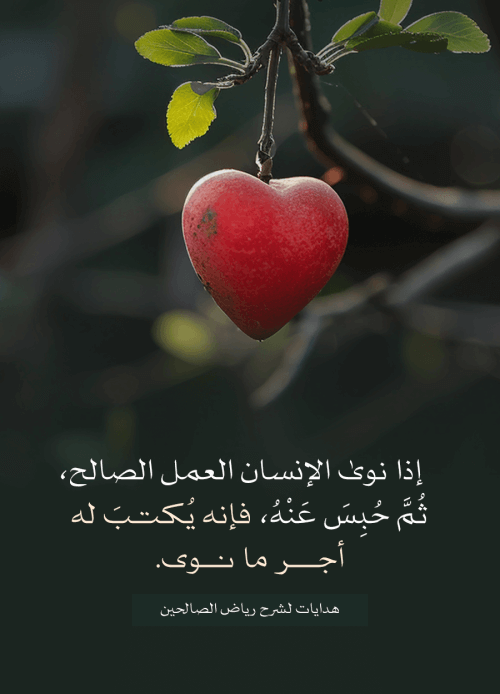
If someone intends to do a good deed but was prevented by a valid excuse, he shall gain the reward of his intention.
Riyadh Al-Salheen with explanation and benefits
Variation of reward for good deeds is based on sincerity and following of the Prophet’s guidance. The more a person is sincere to Allah, and the keener he is on following the Prophet (may Allah’s peace and blessings be upon him), the more perfect his worship will be, and consequently his reward will be bigger.
Riyadh Al-Salheen with explanation and benefits
People differ with regards to their acts of worship according to their intentions. The intentions of some people have reached the ultimate level of sincerity (to Allah) and keenness in following the Sunnah (of the Messenger of Allah) with regard to doing good and righteous deeds, while the intentions of others are below that.
Riyadh Al-Salheen with explanation and benefits
Anyone partaking a role with transgressors and wrongdoers will share their punishment because it is inclusive.
Riyadh Al-Salheen with explanation and benefits
If someone intends to do a good deed but was prevented by a valid excuse, he shall gain the reward of his intention.
Riyadh Al-Salheen with explanation and benefits
Actions are recompensed according to the intentions behind them, and the individual shall receive the reward of what he intended even if the outcome was contrary to his intention.
Riyadh Al-Salheen with explanation and benefits
There is not a single good deed intended sincerely to please Allah except that its doer will be raised in rank and status thereby, so that he would reap the full reward.
Riyadh Al-Salheen with explanation and benefits
Love and contentment is measured by good deeds and intentions because they are the criteria for Allah’s acceptance of the servant; perhaps a small deed reaps great reward because of the intention behind it and perhaps a big deed reaps little reward because of the intention behind it
Riyadh Al-Salheen with explanation and benefits
One of the proofs Allah supports the servant is the latter’s sincere endeavor to rectify his intention and purify his heart by good deeds.
هدايات لشرح رياض الصالحين