






Categories
Discover our diverse collection of categories covering multiple topics to meet your various interestsDa\'wa cards that highlight great meanings of the verses of the Holy Quran and the noble prophetic hadiths in a simple style and attractive display that helps the Muslim to have a deeper understanding of his religion in an easy way
﴿ فَلَا وَرَبِّكَ لَا يُؤۡمِنُونَ حَتَّىٰ يُحَكِّمُوكَ فِيمَا شَجَرَ بَيۡنَهُمۡ ثُمَّ لَا يَجِدُواْ فِيٓ أَنفُسِهِمۡ حَرَجٗا مِّمَّا قَضَيۡتَ وَيُسَلِّمُواْ تَسۡلِيمٗا ﴾
سورة النساء
But no, by your Lord, they will not believe until they accept you [O Prophet] as judge in their disputes, and find no discomfort within their hearts about your judgments, but accept them wholeheartedly.

﴿ فَأَوۡحَيۡنَآ إِلَيۡهِ أَنِ ٱصۡنَعِ ٱلۡفُلۡكَ بِأَعۡيُنِنَا وَوَحۡيِنَا فَإِذَا جَآءَ أَمۡرُنَا وَفَارَ ٱلتَّنُّورُ فَٱسۡلُكۡ فِيهَا مِن كُلّٖ زَوۡجَيۡنِ ٱثۡنَيۡنِ وَأَهۡلَكَ إِلَّا مَن سَبَقَ عَلَيۡهِ ٱلۡقَوۡلُ مِنۡهُمۡۖ وَلَا تُخَٰطِبۡنِي فِي ٱلَّذِينَ ظَلَمُوٓاْ إِنَّهُم مُّغۡرَقُونَ ﴾
سورة المؤمنون
27. So We revealed to him (saying): "Construct the ship under Our Eyes and under Our Revelation (guidance). Then, when Our Command comes, and water gushes forth from the oven, take on board of each kind two (male and female), and your family, except those thereof against whom the Word has already gone forth. And address Me not in favour of those who have done wrong. Verily, they are to be drowned.
﴿ وَإِنَّ عَلَيۡكَ لَعۡنَتِيٓ إِلَىٰ يَوۡمِ ٱلدِّينِ ﴾
سورة ص
And indeed, upon you is My curse until the Day of Recompense."
﴿ فَأَمَّآ إِن كَانَ مِنَ ٱلۡمُقَرَّبِينَ ﴾
سورة الواقعة
And if he [i.e., the deceased] was of those brought near [to Allāh],
﴿ فَخَلَفَ مِنۢ بَعۡدِهِمۡ خَلۡفٞ وَرِثُواْ ٱلۡكِتَٰبَ يَأۡخُذُونَ عَرَضَ هَٰذَا ٱلۡأَدۡنَىٰ وَيَقُولُونَ سَيُغۡفَرُ لَنَا وَإِن يَأۡتِهِمۡ عَرَضٞ مِّثۡلُهُۥ يَأۡخُذُوهُۚ أَلَمۡ يُؤۡخَذۡ عَلَيۡهِم مِّيثَٰقُ ٱلۡكِتَٰبِ أَن لَّا يَقُولُواْ عَلَى ٱللَّهِ إِلَّا ٱلۡحَقَّ وَدَرَسُواْ مَا فِيهِۗ وَٱلدَّارُ ٱلۡأٓخِرَةُ خَيۡرٞ لِّلَّذِينَ يَتَّقُونَۚ أَفَلَا تَعۡقِلُونَ ﴾
سورة الأعراف
And there followed them successors who inherited the Scripture [while] taking the commodities[414] of this lower life and saying, "It will be forgiven for us." And if an offer like it[415] comes to them, they will [again] take it. Was not the covenant of the Scripture [i.e., the Torah] taken from them that they would not say about Allāh except the truth, and they studied what was in it? And the home of the Hereafter is better for those who fear Allāh, so will you not use reason?
﴿ قُلۡ إِنَّ ٱلَّذِينَ يَفۡتَرُونَ عَلَى ٱللَّهِ ٱلۡكَذِبَ لَا يُفۡلِحُونَ ﴾
سورة يونس
69. Say: "Verily, those who invent a lie against Allâh will never be successful" -
﴿ لِمَن شَآءَ مِنكُمۡ أَن يَتَقَدَّمَ أَوۡ يَتَأَخَّرَ ﴾
سورة المدثر
to whoever among you chooses to advance or regress.
﴿ لَقَدۡ حَقَّ ٱلۡقَوۡلُ عَلَىٰٓ أَكۡثَرِهِمۡ فَهُمۡ لَا يُؤۡمِنُونَ ﴾
سورة يس
7. Indeed the Word (of punishment) has proved true against most of them, so they will not believe.
﴿ قَالَ ٱلَّذِينَ ٱسۡتَكۡبَرُوٓاْ إِنَّا كُلّٞ فِيهَآ إِنَّ ٱللَّهَ قَدۡ حَكَمَ بَيۡنَ ٱلۡعِبَادِ ﴾
سورة غافر
48. Those who were arrogant will say: "We are all (together) in this (Fire)! Verily, Allâh has judged between (His) slaves!"
‘Ā'ishah, ‘Abdullāh ibn 'Umar, and Anas ibn Mālik (may Allah be pleased with them) reported that the Prophet (may Allah’s peace and blessings be upon him) said: "If the Iqāmah for prayer is proclaimed, and the dinner is served, start with the dinner."
Narrated by Bukhari & Muslim due to its all chains of narrators
If the Iqamāh for prayer is proclaimed, and food or drink are served, one should start with food and drink; in order to satisfy his appetite, and his mind should not be busy with the food.
Abu Hurayrah (may Allah be pleased with him) reported: The Messenger of Allah (may Allah's peace and blessings be upon him) said: "Let not a believing man hate a believing woman. If he dislikes one of her characteristics, he will be pleased with another." Or he said: "another one."
Narrated by Muslim
The Prophet (may Allah's peace and blessings be upon him) forbade a husband from hating his wife in such a way that would lead him to wrong her, abandon her, and turn away from her. Deficiency is part of man's nature, so, if he dislikes a bad characteristic in her, he will find another good one. He will, thus, be pleased with what he approves of and will patiently endure what he disapproves of the bad characteristics. This will help him remain patient without hating her in such a way that leads him to part with her.
Hudhayfah (may Allah be pleased with him) reported: I was with the Prophet (may Allah's peace and blessings be upon him) when he arrived at the dump of some people and passed urine while standing. I stepped aside, but he said: "Draw near." So, I drew near until I stood behind his heels, and he performed ablution and wiped over his leather socks.
Narrated by Bukhari & Muslim
Hudhayfah ibn al-Yamān (may Allah be pleased with him and his father) reports that he was with the Prophet (may Allah's peace and blessings be upon him) who wanted to urinate and, thus, entered the dump of some people, i.e., a place where the garbage and the dust swept off homes are thrown. He passed urine while standing, although he would usually urinate while sitting. Hudhayfah moved away, but he (may Allah's peace and blessings be upon him) said to him: Come close, and Hudhayfah moved close until he was standing behind his heels to act as a barrier for him and let no one see him in such a state. Then the Prophet (may Allah's peace and blessings be upon him) made ablution, and on reaching the point of washing the feet, he only wiped over both of his Khuffs - footwear made of soft leather and the like covering the heels—without taking them off.
Abu Ayyūb al-Ansāri (may Allah be pleased with him) reported that the Prophet (may Allah's peace and blessings be upon him) said: "When you go to a place to relieve yourselves, do not face or turn your back to the Qiblah (prayer direction); rather, turn towards the east or the west." Abu Ayyūb said: We came to the Levant and found lavatories built in the direction of the Qiblah, so, we used to divert ourselves and ask forgiveness from Allah Almighty.
Narrated by Bukhari & Muslim
The Prophet (may Allah's peace and blessings be upon him) forbade the one who wants to relieve himself by urinating or defecating from facing the Qiblah and the direction of the Ka‘bah and from turning his back to it by making it behind his back. Rather, he should turn away from that direction towards the east or the west in case his Qiblah is like that of the people of Madīnah. Then, Abu Ayyūb (may Allah be pleased with him) reported that when they went to the Levant, they found the lavatories, which were set up for answering the call of nature, built facing the direction of the Ka‘bah. So, they used to divert their bodies from the Qiblah and seek forgiveness from Allah despite that.
Abu Qatādah (may Allah be pleased with him) reported: The Messenger of Allah (may Allah's peace and blessings be upon him) said: "None of you should hold his penis with his right hand while urinating, nor wipe himself after answering the call of nature using his right hand, nor breathe into the vessel."
Narrated by Bukhari & Muslim
The Prophet (may Allah's peace and blessings be upon him) clarified here some manners as he forbade men from holding their penis with their right hand while urinating and forbade the act of removing impurity from the private parts, front or back, with the right hand because the right hand is meant to be used for noble matters. He also forbade breathing into the vessel from which one is drinking.
‘Abdullāh ibn ‘Abbās (may Allah be pleased with him) reported: "Some trustworthy men, and the most trustworthy among them in my eyes was ‘Umar, testified before me that the Prophet (may Allah's peace and blessings be upon him) forbade praying after the Fajr prayer up until the sun rises, and after the‘Asr prayer until the sun sets." Abu Sa‘īd (may Allah be pleased with him) reported that the Messenger of Allah (may Allah's peace and blessings be upon him) said: "There should be no prayer after the morning prayer until the sun rises high, and there should be no prayer after the ‘Asr prayer until the sun sets.”
Al-Bukhari and Muslim with its two versions
In these two Hadīths, the Prophet (may Allah's peace and blessings be upon him) forbade praying after the Fajr prayer up until the sun rises and goes beyond its zenith, as seen by the normal eye for as much as the height of a spear fixed in the horizon. This period is estimated to be between 5 to 15 minutes. He also forbade praying after the ‘Asr prayer up until the sun sets, i.e. few minutes before the Adhān of the Magrib prayer. That is because offering prayer at these two times involves resemblance to the polytheists who worship the sun upon its rising and setting, and Muslims are forbidden from acting like them in their worship, because whoever imitates a people becomes one of them.
Abu Hurayrah (may Allah be pleased with him) reported that the Prophet (may Allah's peace and blessings be upon him) said: "Is he who raises his head before the Imam not afraid that Allah may transform his head into that of a donkey or his shape into that of a donkey?"
Narrated by Bukhari & Muslim
The Prophet (may Allah's peace and blessings be upon him) clarifies the serious threat to the one who raises his head in prayer before his Imam, as Allah may transform his head into that of a donkey or transform his shape into that of a donkey.
Ibn ‘Umar (may Allah be pleased with him and his father) reported: The Messenger of Allah (may Allah's peace and blessings be upon him) used to raise his hands in line with his shoulders when commencing the prayer, when saying Takbīr (proclaiming Allah's greatness) for Rukū‘ (bowing), and when raising his head from Rukū‘ he would raise them as well and say: "Sami‘allāhu liman hamidah, rabbana wa laka al-hamd" (Allah hears whoever praises Him, O our Lord, praise be to You). He did not use to do this in Sujūd (prostration).
Narrated by Bukhari & Muslim
The Prophet (may Allah's peace and blessings be upon him) used to raise his hands to be parallel with or in alignment with the shoulder, which is the part where the shoulder and upper arm bones are connected, in three positions during the prayer. First position: When commencing the prayer and making Takbīrat al-Ihrām (Opening Takbīr). Second: When making Takbīr for Rukū‘. Third: When raising his head from Rukū‘ and saying: Sami‘allāhu liman hamidah, rabbana wa laka al-hamd" (Allah hears whoever praises Him, O our Lord, praise be to You). He would not raise his hands upon making Sujūd or rising therefrom.
Ibn Mas‘ūd (may Allah be pleased with him) reported: The Messenger of Allah (may Allah's peace and blessings be upon him) taught me the Tashahhud, with my hand between his two hands, as he would teach me a Surah from the Qur’an: "At-tahiyyātu lillāhi was-salawātu wat-tayyibātu as-Salāmu ‘alayka ayyuha an-nabiyyu wa rahmatullāhi wa barakātuh, as-salāmu ‘alayna wa ‘ala ‘ibādillāhi as-sālihīn, ash-hadu alla ilāha illallāh wa ash-hadu anna Muhammadan ‘abduhu wa rasūluh (Greetings, prayers, and good things are due to Allah. May the peace, mercy, and blessings of Allah be upon you, O Prophet. Peace be upon us and upon the righteous slaves of Allah. I bear witness that there is no god but Allah, and I bear witness that Muhammad is His slave and Messenger)." Another wording reads: "Verily, Allah is the Giver of Peace, so when any of you sits in prayer, let him say: 'At-tahiyyātu lillāhi was-salawātu wat-tayyibātu as-salāmu ‘alayka ayyuha an-nabiyyu wa rahmatullāhi wa barakātuh, as-salāmu ‘alayna wa ‘ala ‘ibādillāhi as-sālihīn (Greetings, prayers, and good things are due to Allah. May the peace, mercy, and blessings of Allah be upon you, O Prophet. Peace be upon us and upon the righteous slaves of Allah).' If you say this, it will benefit every righteous slave of Allah in heaven and on earth. (Then, say:) 'Ash-hadu alla ilāha illallāh wa ash-hadu anna Muhammadan ‘abduhu wa rasūluh (I bear witness that there is no god but Allah, and I bear witness that Muhammad is His slave and Messenger).' Then, let him choose whatever supplication he would like."
Narrated by Bukhari & Muslim
The Prophet (may Allah's peace and blessings be upon him) taught Ibn Mas‘ūd (may Allah be pleased with him) the Tashahhud, which is to be recited in prayer, while holding his hand between both his hands to attract his attention to him, just as he would teach him a Surah from the Qur’an. This signifies how important the Prophet regarded this Tashahhud, its words and meanings. The Prophet (may Allah's peace and blessings be upon him) said: "At-tahiyyātu lillāh": It means that every word or deed denoting glorification is due to Allah Almighty. "As-salawāt": It means that the known prayers, both the obligatory and the voluntary, are due to Allah Almighty. "At-tayyibāt": It means that the good words, deeds, and attributes that denote perfection are all due to Allah Almighty. "As-salāmu ‘alayka ayyuha an-nabiyyu wa rahmatullāhi wa barakātuh": A supplication for him to be granted safety from every evil and harm and to be granted more of all good things. "As-salāmu ‘alayna wa ‘ala ‘ibādillāhi as-sālihīn": It is a supplication for the one praying and for every righteous slave in heaven and on earth to be granted safety. "Ash-hadu alla ilāha illallāh": It means I firmly acknowledge that there is no true god but Allah. "Wa anna Muhammadan ‘abduhu wa rasūluh": I affirm that he is a slave of Allah and His last Messenger. Then, the Prophet (may Allah's peace and blessing be upon him) urged the one praying to choose whatever supplication he would like.
The path of Allah is one whereas the paths of the devil are many; and a truly guided individual is he whom Allah Almighty guided to His path. Allah Almighty said: {This is My straight path; follow it and do not follow other ways, lest they lead you away from His way.} [Surat al-An‘ām: 153]
Riyadh Al-Salheen with explanation and benefits
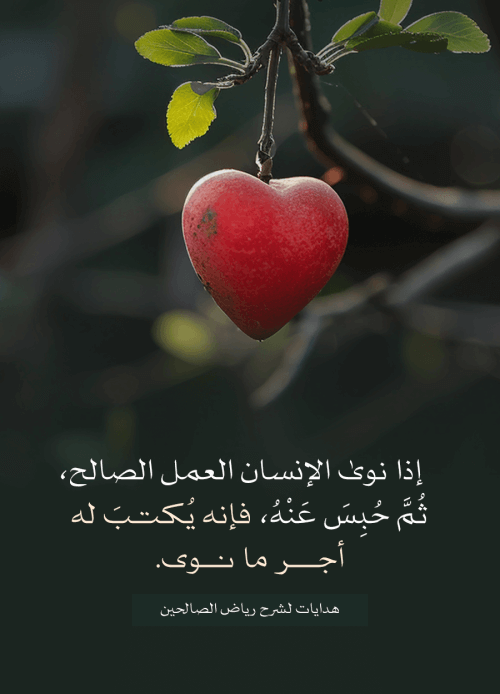
Waiting to do a good deed is in itself a good deed.
Riyadh Al-Salheen with explanation and benefits
Good intention leads its holder to good things.
Riyadh Al-Salheen with explanation and benefits
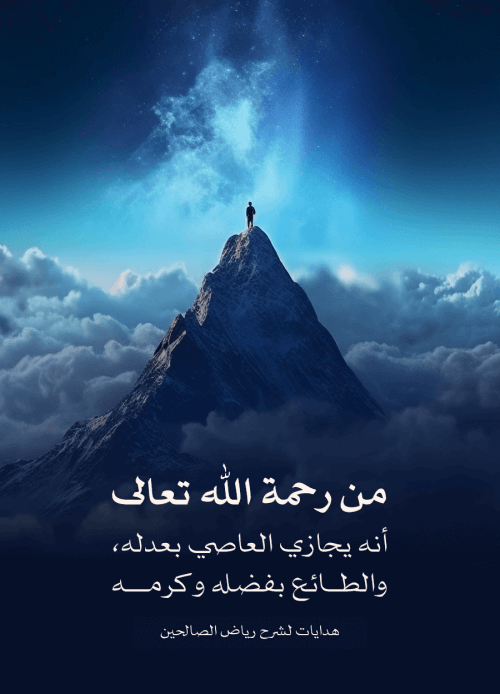
One of the manifestations of Allah’s mercy is that He uses justice to recompense the sinner but uses His grace and bounty to recompense the good-doer.
Riyadh Al-Salheen with explanation and benefits
Sincerity is one of the means to alleviate adversity because each one of them said: “O Allah! If I did that for Your sake only, then relieve us from the distress we are in.”
Riyadh Al-Salheen with explanation and benefits
Good deeds are means to alleviating adversity.
Riyadh Al-Salheen with explanation and benefits
“The righteousness of the heart results from the righteousness of deeds, and the righteousness of deeds results from the righteousness of intention.”
Riyadh Al-Salheen with explanation and benefits
Repentance is a cause for success, which is why a true successful person is the one seeking and committing to a means leading to success.
Riyadh Al-Salheen with explanation and benefits
Hastening to repentance is one of the causes to earning the pleasure of Allah with His servant.
Riyadh Al-Salheen with explanation and benefits