




Categories
Discover our diverse collection of categories covering multiple topics to meet your various interestsDa\'wa cards that highlight great meanings of the verses of the Holy Quran and the noble prophetic hadiths in a simple style and attractive display that helps the Muslim to have a deeper understanding of his religion in an easy way
﴿ وَجَعَلۡتُ لَهُۥ مَالٗا مَّمۡدُودٗا ﴾
سورة المدثر
12. And then granted him resources in abundance.

﴿ فَلَمَّا رَءَا ٱلۡقَمَرَ بَازِغٗا قَالَ هَٰذَا رَبِّيۖ فَلَمَّآ أَفَلَ قَالَ لَئِن لَّمۡ يَهۡدِنِي رَبِّي لَأَكُونَنَّ مِنَ ٱلۡقَوۡمِ ٱلضَّآلِّينَ ﴾
سورة الأنعام
77. When he saw the moon rising up, he said: "This is my lord." But when it set, he said: "Unless my Lord guides me, I shall surely be among the people who went astray."
﴿ وَمَا تَأۡتِيهِم مِّنۡ ءَايَةٖ مِّنۡ ءَايَٰتِ رَبِّهِمۡ إِلَّا كَانُواْ عَنۡهَا مُعۡرِضِينَ ﴾
سورة يس
And no sign comes to them from the signs of their Lord except that they are from it turning away.
﴿ وَقَالُواْ كُونُواْ هُودًا أَوۡ نَصَٰرَىٰ تَهۡتَدُواْۗ قُلۡ بَلۡ مِلَّةَ إِبۡرَٰهِـۧمَ حَنِيفٗاۖ وَمَا كَانَ مِنَ ٱلۡمُشۡرِكِينَ ﴾
سورة البقرة
135. And they say, "Be Jews or Christians, then you will be guided." Say (to them O Muhammad صلى الله عليه وسلم), "Nay, (we follow) only the religion of Ibrâhîm (Abraham), Hanîfa [Islâmic Monotheism, i.e. to worship none but Allâh (Alone)], and he was not of Al-Mushrikûn (those who worshipped others along with Allâh - see V.2:105)."[27]
﴿ ٱللَّهُ لَطِيفُۢ بِعِبَادِهِۦ يَرۡزُقُ مَن يَشَآءُۖ وَهُوَ ٱلۡقَوِيُّ ٱلۡعَزِيزُ ﴾
سورة الشورى
Allah is Kind to His slaves; He gives provision to whom He wills, and He is the All-Powerful, the All-Mighty.
﴿ ءَاتُونِي زُبَرَ ٱلۡحَدِيدِۖ حَتَّىٰٓ إِذَا سَاوَىٰ بَيۡنَ ٱلصَّدَفَيۡنِ قَالَ ٱنفُخُواْۖ حَتَّىٰٓ إِذَا جَعَلَهُۥ نَارٗا قَالَ ءَاتُونِيٓ أُفۡرِغۡ عَلَيۡهِ قِطۡرٗا ﴾
سورة الكهف
Bring me bars of iron" - until, when he had leveled [them] between the two mountain walls, he said, "Blow [with bellows]," until when he had made it [like] fire, he said, "Bring me, that I may pour over it molten copper."
﴿ وَيَعۡبُدُونَ مِن دُونِ ٱللَّهِ مَا لَمۡ يُنَزِّلۡ بِهِۦ سُلۡطَٰنٗا وَمَا لَيۡسَ لَهُم بِهِۦ عِلۡمٞۗ وَمَا لِلظَّٰلِمِينَ مِن نَّصِيرٖ ﴾
سورة الحج
And they worship besides Allāh that for which He has not sent down authority and that of which they have no knowledge. And there will not be for the wrongdoers any helper.
﴿ شَهِدَ ٱللَّهُ أَنَّهُۥ لَآ إِلَٰهَ إِلَّا هُوَ وَٱلۡمَلَٰٓئِكَةُ وَأُوْلُواْ ٱلۡعِلۡمِ قَآئِمَۢا بِٱلۡقِسۡطِۚ لَآ إِلَٰهَ إِلَّا هُوَ ٱلۡعَزِيزُ ٱلۡحَكِيمُ ﴾
سورة آل عمران
18. Allâh bears witness that Lâ ilâha illa Huwa (none has the right to be worshipped but He), and the angels, and those having knowledge (also give this witness); (He always) maintains His creation in Justice. Lâ ilâha illa Huwa (none has the right to be worshipped but He), the All-Mighty, the All-Wise.
﴿ يُرۡسَلُ عَلَيۡكُمَا شُوَاظٞ مِّن نَّارٖ وَنُحَاسٞ فَلَا تَنتَصِرَانِ ﴾
سورة الرحمن
There will be sent upon you a flame of fire and smoke,[1600] and you will not defend yourselves.
Ibn ‘Abbās (may Allah be pleased with him and his father) reported that the Prophet (may Allah's peace and blessings be upon him) said: "Whoever visits a sick person whose time of death has not yet come, and says seven times in his presence: 'As’alullāh al-‘azhīm Rabb al-‘arshi al-‘azhīm an yashfiyak (I ask Allah the Great, Lord of the great Throne, to cure you),' except that Allah will cure him of that sickness."
Narrated by Abu Daoud & At-Termedhy & Ahmad
The Prophet (may Allah's peace and blessings be upon him) informed that no Muslim visits a sick Muslim whose time of death has not yet come, then the visitor supplicates for the sick person, saying: (I ask Allah the Great) in His essence, attributes, and actions, (Lord of the great Throne, to cure you), and repeats it for him seven times except that Allah will cure him of that sickness.
Wā'il al-Hadrami reported: Tāriq ibn Suwayd al-Ju‘fi asked the Prophet (may Allah's peace and blessings be upon him) about alcohol. he forbade him from preparing it. He (Tāriq) said: “I only prepare it for medicinal reasons.” Whereupon the Prophet (may Allah's peace and blessings be upon him) said: “It is not medicine, but an ailment.”
Narrated by Muslim
In this Hadīth, Tāriq ibn Suwayd (may Allah be pleased with him) asked the Prophet (may Allah's peace and blessings be upon him) about alcohol, which he made for medicinal not drinking purposes. The Prophet (may Allah's peace and blessings be upon him) told him that alcohol causes ailments and is not curative. This provides evidence that alcohol is forbidden, as it causes diseases and ailments, and is not useful at all. So it must be destroyed and poured away.
‘Ā'ishah (may Allah be pleased with her) reported that when the Prophet (may Allah's peace and blessings be upon him) visited some of his family members who were sick, he would pass his right hand over them and say: "O Allah, Lord of mankind, remove the affliction. Cure, for You are the one who cures; there is no cure but Yours, a cure that leaves behind no trace of sickness."
Narrated by Bukhari & Muslim
The Prophet (may Allah's peace and blessings be upon him) used to visit some of his wives who were ill, he would supplicate for them with this supplication, and would pass his right hand over them and read this supplication: "O Allah, Lord of mankind," imploring Allah by His universal Lordship, for He is the Lord, the Creator, the Owner, and the Regulator of all affairs. "Remove the affliction," meaning the sickness that affected this person. Cure means remove the sickness and heal the sick. Ash-Shāfi (The Curer or the Healer) is one of Allah's beautiful names, because He is the one who cures the sick. "No one can cure except You," i.e. there is no cure except Allah's cure. Recovering at the hands of human beings is only a means, but the one who cures is Allah. The Prophet asked Allah to cure the sick person completely whereby no trace of illness remains.
Abu Sa‘īd al-Khudri (may Allah be pleased with him) reported: Jibrīl came to the Prophet (may Allah's peace and blessings be upon him) and said: "O Muhammad, have you fallen ill?" He said: 'Yes.' So Jibrīl said: "In the name of Allah I recite over you, (to cleanse you) from everything that troubles you, from the evil of every soul or envious eye, Allah will cure you, in the name of Allah I recite over you)."
Narrated by Muslim
Abu Sa‘īd al-Khudri (may Allah be pleased with him) reported that Jibrīl came to the Prophet (may Allah's peace and blessings be upon him) and asked: "Do you complain of something?" meaning: "Are you sick?" The Prophet responded: 'Yes.' So Jibrīl said: "In the name of Allah I recite over you, to cleanse you from everything that harms you, from the evil of every soul or envious eye, Allah will cure you, in the name of Allah I recite over you." This is a supplication by Jibrīl, the most honorable angel, in favor of the most honorable Messenger (may Allah's peace and blessings be upon him). The part where he asked if the Prophet was ill and the Prophet's affirmative answer indicates that it is permissible that the sick person tells others that he is sick if they ask him. This is not considered a complaint; rather a complaint is to complain of Allah to people, saying: Allah made me sick with such-and-such sickness, thus complaining of the Lord to His creation. This is not permissible, which is why Prophet Ya‘qūb said: {I only complain of my suffering and my grief to Allah} [Sūrat Yūsuf: 86]. In the Ruqyah he recited, Jibrīl mentions the evil of every soul or envious eye, meaning the evil of every human or Jinn or other than that, or the evil of the envious person, meaning what people call the evil eye. An envious person hates to see Allah's blessings upon others and his soul is evil and wicked. Such an evil soul may direct a malicious effect to the envied person, and that is why Jibrīl invoked cure from Allah against the envious eye. He also started the Ruqyah with Basmalah (In the name of Allah) and ended it with Basmalah.
Qays ibn Abi Hāzim reported: We visited Khabbāb ibn al-Aratt (may Allah be pleased with him) when he was ill and he had been cauterized in seven places. He said to us: "Our companions who died (during the lifetime of the Prophet) left (this world) without having their rewards reduced due to enjoying the pleasures of this life, but we have (so much) wealth that we find no way to spend it except on the ground. Had the Prophet (may Allah's peace and blessings be upon him) not forbidden us to wish for death, I would have wished for it." When we visited him for a second time, he was building himself a wall, and he said: "A Muslim is rewarded (in the Hereafter) for whatever he spends, except for something he has spent on building."
Al-Bukhari and Muslim. This is the wording of Al-Bukhari
This Hadīth relates that Khabbāb ibn al-Aratt (may Allah be pleased with him) was sick and had been cauterized in seven places for his sickness, so his companions came to pay him a visit. He told them that the early Companions had died without enjoying any worldly pleasures, which could have lessened the reward they had been promised in the Hereafter. He also said that he had collected so much wealth that he could not find a way to spend it, except on the ground, and that if the Messenger of Allah had not forbidden them from supplicating to Allah for death (except in times of trial regarding one's religion, when one should supplicate to Allah with the reported supplications), he would have asked Allah for it. He also told them that the Prophet (may Allah's peace and blessings be upon him) said that a person is rewarded for everything he spends, except what he spends on the ground, meaning what he builds, because if a person builds only what he needs, this does not require much expenditure. So the money spent on constructing extra (unnecessary) buildings is not rewarded, except a building that was made for the poor to live in or its income was dedicated to the cause of Allah, or something similar. This kind of building is rewarded, but there is no reward in building a place to live in (that is unnecessarily large and beyond the space he needs). Regarding cauterization, its prohibition is meant for anyone who believes that the cure comes from the cauterization, but there is no harm in it for the one who believes that Allah, the Exalted, is the Curer. The prohibition may also be meant for a person who is able to use another method of treatment, but rushed to have cauterization and did not make it the last resort.
‘Āishah (may Allah be pleased with her) reported: When someone complained of an ailment or had a sore or a wound, the Prophet (may Allah's peace and blessings be upon him) did this with his index finger – the narrator, Sufyān ibn ‘Uyaynah, touched the ground with his index finger and then raised it - and said: "In the name of Allah, the dust of our earth along with the saliva of some of us will cure our ailing people, with the permission of our Lord."
Narrated by Bukhari & Muslim
When someone was sick ,or suffering from a wound or a sore, the Prophet (may Allah's peace and blessings be upon him) would moisten (the tip of) his index finger with his saliva then touch the ground with it, so some dust would stick to it. He would then wipe it over the wound or ailing part of the body, saying: “In the name of Allah, the dust of our earth along with the saliva of some of us will cure our ailing people, with the permission of our Lord."
Abu Sa‘īd al-Khudri (may Allah be pleased with him) reported: The Messenger of Allah (may Allah's peace and blessings be upon him) used to seek refuge (with Allah) against the Jinn and the evil eye, until the Mu‘awwidhatayn (Sūrat al-Falaq and Sūrat An-Nās) were revealed. After they had been revealed, he used them for seeking Allah's protection and left everything else.
Narrated by Ibn Majah - Narrated by At-Termedhy - An-Nasaa’i
This Hadīth explains that the Messenger of Allah (may Allah's peace and blessings be upon him) used to seek refuge in Allah, the Exalted, from the evil of the Jinn and the evil eye by means of supplication and Dhikr. For example, he used to say: I seek refuge in Allah from the Jinn and the evil eye. He continued to do so until the Mu‘awwidhatayn (Sūrat al-Falaq and Sūrat An-Nās) were revealed. Afterwards, he mostly used theses two Sūrahs in seeking protection and left other means, because the two Sūrahs contain everything one needs in seeking refuge in Allah against evil.
Abu Sa‘īd al-Khudri (may Allah be pleased with him) reported: A man came to the Prophet (may Allah's peace and blessings be upon him) and said: "My brother has some abdominal trouble." The Prophet (may Allah's peace and blessings be upon him) said to him: "Let him drink honey." The man came for the second time and the Prophet (may Allah's peace and blessings be upon him) said to him: "Let him drink honey." He came for the third time and the Prophet (may Allah's peace and blessings be upon him) said: "Let him drink honey." When he came for the fourth time, he said: "I have done that", and the Prophet (may Allah's peace and blessings be upon him) said: "Allah has spoken the truth, and your brother's abdomen has lied. Let him drink honey." So he made him drink honey and he was cured.
Narrated by Bukhari & Muslim
A man came to the Prophet (may Allah's peace and blessings be upon him) and told him that his brother was suffering from an abdominal disorder. Other narrations of this Hadīth mention that this disorder was diarrhea. The Prophet (may Allah's peace and blessings be upon him) ordered him to give his brother honey to drink, so he gave him some but he did not recover. He went to the Prophet again, and the Prophet ordered him to make him drink honey again, and he did, but his brother did not recover. Then he went to the Prophet (may Allah's peace and blessings be upon him) for the third time and the same thing happened. On the fourth time, the Prophet (may Allah's peace and blessings be upon him) said: ''Allah has spoken the truth and your brother's abdomen has lied. Let him drink honey." The Prophet's statement has two possible interpretations: 1. He was informed about a matter of the unseen through revelation, that the cure for the man's disorder is to drink honey, so he repeatedly ordered him to drink honey so that what he was promised through revelation would come true. 2. The Prophet (may Allah's peace and blessings be upon him) was referring to the Qur'anic verse about honey: {in it is a cure for mankind} [Sūrat An-Nahl: 69], and he knew that this type of sickness can be cured by drinking honey. Hence, when he ordered him for the fourth time to make his brother drink honey, the man did so and his brother was cured with the permission of Allah, the Almighty.
‘Ā'ishah (may Allah be pleased with her) reported the Prophet (may Allah's peace and blessings be upon him) said: "Fever is from the searing heat of Hell, so cool it off with water."
Narrated by Bukhari & Muslim
The Prophet (may Allah's peace and blessings be upon him) informed us that fever is from the intense heat of Hellfire. So, the heat that the sick person experiences is from it. Therefore, he urged us to overcome such heat by water.
A successful servant of Allah is he who chooses to do the most pious deeds bound to raise his rank on the Day of Judgment.
Riyadh Al-Salheen with explanation and benefits
Allah suffices anyone who relies on Him because He does not disappoint those hopeful of Him.
Riyadh Al-Salheen with explanation and benefits
Anyone doing good deeds will reap its fruits even if they were few; so, the individual should never look down upon any good deed.
Riyadh Al-Salheen with explanation and benefits
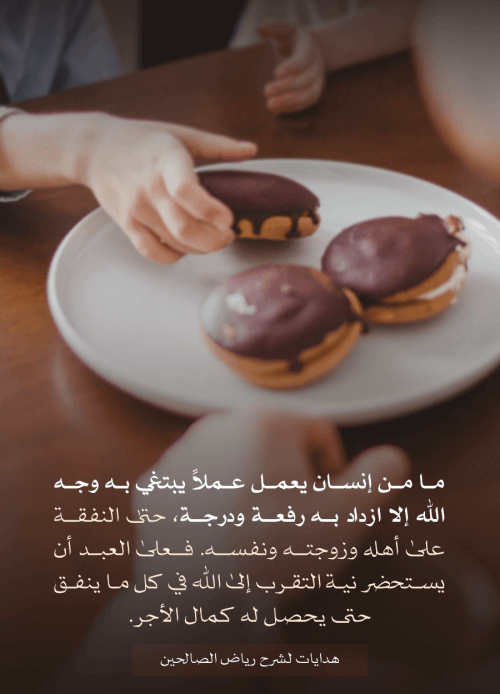
It shows that whoever is sincere in his worship, Allah Almighty will guide him to more of it.
Riyadh Al-Salheen with explanation and benefits
It shows that the prohibited lusts are doors to hellfire; and it means following one’s desires that violate the Sharia
Riyadh Al-Salheen with explanation and benefits
Arduous deeds lead to honor and admission to Paradise.
Riyadh Al-Salheen with explanation and benefits
Aging should inspire self-admonition because one becomes close to meeting Allah Almighty.
Riyadh Al-Salheen with explanation and benefits
Sincerity and honesty are the criteria for deeds that, once fulfilled, the doer will obtain the designated reward.
Riyadh Al-Salheen with explanation and benefits
The greater the benefit extending beyond limited individuals, the greater the reward and the effect.
Riyadh Al-Salheen with explanation and benefits