




Categories
Discover our diverse collection of categories covering multiple topics to meet your various interestsDa\'wa cards that highlight great meanings of the verses of the Holy Quran and the noble prophetic hadiths in a simple style and attractive display that helps the Muslim to have a deeper understanding of his religion in an easy way
﴿ وَلَا ٱلظِّلُّ وَلَا ٱلۡحَرُورُ ﴾
سورة فاطر
21. Nor are (alike) the shade and the sun’s heat.

﴿ وَلَقَدۡ صَرَّفۡنَا لِلنَّاسِ فِي هَٰذَا ٱلۡقُرۡءَانِ مِن كُلِّ مَثَلٖ فَأَبَىٰٓ أَكۡثَرُ ٱلنَّاسِ إِلَّا كُفُورٗا ﴾
سورة الإسراء
We have explained every kind of example[79] for mankind in this Qur’an, yet most people persist in disbelief.
﴿ وَأَمَّا مَنۡ أُوتِيَ كِتَٰبَهُۥ وَرَآءَ ظَهۡرِهِۦ ﴾
سورة الانشقاق
But whoever is given his Record from behind his back,
﴿ فَدَلَّىٰهُمَا بِغُرُورٖۚ فَلَمَّا ذَاقَا ٱلشَّجَرَةَ بَدَتۡ لَهُمَا سَوۡءَٰتُهُمَا وَطَفِقَا يَخۡصِفَانِ عَلَيۡهِمَا مِن وَرَقِ ٱلۡجَنَّةِۖ وَنَادَىٰهُمَا رَبُّهُمَآ أَلَمۡ أَنۡهَكُمَا عَن تِلۡكُمَا ٱلشَّجَرَةِ وَأَقُل لَّكُمَآ إِنَّ ٱلشَّيۡطَٰنَ لَكُمَا عَدُوّٞ مُّبِينٞ ﴾
سورة الأعراف
22. So he misled them with deception. Then when they tasted of the tree, that which was hidden from them of their shame (private parts) became manifest to them and they began to cover themselves with the leaves of Paradise (in order to cover their shame). And their Lord called out to them (saying): "Did I not forbid you that tree and tell you: Verily, Shaitân (Satan) is an open enemy unto you?"
﴿ ذَٰلِكَ بِأَنَّهُمۡ كَانَت تَّأۡتِيهِمۡ رُسُلُهُم بِٱلۡبَيِّنَٰتِ فَكَفَرُواْ فَأَخَذَهُمُ ٱللَّهُۚ إِنَّهُۥ قَوِيّٞ شَدِيدُ ٱلۡعِقَابِ ﴾
سورة غافر
22. That was because there came to them their Messengers with clear evidence (proofs and signs) but they disbelieved (in them). So Allâh seized them (with punishment). Verily He is All-Strong, Severe in punishment.
﴿ ثُمَّ أَوۡرَثۡنَا ٱلۡكِتَٰبَ ٱلَّذِينَ ٱصۡطَفَيۡنَا مِنۡ عِبَادِنَاۖ فَمِنۡهُمۡ ظَالِمٞ لِّنَفۡسِهِۦ وَمِنۡهُم مُّقۡتَصِدٞ وَمِنۡهُمۡ سَابِقُۢ بِٱلۡخَيۡرَٰتِ بِإِذۡنِ ٱللَّهِۚ ذَٰلِكَ هُوَ ٱلۡفَضۡلُ ٱلۡكَبِيرُ ﴾
سورة فاطر
Then We made to inherit the Book those whom We have chosen from among Our slaves[15]. But among them are some who wrong themselves, some follow a middle course, and some are foremost in good deeds with Allah’s permission. That is the great bounty.
﴿ وَقَالُواْ ٱلۡحَمۡدُ لِلَّهِ ٱلَّذِيٓ أَذۡهَبَ عَنَّا ٱلۡحَزَنَۖ إِنَّ رَبَّنَا لَغَفُورٞ شَكُورٌ ﴾
سورة فاطر
And they will say, "Praise to Allāh, who has removed from us [all] sorrow. Indeed, our Lord is Forgiving and Appreciative -
﴿ إِنَّ هَٰذَا لَهُوَ ٱلۡقَصَصُ ٱلۡحَقُّۚ وَمَا مِنۡ إِلَٰهٍ إِلَّا ٱللَّهُۚ وَإِنَّ ٱللَّهَ لَهُوَ ٱلۡعَزِيزُ ٱلۡحَكِيمُ ﴾
سورة آل عمران
Indeed, this is the true narration. And there is no deity except Allāh. And indeed, Allāh is the Exalted in Might, the Wise.
﴿ وَلَا يَخَافُ عُقۡبَٰهَا ﴾
سورة الشمس
15. And He (Allâh) feared not the consequences thereof.
‘Ā'ishah (may Allah be pleased with her) reported that she said: "O Messenger of Allah, I have two neighbors, so which one of them should I give a gift to?" He said: "The one whose door is the nearest to you."
Narrated by Bukhari
‘Ā'ishah (may Allah be pleased with her) said to the Prophet (may Allah's peace and blessings be upon him): I have two neighbors, and I have been ordered to be generous to neighbors in general, but I cannot afford to give a gift to both of them at the same time. So which one should I give a gift to so as to be considered from those who are generous to neighbors? he said: The one whose door is the nearest to you.
‘Abdullāh ibn ‘Abbās (may Allah be pleased with him) reported: On the day of the Conquest of Makkah, the Messenger of Allah (may Allah's peace and blessings be upon him) said: "There is no emigration after the Conquest (of Makkah), but there is Jihad and good intention, and whenever you are called for Jihad, you should immediately respond to the call." On the same day, he added: "Verily, Allah has made this city sacred since the day He created the heavens and the earth. Thus, it is a sanctuary by Allah’s decree until the Day of Judgment. Fighting in it was not permissible for anyone before me, and it was made permissible for me for only an hour of a day. It is sacred by the sacredness granted by Allah until the Day of Judgment. Its thorns should not be cut off, and its game should not be chased, and any lost item found therein should not be picked up except by one who would announce it publicly, and its green grass should not be cut off." Al-‘Abbās said: "O Messenger of Allah, except for lemongrass, for it is used by their blacksmiths and for their domestic purposes.' So, the Prophet (may Allah's peace and blessings be upon him) responded: "Except for lemongrass."
Narrated by Bukhari & Muslim
Ibn ‘Abbās (may Allah be pleased with him) informs that the Prophet (may Allah's peace and blessings be upon him) delivered a sermon on the Day of the Conquest of Makkah. He said that there is no emigration from Makkah, because it has become part of the Muslim lands. He then ordered the Muslims to fight if they are ordered to, in obedience to Allah, His Messenger and the ruler of the land. He then spoke of the sanctity of Makkah, and that it has been made sacred since Allah created the heavens and the earth. He said that it was not made lawful for anyone to fight in before him and that it will not be made permissible for any one after him either, as it was made lawful for him to fight therein for only an hour of the day, and then it returned to its original state of sanctity. He then mentioned that it is not permissible to cut off its thorns or to chase its game, and that no one should pick up lost items found in it except if he wants to announce it. He added that its vegetation should not be cut off, including grass and fodder. He excluded lemongrass because of the benefits it provides to the people of Makkah as it was used by the blacksmiths in starting fire for their work.
Abu ’Umāmah Iyās ibn Tha‘labah al-Hārithi (may Allah be pleased with him) reported that the Messenger of Allah (may Allah's peace and blessings be upon him) said: "Whoever seizes the right of a Muslim person by his oath, Allah will condemn him to Hellfire and will make Paradise forbidden for him." A man said to him: Even if it is something insignificant, O Messenger of Allah? He said: "Even if it is a twig of Arāk."
Narrated by Muslim
The Prophet (may Allah's peace and blessings be upon him) warned against falsely swearing by Allah, knowingly, to unjustly take the right of a Muslim person. The punishment for this is to be deserving of Hellfire and to be deprived of Paradise, and it is considered one of the major sins. A man said: O Messenger of Allah, even if the thing being sworn about is something insignificant? He (may Allah's peace and blessings be upon him) said: Even if it is a tooth-stick taken from the Arāk tree.
‘Ā’ishah (may Allah be pleased with her) reported that the Prophet (may Allah's peace and blessings be upon him) said: “Whoever unjustly usurps even one handspan of land, his neck will be encircled with it down the seven earths.”
Narrated by Bukhari & Muslim
It is prohibited for one to take the property of another except with his consent, particularly the unjust seizure of land because it usually lasts for a long time. Hence, the Prophet (may Allah's peace and blessings be upon him) said that whoever unjustly seizes a piece of land of any size would be severely punished on the Day of Judgment; his neck would be long and thick enough to be encircled with the seized land down the seven earths in retribution for what he did to the owner of that land. This threat does not apply to the use of public lands without seizing or occupying them. In his book Al-Mughni, Ibn Qudāmah said: "With regard to streets, roadways and alleys, no one has the right to develop that land (such as building on it and other activities by which it would become someone’s property), whether they are wide or narrow, and whether that results in less space for people or not, because such spaces are shared by Muslims and their interests are connected to them; so it is more akin to their mosques. It is permissible to benefit from such spaces by sitting there to buy and sell, in a way that does not cause any annoyance to anyone or harm the passers-by, because people in all countries and at all times have approved of people doing that, without denouncing it; and because it is a kind of permissible usage, provided that it does not result in any harm. So it is allowed, like passing through.
Abu Sa‘īd al-Khudri (may Allah be pleased with him) reported; The Messenger of Allah (may Allah's peace and blessings be upon him) forbade Munābadhah, which is when a man throws a garment to another thus selling it to him before the buyer unfolds it or examines it. He also forbade Mulāmasah, which is when a man touches a garment, thus buying it without examining it.
Narrated by Bukhari & Muslim
The Prophet (may Allah's peace and blessings be upon him) forbade any sale that involves Gharar (uncertainty, risk), because of the harm it may incur to one of the contracting parties through a possible injustice in its sale. This can occur when the condition of the item is unknown to the seller, the buyer, or both of them. It can occur in Munābadhah, where the seller throws a garment, for example, to the buyer thereby concluding the sale before the garment has been examined closely or turned over. Likewise in Mulāmasah, which is making a sale effective upon touching a garment, for example, before examining it closely or turning it over. These two contracts lead to uncertainty and deceit regarding the commodity being sold and bought. Either the seller or the buyer is at risk of gaining or losing, thereby engaging in “gambling”, which is prohibited.
Anas ibn Mālik (may Allah be pleased with him) reported that the Messenger of Allah (may Allah's peace and blessings be upon him) forbade the sale of fruits until they are ripe. They said: "What is meant by ripe?" He said: "When they become red." He added: "What if Allah prevents the fruits, how could one of you consider his brother's money lawful for himself?"
Narrated by Bukhari & Muslim
Fruits are prone to many plant diseases before they become ripe, and selling them in this stage brings about no benefit for the buyer. Therefore, the Prophet (may Allah's peace and blessings be upon him) prohibited the seller and the buyer from concluding the sale of fruits before they become ripe. Dates become ripe when they turn red or yellow. Then, the Prophet (may Allah's peace and blessings be upon him) explained the reason behind prohibiting the sale of unripe fruits by mentioning that if all the fruits or some of them suffered blight, then how could the seller consider his brother's money lawful for himself without giving anything in exchange?
‘Abdullāh ibn ‘Umar (may Allah be pleased with him) reported: The Messenger of Allah (may Allah's peace and blessings be upon him) prohibited the selling of a fruit until it is evidently ripe. He forbade both the buyer and the seller (from engaging in such a transaction).
Narrated by Bukhari & Muslim
The Prophet (may Allah's peace and blessings be upon him) prohibited the selling of fruits until their ripeness appears clearly. He prohibited both the buyer and the seller from conducting this transaction.
Mālik ibn Aws ibn al-Hadathān reported: I came saying: Who will exchange the dirhams? Talhah ibn ‘Ubaydullāh, who was in the company of ‘Umar ibn al-Khattāb (may Allah be pleased with both of them), said: Show us your gold, then come to us when our servant comes to give you your silver. Thereupon, ‘Umar ibn al-Khattāb said: No, by Allah, you must either give him his silver or give him back his gold, as the Messenger of Allah (may Allah's peace and blessings be upon him) said: "Silver for gold is Riba (usury) unless exchanged on the spot; wheat for wheat is Riba unless exchanged on the spot; barley for barley is Riba unless exchanged on the spot; and dates for dates is Riba unless exchanged on the spot."
Narrated by Bukhari & Muslim
Mālik ibn Aws, the Tābi‘i, informs that he had gold dinars that he wanted to exchange with silver dirhams. Talhah ibn ‘Ubaydullāh (may Allah be pleased with him) said to him: Give us your dinars to see them. Then, after deciding to buy them, he said to him: Come later when our servant comes to give you the silver dirhams. This situation took place in the presence of ‘Umar ibn al-Khattāb (may Allah be pleased with him), who expressed his disapproval of such a transaction and swore that Talhah should either pay the silver now or give him back his gold that he took from him. He justified this by saying that the Messenger of Allah (may Allah's peace and blessings be upon him) mentioned that when selling silver for gold or vice versa, the exchange should be made immediately; otherwise, this will be a prohibited Riba-based transaction and an invalid sale. Thus, gold should not be sold for silver, and silver should not be sold for gold except hand to hand and with the exchange made on the spot. Moreover, wheat should not be sold for wheat, barley should not be sold for barley, and dates should not be sold for dates except like for like, weight for weight, measure for measure, hand to hand, and nothing thereof should be sold immediately for deferred payment, and it is impermissible for the two parties to depart before the exchange is made.
Abu Hurayrah (may Allah be pleased with him) reported: The Messenger of Allah (may Allah's peace and blessings be upon him) forbade the town-dweller to sell (merchandise) on behalf of a Bedouin. And not to practice Najsh (offering a high price for a thing which you do not really want to buy in order to raise its price value and deceive other buyers). No Muslim should offer more for a thing already bought by his Muslim brother, nor should he propose to a women already engaged to another Muslim. A Muslim woman should not ask that her sister (i.e. another Muslim woman) be divorced in order to invert her plate (i.e. an idiom meaning to deprive her of what she has in order to take her place).
Narrated by Bukhari & Muslim
The beneficial and wholesome teachings of Islam seek to eliminate all means that may cause enmity and hatred among Muslims. This is obvious in the following prohibitions mentioned in this Hadīth: The Prophet (may Allah's peace and blessings be upon him) prohibited raising the price of an item without the true intention of buying it. Some people may do this seeking to benefit of the seller by increasing the price (in front of other buyers), or to harm the actual buyers by making the item become too expensive for him to buy. He prohibited this action because it comprises of falsehoods and lying to the customers and cheating them, and raising the price of merchandise by way of trickery and deception. He also prohibited the city or town dweller to sell merchandise on behalf of the Bedouin because the city dweller knows well the prices of the merchandise while the Bedouin does not and thus the latter might mistakenly sell it at a lower price and the buyers would unfairly benefit from that price difference. The Prophet (may Allah's peace and blessings be upon him) said in this regard: "Leave people (to engage in trade) and Allah will grant them provision through one another." If the Bedouin sells the merchandise himself this will benefit the buyers more. Thus the prohibition that a city dweller sells on behalf of a Bedouin is intended to eliminate harmful consequences from city residents. He also prohibited that a man proposes to marry a woman to whom another man has already proposed until he learns that the other suitor was clearly turned down. This is prohibited because of the obvious enmity and hatred it would cause between the two suitors, and what it involves of depriving a fellow Muslim of something good. He also prohibited that a woman asks her husband to divorce his other wife, or turns him against her or cause quarrels between them so that he eventually divorces her. This is impermissible because of the evil it involves. It creates enmity and deprives the divorced wife of the benefits and good that she enjoyed in her marriage as her husband was obliged to provide for her and clothe her, as well as all the other marital rights. This state of deprivation was expressed in the Hadīth with the idiom and metaphor: "inverting what's on her plate" to express depriving her of the good she enjoys while married.
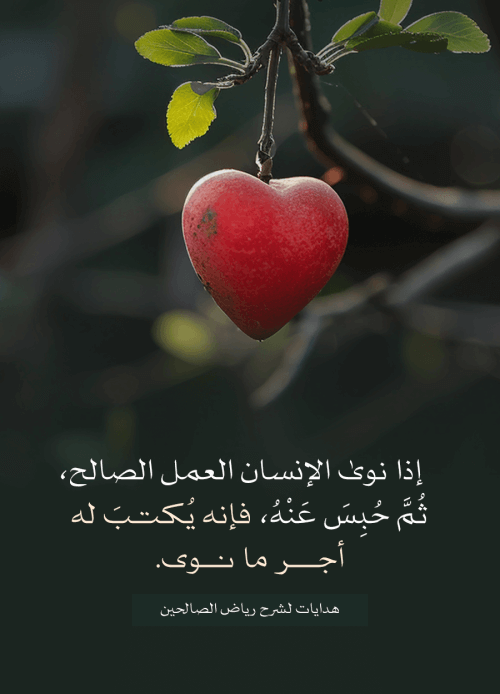
If someone intends to do a good deed but was prevented by a valid excuse, he shall gain the reward of his intention.
Riyadh Al-Salheen with explanation and benefits
Variation of reward for good deeds is based on sincerity and following of the Prophet’s guidance. The more a person is sincere to Allah, and the keener he is on following the Prophet (may Allah’s peace and blessings be upon him), the more perfect his worship will be, and consequently his reward will be bigger.
Riyadh Al-Salheen with explanation and benefits
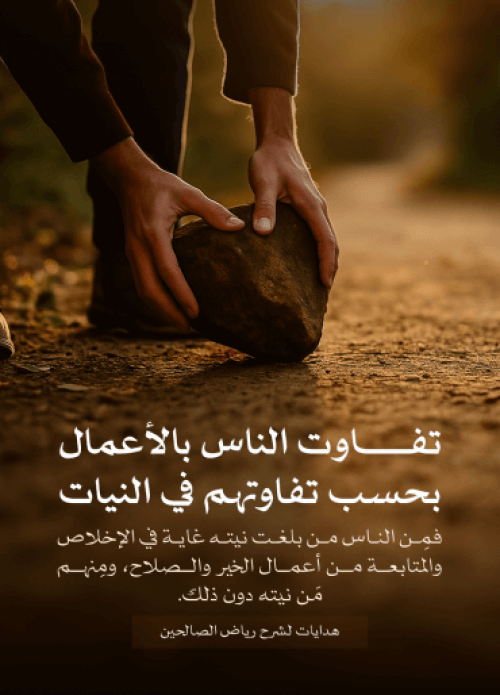
People differ with regards to their acts of worship according to their intentions. The intentions of some people have reached the ultimate level of sincerity (to Allah) and keenness in following the Sunnah (of the Messenger of Allah) with regard to doing good and righteous deeds, while the intentions of others are below that.
Riyadh Al-Salheen with explanation and benefits
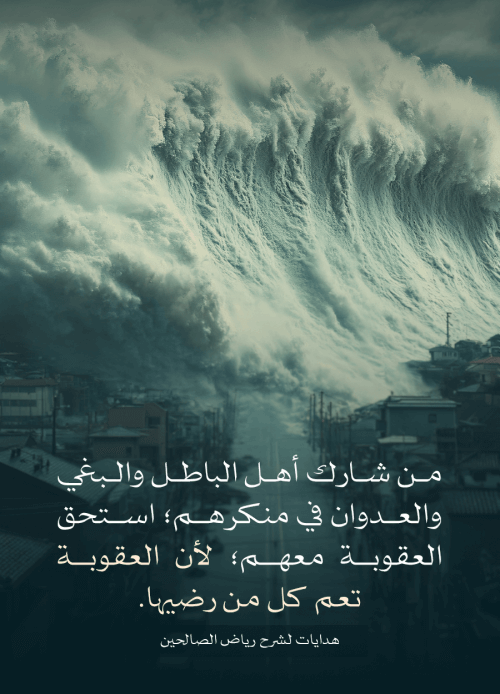
Anyone partaking a role with transgressors and wrongdoers will share their punishment because it is inclusive.
Riyadh Al-Salheen with explanation and benefits
If someone intends to do a good deed but was prevented by a valid excuse, he shall gain the reward of his intention.
Riyadh Al-Salheen with explanation and benefits
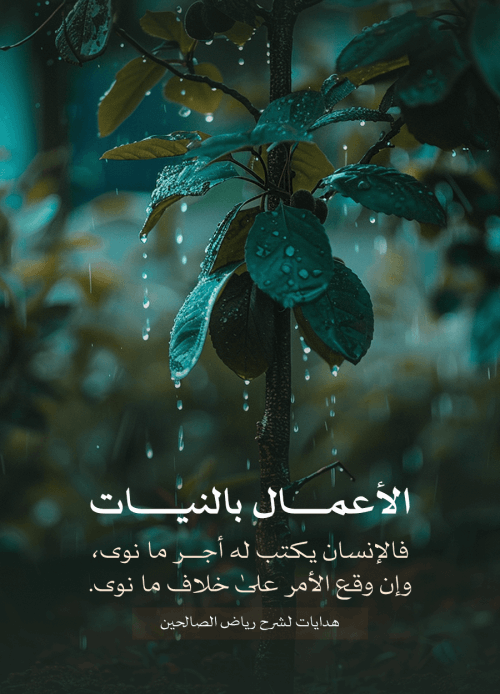
Actions are recompensed according to the intentions behind them, and the individual shall receive the reward of what he intended even if the outcome was contrary to his intention.
Riyadh Al-Salheen with explanation and benefits
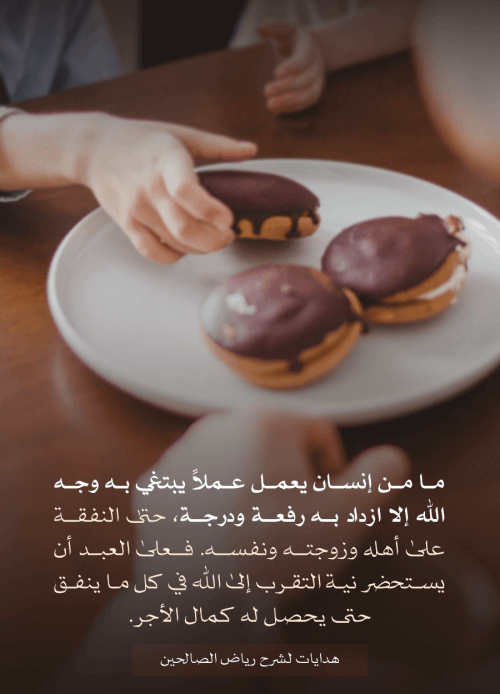
There is not a single good deed intended sincerely to please Allah except that its doer will be raised in rank and status thereby, so that he would reap the full reward.
Riyadh Al-Salheen with explanation and benefits
Love and contentment is measured by good deeds and intentions because they are the criteria for Allah’s acceptance of the servant; perhaps a small deed reaps great reward because of the intention behind it and perhaps a big deed reaps little reward because of the intention behind it
Riyadh Al-Salheen with explanation and benefits
One of the proofs Allah supports the servant is the latter’s sincere endeavor to rectify his intention and purify his heart by good deeds.
هدايات لشرح رياض الصالحين