



Categories
Discover our diverse collection of categories covering multiple topics to meet your various interestsDa\'wa cards that highlight great meanings of the verses of the Holy Quran and the noble prophetic hadiths in a simple style and attractive display that helps the Muslim to have a deeper understanding of his religion in an easy way
﴿ وَيَوۡمَ يَحۡشُرُهُمۡ كَأَن لَّمۡ يَلۡبَثُوٓاْ إِلَّا سَاعَةٗ مِّنَ ٱلنَّهَارِ يَتَعَارَفُونَ بَيۡنَهُمۡۚ قَدۡ خَسِرَ ٱلَّذِينَ كَذَّبُواْ بِلِقَآءِ ٱللَّهِ وَمَا كَانُواْ مُهۡتَدِينَ ﴾
سورة يونس
And on the Day when He will gather them, [it will be] as if they had not remained [in the world] but an hour of the day, [and] they will know each other. Those will have lost who denied the meeting with Allāh and were not guided.

﴿ وَإِذۡ زَيَّنَ لَهُمُ ٱلشَّيۡطَٰنُ أَعۡمَٰلَهُمۡ وَقَالَ لَا غَالِبَ لَكُمُ ٱلۡيَوۡمَ مِنَ ٱلنَّاسِ وَإِنِّي جَارٞ لَّكُمۡۖ فَلَمَّا تَرَآءَتِ ٱلۡفِئَتَانِ نَكَصَ عَلَىٰ عَقِبَيۡهِ وَقَالَ إِنِّي بَرِيٓءٞ مِّنكُمۡ إِنِّيٓ أَرَىٰ مَا لَا تَرَوۡنَ إِنِّيٓ أَخَافُ ٱللَّهَۚ وَٱللَّهُ شَدِيدُ ٱلۡعِقَابِ ﴾
سورة الأنفال
And [remember] when Satan made their deeds pleasing to them and said, "No one can overcome you today from among the people, and indeed, I am your protector." But when the two armies sighted each other, he turned on his heels and said, "Indeed, I am disassociated from you. Indeed, I see what you do not see; indeed, I fear Allāh. And Allāh is severe in penalty."
﴿ ذَٰلِكُمُ ٱللَّهُ رَبُّكُمۡۖ لَآ إِلَٰهَ إِلَّا هُوَۖ خَٰلِقُ كُلِّ شَيۡءٖ فَٱعۡبُدُوهُۚ وَهُوَ عَلَىٰ كُلِّ شَيۡءٖ وَكِيلٞ ﴾
سورة الأنعام
That is Allāh, your Lord; there is no deity except Him, the Creator of all things, so worship Him. And He is Disposer of all things.
﴿ وَإِذَا ٱلۡجِبَالُ نُسِفَتۡ ﴾
سورة المرسلات
And when the mountains are blown away
﴿ إِنَّ هَٰذَا كَانَ لَكُمۡ جَزَآءٗ وَكَانَ سَعۡيُكُم مَّشۡكُورًا ﴾
سورة الإنسان
[And they will be told,] “Indeed, this is your reward, and your efforts have been appreciated.”
﴿ أَمۡ لَمۡ يُنَبَّأۡ بِمَا فِي صُحُفِ مُوسَىٰ ﴾
سورة النجم
Or has he not been informed of what was in the scriptures of Moses
﴿ وَلَا تَجۡعَلۡ يَدَكَ مَغۡلُولَةً إِلَىٰ عُنُقِكَ وَلَا تَبۡسُطۡهَا كُلَّ ٱلۡبَسۡطِ فَتَقۡعُدَ مَلُومٗا مَّحۡسُورًا ﴾
سورة الإسراء
29. And let not your hand be tied (like a miser) to your neck, nor stretch it forth to its utmost reach (like a spendthrift), so that you become blameworthy and in severe poverty.
﴿ فَلَمَّآ أَتَىٰهَا نُودِيَ يَٰمُوسَىٰٓ ﴾
سورة طه
And when he came to it, he was called, "O Moses,
﴿ يَعۡمَلُونَ لَهُۥ مَا يَشَآءُ مِن مَّحَٰرِيبَ وَتَمَٰثِيلَ وَجِفَانٖ كَٱلۡجَوَابِ وَقُدُورٖ رَّاسِيَٰتٍۚ ٱعۡمَلُوٓاْ ءَالَ دَاوُۥدَ شُكۡرٗاۚ وَقَلِيلٞ مِّنۡ عِبَادِيَ ٱلشَّكُورُ ﴾
سورة سبأ
They made for him whatever he wished of sanctuaries[6], images[7], basins as large as reservoirs, and huge fixed cooking pots. “Do [good deeds] in gratitude, O household of David!” But few of My slaves are grateful.”
Anas (may Allah be pleased with him) said: I will narrate to you a Hadīth I heard from the Messenger of Allah (may Allah’s peace and blessings be upon him) and none will narrate it to you other than me. I heard the Messenger of Allah (may Allah’s peace and blessings be upon him) say: "Among the portents of the Hour is that knowledge will be taken away, ignorance will prevail, adultery will spread, drinking alcohol will be common, and men will decrease in number while women will increase so much that for fifty women there will only be one man to look after them."
Narrated by Bukhari & Muslim
The Prophet (may Allah's peace and blessings be upon him) pointed out that among the portents of the Hour approaching is that Shar‘i knowledge will be taken away through the death of scholars. As a result, ignorance will increase and spread, adultery and immorality will be common, drinking alcohol will prevail, and men will decrease in number while women will increase so much that for fifty women there will be one man to take care of their affairs and interests.
Abu Hurayrah (may Allah be pleased with him) reported that the Prophet (may Allah's peace and blessings be upon him) said: "The Hour will not be established until a man would pass by the grave of another man and say: 'I wish I were in his place.'"
Narrated by Bukhari & Muslim
The Prophet (may Allah's peace and blessings be upon him) informed us that the Hour will not be established until a man passes by the grave of another and wishes that he were in his place, dead, because of his fear of losing his religion, given the predominance of falsehood and its people, and the prevalence of trials, sins, and wrongdoings.
Abu Hurayrah (may Allah be pleased with him) reported: The Messenger of Allah (may Allah's peace and blessings be upon him) said: "The Hour will not come until you fight the Jews: until the stone behind which a Jew will be hiding will say: O Muslim, this is a Jew behind me; kill him."
Narrated by Bukhari & Muslim
The Prophet (may Allah's peace and blessings be upon him) reported that the Hour will not occur until the Muslims and the Jews fight each other - until when a Jew flees to hide behind a stone from the Muslims, Allah will make the stone speak and it will call out to the Muslim that there is a Jew behind it, so that he will go and kill him.
Abu Hurayrah (may Allah be pleased with him) reported that the Messenger of Allah (may Allah's peace and blessings be upon him) said: "The Hour will not be established until the time is shortened, so a year will be like a month, a month like a week, a week like a day, a day like an hour, and an hour will be like the burning of a palm leaf."
Narrated by Ahmad
The Prophet (may Allah's peace and blessings be upon him) informed that one of the signs of the Hour is the shortening of time. So, a year passes like a month, a month passes like a week, a week passes like a day, a day passes like one hour, and an hour passes so quickly like the burning of Sa‘afah, which is a palm leaf.
‘Abdullāh ibn ‘Amr (may Allah be pleased with him) reported: The Prophet (may Allah’s peace and blessings be upon him) said: "My Cistern takes a month's journey to cross it. Its water is whiter than milk, its smell is nicer than musk, and its drinking cups are like the stars of the sky; whoever drinks from it will never become thirsty."
Narrated by Bukhari & Muslim
The Prophet (may Allah's peace and blessings be upon him) reported that he will have a Cistern on the Day of Judgment whose length takes a month's journey to cross, and so does its breadth; its water is whiter than milk; its smell is more pleasant than the smell of musk; and its drinking cups are as numerous as the stars of the sky. Whoever drinks from that Cistern using these cups will never become thirsty.
Asmā’ bint Abi Bakr (may Allah be pleased with her) reported: The Prophet (may Allah’s peace and blessings be upon him) said: "I will be at the Cistern so that I see who among you will come to me. But some people will be barred from reaching me. Thereupon, I will say: 'O Lord, they belong to me and my Ummah.' It will be said: 'Do you know what they did after you? By Allah, they quickly turned back upon their heels.'"
Narrated by Bukhari & Muslim
The Prophet (may Allah's peace and blessings be upon him) points out that he will be at his Cistern on the Day of Judgment to see those among his Ummah who will come to it. Some people will be held back close to the Prophet (may Allah's peace and blessings be upon him), who will say: My Lord, they belong to me and my Ummah. It will be said: Do you know what they did after you left them? By Allah, they quickly turned back upon their heels and abandoned their religion. So, they do not belong to you or to your Ummah.
Abu Dharr (may Allah be pleased with him) reported: I said: "O Messenger of Allah, what about the vessels of the Cistern?" He said: "By the One in Whose Hand the soul of Muhammad is, its vessels will outnumber the stars in the sky and its planets shining on a dark cloudless night. These will be the vessels of Paradise. He who drinks from them will never feel thirsty. There will flow in it two spouts from Paradise and he who drinks from it will not feel thirsty. Its breadth is like its length, as wide as the distance between Ammān and Aylah. And its water is whiter than milk and sweeter than honey."
Narrated by Muslim
The Prophet (may Allah's peace and blessings be upon him) swore that the vessels of his Cistern on the Day of Judgment will outnumber the stars and planets of the sky. This appears on a dark moonless night, for stars are not obvious on moonlit nights, as they fade due to the light of the moon, and on cloudless nights, for clouds obstruct the visibility of the stars. And whoever drinks from the vessels of Paradise will never become thirsty again, and this will be the last time he experiences thirst. And two spouts from Paradise will flow in his Cistern, whose breadth is like its length. The Cistern is equilateral. It is as wide as the distance between Ammān, a town in Balqa’, in the Levant, and Aylah, a well-known city on the outskirts of the Levant. The water of the Cistern is whiter than milk and sweeter than honey.
Abu Hurayrah (may Allah be pleased with him) reported: The Messenger of Allah (may Allah's peace and blessings be upon him) said: "Your fire is a one-seventieth part of Hellfire." It was said: "O Messenger of Allah, it would have been enough." Thereupon, he said: "It is sixty-nine parts in excess of (the heat of) fire in this world, each of them being equivalent to its heat."
Narrated by Bukhari & Muslim
The Prophet (may Allah's peace and blessings be upon him) reports that the fire of this world is a one-seventieth part of the fire of Hell. The heat of the fire of the hereafter is greater than the heat of the fire of this world by sixty-nine parts, each of which is equivalent to the heat of the worldly fire. It was said: O Messenger of Allah, the fire of this world would have been enough for punishing those who enter it. In response, he (may Allah's peace and blessings be upon him) said: The fire of Hell is more intense than the fire of this world by sixty-nine parts, with each part being equivalent to its heat.
Ziyād ibn Labīd (may Allah be pleased with him) reported: The Prophet (may Allah’s peace and blessings be upon him) mentioned something and said: "That will be at the time when knowledge disappears." I said: "O Messenger of Allah, how will knowledge disappear when we recite the Qur’an and teach it to our children, and they teach it to their children (and so on) until the Day of Judgment?" He said: "May your mother be bereaved of you, O Ziyād! I thought you were the most knowledgeable man in Madīnah. Is it not the case with these Jews and Christians who read the Torah and the Gospel, yet they do not act upon anything therein?!"
Narrated by Ibn Majah
As the Prophet (may Allah's peace and blessings be upon him) was sitting among his Companions, he said: This is the time at which knowledge will disappear and be taken away from people. Thereupon, Ziyād ibn Labīd al-Ansāri (may Allah be pleased with him) wondered and asked the Prophet (may Allah's peace and blessings be upon him): How will knowledge be taken away from us and we lose it, whereas we recite and memorize the Qur’an?! By Allah, we will recite it and make our women and children and our children's children recite it. In response, the Prophet (may Allah's peace and blessings be upon him) said in wonder: May your mother be bereaved of you, O Ziyād! I considered you to be among the knowledgeable people of Madīnah. Then, the Prophet (may Allah's peace and blessings be upon him) pointed out that knowledge will not be lost by the loss of the Qur’an, but knowledge will be lost by the loss of acting upon it. A case in point is the Jews and the Christians, who have the Torah and the Gospel, yet they did not derive benefit from them or their objective, namely acting upon what they have learned.
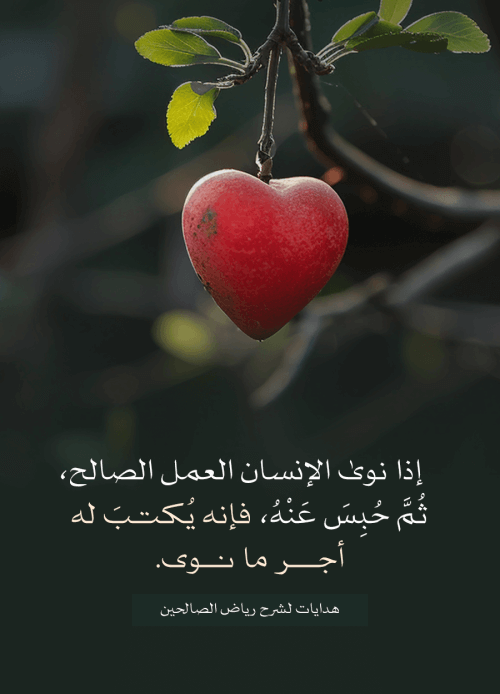
If someone intends to do a good deed but was prevented by a valid excuse, he shall gain the reward of his intention.
Riyadh Al-Salheen with explanation and benefits
Variation of reward for good deeds is based on sincerity and following of the Prophet’s guidance. The more a person is sincere to Allah, and the keener he is on following the Prophet (may Allah’s peace and blessings be upon him), the more perfect his worship will be, and consequently his reward will be bigger.
Riyadh Al-Salheen with explanation and benefits
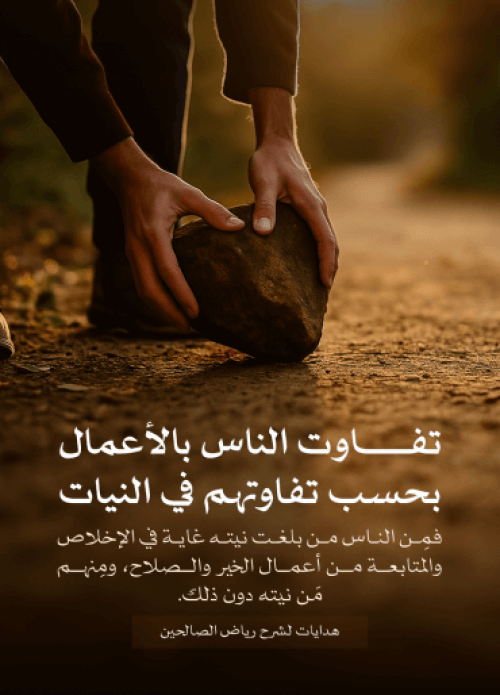
People differ with regards to their acts of worship according to their intentions. The intentions of some people have reached the ultimate level of sincerity (to Allah) and keenness in following the Sunnah (of the Messenger of Allah) with regard to doing good and righteous deeds, while the intentions of others are below that.
Riyadh Al-Salheen with explanation and benefits
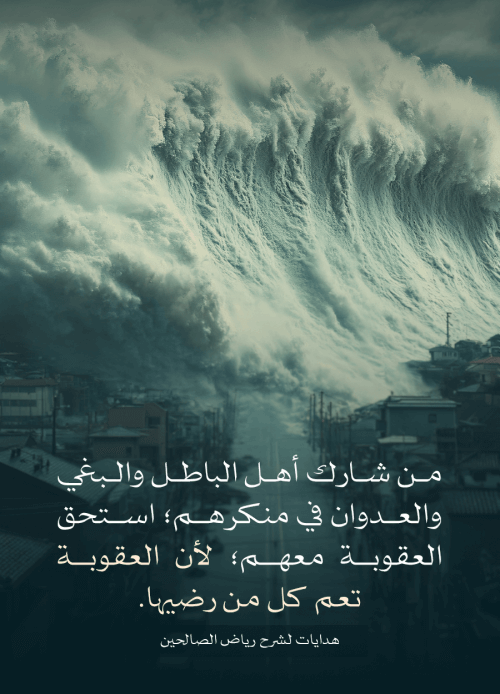
Anyone partaking a role with transgressors and wrongdoers will share their punishment because it is inclusive.
Riyadh Al-Salheen with explanation and benefits
If someone intends to do a good deed but was prevented by a valid excuse, he shall gain the reward of his intention.
Riyadh Al-Salheen with explanation and benefits
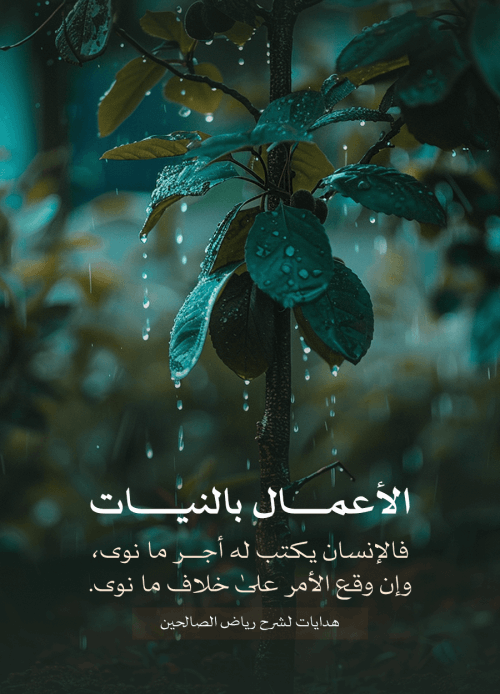
Actions are recompensed according to the intentions behind them, and the individual shall receive the reward of what he intended even if the outcome was contrary to his intention.
Riyadh Al-Salheen with explanation and benefits
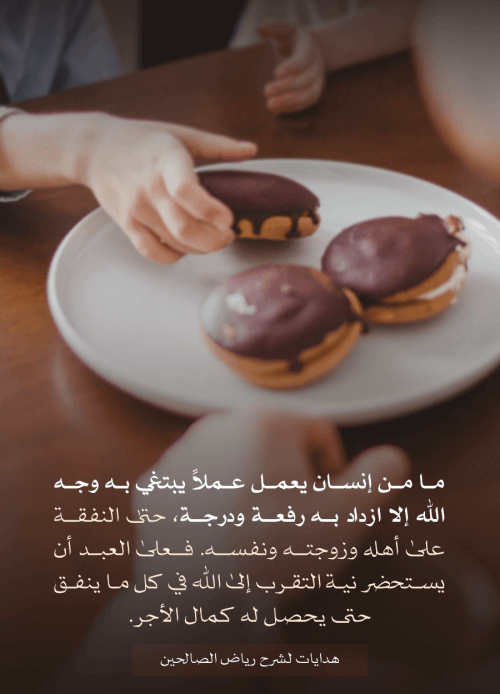
There is not a single good deed intended sincerely to please Allah except that its doer will be raised in rank and status thereby, so that he would reap the full reward.
Riyadh Al-Salheen with explanation and benefits
Love and contentment is measured by good deeds and intentions because they are the criteria for Allah’s acceptance of the servant; perhaps a small deed reaps great reward because of the intention behind it and perhaps a big deed reaps little reward because of the intention behind it
Riyadh Al-Salheen with explanation and benefits
One of the proofs Allah supports the servant is the latter’s sincere endeavor to rectify his intention and purify his heart by good deeds.
هدايات لشرح رياض الصالحين