








Categories
Discover our diverse collection of categories covering multiple topics to meet your various interestsDa\'wa cards that highlight great meanings of the verses of the Holy Quran and the noble prophetic hadiths in a simple style and attractive display that helps the Muslim to have a deeper understanding of his religion in an easy way
﴿ ٱلَّذِينَ ءَامَنُواْ يُقَٰتِلُونَ فِي سَبِيلِ ٱللَّهِۖ وَٱلَّذِينَ كَفَرُواْ يُقَٰتِلُونَ فِي سَبِيلِ ٱلطَّٰغُوتِ فَقَٰتِلُوٓاْ أَوۡلِيَآءَ ٱلشَّيۡطَٰنِۖ إِنَّ كَيۡدَ ٱلشَّيۡطَٰنِ كَانَ ضَعِيفًا ﴾
سورة النساء
The believers fight in the way of Allah, whereas the disbelievers fight in the way of Tāghoot[54] [i.e., false gods]. So fight the allies of Satan. Indeed, the scheme of Satan is ever weak.

﴿ نَاصِيَةٖ كَٰذِبَةٍ خَاطِئَةٖ ﴾
سورة العلق
16. A lying, sinful forelock!
﴿ وَيَٰقَوۡمِ ٱعۡمَلُواْ عَلَىٰ مَكَانَتِكُمۡ إِنِّي عَٰمِلٞۖ سَوۡفَ تَعۡلَمُونَ مَن يَأۡتِيهِ عَذَابٞ يُخۡزِيهِ وَمَنۡ هُوَ كَٰذِبٞۖ وَٱرۡتَقِبُوٓاْ إِنِّي مَعَكُمۡ رَقِيبٞ ﴾
سورة هود
O my people, do whatever you can; I will do mine. You will come to know who will receive a disgracing punishment, and who is a liar. Wait; I too am waiting with you.”
﴿ وَإِذۡ يَمۡكُرُ بِكَ ٱلَّذِينَ كَفَرُواْ لِيُثۡبِتُوكَ أَوۡ يَقۡتُلُوكَ أَوۡ يُخۡرِجُوكَۚ وَيَمۡكُرُونَ وَيَمۡكُرُ ٱللَّهُۖ وَٱللَّهُ خَيۡرُ ٱلۡمَٰكِرِينَ ﴾
سورة الأنفال
And [remember, O Muḥammad], when those who disbelieved plotted against you to restrain you or kill you or evict you [from Makkah]. But they plan, and Allāh plans. And Allāh is the best of planners.
﴿ وَمَا تَسۡـَٔلُهُمۡ عَلَيۡهِ مِنۡ أَجۡرٍۚ إِنۡ هُوَ إِلَّا ذِكۡرٞ لِّلۡعَٰلَمِينَ ﴾
سورة يوسف
And you do not ask of them for it any payment. It is not except a reminder to the worlds.
﴿ وَقَالَ ٱلَّذِينَ كَفَرُواْ لَن نُّؤۡمِنَ بِهَٰذَا ٱلۡقُرۡءَانِ وَلَا بِٱلَّذِي بَيۡنَ يَدَيۡهِۗ وَلَوۡ تَرَىٰٓ إِذِ ٱلظَّٰلِمُونَ مَوۡقُوفُونَ عِندَ رَبِّهِمۡ يَرۡجِعُ بَعۡضُهُمۡ إِلَىٰ بَعۡضٍ ٱلۡقَوۡلَ يَقُولُ ٱلَّذِينَ ٱسۡتُضۡعِفُواْ لِلَّذِينَ ٱسۡتَكۡبَرُواْ لَوۡلَآ أَنتُمۡ لَكُنَّا مُؤۡمِنِينَ ﴾
سورة سبأ
31. And those who disbelieve say: "We believe not in this Qur’ân nor in that which was before it." But if you could see when the Zâlimûn (polytheists and wrong-doers) will be made to stand before their Lord, how they will cast the (blaming) word one to another! Those who were deemed weak will say to those who were arrogant: "Had it not been for you, we should certainly have been believers!"
﴿ فَلَنَأۡتِيَنَّكَ بِسِحۡرٖ مِّثۡلِهِۦ فَٱجۡعَلۡ بَيۡنَنَا وَبَيۡنَكَ مَوۡعِدٗا لَّا نُخۡلِفُهُۥ نَحۡنُ وَلَآ أَنتَ مَكَانٗا سُوٗى ﴾
سورة طه
58. "Then verily, we can produce magic the like thereof; so appoint a meeting between us and you, which neither we nor you shall fail to keep, in an open place where both shall have a just and equal chance (and beholders could witness the competition)."
﴿ قُلۡ أَرَءَيۡتُمۡ إِن كَانَ مِنۡ عِندِ ٱللَّهِ وَكَفَرۡتُم بِهِۦ وَشَهِدَ شَاهِدٞ مِّنۢ بَنِيٓ إِسۡرَٰٓءِيلَ عَلَىٰ مِثۡلِهِۦ فَـَٔامَنَ وَٱسۡتَكۡبَرۡتُمۡۚ إِنَّ ٱللَّهَ لَا يَهۡدِي ٱلۡقَوۡمَ ٱلظَّٰلِمِينَ ﴾
سورة الأحقاف
Say, “What do you think, if this [Qur’an] is really from Allah and yet you reject it, and a witness[4] from the Children of Israel has testified in its favor and believed[5], whereas you persist in arrogance[6]? Indeed, Allah does not guide the wrongdoing people.”
﴿ وَٱذۡكُرۡ عِبَٰدَنَآ إِبۡرَٰهِيمَ وَإِسۡحَٰقَ وَيَعۡقُوبَ أُوْلِي ٱلۡأَيۡدِي وَٱلۡأَبۡصَٰرِ ﴾
سورة ص
And remember Our servants, Abraham, Isaac and Jacob - those of strength and [religious] vision.
Abu Idrīs al-Khawlāni (may Allah have mercy upon him) reported: I once entered the Damascus mosque. I saw a young man who had shining teeth, and people were with him. When they differed over anything, they would refer it to him and would adopt his opinion. I asked who he was and I was told that he was Mu‘ādh ibn Jabal (may Allah be pleased with him). On the next day, I went early to the mosque, but found that he had arrived earlier than me and was praying. I waited until he completed his prayer, and then went to him from the front, greeted him and said: "By Allah, I love you for the sake of Allah." He asked: "By Allah?" I replied: "Yes, by Allah." He then asked me again: "By Allah?" I replied: "Yes, by Allah." Then he took hold of the waist edge of my cloak, drew me close to himself and said: "Rejoice, for I heard the Messenger of Allah (may Allah's peace and blessings be upon him) saying: 'Allah, the Almighty, said: ‘My love is certainly due to those who love one another for My sake, sit with one another for My sake, visit one another for My sake, cooperate and give one another for My sake.''"
Narrated by Ahmad - Maalik
This Hadīth highlights the virtue of loving one another for the sake of Allah. The meaning is that whoever does all of these things, i.e. each of the two parties, as the verb form implies, if he does them seeking the pleasure of Allah, the Almighty, not for a perishable interest or some purpose, then the love of his Master will be due to him. This, indeed, is the greatest reward and it indicates the honor of such deeds. It was also reported that: "Whoever loves, hates, gives, and withholds for My sake, he has perfected faith." "By Allah, I love you for the sake of Allah." He asked: "By Allah?" I replied: "Yes, by Allah." This is a proof that they frequently used oaths and repeated them for the sake of verification and confirmation. "Drew me close to himself", meaning: closely and intimately, displaying acceptance of what he told him, and to convey to him the glad tidings of what the Prophet (may Allah's peace and blessings be upon him) said about the one who does that. So, he said to him: 'Rejoice', meaning: at the state you are in because "I heard the Messenger of Allah (may Allah's peace and blessings be upon him) saying: 'Allah, the Almighty, said"; Mu‘ādh informed him that the Prophet (may Allah's peace and blessings be upon him) reported this statement from his Lord, Blessed and Exalted, so that Abu Idrīs would be certain about the statement and would fully rejoice over the news, since it was the statement of the Prophet (may Allah's peace and blessings be upon him) which he reported from his Lord, and not a personal opinion of Mu‘ādh (may Allah be pleased with him). "My love is certainly due", meaning: My love has been affirmed for them. "To those who love one another for My sake, sit with one another for My sake", meaning: Their gatherings are especially for the sake of Allah, for the sake of cooperation in the remembrance of Allah, the Exalted, establishing His limits, honoring His covenant, fulfilling His commands, preserving His laws, following His orders, and avoiding His prohibitions. "Visit one another for My sake", meaning: Their visits to one another are intended for Allah's sake and seeking His pleasure, love, and approval; whether they do it out of loving each other for His sake, or in cooperation on His obedience. "Cooperate and give one another for My sake", meaning: exert themselves for His pleasure, including spending on Jihad against His enemies, and other such things that they were commanded to do; as well as giving each other money if needed.
Anas ibn Mālik (may Allah be pleased with him) reported that the Prophet (may Allah's peace and blessings be upon him) said: "During my ascent to heaven, I passed by a group of people with copper nails scratching their faces and chests. I asked: 'O Jibrīl, who are these?' He replied: 'These are the ones who eat the flesh of people (by backbiting) and slander them.'"
Narrated by Abu Daoud - Narrated by Ahmad
Meaning of this Hadīth: When the Prophet (may Allah's peace and blessings be upon him) was taken up to heaven on the Night of Ascension, he came across a group of people who were scratching their bodies with their copper nails. He wondered at their state and asked Jibrīl: "Who are these people, and why are they doing this to themselves?" Jibrīl replied that those were the ones who used to backbite people and slander them.
Salmān al-Fārisi (may Allah be pleased with him) reported that the Prophet (may Allah's peace and blessings be upon him) said: "There are three (types of people) to whom Allah will not speak (on the Day of Judgment), nor will He purify, and they will incur a painful punishment: an aged person who commits fornication, a poor person who is arrogant, and a man who has made (swearing by) Allah as his goods; as he does not buy or sell without swearing by Allah.”
At-Tabaraani
The Prophet (may Allah's peace and blessings be upon him) informs us about three types of sinners who will receive the severest punishment because of the hideousness of their crimes. One of them is the elderly person who commits fornication, because the urge to commit that sin is weak given his old age. This shows that the reason he is committing fornication is his love of sin and vice. Although fornication is despised regardless of who commits it, it is even more despised in old age. The second is a poor person who treats people with arrogance. Although arrogance is a despicable trait regardless of who displays it, the poor person has no wealth that prompts him to be arrogant, so his arrogance along with the absence of a motive for it proves that arrogance is in his nature. The third is the person who makes swearing by Allah his habit and uses it frequently when selling and buying, thus being disrespectful to the name of Allah and using it as a means to earn money.
‘Amr ibn Shu‘ayb reported from his father, who reported from his grandfather: The most rebellious of people against Allah, Exalted and Glorified, is someone who kills another in the sacred precincts of Allah; kills someone other than his killer; or someone kills someone out of a pre-Islamic animosity.
Narrated by Ibn Hebban
‘Abdullāh ibn ‘Amr (may Allah be pleased with him) said that the Prophet (may Allah's peace and blessings be upon him) had said that the most rebellious and tyrannical in the sight of Allah, as far as murder is concerned, are three people: 1. Someone who kills someone else whose blood is inviolable under the Shariah in the safe sanctuary of Allah; Makkah. A forbidden killing is the gravest sin after polytheism, and it is more forbidden and sinful when it is committed in the sanctuary of Allah. In this respect, Allah, the Almighty, says: {Whoever intends [a deed] therein of deviation [in religion] or wrongdoing - We will make him taste of a painful punishment} [Sūrat al-Hajj: 25]. In an authentic Hadīth, the Prophet (may Allah's peace and blessings be upon him) said: ''Your blood, honor, and properties are as inviolable to you as this month of yours in this country of yours.'' [Muslim: 1218] 2. Someone who kills someone other than his killer (the person who committed the murder). Allah, the Almighty, says: {No bearer of burdens can bear the burden of another} [Sūrat al-An‘ām: 164]. That is to kill someone other than his killer or to kill, along with his killer, someone else. Excessive murder was a pre-Islamic tradition, that Allah has forbidden. 3. Someone who kills due to the pre-Islamic animosities and feuds that Islam revoked. Exceptions, however, are someone who kills another while defending himself and not for any other reason. Also, killing someone who commits a crime that legalizes killing him, such as deliberate murder in the sanctuary, so the sanctuary does not provide a safe place for people to commit crimes.
Hakīm ibn Hizām (may Allah be pleased with him) reported: I asked the Messenger of Allah (may Allah's peace and blessings be upon him) for some money and he gave me. Then I asked him again and he gave me. Then I asked him again and he gave me, and then he said: "O Hakīm, this money is like a sweet fresh fruit; whoever takes it without greediness, he is blessed in it, and whoever takes it with greediness, he is not blessed in it, and he is like a person who eats but is never satisfied; and the giving hand is better than the receiving hand.'" Hakīm added: "I said: 'O Messenger of Allah, by the One Who sent you with the truth, I shall never accept anything from anyone after you until I leave this world.'" Then Abu Bakr (may Allah be pleased with him) (during his caliphate) would call Hakīm to give him his share from the war booty and he would refuse to take anything. Then ‘Umar (may Allah be pleased with him) (during his caliphate) called him to give him his share but he refused. Upon that, ‘Umar said: "O Muslims, I would like you to bear witness that I offer Hakīm his share from this booty that Allah entitled him to, and he refuses to take it." Thus, Hakīm never took anything from anybody after the Prophet (may Allah's peace and blessings be upon him) till he died.
Narrated by Bukhari & Muslim
Hadīth explanation: Hakīm ibn Hizām (may Allah be pleased with him) went to the Prophet (may Allah's peace and blessings be upon him) to ask him for some money three times and the Prophet gave him every time. Then the Prophet (may Allah's peace and blessings be upon him) said to him that this money is sweet and green; meaning something loved and desired, something that people strive to attain, just as one likes ripe fruit that have an appetizing appearance and sweet taste. Then the Prophet (may Allah's peace and blessings be upon him) said that whoever takes it without greediness; meaning: whoever receives it with indifference to it, without begging constantly, and without gluttony for it, Allah will place blessing in this money and it will grow and increase even if it is a small amount, and the person will be blessed with contentment thereby attaining a rich self-sufficient soul, a relaxed heart and a happy life. On the contrary, whoever takes money with greediness; i.e. he aspires to it and desires it, Allah will not put blessing in it, he will never be satisfied nor content, and he will have an impoverished soul, even if he were given the treasures of the earth. Another Hadīth with a similar meaning was narrated by Muslim: The Prophet (may Allah's peace and blessings be upon him) said: "I am only a treasurer. So the one whom I give who is not greedy, he will be blessed in what he is given, and the one whom I give because of his constant begging and greediness, is like the one who eats and is never full." So if this is the case with one who takes money with greediness, then what about the one who constantly begs? His situation will be far worse. That is why the Prophet (may Allah's peace and blessings be upon him) said to ‘Umar ibn al-Khattāb: "Whatever you receive from this money (war booty) and you are not aspiring to take it nor asking for it, then take it, otherwise, do not take it." The giving hand is better than the receiving hand because it has honored itself and raised itself above the humiliation of asking. Hakīm swore by Allah who sent the Prophet with the truth that he would not ask anyone after him for anything. So when the Prophet passed away and Abu Bakr became the Caliph, he used to offer Hakīm money but Hakīm refused to take it. Then Abu Bakr died and ‘Umar became the Caliph and he summoned Hakīm to give him his share, but Hakīm again refused. So ‘Umar summoned the people to bear witness that Hakīm was offered his share from the Public Treasury of Muslims but he refused to accept it. ‘Umar did that so that Hakīm would not have an argument against him on the Day of Resurrection (that he deprived him of his right), and to free himself from liability to Hakīm before the people. Hakīm insisted on refraining from taking anything from ‘Umar until he died.
Anas (may Allah be pleased with him) reported: The Prophet (may Allah's peace and blessings be upon him) said: "By Allah! There is no true life, except that of the Hereafter."
Narrated by Bukhari & Muslim
Comfortable, contented, and eternal life is the life of the Hereafter. As for this world, no matter how comfortable it may be, it will cease to exist.
Abu Hurayrah (may Allah be pleased with him) reported that the Prophet (may Allah's peace and blessings be upon him) said: "Verily, this world is cursed, and everything in it is cursed, except the remembrance of Allah an all what is relevant to it; a scholar and a seeker of knowledge."
Narrated by Ibn Majah - Narrated by At-Termedhy
The world and all that it contains of adornments is hateful and dispraised in the sight of Allah, because it takes people away from the purpose of their creation; which is to worship Allah and establish His laws. The exception to such hate and dispraise is the remembrance of Allah and all what is relevant to it of acts of worship, as well as learning religious knowledge and teaching it to others, because this is the purpose of their creation.
Jābir (may Allah be pleased with him) reported that the Messenger of Allah (may Allah's peace and blessings be upon him) passed through the market with people around him. He came across a dead goat with its ears cut off. He held it by (the remaining part of) one ear and said: "Who of you would like to have this for one dirham?" They said: "We do not like to have it for anything whatsoever. What shall we do with it?" Then he said: "Would you like to have it anyway?'' They said: "By Allah, had it been alive, it would be of little value because of its cut ears. How could it be worth anything when it is dead?" Thereupon he said: "By Allah, the world is less worthy to Allah than this is to you.''
Narrated by Muslim
Jābir (may Allah be pleased with him) informs us that the Prophet (may Allah's peace and blessings be upon him) once passed through the market and came across a dead goat with cut ears, so he raised its head and asked whether anyone would like to take it for one dirham (an insignificant price at the time). The people refused to take it even for nothing. The Prophet (may Allah's peace and blessings be upon him) further asked if anyone liked to have it, and they replied in the negative. Thereupon, he told them that the world is less worthy in Allah's sight than that dead goat in theirs. With this remark, the Prophet wanted to show his Companions and his Ummah after him that this world is more contemptible in Allah's sight than the cut-eared dead goat in the sight of sound-natured people. This world, in relation to the Hereafter, is worthless to Allah; it does not weigh the wing of a mosquito. Sahl ibn Sa‘d (may Allah be pleased with him) reported that the Prophet (may Allah's peace and blessings be upon him) said: ''If the world weighed, in the sight of Allah, a mosquito's wing, He wouldn't give a disbeliever a drink of water from it.'' He wished to urge his Companions and his Ummah after him to make the life of this world a means to fulfill divine requirements, and not to make it their ultimate objective and purpose as that would lead to their destruction.
An-Nu‘mān ibn Bashīr (may Allah be pleased with him) reported that ‘Umar ibn al-Khattāb (may Allah be pleased with him) mentioned what the people had gained of worldly pleasures and said: "I saw how the Messenger of Allah (may Allah’s peace and blessings be upon him) would pass a whole day writhing (from hunger), not even finding bad dates to fill his stomach with."
Narrated by Muslim
‘Umar (may Allah be pleased with him) mentioned what the people achieved of worldly pleasures when Allah granted them victory in their conquests, and what they accumulated of spoils. So he said that he had seen the Messenger of Allah (may Allah's peace and blessings be upon him) twisting from hunger without finding anything with which to fill his stomach, not even bad dates.
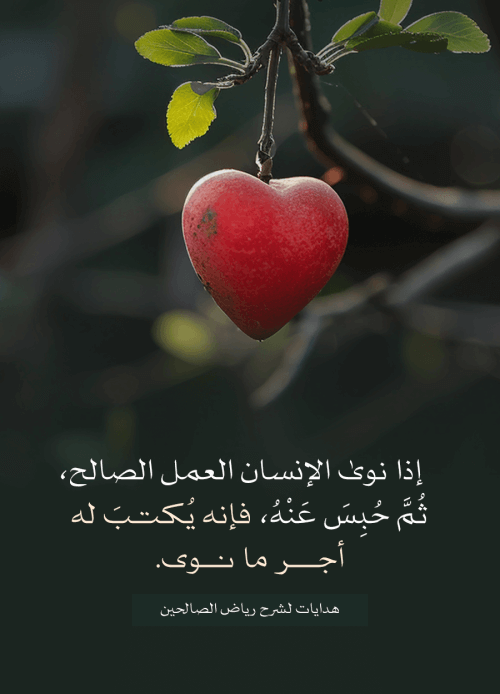
If someone intends to do a good deed but was prevented by a valid excuse, he shall gain the reward of his intention.
Riyadh Al-Salheen with explanation and benefits
Variation of reward for good deeds is based on sincerity and following of the Prophet’s guidance. The more a person is sincere to Allah, and the keener he is on following the Prophet (may Allah’s peace and blessings be upon him), the more perfect his worship will be, and consequently his reward will be bigger.
Riyadh Al-Salheen with explanation and benefits
People differ with regards to their acts of worship according to their intentions. The intentions of some people have reached the ultimate level of sincerity (to Allah) and keenness in following the Sunnah (of the Messenger of Allah) with regard to doing good and righteous deeds, while the intentions of others are below that.
Riyadh Al-Salheen with explanation and benefits
Anyone partaking a role with transgressors and wrongdoers will share their punishment because it is inclusive.
Riyadh Al-Salheen with explanation and benefits
If someone intends to do a good deed but was prevented by a valid excuse, he shall gain the reward of his intention.
Riyadh Al-Salheen with explanation and benefits
Actions are recompensed according to the intentions behind them, and the individual shall receive the reward of what he intended even if the outcome was contrary to his intention.
Riyadh Al-Salheen with explanation and benefits
There is not a single good deed intended sincerely to please Allah except that its doer will be raised in rank and status thereby, so that he would reap the full reward.
Riyadh Al-Salheen with explanation and benefits
Love and contentment is measured by good deeds and intentions because they are the criteria for Allah’s acceptance of the servant; perhaps a small deed reaps great reward because of the intention behind it and perhaps a big deed reaps little reward because of the intention behind it
Riyadh Al-Salheen with explanation and benefits
One of the proofs Allah supports the servant is the latter’s sincere endeavor to rectify his intention and purify his heart by good deeds.
هدايات لشرح رياض الصالحين