



Categories
Discover our diverse collection of categories covering multiple topics to meet your various interestsDa\'wa cards that highlight great meanings of the verses of the Holy Quran and the noble prophetic hadiths in a simple style and attractive display that helps the Muslim to have a deeper understanding of his religion in an easy way
﴿ وَتِلۡكَ ٱلۡجَنَّةُ ٱلَّتِيٓ أُورِثۡتُمُوهَا بِمَا كُنتُمۡ تَعۡمَلُونَ ﴾
سورة الزخرف
And that is Paradise which you are made to inherit for what you used to do.

﴿ وَنُفِخَ فِي ٱلصُّورِ فَصَعِقَ مَن فِي ٱلسَّمَٰوَٰتِ وَمَن فِي ٱلۡأَرۡضِ إِلَّا مَن شَآءَ ٱللَّهُۖ ثُمَّ نُفِخَ فِيهِ أُخۡرَىٰ فَإِذَا هُمۡ قِيَامٞ يَنظُرُونَ ﴾
سورة الزمر
And the Horn will be blown, and whoever is in the heavens and whoever is on the earth will fall dead except whom Allāh wills. Then it will be blown again, and at once they will be standing, looking on.
﴿ وَإِذَا قِيلَ لَهُمُ ٱتَّبِعُواْ مَآ أَنزَلَ ٱللَّهُ قَالُواْ بَلۡ نَتَّبِعُ مَا وَجَدۡنَا عَلَيۡهِ ءَابَآءَنَآۚ أَوَلَوۡ كَانَ ٱلشَّيۡطَٰنُ يَدۡعُوهُمۡ إِلَىٰ عَذَابِ ٱلسَّعِيرِ ﴾
سورة لقمان
When it is said to them, “Follow what Allah has sent down,” they say, “No, we follow what we found our forefathers doing.” Is that so, even if Satan is calling them to the punishment of the Blazing Fire?
﴿ أَمۡ لَمۡ يَعۡرِفُواْ رَسُولَهُمۡ فَهُمۡ لَهُۥ مُنكِرُونَ ﴾
سورة المؤمنون
Or is it that they do not recognize their Messenger, so they deny him?
﴿ أَوۡ أَمَرَ بِٱلتَّقۡوَىٰٓ ﴾
سورة العلق
and enjoins righteousness?
﴿ وَمِنۡ ءَايَٰتِهِۦ مَنَامُكُم بِٱلَّيۡلِ وَٱلنَّهَارِ وَٱبۡتِغَآؤُكُم مِّن فَضۡلِهِۦٓۚ إِنَّ فِي ذَٰلِكَ لَأٓيَٰتٖ لِّقَوۡمٖ يَسۡمَعُونَ ﴾
سورة الروم
And among His signs is your sleep by night and day, and your seeking of His bounty [by day]. Indeed, there are signs in this for people who listen.
﴿ ٱلَّذِينَ إِذَا ٱكۡتَالُواْ عَلَى ٱلنَّاسِ يَسۡتَوۡفُونَ ﴾
سورة المطففين
2. Those who, when they have to receive by measure from men, demand full measure,
﴿ فَٱلۡمُدَبِّرَٰتِ أَمۡرٗا ﴾
سورة النازعات
And those who arrange [each] matter,[1837]
﴿ وَلَا يَحۡسَبَنَّ ٱلَّذِينَ يَبۡخَلُونَ بِمَآ ءَاتَىٰهُمُ ٱللَّهُ مِن فَضۡلِهِۦ هُوَ خَيۡرٗا لَّهُمۖ بَلۡ هُوَ شَرّٞ لَّهُمۡۖ سَيُطَوَّقُونَ مَا بَخِلُواْ بِهِۦ يَوۡمَ ٱلۡقِيَٰمَةِۗ وَلِلَّهِ مِيرَٰثُ ٱلسَّمَٰوَٰتِ وَٱلۡأَرۡضِۗ وَٱللَّهُ بِمَا تَعۡمَلُونَ خَبِيرٞ ﴾
سورة آل عمران
180. And let not those who covetously withhold of that which Allâh has bestowed on them of His Bounty (Wealth) think that it is good for them (and so they do not pay the obligatory Zakât ). Nay, it will be worse for them; the things which they covetously withheld shall be tied to their necks like a collar on the Day of Resurrection[34]. And to Allâh belongs the heritage of the heavens and the earth; and Allâh is Well-Acquainted with all that you do.
Abu Hurayrah (may Allah be pleased with him) reported that the Prophet (may Allah's peace and blessings be upon him) said: "Whoever finds his property intact with a bankrupt person, he has more right to take it than anyone else."
Narrated by Bukhari & Muslim
Whoever sells his property to someone, or deposits it with him, or loans it to him or the like, and then that person (who received it) becomes bankrupt or insolvent, meaning that his money is not enough to pay off his debts, then the seller has the right to take back his property if he finds it as it is, as he is more entitled to it than any other person.
‘Abdullāh ibn ‘Umar (may Allah be pleased with him) reported that the Prophet (may Allah's peace and blessings be upon him) said: "If someone sells pollinated date palms, their fruits will be for the seller, unless the buyer stipulates the contrary." In another narration: "And if someone buys a slave, his property is for the seller, unless the buyer stipulates the contrary."
Narrated by Bukhari & Muslim
He determined that pollination and its fruits belong to the seller, for he is the one who did the work that was required for this. However, if the buyer stipulates that the fruits shall be for him, though the palm trees have been pollinated, and the seller agrees, then they should abide by this condition. The same applies to a slave who is granted some property by his master. If his master sells him, the property shall go back to the seller, for it is not covered by the sales contract. However, if the buyer stipulates that he shall take all or part of the slave's property, this shall be part of the contract.
‘Abdullāh ibn ‘Abbās(may Allah be pleased with him) reported: 'The Messenger of Allah (may Allah's peace and blessings be upon him) forbade riders (carrying merchandise) being met on their way, and a townsman selling for a man from the desert.'' The narrator asked Ibn ‘Abbās: ''What does it mean that a townsman should not sell for a man from the desert?" He said: ''That he should not work as a broker on his behalf.''
Narrated by Bukhari & Muslim
The Prophet (may Allah's peace and blessings be upon him) forbade certain types of transactions because they negatively impact the parties involved. 1. It is forbidden to go to meet people arriving with merchandise, in order to buy their goods before they reach the market. If those arriving do not know the market price, the transaction will be unfair to them as they could lose the real amount that they had struggled to earn. The real value of their commodity will be an easy gain for those who had not worked for it. 2. It is forbidden for a townsman to offer to keep the merchandise of a man coming from the desert to sell his wares in the town at the market value of the day and return, and sell it when prices go up. This transaction is forbidden due to the harm done to the townspeople. The laws of Islam thus protect the rights of both the unknown seller and the townspeople.
‘Abdullāh ibn ‘Umar (may Allah be pleased with him) reported that the Messenger of Allah (may Allah's peace and blessings be upon him) forbade the Muzābanah sale: that is to sell fruits in one's garden, if it is palm trees, for dates by dry measure; and if it is a vineyard, to sell for raisins by dry measure; and if it is any crop to sell for a dry measure of its food. He forbade all such transactions.
Narrated by Bukhari & Muslim
The Prophet (may Allah's peace and blessings be upon him) forbade the Muzābanah sale, which is to sell something definite for an indefinite amount of its kinds because of the harms this transaction involves, and also because of the uncertainty of the correspondence of the two commodities, which leads to usury. Examples were given to clarify and explain it: to sell fruits in one's garden, if it is a palm garden, for dates by dry measure; and if it is a vineyard, to sell for raisins by dry measure; and if it is any crop to sell for a dry measure of the food of its kind. He forbade all such transactions because of the harm and detriment it involves.
‘Abdullāh ibn ‘Umar (may Allah be pleased with him) reported: The Messenger of Allah (may Allah's peace and blessings be upon him) forbade the transaction called Habal al-Habalah which was practiced in pre-Islamic times. A man would buy the meat of the slaughtered camel up to Habal al-Habalah, which implies that a she-camel should give birth and then its offspring would grow young and become pregnant and give birth. It was said that a man would sell his old she-camel for the unborn offspring of the fetus inside the womb of the buyer's camel (i.e. he buys the offspring of the offspring of the pregnant camel).
Narrated by Bukhari & Muslim
Habal al-Habalah is among the prohibited sale transactions. The following are the two most common interpretations of it: 1. That it implies suspension. That is, a man sells something in return for a deferred payment, which is due when the she-camel gives birth, then the newborn she-camel matures and gives birth as well. This transaction is prohibited because the time when the payment is due is unknown, given that the term fixed for payment has an effect on determining the price, based on the length of that term. 2. That the transaction means selling something unknown and non-existent. For example, a man sells to another the offspring of the offspring of a pregnant she-camel. This is prohibited because of the substantial harm and uncertainty involved. In fact, it is not certainly known whether the offspring will be male or female, one or two, alive or dead. Furthermore, the time of settling the transaction is also unknown. Hence, this is a type of sale transactions that involves lack of knowledge of all the aspects of the sale. Being so, it results in many harmful consequences and ends in disputes. In general, this sale has four forms: 1. Selling the offspring of a pregnant she-camel. 2. Selling the offspring of the offspring of a pregnant she-camel. This is a contract whose object is unknown. 3. Delaying the sale of the contracted object, meaning that he delays the time when the sold object becomes the property of the buyer until the she-camel gives birth, or until its unborn offspring gives birth. 4. Finalizing the sale but deferring the price to an unknown time.
Jābir ibn ‘Abdullāh (may Allah be pleased with him) reported that the Prophet (may Allah's peace and blessings be upon him) forbade the sales called Mukhābarah, Muhāqalah, Muzābanah and the selling of fruits until they are fit for eating. He also forbade the selling of fruits but for money, except in the case of ‘Araya.
Narrated by Bukhari & Muslim
The Prophet (may Allah's peace and blessings be upon him) forbade some of the sales of crops because of the harm they incur on one or both sides of the transaction (buyer and seller). These sales include Mukhābarah, which is to lease out land in return for the produce of a specified part of the land; Muhāqalah, which is to sell wheat in the ear in return for husked wheat (wheat separated from the chaff); Muzābanah, which is to sell dates on palm trees in return for dates. He also forbade selling fruit until its condition becomes clear that it is free from blight and good for eating, but he made an exception for ‘Araya (date-palms), i.e. ripe dates after their value is estimated, in return for the same value of fruit.
‘Abdullāh ibn ‘Umar (may Allah be pleased with him) reported: ‘Umar acquired a piece of land in Khaybar, so he came to the Prophet (may Allah's peace and blessings be upon him) to know what he should do with it. He said: "O Messenger of Allah, I have acquired a piece of land in Khaybar, and I have never acquired a property more precious to me than that. What do you command me to do with it?" He said: "If you wish you can keep its origin as an endowment, and give its yield in charity." So, ‘Umar gave the land in charity (i.e. as an endowment on the condition that the land would neither be sold nor given as a gift, nor bequeathed). He gave its yield as charity to the poor, the relatives, for emancipation of slaves, in Allah's cause, and for the travelers. It was permissible for its administrator to eat from it in a reasonable just manner and feed his friends without seeking to be wealthy by its means. In another wording: "...without storing the property with the purpose of becoming rich.”
Narrated by Bukhari & Muslim
‘Umar (may Allah be pleased with him) got a piece of land in Khaybar that was about one hundred shares, and which he considered the most valuable of his possessions, given its good quality and excellence. The Companions used to compete in doing good deeds. So, ‘Umar (may Allah be pleased with him) came to the Prophet (may Allah's peace and blessings be upon him) seeking to attain righteousness that was mentioned in the verse (which means): {You will not attain righteousness until you spend from that which you love} [Sūrat Āl-‘Imrān: 92]. He consulted the Prophet (may Allah's peace and blessings be upon him) on how to give that piece of land in charity for the sake of Allah. So, the Prophet (may Allah's peace and blessings be upon him) advised him with the best type of charity, and that was to keep the land itself as an endowment to be used for charitable purposes. ‘Umar did that and made the land itself an endowment that would neither be sold, nor given as a gift, nor bequeathed, nor be subject to any other type of disposal that could cause the transference of ownership, or act as a means to transferring ownership. Its yield was to be given as charity for the poor and needy, the relatives, in the emancipation of slaves, for paying blood money due upon people who were unable to pay it, for aiding those who performed Jihad to make Allah's word the most superior and support His religion, for feeding the travelers who ran out of expenditure while in a country other than theirs, and for feeding the guests, since feeding guests is part of believing in Allah, the Almighty. Given the fact that the land needs someone to take care of it and maintain it by way of irrigation and reform, it has been made permissible for the administrator of the land to eat from it in a reasonable just manner. He eats what he needs, and he may also feed his friends, without intending to obtain through it money that is extra to his need. That is because an endowment is only meant to be spent in good charitable ways, not for gaining money and achieving wealth.
Abu Sa‘īd al-Khudri (may Allah be pleased with him) reported: Once Bilāl brought some Barni dates to the Prophet (may Allah's peace and blessings be upon him) who asked him, "Where did you get these dates?" Bilāl replied: "I had some inferior type of dates, and I exchanged two Sā‘s of it for one Sā‘ of Barni dates in order to give it to the Prophet (may Allah's peace and blessings be upon him) to eat." Thereupon, the Prophet (may Allah's peace and blessings be upon him) said: "Beware! Beware! This is definitely usury! This is definitely usury! Do not do so, but if you want to buy (a superior kind of dates) sell the inferior dates for money and then buy the superior kind of dates with that money."
Narrated by Bukhari & Muslim
Bilāl came to the Prophet (may Allah's peace and blessings be upon him) with some good Burni dates. The Prophet (may Allah's peace and blessings be upon him) was surprised at their good quality and asked him: "From where did you get these dates?" Bilāl responded: "I had some other dates of less quality so I sold two Sā‘s of them for one Sā‘ of these Barni dates (in an exchange) to let the Prophet (may Allah's peace and blessings be upon him) eat from them. The Prophet was greatly disturbed by this deal and he expressed his annoyance because any form of disobedience in his sight was the greatest calamity. So he explained himself and said: "What you did Bilāl is the prohibited usury in essence. So, never do it. If you want to exchange something of bad quality, sell it first and then buy with its money something of better quality. This is the permissible way to do this kind of transaction in order to stay away from impermissible ways.
Abu Mas‘ūd (may Allah be pleased with him) reported: The Messenger of Allah (may Allah's peace and blessings be upon him) prohibited the price of a dog, the earning of a prostitute, and the money paid to a soothsayer.
Narrated by Bukhari & Muslim
There are many noble and good ways to seek sustenance and provision which Allah has blessed us with instead of the evil, corrupt and illegal ways. The good ways suffices the person so he is in no need of the evil ones. The huge harm resulting from the evil ways outweighs whatever benefit they may presumably involve. Islamic law prohibits all the evil ways of earning provision, including the three types mentioned in this Hadīth: 1. The price of selling a dog, as it is malevolent and impure (except for the trained dogs for three purposes: herding, hunting, and guarding, as mentioned in other verses of the Qur’an and Hadīth, etc). 2. The money a prostitute receives in return for practicing immorality, which destroys one's religion as well as the life of this world. 3. The money paid to people of misguidance and fraud, like soothsayers, diviners, and tricksters, who claim that they have knowledge of the unseen and have control over the created beings. They deceive people by their falsehood in order to take their wealth and devour it unlawfully. All of these ways are evil and prohibited in Islam and are impermissible to be used. One should not give anything in exchange for them, since Allah has provided noble, good and permissible ways to earn provisions that can substitute for these (and any) evil, corrupt and illegal ways.
Repenting to Allah Almighty is a cause for quitting sins and for contentment with the provision that Allah alloted for His servant.
Riyadh Al-Salheen with explanation and benefits
Facing affliction with patience and expectation of the reward from Allah raises one’s ranks and expiates his sins.
Riyadh Al-Salheen with explanation and benefits
The afflictions befalling the believer is a proof that Allah loves him and wills good for him.
Riyadh Al-Salheen with explanation and benefits
Anyone who bears a calamity patiently and awaits Allah’s reward, Allah, the Exalted, will compensate him with better than what he lost either in himself or his family.
Riyadh Al-Salheen with explanation and benefits
When the believer bears patiently and awaits Allah’s reward, Allah Almighty expiates his sins.
Riyadh Al-Salheen with explanation and benefits
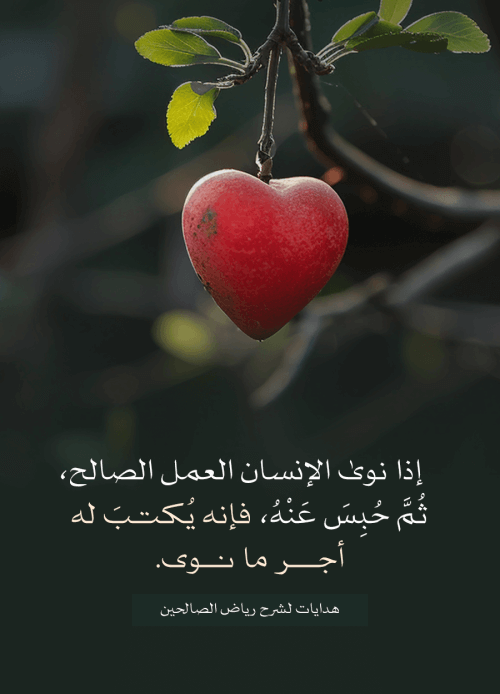
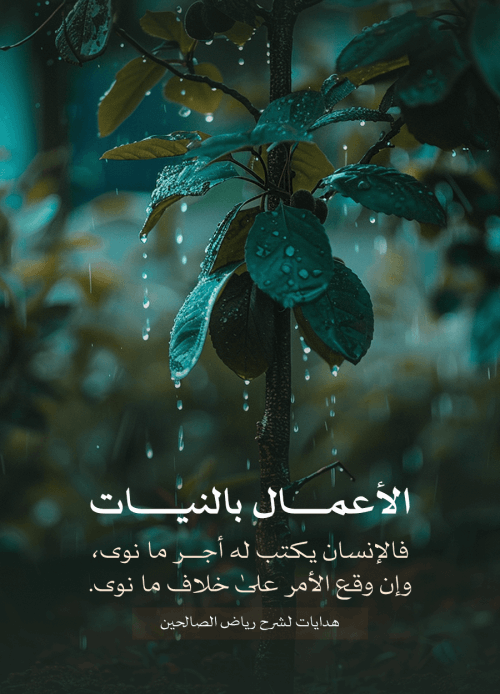
Truthfulness of the hearts is a cause to attain what is desired. Whoever intends to do a good deed will be rewarded for it even if he were unable to do it or failed to complete it.
Riyadh Al-Salheen with explanation and benefits
Thanking Allah for His blessings is one of the reasons for their permanence and increase.
Riyadh Al-Salheen with explanation and benefits
Once something is blessed, it becomes abundant even if it is little; and once something is stripped of blessings, it becomes little even if it is abundant.
Riyadh Al-Salheen with explanation and benefits
Taqwa is a [metaphorical] light helping the individual to discern between the truth and falsehood, the good and the harmful, and the [standard practice] of Sunnah from [religious] innovation.
Riyadh Al-Salheen with explanation and benefits