








Categories
Discover our diverse collection of categories covering multiple topics to meet your various interestsDa\'wa cards that highlight great meanings of the verses of the Holy Quran and the noble prophetic hadiths in a simple style and attractive display that helps the Muslim to have a deeper understanding of his religion in an easy way
﴿ وَقَالَتۡ لِأُخۡتِهِۦ قُصِّيهِۖ فَبَصُرَتۡ بِهِۦ عَن جُنُبٖ وَهُمۡ لَا يَشۡعُرُونَ ﴾
سورة القصص
She said to his sister, “Keep track of him.” So she watched him from a distance, without them noticing.

﴿ وَلَوۡ جَعَلۡنَٰهُ مَلَكٗا لَّجَعَلۡنَٰهُ رَجُلٗا وَلَلَبَسۡنَا عَلَيۡهِم مَّا يَلۡبِسُونَ ﴾
سورة الأنعام
And if We had made him an angel, We would have surely made him [appear as] a man[3], and We would have caused them confusion just as they are confused.
﴿ كَلَّآ إِنَّ كِتَٰبَ ٱلۡأَبۡرَارِ لَفِي عِلِّيِّينَ ﴾
سورة المطففين
18. Nay! Verily, the Record (writing of the deeds) of Al-Abrâr (the pious believers of Islamic Monotheism) is (preserved) in ‘Illiyyûn
﴿ أُوْلَٰٓئِكَ يُجۡزَوۡنَ ٱلۡغُرۡفَةَ بِمَا صَبَرُواْ وَيُلَقَّوۡنَ فِيهَا تَحِيَّةٗ وَسَلَٰمًا ﴾
سورة الفرقان
It is they who will be rewarded with high palaces [in Paradise] for their perseverance, and they will be received therein with salutations and greetings of peace,
﴿ فَعَّالٞ لِّمَا يُرِيدُ ﴾
سورة البروج
He does whatever He wills.
﴿ وَأُزۡلِفَتِ ٱلۡجَنَّةُ لِلۡمُتَّقِينَ ﴾
سورة الشعراء
Paradise will be brought near to the righteous,
﴿ يَٰٓأَيُّهَا ٱلَّذِينَ ءَامَنُوٓاْ إِن تُطِيعُواْ ٱلَّذِينَ كَفَرُواْ يَرُدُّوكُمۡ عَلَىٰٓ أَعۡقَٰبِكُمۡ فَتَنقَلِبُواْ خَٰسِرِينَ ﴾
سورة آل عمران
O you who believe, if you obey those who disbelieve, they will turn you back on your heels, and thus you will return as losers.
﴿ كَلَّاۚ سَيَكۡفُرُونَ بِعِبَادَتِهِمۡ وَيَكُونُونَ عَلَيۡهِمۡ ضِدًّا ﴾
سورة مريم
82. Nay, but they (the so-called gods) will deny their worship of them, and become opponents to them (on the Day of Resurrection).
﴿ فَٱسۡتَخَفَّ قَوۡمَهُۥ فَأَطَاعُوهُۚ إِنَّهُمۡ كَانُواْ قَوۡمٗا فَٰسِقِينَ ﴾
سورة الزخرف
So he bluffed his people, and they obeyed him. Indeed, they were [themselves] a people defiantly disobedient [of Allāh].
Abu Hurayrah (may Allah be pleased with him) reported: The Messenger of Allah (may Allah's peace and blessings be upon him) said: "He who performs ablution properly and then comes to the Friday prayer and listens to it attentively and keeps silent, his sins between that Friday and the following Friday will be forgiven, with the addition of three more days; but he who touches a pebble has engaged in idle activity."
Narrated by Muslim
The Prophet (may Allah's peace and blessings be upon him) informs that if a Muslim performs ablution properly, fulfilling its obligatory elements and observing its Sunnahs and etiquettes, and then goes to the Friday prayer and listens attentively to the preacher, refraining from idle activity, Allah will forgive for him the minor sins committed in ten days, from this Friday prayer to the next Friday prayer, in addition to three days. This is because the reward for a good deed is multiplied tenfold. Then, he (may Allah's peace and blessings be upon him) warned about the lack of attention to the admonitions given in the sermon and any physical diversion, like touching the pebbles and so on, saying that whoever does so has engaged in idle activity, and whoever engages in idle activity does not attain the complete reward of Friday prayer.
Abu Hurayrah (may Allah be pleased with him) reported that the Prophet (may Allah's peace and blessings be upon him) said: "Whoever goes to the mosque in the morning or the evening, Allah has prepared an abode for him in Paradise every time he goes in the morning or the evening."
Narrated by Bukhari & Muslim
The Prophet (may Allah's peace and blessings be upon him) gave glad tidings to whoever came to the mosque for worship or seeking knowledge or for any other good purpose at any time, be it in the early morning or at the end of the day, that Allah has prepared for him a place and an accommodation in Paradise whenever he goes to the mosque at night or in the morning.
Abu Mūsa al-Ash‘ari (may Allah be pleased with him) reported that the Prophet (may Allah's peace and blessings be upon him) said: "Whoever passes through any of our mosques or markets with arrows with him, he should hold them by their heads (blades) lest he injures any of the Muslims with them."
Narrated by Bukhari & Muslim
Whoever passes through mosques, markets, and places where Muslims gather while he has a weapon with him, such as arrows or the like, he should hold it by its head well, in a firm grip, lest it injures any of the Muslims.
‘Abdullāh ibn Salām (may Allah be pleased with him) reported: When the Prophet (may Allah's peace and blessings be upon him) came to Madīnah, the people rushed to meet him, and it was said: The Messenger of Allah (may Allah's peace and blessings be upon him) has come! The Messenger of Allah (may Allah's peace and blessings be upon him) has come! The Messenger of Allah (may Allah's peace and blessings be upon him) has come! Three times. I came with the people to see him, and when I saw his face clearly, I knew that his face was not the face of a liar. The first thing I heard him say was: "O people, spread the greeting of peace, feed others, maintain kinship ties, and pray at night when people are asleep, and you will enter Paradise in peace."
Narrated by At-Termedhy & Ibn Majah & Ahmad
When the Prophet (may Allah's peace and blessings be upon him) came to Madīnah and the people saw him, they rushed toward him. Among them was ‘Abdullāh ibn Salām (may Allah be pleased with him), who was a Jew. As he saw him, he knew that his face was not one of a liar, given the light, beauty, and true awe that appeared on it. The first thing he heard from the Prophet (may Allah's peace and blessings be upon him) was that he urged the people to perform deeds that lead them to enter Paradise, such as the following: First: Spreading and proclaiming the greeting of peace and frequently doing it, greeting those you know and those you do not know. Second: Feeding people through charity, gift, and hospitality. Third: Upholding kinship ties from the father's or mother's side. Fourth: Offering the supererogatory prayer of Qiyām al-Layl while people are asleep.
Abu Hurayrah (may Allah be pleased with him) reported that the Prophet (may Allah's peace and blessings be upon him) said: "When the Imām says amen, you too say amen, for whoever says amen at the same time the angels say amen will have his previous sins forgiven."
Narrated by Bukhari & Muslim
The Prophet (may Allah's peace and blessings be upon him) ordered us to say 'amen' when the Imām says it because this is the time when the angels say 'amen', and whoever says it at the same time as the angels his previous sins will be forgiven.
Abu Hurayrah (may Allah be pleased with him) reported that the Prophet (may Allah's peace and blessings be upon him) said: "If any of you leads the people in prayer, let him shorten it, because among them are the weak, the sick, and the busy (who have needs to fulfill). If any of you prays alone, then let him prolong (his prayer) as much as he wishes."
Narrated by Bukhari & Muslim
The Prophet (may Allah's peace and blessings be upon him) commanded the Muslims to shorten the prayer according to what is in the Sunnah. He justified that by saying that the weak people, as well as the sick and busy people, pray behind them. However, when they pray individually, they are free to either prolong or shorten the prayer as they wish.
Abu Hurayrah (may Allah be pleased with him) reported that the Prophet (may Allah's peace and blessings be upon him) said: "The Imām is appointed so that he should be followed; so, do not act differently from him. When he makes Takbīr all of you should say it after him; bow when he bows; say 'O our Lord, all praise be to You' when he says: Allah hears the one who praises Him; prostrate when he prostates; and all of you should pray sitting when he prays sitting."
Narrated by Bukhari & Muslim
The Prophet (may Allah's peace and blessings be upon him) mentioned the wisdom behind appointing an Imām, which is that the worshipers should follow him in their congregational prayer. They should not act differently from him in the actions of the prayer. Rather, the Imām's movements during the prayer should be observed and followed in the same order he does them. Thus, when the Imām says Takbīr, then the congregation should follow him in doing so. When the Imām bows then they all should follow him, and when the Imām reminds them that Allah will answer the ones who praise Him by saying "Allah hears the one who praises Him", then they should praise Allah by saying: "Our Lord, praise be to You". When the Imām prostrates, Muslims praying behind him should prostrate as well, and if he prays sitting because he is unable to stand, then all of them should pray sitting as well even if they are able to stand. This is how the Imām should be followed.
Abu Zuhayr ‘Umārah ibn Ru’aybah (may Allah be pleased with him) reported: The Messenger of Allah (may Allah's peace and blessings be upon him) said: "He who prays before sunrise and before sunset will not enter Hellfire."
Narrated by Muslim
The Messenger of Allah (may Allah's peace and blessings be upon him) informs that one who regularly offers the Fajr and ‘Asr prayers will not enter Hellfire. He mentioned these two prayers in particular given that they are the most difficult of all prayers because the morning prayer is at the time when one is enjoying deep sleep, and the ‘Asr prayer is at the time when one is preoccupied with daytime chores and trade, and whoever regularly observes these two prayers despite the hardship will regularly observe the rest of the prayers.
‘Uthmān (may Allah be pleased with him) reported that he heard the Messenger of Allah (may Allah's peace and blessings be upon him) say: "No Muslim person who, when an obligatory prayer becomes due, perfects its ablution, humility, and bowing except that it becomes an expiation for the sins that preceded it as long as he has not committed a major sin, and this applies to all times."
Narrated by Muslim
The Prophet (may Allah's peace and blessings be upon him) clarified that no Muslim who, when the time for an obligatory prayer becomes due, perfects and completes its ablution, then prays with humility in such a way that his heart and all of his body organs are devoted to Allah and heedful of His greatness, and he perfects the acts of prayer like bowing, prostration and other actions, except that this prayer will serve as an expiation for the preceding minor sins as long as he has not committed a major sin; and this merit applies to all times and every prayer.
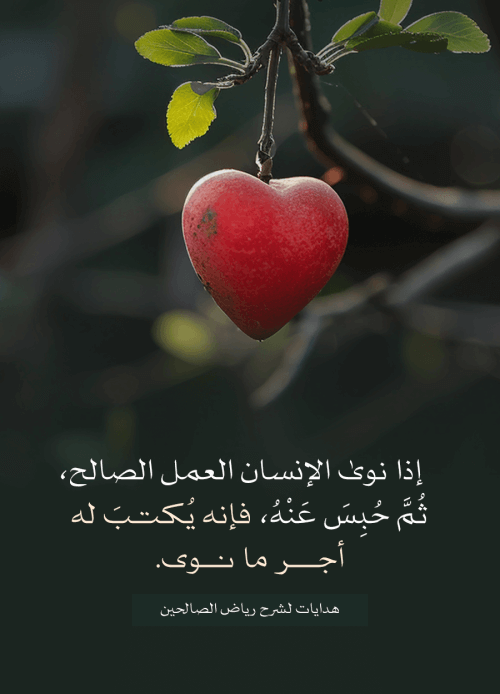
If someone intends to do a good deed but was prevented by a valid excuse, he shall gain the reward of his intention.
Riyadh Al-Salheen with explanation and benefits
Variation of reward for good deeds is based on sincerity and following of the Prophet’s guidance. The more a person is sincere to Allah, and the keener he is on following the Prophet (may Allah’s peace and blessings be upon him), the more perfect his worship will be, and consequently his reward will be bigger.
Riyadh Al-Salheen with explanation and benefits
People differ with regards to their acts of worship according to their intentions. The intentions of some people have reached the ultimate level of sincerity (to Allah) and keenness in following the Sunnah (of the Messenger of Allah) with regard to doing good and righteous deeds, while the intentions of others are below that.
Riyadh Al-Salheen with explanation and benefits
Anyone partaking a role with transgressors and wrongdoers will share their punishment because it is inclusive.
Riyadh Al-Salheen with explanation and benefits
If someone intends to do a good deed but was prevented by a valid excuse, he shall gain the reward of his intention.
Riyadh Al-Salheen with explanation and benefits
Actions are recompensed according to the intentions behind them, and the individual shall receive the reward of what he intended even if the outcome was contrary to his intention.
Riyadh Al-Salheen with explanation and benefits
There is not a single good deed intended sincerely to please Allah except that its doer will be raised in rank and status thereby, so that he would reap the full reward.
Riyadh Al-Salheen with explanation and benefits
Love and contentment is measured by good deeds and intentions because they are the criteria for Allah’s acceptance of the servant; perhaps a small deed reaps great reward because of the intention behind it and perhaps a big deed reaps little reward because of the intention behind it
Riyadh Al-Salheen with explanation and benefits
One of the proofs Allah supports the servant is the latter’s sincere endeavor to rectify his intention and purify his heart by good deeds.
هدايات لشرح رياض الصالحين