




Categories
Discover our diverse collection of categories covering multiple topics to meet your various interestsDa\'wa cards that highlight great meanings of the verses of the Holy Quran and the noble prophetic hadiths in a simple style and attractive display that helps the Muslim to have a deeper understanding of his religion in an easy way
﴿ لَعَلَّنَا نَتَّبِعُ ٱلسَّحَرَةَ إِن كَانُواْ هُمُ ٱلۡغَٰلِبِينَ ﴾
سورة الشعراء
so that we may follow the magicians, if they are victorious?”

﴿ وَإِذَا قُرِئَ ٱلۡقُرۡءَانُ فَٱسۡتَمِعُواْ لَهُۥ وَأَنصِتُواْ لَعَلَّكُمۡ تُرۡحَمُونَ ﴾
سورة الأعراف
204. So, when the Qur’ân is recited, listen to it, and be silent that you may receive mercy. [i.e. during the compulsory congregational prayers when the Imâm (of a mosque) is leading the prayer (except Sûrat Al-Fâtihah), and also when he is delivering the Friday-prayer Khutbah]. (Tafsir At-Tabari).
﴿ فَلَمَّا نَسُواْ مَا ذُكِّرُواْ بِهِۦ فَتَحۡنَا عَلَيۡهِمۡ أَبۡوَٰبَ كُلِّ شَيۡءٍ حَتَّىٰٓ إِذَا فَرِحُواْ بِمَآ أُوتُوٓاْ أَخَذۡنَٰهُم بَغۡتَةٗ فَإِذَا هُم مُّبۡلِسُونَ ﴾
سورة الأنعام
When they forgot the reminder that they were given[13], We opened for them the doors of everything – until when they rejoiced in pride for what they were given, We seized them by surprise, so they fell into utter despair.
﴿ وَإِذۡ يَتَحَآجُّونَ فِي ٱلنَّارِ فَيَقُولُ ٱلضُّعَفَٰٓؤُاْ لِلَّذِينَ ٱسۡتَكۡبَرُوٓاْ إِنَّا كُنَّا لَكُمۡ تَبَعٗا فَهَلۡ أَنتُم مُّغۡنُونَ عَنَّا نَصِيبٗا مِّنَ ٱلنَّارِ ﴾
سورة غافر
47. And, when they will dispute in the Fire, the weak will say to those who were arrogant: "Verily, we followed you: can you then take from us some portion of the Fire?"
﴿ وَمِنَ ٱلَّيۡلِ فَتَهَجَّدۡ بِهِۦ نَافِلَةٗ لَّكَ عَسَىٰٓ أَن يَبۡعَثَكَ رَبُّكَ مَقَامٗا مَّحۡمُودٗا ﴾
سورة الإسراء
And from [part of] the night, pray[769] with it [i.e., recitation of the Qur’ān] as additional [worship] for you; it is expected that[770] your Lord will resurrect you to a praised station.[771]
﴿ إِنَّ ٱلَّذِينَ كَفَرُواْ وَصَدُّواْ عَن سَبِيلِ ٱللَّهِ ثُمَّ مَاتُواْ وَهُمۡ كُفَّارٞ فَلَن يَغۡفِرَ ٱللَّهُ لَهُمۡ ﴾
سورة محمد
Those who disbelieve and prevent others from Allah’s way, and then die as disbelievers, Allah will never forgive them.
﴿ وَلَآ أَنتُمۡ عَٰبِدُونَ مَآ أَعۡبُدُ ﴾
سورة الكافرون
nor do you worship what I worship.
﴿ وَعِنَبٗا وَقَضۡبٗا ﴾
سورة عبس
as well as grapes and fodder,
﴿ وَمَآ أَدۡرَىٰكَ مَا سَقَرُ ﴾
سورة المدثر
And what can make you know what is Saqar?
Rāfi‘ ibn Khadīj (may Allah be pleased with him) reported that the Messenger of Allah (may Allah's peace and blessings be upon him) said: "The price of a dog is evil, the earning of a prostitute is evil and the earning of a cupper is evil."
Narrated by Muslim
The Prophet (may Allah's peace and blessings be upon him) clarifies for us the evil types of earnings, so that we would avoid them and resort to lawful ways of earnings instead. The money earned from selling dogs, the money earned by a prostitute and the money earned by the cupper are examples of such evil earnings. Note that the word translated as evil here is 'Khabīth' and has many meanings including evil, malicious, disgusting, offensive, etc.
Abu Mūsa (may Allah be pleased with him) reported that the Messenger of Allah (may Allah's peace and blessings be upon him) said: "The death of my Ummah is by stabbing and the plague." It was said: "O Messenger of Allah, as for stabbing, we know it, but what is the plague?" He said: "Jabbing by your enemies from among the Jinn. In both cases, there are martyrs."
Narrated by Ahmad
The Prophet (may Allah's peace and blessings be upon him) mentions that the death of the majority of the Muslims is caused by two things: First: fighting with weapons against the disbelievers in wars, and inter-Muslim fights at times of civil strife. Second: the plague, which causes widespread and collective death caused by the Muslims' enemies from among the non-Muslim Jinn, by jabbing them. Anyone who dies of either type, killing or the plague, is a martyr. However, some said that in this Hadīth, the Prophet (may Allah's peace and blessings be upon him) prayed that the members of his Ummah would die of either type so that they attain martyrdom. The first interpretation is the correct one. Allah knows best.
Abu Hurayrah (may Allah be pleased with him) reported: Abu Hind performed cupping for the Prophet (may Allah's peace and blessings be upon him) in the middle of his head. The Prophet (may Allah's peace and blessings be upon him) then said: "O Banu Bayādah, marry off (your daughters) to Abu Hind, and ask him to marry off (his daughters) to you.' He added: 'If there is benefit in anything that you use for treatment, then it is cupping.'"
Narrated by Abu Daoud
This Hadīth shows that the Prophet (may Allah's peace and blessings be upon him) had cupping made for him in his head by Abu Hind (may Allah be pleased with him). It also implies that suitability in family background and profession is not considered in marriage, for the Prophet (may Allah's peace and blessings be upon him) commanded Banu Bayādah, one of the Ansār tribes who belonged to the Azdi and Qahtāni Arabs, to marry their daughters off to Abu Hind and marry his daughters. Abu Hind was one of the freed slaves who belonged to Banu Bayādah, and beside being an ex-slave, his job was making cupping, which was a lowly profession in the sight of the Arabs. However, the Prophet (may Allah's peace and blessings be upon him) did not pay attention to suitability in family background or profession. Other texts indicate that suitability in religiousness and morals should be considered. Finally, the Prophet (may Allah's peace and blessings be upon him) mentioned that among the best methods of treatment is cupping.
‘Abdullāh ibn ‘Amr (may Allah be pleased with him) reported that the Messenger of Allah (may Allah's peace and blessings be upon him) said: "Anyone who practices medicine although he is not known to have learned medicine is liable (to compensate any damage)."
Narrated by Ibn Majah - An-Nasaa’i - Narrated by Abu Daoud
Anyone who claims to know medicine while he has neither knowledge nor experience in it and thus deludes people into receiving his treatment is responsible for the damages that he causes to them. In this respect, he has transgressed by cheating people and practicing something that he did not master. No difference is reported on the fact that if someone treats another and commits a transgression in the treatment process whereby the sick person who receives treatment is damaged, the treating person is responsible for the damage. The same thing applies to anyone who practices a science or a job of which he has no knowledge; he is a transgressor. If damage results from his practice, he is required to pay blood money for it. However, no retribution is to be inflicted on him, for he handled the sick person with his permission.
Anas reported that he said to Thābit: "Shall I not perform for you the Ruqyah of the Messenger of Allah (may Allah’s peace and blessings be upon him)?" He said: 'Yes.' He (Anas) said: "Oh Allah, Lord of mankind, Remover of harm. Cure, You are the Curer. There is no curer but You. A cure that leaves behind no illness.”
Narrated by Bukhari
Anas ibn Mālik (may Allah be pleased with him) called Thābit al-Bunāni and said to him: “Shall I not perform for you the Ruqyah of the Messenger of Allah (may Allah’s peace and blessings be upon him)?” He used to supplicate his Lord on behalf of the sick person to remove the illness, its severity and pain, and to grant him a cure after which no trace of illness remains. Scholars unanimously agree on the permissibility of using Ruqyah when three conditions are met: 1- It is made by reciting the words of Allah, or mentioning His Names or Attributes. 2- It is in Arabic or any other language whose meanings can be clearly identified. It is preferable to use expressions reported in Hadīths. 3- It must be believed that the Ruqyah in itself cannot be effective, rather it may be so only by the decree of Allah, the Exalted.
‘Abdullāh ibn ‘Umar (may Allah be pleased with him) reported that the Prophet (may Allah's peace and blessings be upon him) said: "Two kinds of dead meat and two kinds of blood have been made lawful for you. The two kinds of dead meat are fish and locusts, and the two kinds of blood are the liver and spleen."
Narrated by Ibn Majah - Narrated by Ahmad
Ibn ‘Umar informs us about two Fiqhi rulings related to the lawfulness of eating some things: the first is the lawfulness of eating dead locusts and fish, and the second is the lawfulness of eating two types of blood, which are the liver and the spleen. These two rulings are exceptions to the prohibition of eating dead animals and blood.
Abu Hurayrah (may Allah be pleased with him) reported that the Messenger of Allah (may Allah’s peace and blessings be upon him) said: “If a fly falls into the drink of anyone of you, he should dip it (in the drink) and then remove it, for in one of its wings there is a disease and in the other there is cure.” Another narration adds: “It (the fly) protects itself with the wing that has the disease.”
Narrated by Bukhari
The Prophet (may Allah's peace and blessings be upon him) informs us that if a fly falls into a drink, it does not affect it; rather, the person drinking should immerse the whole fly in the drink. The reason is that one of the fly’s wings carries a disease, and this is the wing that falls in the liquid. The other wing, however, carries the cure from that disease. Modern medicine has proven the validity of this piece of information, which Muslims have known for centuries; so, praise be to Allah for the blessing of Islam.
Anas ibn Mālik (may Allah be pleased with him) reported: Allah sent down the verse wherein He prohibited alcohol at a time when there was no other (intoxicant) drink in Madīnah except that prepared from dates.
Narrated by Muslim
In this Hadīth, Anas (may Allah be pleased with him) says that when Allah, the Almighty, revealed the verse that made alcohol unlawful to drink, there was no drink in Madīnah from which alcohol was produced except dates. This indicates that alcohol is prohibited because it causes intoxication, not because of the substance it is made from.
Ibn ‘Umar (may Allah be pleased with him and his father) reported: The Messenger of Allah (may Allah's peace and blessings be upon him) said: "Every intoxicant is Khamr (alcoholic drink), and every intoxicant is prohibited. Whoever drinks Khamr in this world and dies while being addicted to it without repenting will not drink it in the Hereafter."
The Prophet (may Allah's peace and blessings be upon him) clarified that whatever leads to losing control over one's mental faculties is considered intoxicant Khamr, whether it is to be drunk, eaten, inhaled, or otherwise; and whatever is intoxicant and clouds the mind is prohibited and forbidden by Allah Almighty, whether it is a small or big amount. Whoever drinks any of these intoxicants on a regular basis without repenting thereof until he dies will deserve Allah's punishment, namely being deprived of drinking it in Paradise.
If someone intends to do a good deed but was prevented by a valid excuse, he shall gain the reward of his intention.
Riyadh Al-Salheen with explanation and benefits
Variation of reward for good deeds is based on sincerity and following of the Prophet’s guidance. The more a person is sincere to Allah, and the keener he is on following the Prophet (may Allah’s peace and blessings be upon him), the more perfect his worship will be, and consequently his reward will be bigger.
Riyadh Al-Salheen with explanation and benefits
People differ with regards to their acts of worship according to their intentions. The intentions of some people have reached the ultimate level of sincerity (to Allah) and keenness in following the Sunnah (of the Messenger of Allah) with regard to doing good and righteous deeds, while the intentions of others are below that.
Riyadh Al-Salheen with explanation and benefits
Anyone partaking a role with transgressors and wrongdoers will share their punishment because it is inclusive.
Riyadh Al-Salheen with explanation and benefits
If someone intends to do a good deed but was prevented by a valid excuse, he shall gain the reward of his intention.
Riyadh Al-Salheen with explanation and benefits
Actions are recompensed according to the intentions behind them, and the individual shall receive the reward of what he intended even if the outcome was contrary to his intention.
Riyadh Al-Salheen with explanation and benefits
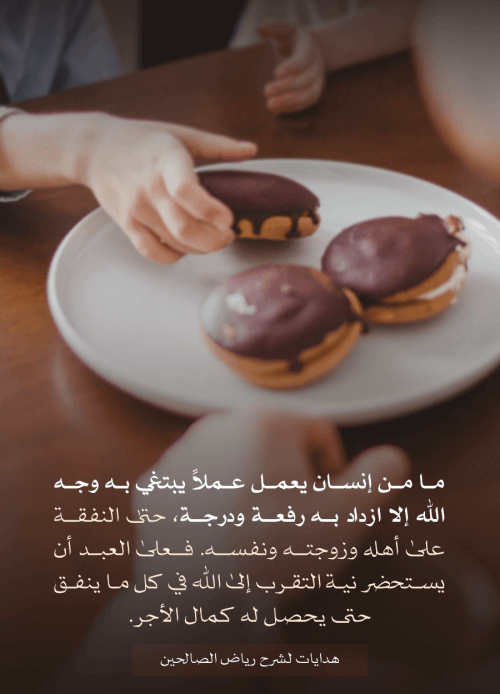
There is not a single good deed intended sincerely to please Allah except that its doer will be raised in rank and status thereby, so that he would reap the full reward.
Riyadh Al-Salheen with explanation and benefits
Love and contentment is measured by good deeds and intentions because they are the criteria for Allah’s acceptance of the servant; perhaps a small deed reaps great reward because of the intention behind it and perhaps a big deed reaps little reward because of the intention behind it
Riyadh Al-Salheen with explanation and benefits
One of the proofs Allah supports the servant is the latter’s sincere endeavor to rectify his intention and purify his heart by good deeds.
هدايات لشرح رياض الصالحين