








Categories
Discover our diverse collection of categories covering multiple topics to meet your various interestsDa\'wa cards that highlight great meanings of the verses of the Holy Quran and the noble prophetic hadiths in a simple style and attractive display that helps the Muslim to have a deeper understanding of his religion in an easy way
﴿ قُلۡ هُوَ ٱلرَّحۡمَٰنُ ءَامَنَّا بِهِۦ وَعَلَيۡهِ تَوَكَّلۡنَاۖ فَسَتَعۡلَمُونَ مَنۡ هُوَ فِي ضَلَٰلٖ مُّبِينٖ ﴾
سورة الملك
Say, "He is the Most Merciful; we have believed in Him, and upon Him we have relied. And you will [come to] know who it is that is in clear error."

﴿ أَفَغَيۡرَ دِينِ ٱللَّهِ يَبۡغُونَ وَلَهُۥٓ أَسۡلَمَ مَن فِي ٱلسَّمَٰوَٰتِ وَٱلۡأَرۡضِ طَوۡعٗا وَكَرۡهٗا وَإِلَيۡهِ يُرۡجَعُونَ ﴾
سورة آل عمران
Do they seek other than the religion of Allah, whereas to Him submit all those in the heavens and on earth, willingly or unwilling, and to Him they will return?
﴿ وَمَا جَعَلۡنَآ أَصۡحَٰبَ ٱلنَّارِ إِلَّا مَلَٰٓئِكَةٗۖ وَمَا جَعَلۡنَا عِدَّتَهُمۡ إِلَّا فِتۡنَةٗ لِّلَّذِينَ كَفَرُواْ لِيَسۡتَيۡقِنَ ٱلَّذِينَ أُوتُواْ ٱلۡكِتَٰبَ وَيَزۡدَادَ ٱلَّذِينَ ءَامَنُوٓاْ إِيمَٰنٗا وَلَا يَرۡتَابَ ٱلَّذِينَ أُوتُواْ ٱلۡكِتَٰبَ وَٱلۡمُؤۡمِنُونَ وَلِيَقُولَ ٱلَّذِينَ فِي قُلُوبِهِم مَّرَضٞ وَٱلۡكَٰفِرُونَ مَاذَآ أَرَادَ ٱللَّهُ بِهَٰذَا مَثَلٗاۚ كَذَٰلِكَ يُضِلُّ ٱللَّهُ مَن يَشَآءُ وَيَهۡدِي مَن يَشَآءُۚ وَمَا يَعۡلَمُ جُنُودَ رَبِّكَ إِلَّا هُوَۚ وَمَا هِيَ إِلَّا ذِكۡرَىٰ لِلۡبَشَرِ ﴾
سورة المدثر
And We have not made the keepers of the Fire except angels. And We have not made their number except as a trial for those who disbelieve - that those who were given the Scripture will be convinced and those who have believed will increase in faith and those who were given the Scripture and the believers will not doubt and that those in whose hearts is disease [i.e., hypocrisy] and the disbelievers will say, "What does Allāh intend by this as an example?" Thus does Allāh send astray whom He wills and guide whom He wills. And none knows the soldiers of your Lord except Him. And it [i.e., mention of the Fire] is not but a reminder to humanity.
﴿ وَمَآ ءَاتَيۡنَٰهُم مِّن كُتُبٖ يَدۡرُسُونَهَاۖ وَمَآ أَرۡسَلۡنَآ إِلَيۡهِمۡ قَبۡلَكَ مِن نَّذِيرٖ ﴾
سورة سبأ
even though We did not give them any scriptures to study, nor did We send them any warner before you.
﴿ وَأَنتُمۡ سَٰمِدُونَ ﴾
سورة النجم
While you are proudly sporting?[1575]
﴿ قَالَ تَٱللَّهِ إِن كِدتَّ لَتُرۡدِينِ ﴾
سورة الصافات
He will say, “By Allah, you were about to ruin me.
﴿ فَأَصۡحَٰبُ ٱلۡمَيۡمَنَةِ مَآ أَصۡحَٰبُ ٱلۡمَيۡمَنَةِ ﴾
سورة الواقعة
8. So those on the Right Hand (i.e. those who will be given their Records in their right hands) - how (fortunate) will be those on the Right Hand! (As a respect for them, because they will enter Paradise).
﴿ قَالُوٓاْ إِنَّا كُنَّا قَبۡلُ فِيٓ أَهۡلِنَا مُشۡفِقِينَ ﴾
سورة الطور
They will say, "Indeed, we were previously among our people fearful [of displeasing Allāh].
﴿ إِنَّآ أَرۡسَلۡنَا نُوحًا إِلَىٰ قَوۡمِهِۦٓ أَنۡ أَنذِرۡ قَوۡمَكَ مِن قَبۡلِ أَن يَأۡتِيَهُمۡ عَذَابٌ أَلِيمٞ ﴾
سورة نوح
1. Verily, We sent Nûh (Noah) to his people (saying): "Warn your people before there comes to them a painful torment."
Abu Hurayrah (may Allah be pleased with him) narrated that the Messenger of Allah (may Allah's peace and blessings be upon him) said: "The faithful and diligent slave will receive a double reward." Abu Hurayrah added: "By Him in Whose Hand the soul of Abu Hurayrah is, if it wasn’t for Jihad in the cause of Allah, and Hajj, and kindness to my mother, I would prefer to die as a slave."
Narrated by Bukhari & Muslim
Abu Hurayrah (may Allah be pleased with him) reported that the Messenger of Allah (may Allah's peace and blessings be upon him) said that the slave who faithfully serves his master and fulfills the rights of his Lord will have a double reward. He receives a reward for fulfilling Allah's right upon him in terms of worship and another reward for fulfilling his master's right upon him in terms of service. Abu Hurayrah then added that were it not for the fact that jihad is not obligatory on the slave (and there is a great reward for performing Jihad) and the fact that he used to provide for his mother and take care of her, he would have preferred to die as a slave to receive the double reward.
Abu Hurayrah (may Allah be pleased with him) reported that the Messenger of Allah (may Allah's peace and blessings be upon him) mentioned that a man from the Children of Israel asked another to lend him one thousand dinars. The man asked him to bring witnesses. The former replied: "Allah is sufficient as witness." The second said: "Bring me a surety." The former replied: "Allah is sufficient as surety." The man said: "You are right," and lent him the money for a certain period. The first man went across the sea. When he finished his job, he searched for a conveyance so that he might reach the other in time for the repayment of the debt, but he could not find any. So he took a piece of wood and made a hole in it, inserted one thousand dinars and a letter to the lender in it, and then firmly closed (i.e. sealed) the hole. He took the piece of wood to the sea and said: "O Allah, You know well that I took a loan of one thousand dinars from so-and-so. He demanded a surety from me, but I told him that Allah's guarantee was sufficient, and he accepted Your guarantee. He then asked for a witness, and I told him that Allah was sufficient as witness, and he accepted You as Witness. No doubt, I tried hard to find a conveyance so that I could give him his money, but I could not find any, so I hand over this money to You." Saying that, he threw the piece of wood into the sea till it went out far into it, and then he went away. Meanwhile, he started searching for a conveyance in order to reach the creditor's country. One day, the lender came out to see whether a ship had arrived bringing his money, when all of a sudden, he saw the piece of wood in which his money had been deposited. He took it home to use it for fire. When he sawed it, he found his money and the letter inside it. Shortly after that, the debtor came, bringing one thousand dinars to him, and he said: "By Allah, I had been trying hard to find a boat so that I could send you your money, but I failed to find one before the one I have come by." The lender asked: "Have you sent something to me?" The debtor replied: "I told you I could not find a boat other than the one I have come by." The lender said: "Allah has delivered the money which you sent in the piece of wood on your behalf. So you may keep your one thousand dinars and depart while being guided on the straight path."
Narrated by Bukhari
The Messenger of Allah (may Allah's peace and blessings be upon him) mentioned that a man from the Children of Israel requested a loan of one thousand dinars from another man. The man said to him: "Bring someone to bear witness that you have taken one thousand dinars." The man who needed the loan said: "Allah is sufficient as witness", meaning: it is sufficient for both of us that Allah is a witness over us. Then the man said to him: "Bring me a surety." So he said: "Allah is sufficient as surety", meaning: Allah is sufficient for you as a guarantee. So he replied: "You are right." So he gave him one thousand dinar for a specific period of time. So the man who requested the loan went on a ship in the ocean with the money with him in order to do business. When the appointed time to repay the loan came, he searched for a boat so that he could repay the man he took the loan from, but he did not find any. He took a piece of wood and made a hole in it and put the one thousand dinars inside the wood along with a letter from him to the debtor, saying: "From so-and-so, to so-and-so: I paid your money to an agent who will pay you on behalf of me." Then he covered the hole in the wood and sealed it. Then he took the piece of wood to the ocean and said: "O Allah you know that I have borrowed one thousand dinars from this person, and he asked me for a guarantor, and I said: 'Allah is sufficient as guarantor,' and he was pleased with you as guarantor. And he asked me for a witness and I said to him: 'Allah is sufficient as witness,' and he was pleased as you as witness. I exerted my effort in trying to find a boat to send the money that I owed, but I was not able to find any boat. And I leave it with you as a trust and deposit." Then he threw the piece of wood into the ocean until it disappeared inside the water. He left and continued to search for a boat that was going to the country of the man whom he borrowed one thousand dinar from, thinking that what he initially did was insufficient. As for the debtor, he went outside at the time of payment, looking for the boat that may be coming with his money that he lent to the man, expecting that he might send it with someone or come by himself. However, he did not find any boat. Suddenly, he saw the piece of wood that contained the money and took it to his house to use it for firewood, and he did not know that the money was inside. When he cut it with a saw, he found the money and the letter that the man had written. Then the man who had taken the loan came with another one thousand dinars. He said to the man who had given him the loan: "I exerted my efforts greatly in searching for a boat to come to you and pay back your loan, but I did not find any boat before now." The debtor said: "Did you send anything to me?" He said: "I am telling you that I did not find any boat before this boat that I came by now." Thereupon, the debtor said to him: "Allah has paid the one thousand dinars that you sent in the piece of wood on your behalf, so you may leave with the other one thousand dinars while being guided on the straight path."
‘Amr ibn Khārijah (may Allah be pleased with him) reported: The Prophet (may Allah's peace and blessings be upon him) delivered a sermon upon his she-camel, while I was under the front of her neck, and she was chewing her curd, with her saliva dripping between my shoulders. I heard him say: "Indeed, Allah has given everyone deserving a right his due right. So, there is no will for an inheritor. The child belongs to the bed, and the adulterer gets the stone. Whoever claims to belong to someone other than his father or (a freed slave) attributes himself to those other than his masters, spurning them, upon him will be the curse of Allah, and no obligatory or supererogatory act of worship will be accepted from him."
Narrated by Ibn Majah - Narrated by At-Termedhy - Narrated by Ahmad
‘Amr ibn Khārijah (may Allah be pleased with him) reported that he was close to the Prophet (may Allah's peace and blessings be upon him) as he delivered a sermon from above his she-camel, whose saliva was dripping down upon ‘Amr's shoulders. He went on to relate that the Prophet (may Allah's peace and blessings be upon him) demonstrated a number of rulings in his sermon, as follows: 1. Allah, the Almighty, has allocated to each person his due right and designated share, and therefore it is not permissible to include an heir in the will. 2. The newborn belongs to the bed, i.e. the woman’s husband or master. The adulterer has no claim to the child; rather, he only deserves disappointment and the due punishment for his crime. 3. It is prohibited for a person to be attributed to other than his father or a slave to other than his masters who set him free. The Hadīth makes it clear that whoever does so shall be subject to the curse of Allah, the Almighty, and that Allah shall not accept any act of worship from him, be it obligatory or supererogatory.
‘Awf ibn Mālik – or ibn al-Hārith – ibn at-Tufayl reported: ‘Ā’ishah (may Allah be pleased with her) was told that ‘Abdullāh ibn Az-Zubayr, upon hearing that she was selling or giving something as a gift, said: "By Allah, if ‘Ā’ishah does not give this up, I will declare her incompetent to dispose of her wealth." She asked: "Did he say so?" They replied: ‘Yes.’ So she said: "I vow to Allah that I will never speak to Ibn Az-Zubayr." When this separation had lasted for a long time, Ibn Az-Zubayr sought to intercede with her, but she said: "By Allah, I will not accept the intercession of anyone for him and will not commit a sin by breaking my vow." As this state of affairs continued for long, Ibn Az-Zubayr was concerned and he approached Al-Miswar ibn Makhramah and ‘Abdur-Rahmān ibn al-Aswad ibn ‘Abd Yaghūth and said to them: "I beseech you by Allah to help me to visit ‘Ā’ishah; it is unlawful for her to vow to sever ties with me." Al-Miswar and ‘Abdur-Rahmān took him to ‘Ā’ishah and asked for permission to enter her house, saying: "Peace, mercy, and blessings of Allah be upon you! May we come in?" She said: "Come in." They said: "All of us?" She said: "Yes, come in all of you," unaware that Ibn Az-Zubayr was with them. As they came in, Ibn Az-Zubayr entered the screened place and took hold of ‘Ā’ishah and was weeping and imploring her to forgive him. Al-Miswar and ‘Abdur-Rahmān also were begging her to speak to him and accept his apology. They said: "As you know, the Prophet (may Allah's peace and blessings be upon him) forbade a Muslim from forsaking his fellow Muslim, and it is unlawful for a Muslim to do so for more than three days." As they continued to remind and press her, she began to weep and say: "I made a vow, and a vow is something grave." They persisted in their appeal until she talked to Ibn Az-Zubayr, and she freed forty slaves in expiation for her vow. Later, whenever she remembered this vow, she would weep profusely, wetting her veil.
Narrated by Bukhari
‘Abdullāh ibn Az-Zubayr (may Allah be pleased with him) heard that ‘Ā'ishah (may Allah be pleased with her) made many large donations. Viewing this as an extravagance, he remarked: "By Allah, if ‘Ā’ishah does not give up this, I will declare her incompetent to dispose of her wealth." This was truly hurtful to ‘Ā'ishah, one of the Mothers of the Believers, as she was his maternal aunt and also because she possessed vast knowledge, sound reason, forbearance, and wisdom that should deter people from speaking about her in this way. When she heard ‘Abdullāh’s statement through the gossips, who always seek to damage people’s ties and stir up discord amongst them, she vowed to never speak to him again as she was so upset. She boycotted him, which was something too hard for him to bear. So he tried to appease her, but she was determined, because she was concerned about the seriousness of her vow. Ibn Az-Zubayr sought the help of two of the Prophet’s Companions, who played a good ruse that led to a good outcome; repairing the relationship between people. They went to ‘Ā’ishah, greeted her, and asked her permission to enter her house. They asked: “May we enter?” She said: ‘Yes.’ They said: “All of us?” She said: ‘Yes’, not knowing that ‘Abdullāh was with them. They all entered as she hid behind the veil that was particularly observed by the Mothers of Believers to prevent people from seeing them - ordinary women are just required to conceal their faces and bodies, but that veil acted like a barrier between the Prophet’s wives and their unrelated men. When they entered, Ibn Az-Zubayr, her nephew, bypassed the veil and rushed towards her, weeping and imploring her to forgive him. He warned her that the severance of kinship ties was forbidden, but she took her vow very seriously and was afraid to break it. The two men persuaded her to change her mind, reminding her of the Prophet's Hadīth stating that it is unlawful for a Muslim to desert his fellow Muslim for over three days. Finally convinced, she wept and spoke to him. ‘Ā’ishah (may Allah be pleased with her) was so affected by this situation that she would cry every time she remembered it. To expiate for her broken vow, she emancipated forty slaves, hoping that Allah, the Almighty, would save her from Hellfire. Indeed, this reflected her caution and extreme piety, as the due expiation is the emancipation of just one slave.
‘Ā’ishah (may Allah be pleased with her) bought Barīrah from a household belonging to the Ansār, and they stipulated that they retain the ex-slave's allegiance. The Messenger of Allah (may Allah’s peace and blessings be upon him) said: "Allegiance is pledged to the one who did the favor (of setting the slave free)." The Prophet (may Allah's peace and blessings be upon him) also gave Barīrah the choice (either to retain her marriage or break it), as her husband was a slave. She gave some meat to ‘Ā’ishah as a gift, and the Messenger of Allah (may Allah’s peace and blessings be upon him) said: "I wish you could cook this meat for us." ‘Ā’ishah said: "It was given in charity to Barīrah." He said: "It was charity to her but a gift to us."
Narrated by Bukhari & Muslim
According to this Hadīth, ‘Ā’ishah (may Allah be pleased with her) bought Barīrah and freed her, but her ex-master conditioned that they retain Barīrah's allegiance. The Messenger of Allah (may Allah’s peace and blessings be upon him) told her that this condition is void because allegiance is pledged to the one who did the favor of setting the slave free. Regarding Barīrah, she was married to a slave named Mughīth, so when she became higher than him (in rank) as a free woman with an independent will, the Prophet (may Allah's peace and blessings be upon him) gave her the choice either to retain her matrimonial bond or break it. Later, Barīrah received meat as charity and sent some of it to ‘Ā’ishah (may Allah be pleased with her) as a gift. The Messenger of Allah (may Allah’s peace and blessings be upon him) wanted to eat from that meat. ‘Ā’ishah (may Allah be pleased with her) told the Prophet (may Allah's peace and blessings be upon him) that it had originally been given in charity to Barīrah, and thus he was not allowed to eat from it. However, the Prophet (may Allah's peace and blessings be upon him) told her that Barīrah was given the meat as charity, while the Prophet (may Allah's peace and blessings be upon him) was given it as a gift from her. Therefore, the ruling of this meat changed from a charity to a gift, so eating it was allowable for the Prophet (may Allah's peace and blessings be upon him) and his household.
Anas reported that his aunt, Ar-Rubayyi‘, broke the incisor of a girl. The aunt's family requested the girl's relatives for pardon, but they refused, then they proposed a compensation, but they refused. Then they went to the Messenger of Allah (may Allah's peace and blessings be upon him) and refused everything except retribution. So the Messenger of Allah (may Allah's peace and blessings be upon him) judged that retribution be applied. Anas ibn An-Nadr said: "O Messenger of Allah, will the incisor of Ar-Rubayyi‘ be broken? No, by the One Who sent you with the Truth, her incisor will not be broken." Therefore, the Messenger of Allah (may Allah's peace and blessings be upon him) said: "O Anas, the prescribed law of Allah is retribution." Thereupon, those people agreed on pardon. Then the Messenger of Allah (may Allah's peace and blessings be upon him) said: "Among Allah's slaves, there are some who, if they take an oath by Allah (concerning something), Allah fulfills it."
Al-Bukhari and Muslim. This is the wording of Al-Bukhari
This Hadīth indicates that Ar-Rubayyi‘ (may Allah be pleased with her) broke some of the front teeth of a girl from the Ansār. So the Prophet (may Allah's peace and blessings be upon him) wanted that retribution be inflicted upon her, such that her equivalent front teeth be broken. However, her brother Anas ibn An-Nadr asked rhetorically, not denying the judgment of Allah, whether her teeth should be broken. He swore, out of good faith in Allah, that her teeth would not be broken. Nevertheless, the Prophet (may Allah's peace and blessings be upon him) reminded him that the divine judgment entails retribution. So when the victim's family saw that, they agreed to accept the compensation and gave up retribution. Hence, the Prophet (may Allah's peace and blessings be upon him) said that among the slaves of Allah, there are some people who, if they swear an oath, Allah fulfills it for them, owing to their righteousness and trust in Allah.
Ibn ‘Umar (may Allah be pleased with him) reported: The Prophet (may Allah's peace and blessings be upon him) would hold horse races and would prefer the stronger horses for the longer distances.
Narrated by Abu Daoud - Narrated by Ahmad
This Hadīth illustrates the permissibility of holding horse races, and setting for them different distances to cover according to the variable degrees of horses in terms of their strength and endurance. Horses vary in stamina, so they should be given suitable distances.
Samurah reported that the Messenger of Allah (may Allah's peace and blessings be upon him) said: "If anyone gets possession of a relative who is within the prohibited degrees, that person becomes free."
Narrated by Ibn Majah - Narrated by At-Termedhy - Narrated by Abu Daoud - Narrated by Ahmad
This Hadīth illustrates that anyone who owns someone who is a close relative to him in such a way that it entails prohibition of marriage, then that person becomes free once he is owned. For example, if someone comes to own his father, mother, sister, aunt, etc. through purchase, gift, booty, or inheritance, they are to be set free.
Safīnah (may Allah be pleased with him) reported: I was Umm Salāmah’s slave, and she said: "I will free you on condition that you serve the Messenger of Allah (may Allah's peace and blessings be upon him) for as long as you live." I replied: "Even if you do not make this a condition, I will never desert the Messenger of Allah (may Allah's peace and blessings be upon him) for as long as I live." She manumitted me pursuant to this condition.
Narrated by Ibn Majah - Narrated by Abu Daoud - Narrated by Ahmad
In this Hadīth, Safīnah (may Allah be pleased with him) relates that he was a slave of Umm Salāmah (may Allah be pleased with her) and she freed him on condition that he served the Messenger of Allah (may Allah’s peace and blessings be upon him) for the rest of his life. He told her that, even if she had not stipulated this condition, he would not desert the Prophet (may Allah's peace and blessings be upon him) as long as he lived. She manumitted him subject to this condition. The Hadīth indicates that it is valid to stipulate a condition in relation to the manumission of slaves.
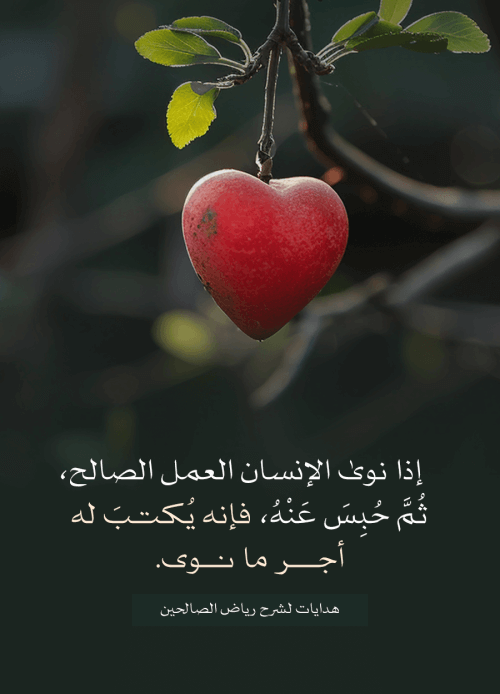
If someone intends to do a good deed but was prevented by a valid excuse, he shall gain the reward of his intention.
Riyadh Al-Salheen with explanation and benefits
Variation of reward for good deeds is based on sincerity and following of the Prophet’s guidance. The more a person is sincere to Allah, and the keener he is on following the Prophet (may Allah’s peace and blessings be upon him), the more perfect his worship will be, and consequently his reward will be bigger.
Riyadh Al-Salheen with explanation and benefits
People differ with regards to their acts of worship according to their intentions. The intentions of some people have reached the ultimate level of sincerity (to Allah) and keenness in following the Sunnah (of the Messenger of Allah) with regard to doing good and righteous deeds, while the intentions of others are below that.
Riyadh Al-Salheen with explanation and benefits
Anyone partaking a role with transgressors and wrongdoers will share their punishment because it is inclusive.
Riyadh Al-Salheen with explanation and benefits
If someone intends to do a good deed but was prevented by a valid excuse, he shall gain the reward of his intention.
Riyadh Al-Salheen with explanation and benefits
Actions are recompensed according to the intentions behind them, and the individual shall receive the reward of what he intended even if the outcome was contrary to his intention.
Riyadh Al-Salheen with explanation and benefits
There is not a single good deed intended sincerely to please Allah except that its doer will be raised in rank and status thereby, so that he would reap the full reward.
Riyadh Al-Salheen with explanation and benefits
Love and contentment is measured by good deeds and intentions because they are the criteria for Allah’s acceptance of the servant; perhaps a small deed reaps great reward because of the intention behind it and perhaps a big deed reaps little reward because of the intention behind it
Riyadh Al-Salheen with explanation and benefits
One of the proofs Allah supports the servant is the latter’s sincere endeavor to rectify his intention and purify his heart by good deeds.
هدايات لشرح رياض الصالحين