




Categories
Discover our diverse collection of categories covering multiple topics to meet your various interestsDa\'wa cards that highlight great meanings of the verses of the Holy Quran and the noble prophetic hadiths in a simple style and attractive display that helps the Muslim to have a deeper understanding of his religion in an easy way
﴿ قَالُواْ وَهُمۡ فِيهَا يَخۡتَصِمُونَ ﴾
سورة الشعراء
They will say while they dispute therein,

﴿ هُوَ ٱللَّهُ ٱلَّذِي لَآ إِلَٰهَ إِلَّا هُوَ ٱلۡمَلِكُ ٱلۡقُدُّوسُ ٱلسَّلَٰمُ ٱلۡمُؤۡمِنُ ٱلۡمُهَيۡمِنُ ٱلۡعَزِيزُ ٱلۡجَبَّارُ ٱلۡمُتَكَبِّرُۚ سُبۡحَٰنَ ٱللَّهِ عَمَّا يُشۡرِكُونَ ﴾
سورة الحشر
He is Allah; none has the right to be worshiped except Him, the Sovereign[15], the Most Holy[16], the Most Perfect[17], the Granter of Security[18], the Watcher over all, the All-Mighty, the Compeller[19], the Supreme[20]. Glory be to Allah far above what they associate with Him.
﴿ ثُمَّ أَمَاتَهُۥ فَأَقۡبَرَهُۥ ﴾
سورة عبس
then He caused him to die and be buried;
﴿ وَمَا كَانَ لَنَا عَلَيۡكُم مِّن سُلۡطَٰنِۭۖ بَلۡ كُنتُمۡ قَوۡمٗا طَٰغِينَ ﴾
سورة الصافات
And we had over you no authority, but you were a transgressing people.
﴿ وَمَن يَعۡمَلۡ سُوٓءًا أَوۡ يَظۡلِمۡ نَفۡسَهُۥ ثُمَّ يَسۡتَغۡفِرِ ٱللَّهَ يَجِدِ ٱللَّهَ غَفُورٗا رَّحِيمٗا ﴾
سورة النساء
110. And whoever does evil or wrongs himself but afterwards seeks Allâh’s Forgiveness, he will find Allâh Oft-Forgiving, Most Merciful.
﴿ قَالَ لَهُۥ صَاحِبُهُۥ وَهُوَ يُحَاوِرُهُۥٓ أَكَفَرۡتَ بِٱلَّذِي خَلَقَكَ مِن تُرَابٖ ثُمَّ مِن نُّطۡفَةٖ ثُمَّ سَوَّىٰكَ رَجُلٗا ﴾
سورة الكهف
37. His companion said to him during the talk with him: "Do you disbelieve in Him Who created you out of dust (i.e. your father Adam), then out of Nutfah (mixed semen drops of male and female discharge), then fashioned you into a man?
﴿ وَلَئِنۡ أَصَٰبَكُمۡ فَضۡلٞ مِّنَ ٱللَّهِ لَيَقُولَنَّ كَأَن لَّمۡ تَكُنۢ بَيۡنَكُمۡ وَبَيۡنَهُۥ مَوَدَّةٞ يَٰلَيۡتَنِي كُنتُ مَعَهُمۡ فَأَفُوزَ فَوۡزًا عَظِيمٗا ﴾
سورة النساء
But if bounty comes to you from Allāh, he will surely say, as if [i.e., showing that] there had never been between you and him any affection, "Oh, I wish I had been with them so I could have attained a great attainment."[197]
﴿ وَأَمۡطَرۡنَا عَلَيۡهِم مَّطَرٗاۖ فَسَآءَ مَطَرُ ٱلۡمُنذَرِينَ ﴾
سورة النمل
And We rained upon them a rain [of stones], and evil was the rain of those who were warned.
﴿ وَإِن كَانَ ذُو عُسۡرَةٖ فَنَظِرَةٌ إِلَىٰ مَيۡسَرَةٖۚ وَأَن تَصَدَّقُواْ خَيۡرٞ لَّكُمۡ إِن كُنتُمۡ تَعۡلَمُونَ ﴾
سورة البقرة
If the debtor is in hardship, give him respite until it is easy for him to pay back. But if you waive it as charity[171], that is better for you, if only you knew.
Ibn ‘Abbās (may Allah be pleased with him and his father) reported: The Messenger of Allah (may Allah's peace and blessings be upon him) said to a woman from the Ansār—Ibn ‘Abbās named her, but I forgot her name—"What prevented you from performing Hajj with us?" She said: We only had two camels, and the father of her son and her son performed Hajj on one camel and left us a camel to carry water on. He said: "Perform ‘Umrah when Ramadan comes, for ‘Umrah in it is equivalent to Hajj."
Narrated by Bukhari & Muslim
On returning from the Farewell Hajj, the Prophet (may Allah's peace and blessings be upon him) said to a woman from the Ansār who did not perform Hajj: What prevented you from performing Hajj with us? Her excuse was that they had two camels; one of which her husband and son performed Hajj on, leaving the other to bring them water from the well. Thereupon, the Prophet (may Allah's peace and blessings be upon him) informed her that ‘Umrah performed during the month of Ramadan is similar in reward to that of Hajj.
Abu Hurayrah (may Allah be pleased with him) reported: The Prophet (may Allah's peace and blessings be upon him) used to observe I‘tikāf during each Ramadan for ten days. The year in which he died, he observed I‘tikāf for twenty days.
Narrated by Bukhari
The Prophet (may Allah's peace and blessings be upon him) used to confine himself to the mosque to worship Allah for ten days in each Ramadan, particularly the middle ten nights of the month, with the hope that he would observe Laylat al-Qadr [Night of Decree] in those days. When he knew that the Night of Decree was in the last ten nights, he confined himself during those ten nights. The year in which he died, he secluded himself for twenty days to worship Allah Almighty more, and to get even closer to Him.
‘Ā’ishah, Mother of the Believers, (may Allah be pleased with her) reported saying: O Messenger of Allah, we consider Jihad the best deed; should we not perform Jihad? He said, "No; rather, the best Jihad is Mabrūr (accepted) Hajj."
Narrated by Bukhari
The Companions (may Allah be pleased with them) used to consider Jihad in the cause of Allah and fighting the enemies among the best of deeds. Therefore, ‘Ā’ishah (may Allah be pleased with her) asked the Prophet (may Allah's peace and blessings be upon him) if women should perform Jihad. He (may Allah's peace and blessings be upon him) guided them to the best Jihad they could perform, namely the Mabrūr Hajj that conforms with the Qur’an and Sunnah and that is free of sin and ostentation.
‘Abdullāh ibn ‘Umar (may Allah be pleased with him) reported that a woman was found killed in one of the expeditions of the Prophet (may Allah's peace and blessings be upon him), and so the Messenger of Allah (may Allah's peace and blessings be upon him) denounced killing women and boys.
Narrated by Bukhari & Muslim
The Prophet (may Allah's peace and blessings be upon him) saw a woman killed in one of the battles, and he denounced killing women and young boys who had not reached puberty.
Abu Tha‘labah al-Khushani (may Allah be pleased with him) reported: I went to the Messenger of Allah (may Allah's peace and blessings be upon him) and asked: "We live in the land of the People of the Book; can we eat in their plates? It is also a land of game, and I hunt the game with my bow, with my untrained hound and with my trained hound. What is lawful for me to eat?" He said: "As for what you have mentioned about the plates of the People of the Book, if you can find other plates, do not use theirs, but if you cannot find (other than theirs), wash their plates and eat in them. If you hunt an animal with your bow after mentioning Allah's name, eat it. If you hunt something with your trained hound after mentioning Allah's name, eat it. If you hunt something with your untrained hound and manage to slaughter it (before it dies), eat it."
Narrated by Bukhari & Muslim
Abu Tha‘labah (may Allah be pleased with him) asked the Prophet (may Allah's peace and blessings be upon him) if they were allowed to eat in the plates of the People of the Book, although they may be impure? "The People of the Book" refers to the Jews and the Christians, who were Abu Tha‘labah’s neighbors. The Prophet (may Allah's peace and blessings be upon him) permitted him to use these plates for eating or otherwise on two conditions: 1. Failing to find other utensils. 2. Washing them. He then said that they were living in a land full of game and he would hunt with his bow, his trained hound, and his untrained hound. He asked what would be lawful to eat if caught by any of them. The Prophet (may Allah's peace and blessings be upon him) told him that the game shot by his bow would be permissible to eat on condition that he must mention the name of Allah, the Exalted, when he releases the arrow from the bow. Likewise, it would be permissible to eat the game caught by the trained hound if the name of Allah was mentioned when releasing it. However, it would not be permissible to eat the game caught by the untrained hound, unless the game was found alive and slaughtered in an approved manner.
Ibn ‘Umar (may Allah be pleased with him) reported: The Prophet (may Allah's peace and blessings be upon him) forbade vowing and said: "Indeed, it does not bring any good; rather it is only a means to extract something from the miser."
Narrated by Bukhari & Muslim
The Prophet (may Allah's peace and blessings be upon him) forbade making a vow, which means that a person obliges himself to do something not ordained upon him by the Shariah. He said: A vow does not advance anything or postpone it. Rather. it is only a means whereby something can be extracted from the miser who only does what is obligatory for him; and a vow does not bring about something that had not been predestined for him.
Abu Mūsa al-Ash‘ari (may Allah be pleased with him) reported: I went to the Messenger of Allah (may Allah's peace and blessings be upon him) along with a group of Ash‘ari people, asking him for mounts. He said: "By Allah, I will not give you anything to ride, and I have nothing to mount you on." We stayed there as long as Allah wished. Then some camels were brought to him, and he ordered that we be given three camels. When we set out, some of us said to others: "Allah will not bless us, as we all went to the Messenger of Allah (may Allah's peace and blessings be upon him) asking him for mounts, and although he had sworn that he would not give us mounts, he did give us." Abu Mūsa said: We went to the Prophet (may Allah's peace and blessings be upon him) and mentioned that to him. He said: "I have not provided you with mounts, but Allah has. By Allah, Allah Willing, if I ever take an oath and then see that another option is better than the first, I will make expiation for my oath and do what is better."
Narrated by Bukhari & Muslim
Abu Mūsa al-Ash‘ari (may Allah be pleased with him) informs that he went to the Messenger of Allah (may Allah's peace and blessings be upon him) along with a group of people from his tribe. They aimed to ask the Prophet (may Allah's peace and blessings be upon him) to give them camels to ride so that they could take part in Jihad. He (may Allah's peace and blessings be upon him) swore that he would not provide them with mounts and that he did not have any to give them. They went back and stayed for a period of time. Then, three camels were brought to the Prophet (may Allah's peace and blessings be upon him), who sent them to them. They said to one another: Allah will not bless these camels for us, for the Prophet (may Allah's peace and blessings be upon him) swore that he would not provide us with mounts. So, they went and asked him about this issue. Thereupon, the Prophet (may Allah's peace and blessings be upon him) said: Allah Almighty is the One Who has provided you with mounts, for He has granted help and sustenance. I am only a means through which this has come to pass. Then, he (may Allah's peace and blessings be upon him) said: By Allah, Allah Willing, I do not take an oath to do or abandon something and then see that another choice is better and preferable except that I choose to do what is better, aleave the thing upon which I swore, and make expiation for my oath.
Abu Mūsa (may Allah be pleased with him) reported: The Messenger of Allah (may Allah's peace and blessings be upon him) was asked about a man who fights out of valor, fights out of chauvinism, and fights out of ostentation. Which one of them is in the cause of Allah? The Messenger of Allah (may Allah's peace and blessings be upon him) said: "Whoever fights so that the word of Allah be supreme is indeed in the cause of Allah."
Narrated by Bukhari & Muslim
The Prophet (may Allah's peace and blessings be upon him) was asked about the fighters' different motives, like the one who fights out of valor, chauvinism, or to impress people or for any other purpose. Which of these is in the cause of Allah? The Prophet (may Allah's peace and blessings be upon him) stated that the fighter in the cause of Allah is the one who fights to make the word of Allah supreme.
Thābit ibn Ad-Dahhāk (may Allah be pleased with him) reported: I gave an oath of allegiance to the Messenger of Allah (may Allah's peace and blessings be upon him) under the tree. Then, the Messenger (may Allah's peace and blessings be upon him) said: "If anyone swears by a religion other than Islam falsely and intentionally, he is as he has said. If anyone kills himself with something, he will be punished with it on the Day of Judgment. A man cannot make a vow on something that he does not possess." Another narration reads: "Cursing a believer is like killing him." A third narration stipulates: "If anyone makes a false claim to an increase of something, Allah, the Exalted and Glorified, will only give him a decrease."
Narrated by Bukhari & Muslim
Thābit ibn Ad-Dahhāk al-Ansāri (may Allah be pleased with him) is one of those who gave an oath of allegiance to the Prophet (may Allah's peace and blessings be upon him) under the tree in Bay‘at Ar-Ridwān on the day of Hudaybiyah. He reported that the Prophet (may Allah's peace and blessings be upon him) said that if someone intentionally swears by a religion other than Islam, he would be as he swore. In other words, he would be a Jew, Christian, Zoroastrian, or a disbeliever, or he would be disassociated from Allah and His Messenger if did such and such. If he falsely makes such an oath intentionally, he would belong to the non-Islamic religion that he had ascribed himself to in the oath. And if someone kills himself with a sword, knife, bullet, or any lethal object, he will be punished with that object on the Day of Judgment. Additionally, if a person makes a vow on something that he doesn't possess, like vowing to free a slave that he does not own or to give charity from someone else's money, such a vow is null and void, because the one making the vow doesn't own what he is making the vow on. Also, cursing a believer is like killing him, because both acts violate what Allah, the Almighty, has prohibited and are considered as sins and warrant a punishment. Furthermore, if someone exaggerates and proudly claims to have what he does not possess, such as wealth, knowledge, family background, position, etc., Allah will increase him in nothing but humiliation and degradation. This is because such a person wants to elevate himself through something he doesn't have. So, he will be punished with the opposite of his objective.
The path of Allah is one whereas the paths of the devil are many; and a truly guided individual is he whom Allah Almighty guided to His path. Allah Almighty said: {This is My straight path; follow it and do not follow other ways, lest they lead you away from His way.} [Surat al-An‘ām: 153]
Riyadh Al-Salheen with explanation and benefits
Waiting to do a good deed is in itself a good deed.
Riyadh Al-Salheen with explanation and benefits
Good intention leads its holder to good things.
Riyadh Al-Salheen with explanation and benefits
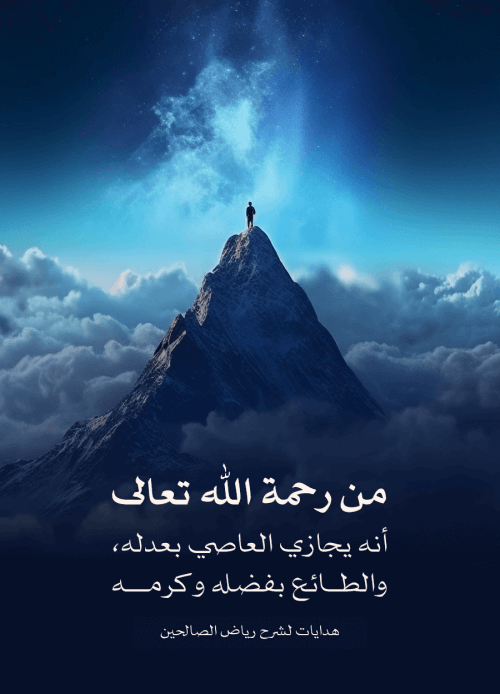
One of the manifestations of Allah’s mercy is that He uses justice to recompense the sinner but uses His grace and bounty to recompense the good-doer.
Riyadh Al-Salheen with explanation and benefits
Sincerity is one of the means to alleviate adversity because each one of them said: “O Allah! If I did that for Your sake only, then relieve us from the distress we are in.”
Riyadh Al-Salheen with explanation and benefits
Good deeds are means to alleviating adversity.
Riyadh Al-Salheen with explanation and benefits
“The righteousness of the heart results from the righteousness of deeds, and the righteousness of deeds results from the righteousness of intention.”
Riyadh Al-Salheen with explanation and benefits
Repentance is a cause for success, which is why a true successful person is the one seeking and committing to a means leading to success.
Riyadh Al-Salheen with explanation and benefits
Hastening to repentance is one of the causes to earning the pleasure of Allah with His servant.
Riyadh Al-Salheen with explanation and benefits