








Categories
Discover our diverse collection of categories covering multiple topics to meet your various interestsDa\'wa cards that highlight great meanings of the verses of the Holy Quran and the noble prophetic hadiths in a simple style and attractive display that helps the Muslim to have a deeper understanding of his religion in an easy way
﴿ أَطَّلَعَ ٱلۡغَيۡبَ أَمِ ٱتَّخَذَ عِندَ ٱلرَّحۡمَٰنِ عَهۡدٗا ﴾
سورة مريم
Has he looked into the unseen, or has he taken from the Most Merciful a promise?

﴿ قُل رَّبِّ إِمَّا تُرِيَنِّي مَا يُوعَدُونَ ﴾
سورة المؤمنون
Say, [O Muḥammad], "My Lord, if You should show me that which they are promised,
﴿ أَفَرَءَيۡتُمُ ٱللَّٰتَ وَٱلۡعُزَّىٰ ﴾
سورة النجم
Have you [O disbelievers] thought about [the idols of] Lāt and ‘Uzzā,
﴿ فَٰكِهِينَ بِمَآ ءَاتَىٰهُمۡ رَبُّهُمۡ وَوَقَىٰهُمۡ رَبُّهُمۡ عَذَابَ ٱلۡجَحِيمِ ﴾
سورة الطور
18. Enjoying in that which their Lord has bestowed on them, and (the fact that) their Lord saved them from the torment of the blazing Fire.
﴿ وَيَوۡمَ يَحۡشُرُهُمۡ كَأَن لَّمۡ يَلۡبَثُوٓاْ إِلَّا سَاعَةٗ مِّنَ ٱلنَّهَارِ يَتَعَارَفُونَ بَيۡنَهُمۡۚ قَدۡ خَسِرَ ٱلَّذِينَ كَذَّبُواْ بِلِقَآءِ ٱللَّهِ وَمَا كَانُواْ مُهۡتَدِينَ ﴾
سورة يونس
45. And on the Day when He shall gather (resurrect) them together, (it will be) as if they had not stayed (in the life of this world and graves) but an hour of a day. They will recognise each other. Ruined indeed will be those who denied the Meeting with Allâh, and were not guided.
﴿ وَتَكُونُ ٱلۡجِبَالُ كَٱلۡعِهۡنِ ﴾
سورة المعارج
And the mountains will be like wool,[1750]
﴿ فَخَلَفَ مِنۢ بَعۡدِهِمۡ خَلۡفٞ وَرِثُواْ ٱلۡكِتَٰبَ يَأۡخُذُونَ عَرَضَ هَٰذَا ٱلۡأَدۡنَىٰ وَيَقُولُونَ سَيُغۡفَرُ لَنَا وَإِن يَأۡتِهِمۡ عَرَضٞ مِّثۡلُهُۥ يَأۡخُذُوهُۚ أَلَمۡ يُؤۡخَذۡ عَلَيۡهِم مِّيثَٰقُ ٱلۡكِتَٰبِ أَن لَّا يَقُولُواْ عَلَى ٱللَّهِ إِلَّا ٱلۡحَقَّ وَدَرَسُواْ مَا فِيهِۗ وَٱلدَّارُ ٱلۡأٓخِرَةُ خَيۡرٞ لِّلَّذِينَ يَتَّقُونَۚ أَفَلَا تَعۡقِلُونَ ﴾
سورة الأعراف
169. Then after them succeeded an (evil) generation, which inherited the Book, but they chose (for themselves) the goods of this low life (evil pleasures of this world) saying (as an excuse): "(Everything) will be forgiven to us." And if (again) the offer of the like (evil pleasures of this world) came their way, they would (again) seize them (would commit those sins). Was not the covenant of the Book taken from them that they would not say about Allâh anything but the truth? And they have studied what is in it (the Book). And the home of the Hereafter is better for those who are Al-Muttaqûn (the pious - See V.2:2). Do not you then understand?
﴿ وَسَلَٰمٌ عَلَيۡهِ يَوۡمَ وُلِدَ وَيَوۡمَ يَمُوتُ وَيَوۡمَ يُبۡعَثُ حَيّٗا ﴾
سورة مريم
Peace be on him the day he was born, the day he will die, and the day he will be raised up to life again!
﴿ فَلَمَّا جَآءَ ٱلسَّحَرَةُ قَالَ لَهُم مُّوسَىٰٓ أَلۡقُواْ مَآ أَنتُم مُّلۡقُونَ ﴾
سورة يونس
So when the magicians came, Moses said to them, "Throw down whatever you will throw."
Abu Maryam al-Azdi reported: When I went to see Mu‘āwiyah, he said: "How good your visit is to us, O father of so-and-so." (This is an idiom used by the Arabs on such occasions). I said: "I will tell you a Hadīth that I heard. I heard the Messenger of Allah (may Allah's peace and blessings be upon him) say: 'If Allah, the Exalted, puts someone in the position of authority over the affairs of Muslims and he secludes himself, not meeting their needs, deficiencies, and poverty, Allah will keep Himself away from him, not fulfilling his needs, deficiencies, and poverty.'" He said: “He appointed a man to meet people’s needs.”
Narrated by At-Termedhy - Narrated by Abu Daoud - Narrated by Ahmad
Abu Maryam al-Azdi said that one day, he visited Mu‘āwiyah and Mu‘āwiyah was happy to see him and welcomed him. Abu Maryam told him a Hadīth that he heard from the Prophet (may Allah's peace and blessings be upon him) about the people who are appointed in authority over the Muslims and they then conceal themselves from the people and do not fulfill their rights. They shut their doors and are not accessible. Allah, the Almighty, will cover Himself from them on the Day of Judgment, punishing them in the same manner they abused their power. He will withhold His bounty and mercy from them. On hearing that, Mu‘āwiyah (may Allah be pleased with him) appointed someone to look after the needs of people and tell him of their concerns.
Jābir (may Allah be pleased with him) reported: The Prophet (may Allah's peace and blessings be upon him) said to me: "When the revenues of Bahrain arrive, I shall give you this much and this much and this much." He passed away before the revenues were received. When they arrived during the caliphate of Abu Bakr (may Allah be pleased with him), he called out: "Anyone whom the Messenger of Allah (may Allah's peace and blessings be upon him) promised or owed anything should come to me." I went to him and said: "The Prophet (may Allah's peace and blessings be upon him) had said to me such-and-such." He took a double handful out of the money and gave it to me. I counted it and found that it was five hundred. Then he said to me: "Take twice as much more of that amount."
Narrated by Bukhari & Muslim
Jābir ibn ‘Abdullāh (may Allah be pleased with him) says in this Hadīth that the Prophet (may Allah's peace and blessings be upon him) promised to give him a plentiful amount of the money that would come from Bahrain. The money came during the caliphate of Abu Bakr, after the Prophet had passed away. Abu Bakr asked those whom the Prophet had promised to give gifts or to whom he owed things to come over. Indeed, the Prophet (may Allah's peace and blessings be upon him) might have purchased something from someone and owed him the price, or promised to give someone a certain grant. Jābir went to Abu Bakr and told him that the Prophet said that he would give him a certain amount when revenues came from Bahrain. Abu Bakr told him: 'Take.' So he scooped from the money with both hands and counted it, finding it to be five hundred. So Abu Bakr told him: "Take twice as much," because the Prophet (may Allah's peace and blessings be upon him) said: "This much and this much and this much", meaning three times. Thus Abu Bakr fulfilled the Prophet's promise to Jābir.
‘Abdullāh ibn ‘Abbās (may Allah be pleased with him) reported: ‘Uyaynah ibn Hisn came to Madīnah and stayed with his nephew Al-Hurr ibn Qays who was among the people close to ‘Umar (may Allah be pleased with him). The Qur’anic reciters, old or young, had the privilege of joining ‘Umar's council and he used to consult them. ‘Uyaynah said to Al-Hurr: "My nephew, you are privileged in the sight of the Commander of the Believers. So, seek permission for me to sit with him?" Al-Hurr asked ‘Umar and he granted permission. When ‘Uyaynah came into the presence of ‘Umar, he addressed him thus: "O son of Al-Khattāb, By Allah, you neither bestow much on us nor deal with us justly." ‘Umar (may Allah be pleased with him) got so angry that he was about to beat him. Thereupon, Al-Hurr said: ''O Commander of the Believers! Allah said to His Prophet: {Show forgiveness, enjoin what is good, and turn away from the ignorants} [Al-A‘rāf: 199]. Indeed, this one is from the ignorants." By Allah! ‘Umar stood committed to the verse when Al-Hurr recited it, as he always adhered strictly to the Book of Allah.
Narrated by Bukhari
The noble Companion ‘Abdullāh ibn ‘Abbās (may Allah be pleased with him) informs us what happened to the Commander of the Believers ‘Umar ibn al-Khattāb (may Allah be pleased with him) when ‘Uyaynah ibn Hisn, of high status among his people, came to see him in Madīnah. ‘Uyaynah began his speech in a disrespectful manner and then criticized and rebuked ‘Umar, saying: “You neither bestow much on us nor deal with us justly.” As a result, ‘Umar became so furious that he was about to beat him; however, some of the Qur’anic reciters, including ‘Uyaynah’s nephew, Al-Hurr ibn Qays, stood up and addressed the rightly guided caliph ‘Umar, saying: “O Commander of the Believers! Allah said to His Prophet: {Show forgiveness, enjoin what is good, and turn away from the ignorants} [Al-A‘rāf: 199]. This one is from the ignorants.” ‘Umar stood committed to that verse and suppressed his anger, as he always adhered strictly to the Book of Allah. So, he refrained from beating this man in compliance with the verse that was recited to him. This is how the Companions (may Allah be pleased with them) used to show politeness and respect towards the Book of Allah. They would not violate its commands and teachings. Whenever it was said to them, “this is the word of Allah,” they would submit to it, no matter what.
‘Abdullāh ibn ‘Utbah ibn Mas‘ūd reported: I heard ‘Umar ibn al-Khattāb (may Allah be pleased with him) say: "People were judged by the divine revelation during the lifetime of the Messenger of Allah (may Allah's peace and blessings be upon him) but the divine revelation has ceased. Now, we only judge you by what is apparent to us from your deeds. Whoever appears to be good, we trust and honor him, and what he does in secret is no concern of ours, for Allah will judge him for what he does in secret. Whoever appears to be evil, we will not trust or believe him, even if he says that his intentions are good."
Narrated by Bukhari
‘Umar ibn al-Khattāb (may Allah be pleased with him) spoke about the one who concealed evil intentions at the time of divine revelation, and how that was made known to the Prophet (may Allah's peace and blessings be upon him) through the revelation. During the time of the Messenger of Allah (may Allah's peace and blessings be upon him) some people were hypocrites, pretending to be good while concealing evil. However, Allah, the Exalted, exposed them through the revelation to His Messenger (may Allah's peace and blessings be upon him). When the revelation ceased, people were incapable of knowing the hypocrites, because hypocrisy is in the heart. He thus said that they started judging people by what appears to them. So whoever appeared to be good, they dealt with him according to what he showed, even if he had evil intentions. Whoever appeared to be evil, they dealt with him according to the evil he showed, and they were not responsible for his intention. The intention is entrusted to the Lord of the Worlds, Exalted and Glorified, who knows what one's inner self whispers to him.
Jābir ibn Samurah (may Allah be pleased with him) reported: The people of Kufa complained to ‘Umar ibn al-Khattāb (may Allah be pleased with him) about their governor Sa‘d (ibn Abi Waqqās) (may Allah be pleased with him). He dismissed him and appointed ‘Ammār as their governor. They lodged many complaints against Sa‘d and even alleged that Sa‘d does not know how to perform the prayers properly. ‘Umar sent for him and said: "O Abu Is'hāq, those people claim that you do not pray properly." He replied: "By Allah, I used to lead them in prayer exactly as I learnt from the Messenger of Allah (may Allah’s peace and blessings be upon him). I prolong the first two Rak‘ahs of the ‘Ishā' prayer and shorten the last two." ‘Umar then said: "That is what I thought of you, O Abu Is'hāq." Then he sent a man (or more) with him to Kufa to ask the people about him. This man went there and did not leave any mosque without asking about Sa‘d. All the people praised him till he came to the mosque of the tribe of Banu ‘Abs; where a man called Usāmah ibn Qatādah, with a surname of Abu Sa‘d, stood up and said: "Since you asked, I am bound to tell you that Sa‘d never marched with the armies, nor did he ever divide the spoils of war fairly, nor was he ever fair in delivering justice regarding legal verdicts." This complaint reached Sa‘d and he said: "By Allah, I shall make three supplications: O Allah, if this slave of Yours is a liar and got up for showing off and speaking boastfully, then prolong his life, make him poor for the rest of his life, and afflict him with trials." This person suffered, following the invocation of Sa‘d and would tell people he was an old man subjected to trials because of Sa‘d’s invocation. ‘Abd al-Malik ibn ‘Umayr, who narrated from Jābir ibn Samurah, said: "I saw this man afterwards in such a state that his eyebrows were shaggy and had fallen over his eyelids, because of old age; and he used to wink at young girls as they pass by in the roads.”
Narrated by Bukhari & Muslim
The Commander of the Believers ‘Umar ibn al-Khattāb (may Allah be pleased with him) appointed Sa‘d ibn Abi Waqqās (may Allah be pleased with him) as the governor of Kufa, but its people complained to ‘Umar about Sa‘d. They lodged many complaints against Sa‘d and even alleged that Sa‘d did not know how to perform the prayers properly, despite the fact that he was a revered Companion of the Prophet (may Allah's peace and blessings be upon him) and one of the ten who were promised Paradise. Accordingly, ‘Umar sent for Sa‘d and told him that the people of Kufa filed many complaints against him and that they even claimed that he did not pray properly. Sa‘d (may Allah be pleased with him) replied that he used to perform the prayer with them exactly as he learnt it from the Prophet (may Allah's peace and blessings be upon him) i.e. prolonging the first two Rak‘ahs of the ‘Ishā' prayer and shortening the last two. He mentioned the ‘Ishā' prayer, most likely because it was specifically mentioned by the complainers. ‘Umar (may Allah be pleased with him) commended Sa‘d and praised him saying: "That is what I thought of you, O Abu Is'hāq.” In other words ‘Umar (may Allah be pleased with him) confirmed that Sa‘d was trustworthy, and that he was sure that he used to lead the people in prayer and perform it exactly as the Prophet (may Allah’s peace and blessings be upon him). Nevertheless, ‘Umar (may Allah be pleased with him) investigated the issue by sending men to the people of Kufa in order to inquire about Sa‘d and how he used to carry out his duties, because he knew well that he was responsible as a ruler of all Muslims. Those men went there and did not leave any mosque without asking about Sa’d (may Allah be pleased with him). All the people praised him till they came to the mosque of the tribe of Banu ‘Abs. When they asked the people there, a man stood up and said: "Since you asked; I am bound to tell you that Sa‘d never personally marched in Jihad, nor did he ever divide the spoils of war fairly, nor was he ever fair in judging between people!" The man made three serious accusations against Sa‘d (may Allah be pleased with him) who decided to make three invocations against that man. He asked Allah, the Exalted, to prolong the life of that man, make him poverty stricken throughout the course of his life, and afflict him with trials. Nevertheless, before making these invocations, Sa‘d (may Allah be pleased with him) said: “If this slave of Yours is a liar and got up for showing off and speaking boastfully.” Allah, the Exalted, answered the supplication and that man lived long until his eyebrows became shaggy and fell over his eyelids, because of old age, and suffered poverty as well as trials. Despite his old age, he used to wink at the young girls as they pass by in the roads. This man also used to tell people that he was an old man subjected to trials because of Sa‘d’s invocation.
Nafi‘ reported that ‘Umar ibn al-Khattāb (may Allah be pleased with him) allocated a sum of four thousand dirhams for each of the early Muhājirūn, but for his son, he allocated three thousand five hundred. He was asked: "He is also a Muhājir, so why did you allocate a lesser sum for him?" He said: "It was his father who took him along with him. He is not like one who emigrated by himself."
Narrated by Bukhari
‘Umar ibn al-Khattāb (may Allah be pleased with him) gave each of the Muhājirūn four thousand dirhams. His son was also from the Muhājirūn, but he gave him three thousand five hundred dirhams only, because it was his father, ‘Umar, who took him along with him when he emigrated and he had not yet reached puberty at the time. For this reason he did not treat him in the same way he treated the adult Muslims who emigrated by themselves. Indeed, the world have not known after the time of the Prophet (may Allah's peace and blessings be upon him) and Abu Bakr As-Siddīq a ruler who was as ascetic and pious regarding the wealth of the Muslims as ‘Umar. This is the duty of any person who is in charge of the affairs of the Muslims; he must not show favoritism to his relatives, nor to a rich person because of his wealth, or a poor because of his poverty. Rather, he should treat each person properly, as this is a form of piety and justice.
Ibn ‘Abbās (may Allah be pleased with him) reported that the Prophet (may Allah's peace and blessings be upon him) said: "The best number of companions is four; the best detachment is (that made up of) four hundred; and the best army is (that made up of) four thousand; and twelve thousand men will never be defeated because of their small numbers."
Narrated by At-Termedhy - Narrated by Abu Daoud - Narrated by Ahmad
Explanation: The best companionship is that made up of four persons; and the best detachment consists of four hundred soldiers; and the most helpful soldiers are those that have reached four thousand. If an army reaches twelve thousand soldiers, it will not be defeated. If it is defeated, then it will not be due to its small number; rather it might be defeated for some other reasons, such as lack of religious commitment, feeling proud of their large number, committing sins, absence of sincerity to Allah, etc.
Abu Ja‘far ‘Abdullāh ibn Ja‘far (may Allah be pleased with him) reported: The Messenger of Allah (may Allah's peace and blessings be upon him) made me ride behind him one day and confided something to me which I shall never disclose to anyone. What the Messenger of Allah (may Allah's peace and blessings be upon him) liked most to screen himself from others while answering the call of nature was an elevation or a date-palm orchard. Once he entered an orchard belonging to an Ansāri man and found a camel therein. When it saw him, it began to groan and its eyes shed tears. The Prophet (may Allah's peace and blessings be upon him) approached it and patted it on the hump and behind its ears until it calmed down. Then, he asked: "Who is the owner of this camel? To whom does it belong?" An Ansāri youth stepped forward and said: "It is mine, O Messenger of Allah," He said: "Do you not fear Allah regarding this animal which Allah has placed in your possession? It is complaining to me that you starve it and put it to toil."
Narrated by Abu Daoud - Narrated by Ahmad - Narrated by Muslim
‘Abdullāh ibn Ja‘far (may Allah be pleased with him) reported that one day the Prophet (may Allah's peace and blessings be upon him) made him ride behind him on a camel. He confided in him something that he,(may Allah be pleased with him) desired not to disclose, because it was a secret of the Prophet (may Allah's peace and blessings be upon him). Then, he mentioned that whenever the Prophet (may Allah's peace and blessings be upon him) wanted to answer the call of nature, he would either hide behind something high, or in a date-palm orchard where nobody could see him. The orchard usually has tall trees, however, it is not fit for sitting in it. The Messenger of Allah (may Allah's peace and blessings be upon him) entered an orchard that belonged to a man from the Ansār. He found a camel there. Once the camel saw the Prophet (may Allah's peace and blessings be upon him) it started crying. The Prophet (may Allah's peace and blessings be upon him) patted on its hump and behind its ears. Then, he asked about its owner. An Ansāri young man came and told him the camel belonged to him. Thereupon, the Prophet (may Allah's peace and blessings be upon him) said to him: Do you not fear Allah who made you the owner of this camel? It is complaining to me that you keep it hungry and tired.
Ibn ‘Abbās (may Allah be pleased with him) reported: The Messenger of Allah (may Allah's peace and blessings be upon him) saw a donkey that had been branded on the face. He disapproved of it. Thereupon, Al-‘Abbās said: "By Allah, I shall not brand (the animal) but on the part most distant from the face." Al-‘Abbās then commanded that his donkey should be branded on its hips. He was the first to brand an animal on the hips.
Narrated by Muslim
The Prophet (may Allah's peace and blessings be upon him) saw a donkey that was branded on its face, and he denounced it. According to the Hadīth of Ibn ‘Abbās (may Allah be pleased with him) the Prophet (may Allah's peace and blessings be upon him) cursed the one who branded it in its face. Branding is normally done to leave a mark on animals. Shepherds and those who raise farm animals usually have particular branding symbols. Each tribe has its own symbol, either two slashes, a square shape, a circle, or crescent shape. These symbols protect the animal if it is lost and someone finds it, then they will know what tribe it belongs to. Al-‘Abbās ibn ‘Abd al-Muttalib (may Allah be pleased with him) said as it was mentioned in the narration of Ibn Hibbān on the authority of Ibn ‘Abbās that Al-‘Abbās branded a camel or an animal in its face, and the Prophet (may Allah's peace and blessings be upon him) saw it and became angry. So Al-‘Abbās said: I will not brand it except on its backside, so then he branded it on its hips. After knowing about the prohibition of branding in the face, he swore that he would not brand an animal except on a spot that is the furthest from its face. He ordered that his donkey should be branded on its hips, where an animal strikes its buttocks by its tail. An-Nawawi (may Allah have mercy upon him) said: "If someone brands an animal, then it will be desirable to brand sheep on their ears, and camels and cows on their thighs, because it is a hard and rough place where pain is less felt, there is not much hair, and the branding mark is apparent. The benefit of branding is to differentiate between people's animals." Al-‘Abbās (may Allah be pleased with him) was the first one who branded his donkey on its buttocks.
Repenting to Allah Almighty is a cause for quitting sins and for contentment with the provision that Allah alloted for His servant.
Riyadh Al-Salheen with explanation and benefits
Facing affliction with patience and expectation of the reward from Allah raises one’s ranks and expiates his sins.
Riyadh Al-Salheen with explanation and benefits
The afflictions befalling the believer is a proof that Allah loves him and wills good for him.
Riyadh Al-Salheen with explanation and benefits
Anyone who bears a calamity patiently and awaits Allah’s reward, Allah, the Exalted, will compensate him with better than what he lost either in himself or his family.
Riyadh Al-Salheen with explanation and benefits
When the believer bears patiently and awaits Allah’s reward, Allah Almighty expiates his sins.
Riyadh Al-Salheen with explanation and benefits
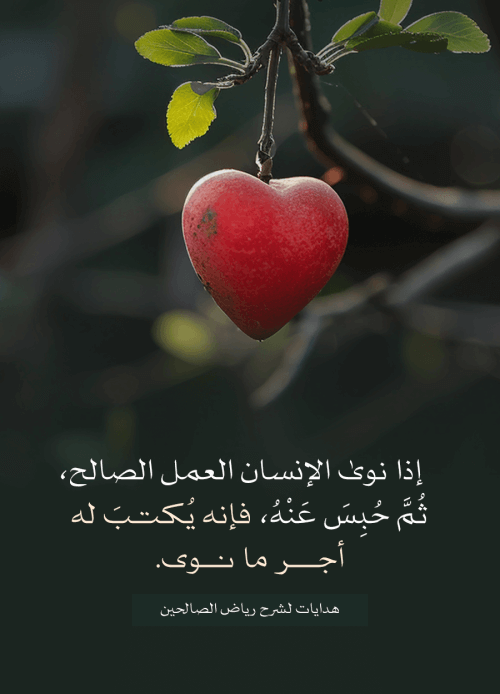
Truthfulness of the hearts is a cause to attain what is desired. Whoever intends to do a good deed will be rewarded for it even if he were unable to do it or failed to complete it.
Riyadh Al-Salheen with explanation and benefits
Thanking Allah for His blessings is one of the reasons for their permanence and increase.
Riyadh Al-Salheen with explanation and benefits
Once something is blessed, it becomes abundant even if it is little; and once something is stripped of blessings, it becomes little even if it is abundant.
Riyadh Al-Salheen with explanation and benefits
Taqwa is a [metaphorical] light helping the individual to discern between the truth and falsehood, the good and the harmful, and the [standard practice] of Sunnah from [religious] innovation.
Riyadh Al-Salheen with explanation and benefits