




Categories
Discover our diverse collection of categories covering multiple topics to meet your various interestsDa\'wa cards that highlight great meanings of the verses of the Holy Quran and the noble prophetic hadiths in a simple style and attractive display that helps the Muslim to have a deeper understanding of his religion in an easy way
﴿ هُوَ ٱللَّهُ ٱلۡخَٰلِقُ ٱلۡبَارِئُ ٱلۡمُصَوِّرُۖ لَهُ ٱلۡأَسۡمَآءُ ٱلۡحُسۡنَىٰۚ يُسَبِّحُ لَهُۥ مَا فِي ٱلسَّمَٰوَٰتِ وَٱلۡأَرۡضِۖ وَهُوَ ٱلۡعَزِيزُ ٱلۡحَكِيمُ ﴾
سورة الحشر
He is Allah, the Creator[21], the Maker[22], the Fashioner[23]. He has the most beautiful names. All that is in the heavens and earth glorifies Him, for He is the All-Mighty, the All-Wise.

﴿ إِذَا تُتۡلَىٰ عَلَيۡهِ ءَايَٰتُنَا قَالَ أَسَٰطِيرُ ٱلۡأَوَّلِينَ ﴾
سورة القلم
When Our verses are recited to him, he says, “Ancient fables!”
﴿ ثُمَّ جَعَلۡنَٰكَ عَلَىٰ شَرِيعَةٖ مِّنَ ٱلۡأَمۡرِ فَٱتَّبِعۡهَا وَلَا تَتَّبِعۡ أَهۡوَآءَ ٱلَّذِينَ لَا يَعۡلَمُونَ ﴾
سورة الجاثية
Then We put you, [O Muḥammad], on an ordained way concerning the matter [of religion]; so follow it and do not follow the inclinations of those who do not know.
﴿ وَأَقۡبَلَ بَعۡضُهُمۡ عَلَىٰ بَعۡضٖ يَتَسَآءَلُونَ ﴾
سورة الطور
25. And some of them draw near to others, questioning.
﴿ وَوَصَّيۡنَا ٱلۡإِنسَٰنَ بِوَٰلِدَيۡهِ حُسۡنٗاۖ وَإِن جَٰهَدَاكَ لِتُشۡرِكَ بِي مَا لَيۡسَ لَكَ بِهِۦ عِلۡمٞ فَلَا تُطِعۡهُمَآۚ إِلَيَّ مَرۡجِعُكُمۡ فَأُنَبِّئُكُم بِمَا كُنتُمۡ تَعۡمَلُونَ ﴾
سورة العنكبوت
8. And We have enjoined on man to be good and dutiful to his parents; but if they strive to make you join with Me (in worship) anything (as a partner) of which you have no knowledge, then obey them not. Unto Me is your return and I shall tell you what you used to do.
﴿ وَءَاتُواْ ٱلنِّسَآءَ صَدُقَٰتِهِنَّ نِحۡلَةٗۚ فَإِن طِبۡنَ لَكُمۡ عَن شَيۡءٖ مِّنۡهُ نَفۡسٗا فَكُلُوهُ هَنِيٓـٔٗا مَّرِيٓـٔٗا ﴾
سورة النساء
And give the women [upon marriage] their [bridal] gifts[161] graciously. But if they give up willingly to you anything of it, then take it in satisfaction and ease.[162]
﴿ أَمۡ خُلِقُواْ مِنۡ غَيۡرِ شَيۡءٍ أَمۡ هُمُ ٱلۡخَٰلِقُونَ ﴾
سورة الطور
35. Were they created by nothing? Or were they themselves the creators?
﴿ وَمَن تَابَ وَعَمِلَ صَٰلِحٗا فَإِنَّهُۥ يَتُوبُ إِلَى ٱللَّهِ مَتَابٗا ﴾
سورة الفرقان
71. And whosoever repents and does righteous good deeds; then verily, he repents towards Allâh with true repentance.
﴿ فَٱصۡبِرۡ لِحُكۡمِ رَبِّكَ وَلَا تُطِعۡ مِنۡهُمۡ ءَاثِمًا أَوۡ كَفُورٗا ﴾
سورة الإنسان
24. Therefore be patient (O Muhammad صلى الله عليه وسلم) with constancy to the Command of your Lord (Allâh, by doing your duty to Him and by conveying His Message to mankind), and obey neither a sinner nor a disbeliever among them.
Abu Sa‘īd al-Khudri (may Allah be pleased with him) reported: Some people from the Ansār asked the Messenger of Allah (may Allah's peace and blessings be upon him) for charity and he gave them. They asked him again, and he gave them until there was nothing left. Thereupon, he said to them: "Whatever good I have, I will not withhold from you. Whoever tries to be chaste, Allah will make him chaste; whoever tries to be self-sufficient, Allah will make him self-sufficient; whoever tries to be patient, Allah will make him patient. No one is granted a gift better and ampler than patience."
Narrated by Bukhari & Muslim
Some people from the Ansār asked the Messenger of Allah (may Allah's peace and blessings be upon him) for alms and he gave them. They asked him again and he gave them until he had nothing left. He told them that he would not withhold anything from them. He urged them to be chaste, self-sufficient, and patient. The Prophet (may Allah's peace and blessings be upon him) informed them that anyone who is satisfied with the divine blessings, without need for people, Allah makes him rich. Indeed, richness is in the heart. With self-sufficiency, one needs nothing from others. Also, being chaste, one earns divine protection for oneself and one's spouse. Finally, anyone who tries to be patient, Allah grants him patience, for there is nothing better than patience.
Abu Hurayrah (may Allah be pleased with him) reported: The Messenger of Allah (may Allah’s peace and blessings be upon him) kissed Al-Hasan ibn ‘Ali while Al-Aqra‘ ibn Hābis was present. Al-Aqra‘ observed: "I have ten children, and I have never kissed any of them." Thereupon, the Messenger of Allah (may Allah’s peace and blessings be upon him) looked at him and said: "Whoever does not show mercy will not be shown mercy!"
Narrated by Bukhari & Muslim
Abu Hurayrah (may Allah be pleased with him) informed that the Messenger (may Allah's peace and blessings be upon him) kissed Al-Hasan ibn ‘Ali while Al-Aqra‘ ibn Hābis At-Tamīmi was sitting with him. Al-Aqra‘ remarked: "I have ten children, and I have never kissed any of them." Thereupon, the Messenger (may Allah's peace and blessings be upon him) looked at him and said: "Whoever does not show mercy will not be shown mercy." In another narration: "What can I do if Allah has removed mercy from your heart?" Meaning: If Allah, the Almighty, has taken the feeling of mercy away from your heart, can I ever bring it back?
‘Abdullāh ibn ‘Amr ibn al-‘Ās (may Allah be pleased with him) reported that the Prophet (may Allah's peace and blessings be upon him) recited the words of Allah, the Exalted, about Prophet Ibrahīm (may Allah's peace and blessings be upon him) who said: {My Lord, indeed they have led astray many among the people. So whoever follows me - then he is of me} [Sūrat Ibrahīm :36], and those of Jesus (peace be upon him) who said: {If You punish them, they are Your slaves, and if You forgive them, verily, You, only You, are the All-Mighty, the All-Wise} [Sūrat al-Mā'idah: 118]. Then, he (Prophet Muhammad) raised up his hands and said: "O Allah, my Ummah, my Ummah" and wept; Allah, the Exalted, said: "O Jibrīl, go to Muhammad and ask him: 'What makes you weep?'" So angel Jibrīl went to him and asked him (what made him weeping) and the Messenger of Allah informed him what he had said (though Allah knew it well). Upon this Allah said: "O Jibrīl, go to Muhammad and say: 'Verily, We will please you with regard to your Ummah and will not displease you.'"
Narrated by Muslim
The Prophet (may Allah's peace and blessings be upon him) recited the statement of Ibrahīm (peace be upon him) about the idols: {My Lord, indeed they (the idols) have led astray many among the people. So whoever follows me - then he is of me.} [Sūrat Ibrahīm: 36] and Jesus' statement: {If You punish them, then indeed they are Your servants, and if You forgive them, then indeed You are the All-Wise and All-Mighty} [Sūrat al-Mā'idah: 118]. Then the Prophet (may Allah's peace and blessings be upon him) raised his hands up and said: "O my Lord, my Ummah, my Ummah," meaning: have mercy upon them and pardon them. Then Allah, Glorified and Exalted, said to angel Jibrīl: "Go to Muhammad and ask him why he is crying?" although He already knew why he was crying. The Prophet (may Allah's peace and blessings be upon him) told Jibrīl that he was concerned about his Ummah, and surely Allah knows what he said. Then Allah said to Jibrīl: "Go to Muhammad and tell him: 'We will please you concerning your Ummah, and Will not sadden you.’" Allah, the Almighty, has really pleased and satisfied the Prophet with regard to his Ummah in many ways, such as: multiplying the rewards of the Muslim Ummah; they are the last Ummah but they will be the foremost on the Day of Resurrection; and they have been favored with many bounties over the rest of the nations.
Anas (may Allah be pleased with him) reported: A slave girl of Madīnah would take hold of the hand of the Prophet (may Allah's peace and blessings be upon him) and would take him wherever she wished.
Narrated by Bukhari
This Hadīth highlights the extreme humbleness of the Prophet (may Allah's peace and blessings be upon him) though he is the best of creation. Any slave girl from Madīnah who sought his help would go to him, take his hand, and take him wherever she wished so he could help her with what she needed. This would happen even though he was the best of mankind. He would not ask her: "Where are you taking me?" or say: "Go to someone else," instead, he would go with her and help her with her need. Nevertheless, Allah raised him through this in status and honor. Note: The intended meaning in this Hadīth is not that the slave girl actually touched the hand of the Prophet in the physical sense. Al-Hāfiz said: “’Taking his hand’ is intended to mean that he accompanied her with gentleness and willingness.” This Hadīth reflects the Prophet's humbleness on several levels, as it mentioned that it was a female who took his hand, not a male, and it was a slave, not a free woman, and it used the indefinite article to indicate that this could happen with any slave girl, whoever she was.
Jubayr ibn Mut‘im (may Allah be pleased with him) reported: While I was walking with the Prophet (may Allah's peace and blessings be upon him) on his return from the battle of Hunayn, a few Bedouins caught hold of him and began to demand their shares. They forced him to a tree, and someone snatched his cloak (which got entangled in that thorny tree). The Prophet (may Allah's peace and blessings be upon him) said: "Give my cloak back to me. Were I to have camels equal to the number of these trees, I would distribute them all among you, and you would not have found me a miser, a liar, or a coward."
Narrated by Bukhari
When the Prophet (may Allah's peace and blessings be upon him) was returning from the battle of Hunayn - a valley between Makkah and Taif - and Jubair ibn Mut‘im was with him, some Bedouins grabbed him and began to demand their shares. They forced him to the Samrah tree (a thorny tree), and his cloak became entangled in the tree's thorns, and they were pulling at him. The Prophet (may Allah's peace and blessings be upon him) said: "Give my cloak back to me. Were I to have camels or cows or sheep equal to the number of these thorny trees, I would distribute them all among you. If you were to try me, you would not find me a miser, a liar, or a coward."
Abu Hurayrah (may Allah be pleased with him) reported: A Bedouin man urinated in the mosque, so the people got up and moved towards him to scorn him. So the Prophet (may Allah's peace and blessings be upon him) said: "Let him and pour a bucket or pail of water onto his urine. You were sent to make things easy and not to make them difficult."
Al-Bukhari and Muslim. This is the wording of Al-Bukhari
A Bedouin man got up and started to urinate inside the Prophet’s Mosque. So, the people attacked him with their tongues, not with their hands; i.e. they shouted at him in scorn. So, the Prophet (may Allah's peace and blessings be upon him) asked them to leave him alone, and when the man finished urinating, the Prophet ordered them to pour a bucket of water over the place where he urinated, and explained to them that they were callers to facilitating matters, not to making matters difficult and thus causing people to turn away from guidance.
Abu ‘Abdullāh Jābir ibn Samurah (may Allah be pleased with him) reported: I used to pray with the Prophet (may Allah's peace and blessings be upon him) and his prayer was moderate in length and his sermon was moderate in length.
Narrated by Muslim
The Prophet's prayer and sermon were not overly long or brief. Yet, they were moderate, being performed and given by the role model for Muslims in general and for Imāms and preachers in particular. So, no one should cite this Hadīth as evidence that the prayer and sermon may take place very quickly, for the Prophet's guidance points to moderation, and sometimes prolongation that causes no boredom.
Abu ‘Abdullāh Jābir ibn ‘Abdullāh (may Allah be pleased with him) reported: The Messenger of Allah (may Allah’s peace and blessings be upon him) dispatched us to intercept a caravan belonging to Quraysh, and he appointed Abu ‘Ubaydah (may Allah be pleased with him) as our commander. He gave us a sack of dates as provision, other than which he did not find anything for us. Abu ‘Ubaydah used to give us one date at a time. He was asked: “What did you use to do with it?” He said: “We used to suck it just as a baby suckles, then we would drink some water after it, which would suffice us for a day until the night. We also used to beat off tree leaves with our sticks, then soak them in water and eat them.” He continued: “We then headed towards the sea coast, where something like a huge mound appeared to us. When we came to it, we found that it was an animal called 'Al-‘Anbar' (sperm whale). Abu ‘Ubaydah said: "It is a dead animal." Then he said: "No, rather we are the messengers of the Messenger of Allah (may Allah’s peace and blessings be upon him) and we have gone out in the cause of Allah. Now you are forced by necessity, so you can eat." We kept on eating from it for a month until we fattened up, and we were three hundred men. And indeed, I saw how we scooped out fat from the cavity of its eye in pitchers, then we would cut pieces from it like a bull or the size of a bull. Abu ‘Ubaydah took thirteen men from us and seated them in the cavity of its eye. He took one of its ribs and fixed it up, then saddled the largest camel of ours and it passed under it (the rib). We took large pieces of its meat as provision for our journey back home. When we arrived at Madīnah, we came to the Messenger of Allah (may Allah’s peace and blessings be upon him) and mentioned all of that to him. Thereupon, he said: "It is sustenance that Allah brought out for you. Do you have anything from its meat with you, so that you would feed us?" We sent some of its meat to the Messenger of Allah (may Allah’s peace and blessings be upon him) which he ate.
Narrated by Bukhari & Muslim
The Prophet (may Allah's peace and blessings be upon him) sent a detachment to overtake a caravan that was carrying wheat and food for Quraysh. He appointed Abu ‘Ubaydah as their commander. The Prophet (may Allah's peace and blessings be upon him) gave them a leather sack of dates, and their commander used to give each one of them one date, due to the scarcity of the provisions they had. They would suck the dates and drink water over them. They also used to pluck the leaves off the trees by their sticks, which are the camels' fodder, then soak them in water to soften them up. When they arrived at the sea shore, they saw something like a mound of sand. When they reached it, they found out that it was a large fish called 'Al-‘Anbar' (sperm whale). Their commander Abu ‘Ubaydah forbade them from eating from it because it was dead, and dead animals are unlawful according to the Qur’anic texts. Then, he changed his ruling and allowed them to eat from it, because it is permissible for the Muslim to eat dead animals when he is forced by necessity, particularly they were on a journey that was an act of obedience to Allah, the Exalted. They forgot that the dead animals of the sea are lawful. Based on necessity, they ate from it and carried some of its meat with them. When they arrived at Madīnah, they informed the Messenger of Allah (may Allah’s peace and blessings be upon him) of that incident, whereupon he approved their action and ate from it.
‘Ā'ishah bint Abu Bakr (may Allah be pleased with him) reported: The Messenger of Allah (may Allah's peace and blessings be upon him) bought food from a Jew and pledged him his iron armor.
Narrated by Bukhari & Muslim
The Prophet (may Allah's peace and blessings be upon him) bought barley to serve as food from a Jew, and pawned his coat of mail that he needed for Jihad with him. The Prophet (may Allah's peace and blessings be upon him) used to wear that armor in war to give himself extra protection from the enemy's weapons.
The path of Allah is one whereas the paths of the devil are many; and a truly guided individual is he whom Allah Almighty guided to His path. Allah Almighty said: {This is My straight path; follow it and do not follow other ways, lest they lead you away from His way.} [Surat al-An‘ām: 153]
Riyadh Al-Salheen with explanation and benefits
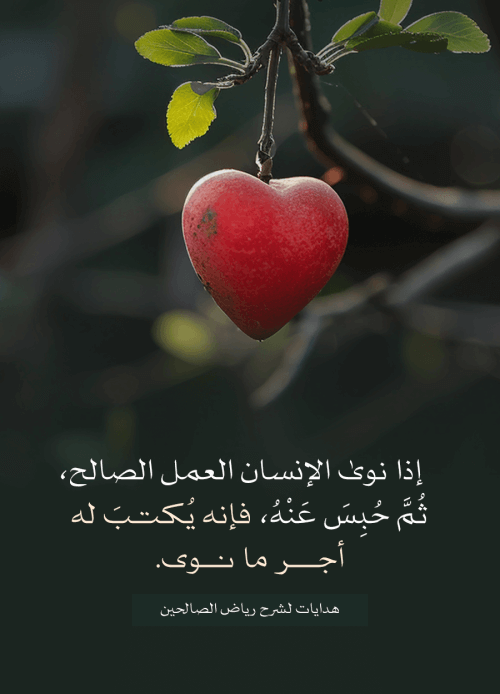
Waiting to do a good deed is in itself a good deed.
Riyadh Al-Salheen with explanation and benefits
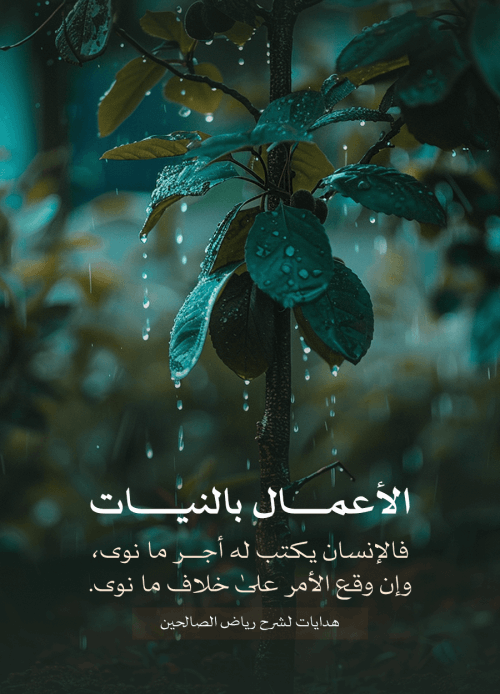
Good intention leads its holder to good things.
Riyadh Al-Salheen with explanation and benefits
One of the manifestations of Allah’s mercy is that He uses justice to recompense the sinner but uses His grace and bounty to recompense the good-doer.
Riyadh Al-Salheen with explanation and benefits
Sincerity is one of the means to alleviate adversity because each one of them said: “O Allah! If I did that for Your sake only, then relieve us from the distress we are in.”
Riyadh Al-Salheen with explanation and benefits
Good deeds are means to alleviating adversity.
Riyadh Al-Salheen with explanation and benefits
“The righteousness of the heart results from the righteousness of deeds, and the righteousness of deeds results from the righteousness of intention.”
Riyadh Al-Salheen with explanation and benefits
Repentance is a cause for success, which is why a true successful person is the one seeking and committing to a means leading to success.
Riyadh Al-Salheen with explanation and benefits
Hastening to repentance is one of the causes to earning the pleasure of Allah with His servant.
Riyadh Al-Salheen with explanation and benefits