







Categories
Discover our diverse collection of categories covering multiple topics to meet your various interestsDa\'wa cards that highlight great meanings of the verses of the Holy Quran and the noble prophetic hadiths in a simple style and attractive display that helps the Muslim to have a deeper understanding of his religion in an easy way
﴿ وَمَن كَفَرَ فَلَا يَحۡزُنكَ كُفۡرُهُۥٓۚ إِلَيۡنَا مَرۡجِعُهُمۡ فَنُنَبِّئُهُم بِمَا عَمِلُوٓاْۚ إِنَّ ٱللَّهَ عَلِيمُۢ بِذَاتِ ٱلصُّدُورِ ﴾
سورة لقمان
And whoever has disbelieved - let not his disbelief grieve you. To Us is their return, and We will inform them of what they did. Indeed, Allāh is Knowing of that within the breasts.
﴿ أَلَمۡ تَرَوۡاْ أَنَّ ٱللَّهَ سَخَّرَ لَكُم مَّا فِي ٱلسَّمَٰوَٰتِ وَمَا فِي ٱلۡأَرۡضِ وَأَسۡبَغَ عَلَيۡكُمۡ نِعَمَهُۥ ظَٰهِرَةٗ وَبَاطِنَةٗۗ وَمِنَ ٱلنَّاسِ مَن يُجَٰدِلُ فِي ٱللَّهِ بِغَيۡرِ عِلۡمٖ وَلَا هُدٗى وَلَا كِتَٰبٖ مُّنِيرٖ ﴾
سورة لقمان
20. See you not (O men) that Allâh has subjected for you whatsoever is in the heavens and whatsoever is in the earth, and has completed and perfected His Graces upon you, (both) apparent (i.e. Islâmic Monotheism, and the lawful pleasures of this world, including health, good looks, etc.) and hidden [i.e. One’s Faith in Allâh (of Islâmic Monotheism) knowledge, wisdom, guidance for doing righteous deeds, and also the pleasures and delights of the Hereafter in Paradise]? Yet of mankind is he who disputes about Allâh without knowledge or guidance or a Book giving light!
﴿ وَقَالَ ٱلَّذِينَ كَفَرُواْ لِلَّذِينَ ءَامَنُواْ ٱتَّبِعُواْ سَبِيلَنَا وَلۡنَحۡمِلۡ خَطَٰيَٰكُمۡ وَمَا هُم بِحَٰمِلِينَ مِنۡ خَطَٰيَٰهُم مِّن شَيۡءٍۖ إِنَّهُمۡ لَكَٰذِبُونَ ﴾
سورة العنكبوت
12. And those who disbelieve say to those who believe: "Follow our way and we will verily bear your sins." Never will they bear anything of their sins. Surely, they are liars.
﴿ يَعۡلَمُ مَا بَيۡنَ أَيۡدِيهِمۡ وَمَا خَلۡفَهُمۡ وَلَا يُحِيطُونَ بِهِۦ عِلۡمٗا ﴾
سورة طه
He knows all that is ahead of them and all that is behind them[38], but they do not encompass it[39] with their knowledge.
﴿ قَدۡ خَسِرَ ٱلَّذِينَ قَتَلُوٓاْ أَوۡلَٰدَهُمۡ سَفَهَۢا بِغَيۡرِ عِلۡمٖ وَحَرَّمُواْ مَا رَزَقَهُمُ ٱللَّهُ ٱفۡتِرَآءً عَلَى ٱللَّهِۚ قَدۡ ضَلُّواْ وَمَا كَانُواْ مُهۡتَدِينَ ﴾
سورة الأنعام
Losers indeed are those who kill their children foolishly out of ignorance and prohibit what Allah has provided for them – fabricating lies against Him. They have gone astray and are not guided.
﴿ وَإِذَا عَلِمَ مِنۡ ءَايَٰتِنَا شَيۡـًٔا ٱتَّخَذَهَا هُزُوًاۚ أُوْلَٰٓئِكَ لَهُمۡ عَذَابٞ مُّهِينٞ ﴾
سورة الجاثية
When he comes to know anything of Our verses, he takes them in ridicule. For them there will be a humiliating punishment.
﴿ ضَرَبَ ٱللَّهُ مَثَلٗا لِّلَّذِينَ كَفَرُواْ ٱمۡرَأَتَ نُوحٖ وَٱمۡرَأَتَ لُوطٖۖ كَانَتَا تَحۡتَ عَبۡدَيۡنِ مِنۡ عِبَادِنَا صَٰلِحَيۡنِ فَخَانَتَاهُمَا فَلَمۡ يُغۡنِيَا عَنۡهُمَا مِنَ ٱللَّهِ شَيۡـٔٗا وَقِيلَ ٱدۡخُلَا ٱلنَّارَ مَعَ ٱلدَّٰخِلِينَ ﴾
سورة التحريم
10. Allâh sets forth an example for those who disbelieve: the wife of Nûh (Noah) and the wife of Lût (Lot). They were under two of our righteous slaves, but they both betrayed them (their husbands by rejecting their doctrine). So they [Nûh (Noah) and Lût (Lot) عليهما السلام] availed them (their respective wives) not against Allâh and it was said: "Enter the Fire along with those who enter!"
﴿ وَقَالَ ٱلۡإِنسَٰنُ مَا لَهَا ﴾
سورة الزلزلة
and man says[2], “What is the matter with it?”
﴿ فَكَذَّبُوهُ فَأَخَذَتۡهُمُ ٱلرَّجۡفَةُ فَأَصۡبَحُواْ فِي دَارِهِمۡ جَٰثِمِينَ ﴾
سورة العنكبوت
But they rejected him, so an earthquake seized them and they fell lifeless in their homes.
﴿ فَأَمَّا ٱلۡإِنسَٰنُ إِذَا مَا ٱبۡتَلَىٰهُ رَبُّهُۥ فَأَكۡرَمَهُۥ وَنَعَّمَهُۥ فَيَقُولُ رَبِّيٓ أَكۡرَمَنِ ﴾
سورة الفجر
As for man, when he is tested by his Lord by honoring him and bestowing blessings upon him, he says, “My Lord has [deservedly] honored me[5]!”
Sahl ibn Sa‘d (may Allah be pleased with him) reported that the Prophet (may Allah's peace and blessings be upon him) said: "The dwellers of Paradise will see the upper abodes of Paradise as you see the stars in the sky."
Narrated by Bukhari & Muslim
The dwellers of Paradise are of different ranks and levels based on their degrees of virtue. The dwellers of the highest ranks will be seen as the stars by those in the lower ranks.
Abu Hurayrah (may Allah be pleased with him) reported that the Prophet (may Allah's peace and blessings be upon him) said: "If I am invited to a meal of a sheep's trotter or arm, I would accept the invitation, and if an arm or trotter were gifted to me, I would accept the gift."
Narrated by Bukhari
This Hadīth is an indication of the Prophet's exemplary manners and humility, as well as his keenness to avoid hurting people's feelings by accepting their gifts even if they are seemingly insignificant, and by answering their invitation to their houses even if he knew that the meal he was invited to was humble. Because the reason behind accepting a gift and accepting an invitation is to pleasing the host and strengthening love and friendship, while refusing a gift or not accepting an invitation creates repulsion and hatred, and its humbleness should not be looked down upon. The sheep's arm (shoulder) and trotter (foot and calf) were specifically mentioned to combine between the worthless part and the best part, as the Prophet (may Allah's peace and blessings be upon him) liked the shoulder meat more than any other part of the sheep, while the foot has no value. So, the value of the gift or meal was of no importance to him.
Anas (may Allah be pleased with him) reported: I have never touched plain or woven silk softer than the palm of the Messenger of Allah (may Allah’s peace and blessings be upon him) nor have I smelt a perfume more pleasant than the scent of the Messenger of Allah. Verily, I have served the Messenger of Allah for ten years, and not once did he say to me 'uff', nor did he say about something I had done, “why did you do it?”, nor about something I hadn’t done, “why didn’t you do it?”
Narrated by Bukhari & Muslim
Anas ibn Mālik (may Allah be pleased with him) who had served the Prophet for ten years, said: "I have never touched plain or woven silk softer than the palm of the Messenger of Allah (may Allah’s peace and blessings be upon him)." People would find the hands of the Prophet to be soft when they touched them, and they would also find his scent to be pleasant. Anas narrates that he never smelt a fragrance more pleasant than the scent of the Prophet. Anas then said that he served the Prophet for ten years, and not once did he say 'uff' to him, which is an interjection that denotes being fed up and annoyed with someone. For ten years, the Messenger never expressed being fed up with him, whereas if someone served us or accompanied us for one week or so, we inevitably feel some sort of annoyance with them. The Prophet also never questioned him why he did something in a certain way, including the things that Anas did without the Prophet's instructions. Even though he was his servant, he treated him kindly and respectfully and never asked why he didn’t do something that he hadn’t done. This is part of the good moral character of the Messenger of Allah (may Allah’s peace and blessings be upon him).
‘Ā’ishah (may Allah be pleased with her) reported: The Messenger of Allah (may Allah’s peace and blessings be upon him) never struck anything with his hand, neither a woman nor a servant, except when he was fighting in the cause of Allah. He would never avenge himself concerning anything that was done to him except if the limits of Allah, the Almighty, were transgressed. Then (in that case) he would seek revenge for the sake of Allah, the Almighty.
Narrated by Muslim
One of the morals of the Prophet (may Allah's peace and blessings be upon him) was that he never hit an animal or other creature, and he neither hit a woman nor a servant though it was common practice to hit them. Since he never hit these two despite the common practice, he did not hit any other creature whom it was not common to hit with greater reason. The exception was when he would fight in the cause of Allah to raise the word of Allah high. He also never sought vengeance for harm that was inflicted upon him, such as the incident in the battle of Uhud, when the disbelievers injured his head and broke one of his front teeth, and other acts of aggression and assault on their part. He used to pardon, forgive, and show forbearance. He did not seek vengeance except when the limits of Allah were transgressed, as he never approved of any such act from anyone.
‘Ā’ishah (may Allah be pleased with her) reported: I asked the Prophet (may Allah's peace and blessings be upon him): "Have you ever experienced a day harder than the day of (the battle of) Uhud?" He replied: "Indeed, I have suffered a lot at the hands of your people (i.e., the disbelievers from of the Quraysh Tribe), the harshest of which was what they did to me on the Day of Al-‘Aqabah when I went to Ibn ‘Abd Yalīl ibn ‘Abd Kulāl with the purpose of inviting him to Islam, but he made no response (to my call). So I departed with deep distress (to the point that I did not know where I was going). I did not recover until I arrived at Qarn Ath-Tha‘ālib. There, I raised my head and saw a cloud shading me. I looked and, lo and behold, I saw in it Jibrīl (peace be upon him) who called me and said: Indeed, Allah, the Exalted, heard what your people said to you and the response they gave you. He has sent to you the angel in charge of mountains to order him to do whatever you wish concerning them. Then the angel of the mountains called me, greeted me and said: O Muhammad, Allah has listened to what your people had said to you. I am the angel of mountains, and my Lord has sent me to you so that you may give me your orders concerning them. If you wish I would bring together the Akhshabayn (two mountains that stand opposite to each other at the outskirts of Makkah) to crush them in between."
Narrated by Bukhari & Muslim
When ‘Ā’ishah asked the Prophet (may Allah's peace and blessings be upon him) if he had experienced a day more difficult than the Day of Uhud, he replied: 'Yes,' and he mentioned to her the story of his journey to Taif. When the Prophet (may Allah's peace and blessings be upon him) invited the people of Quraysh to Islam, and they did not respond to him, he headed towards Taif, to convey Allah's Message to them. But, when he invited the people of Taif to Islam, their attitude was worse than that of the people of Makkah. They started throwing stones at him until his heel bled. He presented himself to Ibn ‘Abd Yalīl ibn ‘Abd Kulāl, who was one of the dignitaries of the tribe of Thaqīf in Taif. He also rejected his call. So, the Prophet (may Allah's peace and blessings be upon him) left Taif so sad and disappointed to the point of not knowing where he was going. He did not become aware of his surroundings until he reached a place called Qarn Ath-Tha‘ālib. There, a cloud hovered over him and shaded him. As he lifted his head to the sky, he saw Jibrīl inside this cloud, who said to him: This is the Angel of Mountains with me. He greets you with peace. The angel greeted the Prophet (may Allah's peace and blessings be upon him) then said to him: My Lord has sent me to you, if you wish I can make the two huge mountains collapse over them and crush them. But, out of his forbearance and foresight, the Prophet (may Allah's peace and blessings be upon him) responded: "No, for I do hope that Allah will bring forth from their progeny those who would worship Allah alone and not associate partners with Him." This is exactly what happened, as Allah brought forth from the loins of those infidels who harmed him righteous servants who worship Allah alone and who do not associate partners with Him.
Anas (may Allah be pleased with him) reported that Abu Talhah said to Umm Sulaym: "I felt some feebleness in the voice of the Messenger of Allah (may Allah's peace and blessings be upon him) and perceived that it was due to hunger; so have you anything with you?" She replied in the affirmative, and brought out barley loaves, then took out a head-covering of hers, in a part of which she wrapped those loaves and then put them beneath my mantle and covered me with a part of it. She then sent me to the Messenger of Allah (may Allah's peace and blessings be upon him). I [Anas] set forth and found the Messenger of Allah (may Allah's peace and blessings be upon him) sitting in the mosque and some companions were with him. I stood near them, whereupon the Messenger of Allah (may Allah's peace and blessings be upon him) said: "Has Abu Talhah sent you?" I replied in the affirmative, whereupon he said: "Is it for a feast?" I replied in the affirmative. Thereupon the Messenger of Allah (may Allah's peace and blessings be upon him) said to those who were with him to get up. They set off and so I did before them, until I came to Abu Talhah and informed him. Abu Talhah said: "O Umm Sulaym, the Messenger of Allah (may Allah's peace and blessings be upon him) has arrived along with some people and we do not have enough to feed them?" She said: "Allah and His Messenger know best." Abu Talhah went out (to receive him) until he met the Messenger of Allah (may Allah's peace and blessings be upon him) he proceeded along with him until they both entered. Then the Messenger of Allah (may Allah's peace and blessings be upon him) said: "O Umm Sulaym, bring forth that which you have with you," and she brought such bread. The Messenger of Allah (may Allah's peace and blessings be upon him) then commanded that the bread be broken into small pieces, and when Umm Sulaym had squeezed a container of fat on it as a dressing, the Messenger of Allah (may Allah's peace and blessings be upon him) said whatever that Allah willed him to say over it. He then said: "Allow ten to enter." He permitted them, and they ate until they were satiated. They then went out. He again said: "Allow ten more," and he permitted them and they ate until all the people were satiated, and they were seventy or eighty men" [Al-Bukhāri and Muslim]. In another narration: "They continued to enter and exit, ten at a time, until no one remained who had not entered and eaten to his fill. He then collected the leftovers and it was the same quantity as what had been eaten." In another narration: "They ate ten at a time, until eighty people had eaten. Then the Prophet (may Allah's peace and blessings be upon him) and the hosts ate, and they left a surplus." In another narration: "There was enough leftover to feed their neighbors." In another narration reported by Anas who said: "One day I came to the Messenger of Allah (may Allah's peace and blessings be upon him) and found him sitting with his companions, and he had tied his belly with a bandage. I asked some of his companions why the Messenger of Allah (may Allah's peace and blessings be upon him) had bandaged his belly. They said that it was due to hunger. I then went to Abu Talhah, the husband of Umm Sulaym bint Milhān, and said to him: "Father, I saw the Messenger of Allah (may Allah's peace and blessings be upon him) having bandaged his belly. I asked some of his companions the reason and they said that it was due to hunger." Abu Talhah came to my mother and said: "Is there anything?" She said: "Yes, I have some pieces of bread with me and some dates. If the Messenger of Allah (may Allah's peace and blessings be upon him) comes to us alone we can feed him to his fill, but if someone comes along with him this would be insufficient for them." And he mentioned the rest of the Hadīth.
Narrated by Bukhari & Muslim
This Hadīth means that one day the Prophet (may Allah's peace and blessings be upon him) was famished, and Abu Talhah (may Allah be pleased with him) realized that from the weakness of his voice. So he told his wife, Umm Sulaym (may Allah be pleased with her) about it and asked if she had some food. She said that they had enough to feed the Prophet (may Allah's peace and blessings be upon him). She took out some barley loaves and then took one of her head coverings, wrapped the bread up with it and placed it under Anas's cloak and covered him with the other end of the head covering. When Anas approached the Prophet (may Allah's peace and blessings be upon him) he found him sitting among his Companions, so he went over to him and stood there. The Messenger of Allah (may Allah's peace and blessings be upon him) asked: "Did Abu Talhah send you?" Anas said: 'Yes.' He was unable to give the food to the Prophet (may Allah's peace and blessings be upon him) because there were many Companions around him. He also knew that the Prophet (may Allah's peace and blessings be upon him) was not used to eating food alone apart from his Companions. By his answer, Anas meant to invite the Prophet to come alone to the house of Abu Talhah, so he could eat as the family had wished. However, the Prophet (may Allah's peace and blessings be upon him) told his Companions to come with him. They all set off and Anas said: "I set off ahead of them," and in another narration: "I was sad because many came along with him." He added: "I came to Abu Talhah and informed him. Abu Talhah said: "O Umm Sulaym, the Messenger of Allah (may Allah's peace and blessings be upon him) has arrived with some people, and we do not have enough to feed them." She said: "Allah and His Messenger know best." Umm Sulaym (may Allah be pleased with her) entrusted the matter to Allah and His Messenger, as if she recognized that the Prophet (may Allah's peace and blessings be upon him) had done that intentionally, so that the honor of multiplying the food could be demonstrated by him. Her response indicates her superior understanding. Abu Talhah went to meet the Messenger of Allah (may Allah's peace and blessings be upon him) and he proceeded with him until they both entered the house. The Messenger of Allah (may Allah's peace and blessings be upon him) said (to Umm Sulaym): "Bring what you have." In another narration: "Abu Talhah received him and said: 'O Messenger of Allah, We have nothing but a loaf of bread that Umm Sulaym made.'" And in another narration, Abu Talhah said: "It is only a loaf of bread," whereupon the Messenger of Allah (may Allah's peace and blessings be upon him) said: "Allah will bless it." And in another narration, Abu Talhah said: "O Messenger of Allah, I sent Anas just to invite you; we do not have enough to feed all those I see," whereupon the Prophet (may Allah's peace and blessings be upon him) said: "Go in, for indeed Allah will bless whatever you have." When the Messenger of Allah (may Allah's peace and blessings be upon him) entered the home of Abu Talhah, he said: "Bring what you have, Umm Sulaym.'' So she brought the loaf of bread, which the Messenger of Allah (may Allah's peace and blessings be upon him) asked to be broken into small pieces. Umm Sulaym squeezed some fat out of a leather container onto the food to dress it and the Messenger of Allah (may Allah's peace and blessings be upon him) make a supplication over the food. In another narration: "I brought it and he untied it and said: 'In the Name of Allah. O Allah, make it blessed in abundance.'" Then he said: "Allow ten to enter." He gave them permission, and they ate until they were satiated and then went out. He again said: "Allow ten more," and he gave them permission and they ate until all the people were satiated, and they were seventy or eighty men. [Al-Bukhāri and Muslim] In another narration: "They continued to enter and exit, ten at a time, until no one remained who had not entered and eaten his fill. He then collected the leftovers and it was the same quantity as before they started eating." In another narration: "They ate ten at a time, until eighty people had eaten. Then the Prophet (may Allah's peace and blessings be upon him) and the hosts ate and they left a surplus." In another narration: "There was enough leftover to feed their neighbors."
Jābir ibn ‘Abdullāh (may Allah be pleased with him) reported: I prayed with the Messenger of Allah (may Allah’s peace and blessings be upon him) on the day of Eid. He commenced with the prayer before the sermon, and did so without Adhān or Iqāmah. He then stood up leaning on Bilāl, and he commanded people to fear Allah and obey Him, and he preached to the people and reminded them. He then walked until he reached the women, and he preached to them, admonished them, and then said to them: "Give charity, for the majority of you will be the firewood of Hell." A woman in the center of the crowd, with dark spots on her cheeks, said: "Why is that so, O Messenger of Allah?" He said: "It is because you often complain and show ingratitude to your spouses." Thus, they began to donate their jewelry, like earrings and rings, throwing them in Bilāl's garment (that he had spread out).
Narrated by Bukhari & Muslim
The Messenger of Allah (may Allah’s peace and blessings be upon him) led his Companions in the Eid prayer without announcing the Adhān or Iqāmah. When he completed the prayer, he delivered a sermon. He began by ordering them to fear Allah by performing what Allah has commanded and avoiding what He has prohibited, and to obey Allah in public and in secret. He also ordered them to remember the promise of Allah as well as His threat, thus admonishing them through hope and fear. Since the women were in a place separate from the men and were, thus, not able to listen to the sermon, and out of the Prophet's care and pity for the old and the young, he went to them with Bilāl. He preached to them and reminded them of the Hereafter, and he further instructed them with an advice tailored specifically for them. He told them that that they will constitute the majority of the Hellfire inhabitants, and that giving charity is their way for salvation, because it alleviates Allah's anger. A woman, who was sitting in the middle of the crowd, stood up and asked why most of the women will enter Hellfire, so that they may avoid doing whatever is leading to it. He said it is because women complain constantly, speak what is evil, and are ungrateful when their spouses fall short with them once. Since the female Companions (may Allah be pleased with him) had always been striving towards doing good and fleeing from what angers Allah, they immediately donated their jewelry that they were wearing, rings and earrings, and threw it into the lap of Bilāl. They did this out of love for Allah and seeking His pleasure and His reward.
‘Ā’ishah (may Allah be pleased with her) reported that during the days of Mina, Abu Bakr came to her while there where two girls with her; they were beating drums, and the Prophet (may Allah's peace and blessings be upon him) was covering himself with his garment (while he was lying down). Abu Bakr rebuked the two girls, but the Prophet uncovered his face and said: "O Abu Bakr, leave them, for these are the days of Eid." Those were the days of Mina, ‘Ā’ishah added: "I was being screened by the Prophet while I was watching the Ethiopians playing in the Mosque." ‘Umar rebuked them, but the Prophet (may Allah's peace and blessings be upon him) said: "Leave them, O Banu Arfida, play; it is safe."
Narrated by Bukhari & Muslim
This Hadīth displays the ease and kindness of this religion. It shows how its methodology contradicts that of extremists, who believe the religion to be harsh and violent. This Hadīth proves the permissibility of beating the drum and singing on the days of Eid based on the actions of the two girls in the presence of Prophet Muhammad (may Allah's peace and blessings be upon him) besides his reprimand to the one who reprimanded the two girls. The same goes for playing with spears and the likes. Ethiopians naturally love playing and beating drums. So the Prophet (may Allah's peace and blessings be upon him) allowed them to do what they wanted in the mosque, targeting to (clarify) a state policy. It is asserted in some of the Hadīth's wordings. This policy includes: 1. Announcing to non-Muslim groups who are afraid to embrace Islam because they assume that it is harsh and violent that Islam is a religion of kindness, peace, and pardon, especially amongst sects like the Jews, who are remote from it and prevent people from it. For this reason, some narrations of the Hadīth report that ‘Umar reprimanded the Ethiopians, but the Prophet (may Allah's peace and blessings be upon him) said: "Leave them alone, so that the Jews will know that there is ease in our religion and that I was sent with the pure and kind religion." 2. They played on the day of Eid, which are days of happiness and pleasure and indulging oneself with permissible practices. 3. It is a manly game featuring enthusiasm and courage.
Abu Hurayrah (may Allah be pleased with him) reported that he heard the Prophet (may Allah's peace and blessings be upon him) say: ''There were three (men) from the Children of Israel: a leper, a bald-headed, and a blind. Allah wanted to test them, so He sent to them an angel. The angel went to the leper and said: 'Which thing do you like most?' He said: 'A good color, fine skin, and to get rid of what makes me disgusting in the eyes of people.' He wiped over his body, so his illness went away and he was given a good color and fine skin. He (the angel) said: 'Which wealth do you like most?' He said: 'Camels, or cows (the sub-narrator Is'hāq was in doubt).' So he was given a she-camel in an advanced stage of pregnancy, and he (the angel) said: 'May Allah bless it for you.' Then he went to the bald-headed man and said: 'Which thing do you like most?' He said: 'Good hair, and to get rid of what makes me disgusting in the eyes of people.' He wiped over his head, so his condition went away and he was given good hair. Then the angel said: 'Which wealth do you like most?' He said: 'Cows or camels.' So, he was given a pregnant cow and the angel said: 'May Allah bless it for you.' Then he went to the blind man and said: 'Which thing do you like most?' He said: 'That Allah restores to me my eyesight so that I can see people.' He wiped over his eyes, so Allah restored to him his eyesight. Then the angel said: 'Which wealth do you like most?' He said: 'Sheep.' So he was given a pregnant ewe. The three then had offspring from the ones given to them: one had a valley of camels, the second a valley of cows, and the third a valley of sheep. Later, the angel went to the leper in his (past) appearance and said: 'I am a poor person, and I am running out of provision in my journey, so I cannot reach my destination except with the help of Allah and then your favor. I ask you by the One Who gave you good color, fine skin and wealth to give me one camel to carry me in my journey.' He said: 'I have many rights to fulfill.' Thereupon, he (the angel) said: 'It seems to me that I know you. Were you not a leper whom people found disgusting, and a poor man then Allah gave you wealth?' He said: 'I have inherited this wealth from my forefathers.' Thereupon, the angel said: 'If you are lying, may Allah change you to your past condition.' He then went in his (past) appearance to the bald-headed man and said to him the same as what he had said to the leper, and he replied to him in the same way the leper did. So, the angel said: 'If you are lying, may Allah change you to your past condition.' Then he went in his (past) appearance to the blind man and said: 'I am a poor man and a wayfarer. My provisions have run short in my journey, and today there is no way to reach my destination except with the help of Allah and then with your help. So, I ask you by the One Who restored to you your eyesight to give me one sheep by which I should be able to make provisions for the journey.' The man said: 'I was blind and Allah restored to me my eyesight. You may take whatever you like and leave whatever you like. By Allah, I shall not stand in your way today for what you take in the name of Allah.' Thereupon, the angel said: 'Keep your property. The fact is that the three of you were put to test. Now, Allah is pleased with you and is displeased with your two companions.'"
Narrated by Bukhari & Muslim
The Prophet (may Allah's peace and blessings be upon him) tells the story of three men from the Children of Israel. They were poor and each had a physical defect: one was a leper with bad skin and abnormal skin color, the second was bald-headed with all or most of the hair on his head gone, and the third was blind. Allah, the Almighty, wanted to test their faith and gratitude so He sent to them an angel in the form of a man. The angel went to the leper first, for his condition was the most loathsome, repulsive, and serious. He asked him which thing he liked most. The leper said: good color and good skin and to be rid of what made people avoid me. He did not only ask for good color but wanted his leprosy to be gone completely, for with this disease one has very rough and wrinkled skin, which makes it uglier and makes him feel more ashamed of it. Then, the angel asked him which wealth he liked most. The leper said: camels or cows. The sub-narrator was uncertain if he had heard it 'camels' or 'cows'. However, it is most probable that it was 'camels,' for the text later mentions that the leper was given a she-camel that was ten-months pregnant. A gift like this was very precious. The angel prayed that Allah bless the she-camel for the leper. The prayer was answered, as shown later in the Hadīth. Then the angel went to the bald man and asked him what thing he liked most. The bald man said that he liked to have good hair and that his baldness be cured, for people detested him because of it. The angel wiped over his head or his whole body (the first is more likely), so the baldness was gone. The man was given good hair. The angel then asked him which wealth he liked most, and he said that it was cows. So, he was given a pregnant cow. The angel prayed that the cow be blessed for him. The prayer was answered, as shown later in the Hadīth. Then the angel went to the blind man and asked him which thing he liked most. The blind man said: it is that Allah would restore to me my eyesight. So, the angel passed his hand over the man's eyes or over his whole body (the first is more likely). So, Allah restored to the man his eyesight. Then the angel asked him which wealth he liked most, and he said that it was sheep. So he was given a ewe with a little lamb, or a pregnant ewe (as per another narration). The three men took care of their animal gifts, which produced many offspring. The first had a valley filled with camels, the second had a valley filled with cows, and the third had a valley filled with sheep. Later on, the angel came to the leper in his past image, wearing worn-out clothes. He told him that he was a poor man who ran out of provision in his travel, and that he could not reach his destination except with the help of Allah, then with the man's favor. The angel was implicitly referring to the man's wealth, as it was apparent that he was rich. He asked him by Allah who gave him a good color, fine skin, and wealth after his past miserable condition of poverty and illness, for a he-camel to ride in his travel. The leper said: I have many debts to settle, and I do not have anything extra to give you, so go ask someone else. The angel said: It seems to me that I know you. Were you not a leper whom people found detestable but Allah granted you recovery, and you were poor but Allah gave you wealth? The man said that he inherited his wealth from his father and grandfather. In other words, he denied his miserable past and claimed that he grew up in good conditions, which is absolute denial of Allah's favors upon Him and ungratefulness to Him, prompted by his miserliness. Thereupon, the angel prayed that if the man was lying that Allah restores him to his former condition. Then the angel went to the bald man in the image in which people used to detest him for. The bald man responded to the angel in the same way the leper had done. Although the angel went to him looking like him before recovery and wealth, and although he received such recovery and wealth at his hands, he denied knowing him and even boasted that he inherited the wealth from his father. So, in addition to being a liar, he reached an extent of wickedness and foolishness that others have not reached. Therefore, the angel prayed that if the man was lying that Allah restores him to his former condition. Then the angel went to the blind man in the form of a blind man. He told him that he was a poor man and a wayfarer who was on a journey and ran out of provision. He also told him that he could not reach his destination except with the help of Allah then with his help. He asked him by Allah Who restored to him his eyesight to give him one sheep as a provision for his journey. The man, aware of Allah's favor upon him and his transformation from misery to a good life, said: Indeed I was blind and Allah restored my eyesight. So, take from his sheep whatever you wish to take and leave whatever you wish to leave, and I will not ask you to return anything that you take. The angel told him: Keep your property. The three of you were being tested. Allah, the All-Knowing of all matters, was testing you so that you would be rewarded based on what you did, not based on His foreknowledge of your actions and fate. Verily, you have earned Allah's pleasure, while your companions; the leper and the bald man, have incurred His wrath.
‘Ā'ishah (may Allah be pleased with her) reported: The Prophet (may Allah's peace and blessings be upon him) did not take a second wife until Khadījah died.
Narrated by Muslim
The Prophet (may Allah's peace and blessings be upon him) did not get married while Khadījah bint Khuwaylid (may Allah be please with her) was his wife until after she died. This attitude implies how much the Prophet (may Allah's peace and blessings be upon him) cherished Khadījah, his first wife.
It shows that the prohibited lusts are doors to hellfire; and it means following one’s desires that violate the Sharia
Riyadh Al-Salheen with explanation and benefits
Arduous deeds lead to honor and admission to Paradise.
Riyadh Al-Salheen with explanation and benefits
Aging should inspire self-admonition because one becomes close to meeting Allah Almighty.
Riyadh Al-Salheen with explanation and benefits
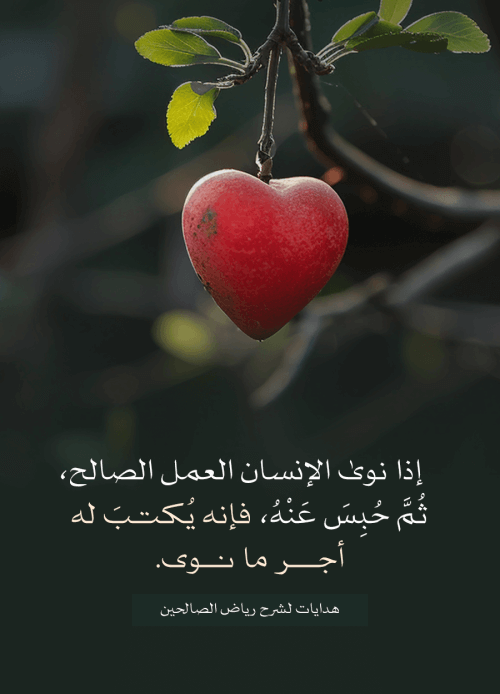
Sincerity and honesty are the criteria for deeds that, once fulfilled, the doer will obtain the designated reward.
Riyadh Al-Salheen with explanation and benefits
The greater the benefit extending beyond limited individuals, the greater the reward and the effect.
Riyadh Al-Salheen with explanation and benefits
Perfection and goodness lie entirely in following the path of the Prophets (peace be upon them) in terms of knowledge and action.
Riyadh Al-Salheen with explanation and benefits