








Categories
Discover our diverse collection of categories covering multiple topics to meet your various interestsDa\'wa cards that highlight great meanings of the verses of the Holy Quran and the noble prophetic hadiths in a simple style and attractive display that helps the Muslim to have a deeper understanding of his religion in an easy way
﴿ قَالَ كَذَٰلِكَ أَتَتۡكَ ءَايَٰتُنَا فَنَسِيتَهَاۖ وَكَذَٰلِكَ ٱلۡيَوۡمَ تُنسَىٰ ﴾
سورة طه
[Allāh] will say, "Thus did Our signs come to you, and you forgot [i.e., disregarded] them; and thus will you this Day be forgotten."

﴿ يَشۡهَدُهُ ٱلۡمُقَرَّبُونَ ﴾
سورة المطففين
witnessed by those who are close to Allah.
﴿ وَلَا تُطِعِ ٱلۡكَٰفِرِينَ وَٱلۡمُنَٰفِقِينَ وَدَعۡ أَذَىٰهُمۡ وَتَوَكَّلۡ عَلَى ٱللَّهِۚ وَكَفَىٰ بِٱللَّهِ وَكِيلٗا ﴾
سورة الأحزاب
And do not obey the disbelievers and the hypocrites and disregard their annoyance, and rely upon Allāh. And sufficient is Allāh as Disposer of affairs.
﴿ فَٱلۡتَقَطَهُۥٓ ءَالُ فِرۡعَوۡنَ لِيَكُونَ لَهُمۡ عَدُوّٗا وَحَزَنًاۗ إِنَّ فِرۡعَوۡنَ وَهَٰمَٰنَ وَجُنُودَهُمَا كَانُواْ خَٰطِـِٔينَ ﴾
سورة القصص
8. Then the household of Fir‘aun (Pharaoh) picked him up, that he might become for them an enemy and a (cause of) grief. Verily, Fir‘aun (Pharaoh), Hâmân and their hosts were sinners.
﴿ أَءِذَا مِتۡنَا وَكُنَّا تُرَابٗا وَعِظَٰمًا أَءِنَّا لَمَبۡعُوثُونَ ﴾
سورة الصافات
When we have died and become dust and bones, are we indeed to be resurrected?
﴿ يَٰٓأَهۡلَ ٱلۡكِتَٰبِ لَا تَغۡلُواْ فِي دِينِكُمۡ وَلَا تَقُولُواْ عَلَى ٱللَّهِ إِلَّا ٱلۡحَقَّۚ إِنَّمَا ٱلۡمَسِيحُ عِيسَى ٱبۡنُ مَرۡيَمَ رَسُولُ ٱللَّهِ وَكَلِمَتُهُۥٓ أَلۡقَىٰهَآ إِلَىٰ مَرۡيَمَ وَرُوحٞ مِّنۡهُۖ فَـَٔامِنُواْ بِٱللَّهِ وَرُسُلِهِۦۖ وَلَا تَقُولُواْ ثَلَٰثَةٌۚ ٱنتَهُواْ خَيۡرٗا لَّكُمۡۚ إِنَّمَا ٱللَّهُ إِلَٰهٞ وَٰحِدٞۖ سُبۡحَٰنَهُۥٓ أَن يَكُونَ لَهُۥ وَلَدٞۘ لَّهُۥ مَا فِي ٱلسَّمَٰوَٰتِ وَمَا فِي ٱلۡأَرۡضِۗ وَكَفَىٰ بِٱللَّهِ وَكِيلٗا ﴾
سورة النساء
O People of the Scripture, do not commit excess in your religion[236] or say about Allāh except the truth. The Messiah, Jesus the son of Mary, was but a messenger of Allāh and His word which He directed to Mary and a soul [created at a command] from Him. So believe in Allāh and His messengers. And do not say, "Three"; desist - it is better for you. Indeed, Allāh is but one God. Exalted is He above having a son. To Him belongs whatever is in the heavens and whatever is on the earth. And sufficient is Allāh as Disposer of affairs.
﴿ وَقَالُوٓاْ ءَأَٰلِهَتُنَا خَيۡرٌ أَمۡ هُوَۚ مَا ضَرَبُوهُ لَكَ إِلَّا جَدَلَۢاۚ بَلۡ هُمۡ قَوۡمٌ خَصِمُونَ ﴾
سورة الزخرف
and they said, “Are Our gods better or he[23]?” They only mentioned him to you for the sake of argument. They are indeed a contentious people.
﴿ أُوْلَٰٓئِكَ ٱلَّذِينَ نَتَقَبَّلُ عَنۡهُمۡ أَحۡسَنَ مَا عَمِلُواْ وَنَتَجَاوَزُ عَن سَيِّـَٔاتِهِمۡ فِيٓ أَصۡحَٰبِ ٱلۡجَنَّةِۖ وَعۡدَ ٱلصِّدۡقِ ٱلَّذِي كَانُواْ يُوعَدُونَ ﴾
سورة الأحقاف
16. They are those from whom We shall accept the best of their deeds and overlook their evil deeds. (They shall be) among the dwellers of Paradise - a promise of truth, which they have been promised.
﴿ فَٱلۡمُورِيَٰتِ قَدۡحٗا ﴾
سورة العاديات
striking sparks of fire [with their hooves][2],
Abu Mūsa al-Ash‘ari (may Allah be pleased with him) reported: The Messenger of Allah (may Allah’s peace and blessings be upon him) said: "If a person falls ill or travels, he shall be credited with whatever good deeds he used to perform while being at home and in good health."
Narrated by Bukhari
The Prophet (may Allah's peace and blessings be upon him) mentions Allah's bounty and mercy, and that if a Muslim habitually performs a certain good deed while in good health and being at home, and then something occurs to him, such as an illness that makes him unable to do this deed, or a journey that keeps him too busy to do so, or any other excuse, he will get his reward in full, as he used to obtain it for performing this deed while in good health and at home.
Tamīm ad-Dāri (may Allah be pleased with him) reported: The Prophet (may Allah's peace and blessings be upon him) said: "Religion is sincerity." We said: "To whom?" He said: "To Allah, to His Book, to His Messenger, to the Muslim leaders and their common folk."
Narrated by Muslim
The Prophet (may Allah's peace and blessings be upon him) informed that the religion rests upon sincerity and truthfulness, to be observed as Allah ordained, in a perfect manner without shortcomings or deception. It was said to the Prophet (may Allah's peace and blessings be upon him): To whom should sincerity be? He said: First: Sincerity should be to Allah Almighty: by performing deeds sincerely for His sake, not associating partners with Him, believing in His lordship, divinity, names, and attributes, venerating His command, and calling people to believe in Him. Second: Sincerity should be to His Book, namely the noble Qur’an: by believing that it is His speech and the last book revealed by Him and that it superseded all the legislations before it - and by revering it, reciting it correctly, acting upon its definite verses and accepting its ambiguous ones, defending it against the misinterpretation of those who seek to distort it, heeding its lessons and admonitions, spreading its knowledge, and calling people to it. Third: Sincerity should be to His Messenger Muhammad (may Allah's peace and blessings be upon him): by believing that he is the last Messenger, believing him in all that he came with, observing his commands and prohibitions, worshiping Allah only according to what he came with, venerating and revering him, spreading his call, disseminating his Shariah, and negating the accusations leveled against him. Fourth: Sincerity should be to the leaders of the Muslims: by helping them in what is right, not fighting them over power, and hearing and obeying them in what is pleasing to Allah. Fifth: Sincerity should be to the Muslims: by showing kindness to them, calling them to Allah, averting harm from them, wishing good for them, and cooperating with them in righteousness and piety.
‘Ā’ishah (may Allah be pleased with her) reported: I heard the Messenger of Allah (may Allah’s peace and blessings be upon him) say: "O Allah, treat harshly those who have any charge over my Ummah and treat them harshly, and treat gently those who have any charge over my Ummah and treat them gently."
Narrated by Muslim
The Messenger of Allah (may Allah's peace and blessings be upon him) supplicated against anyone who takes charge of some affairs of the Muslims, be they little or significant, and whether his authority is public or a private and specific one, and he puts them into difficulty and does not treat them gently, that Allah Almighty give him recompense of the same type of his action: putting him into difficulty. And he supplicated for anyone who takes charge over the Muslims and treats them gently and makes things easy for them that Allah treat him gently and make things easy for him.
Ma‘qil ibn Yasār (may Allah be pleased with him) reported: I heard the Messenger of Allah (may Allah's peace and blessings be upon him) say: "There is no one whom Allah puts in a position of authority, and he dies on the day he dies while cheating those under his authority except that Allah will forbid Paradise for him."
Narrated by Bukhari & Muslim
The Prophet (may Allah's peace and blessings be upon him) informs that if Allah Almighty puts someone in authority over people, be it public authority, like the ruler, or a private one, like a man in his house and a woman in her house, and he neglects the right of those under his authority, cheats them, and acts insincerely towards them, ruining their worldly and religious rights, then he deserves this severe punishment.
Abu Hurayrah (may Allah be pleased with him) reported: The Prophet (may Allah's peace and blessings be upon him) said: "Whoever gives up obedience and isolates from the community and dies has died a death like that of jāhiliyyah (the pre-Islamic era of ignorance). Whoever fights under a blind banner, getting flared up for his people's pride, calling to fight for the sake of his people's pride or in support of his people's pride, and gets killed, his killing is like that of jāhiliyyah. Whoever revolts against my Ummah, killing the righteous and the wicked of them, not avoiding the believers among them and not fulfilling a covenant with those with whom he has made covenants, he does not belong to me, and I do not belong to him."
Narrated by Muslim
The Prophet (may Allah's peace and blessings be upon him) pointed out that if anyone departs from obedience to the rulers and separates from the community of Muslims who agreed to pledge allegiance to the ruler and dies in this state of separation and disobedience, he has died like the death of the people of jāhiliyyah, who would not obey a leader or join one group; instead, they were different groups and tribes fighting one another. . And the Prophet (may Allah's peace and blessings be upon him) informed that if anyone fights under a banner with which he cannot distinguish the truth from falsehood. He gets angry for the sole purpose of bias for his people or tribe, not for supporting the religion and the truth. He fights for fanaticism without insight or knowledge; his killing is like that of jāhiliyyah if he dies in this state. And that if anyone revolts against his Ummah, striking the righteous and the wicked of them and not caring about what he does or not fearing the punishment for killing the believers among them, and does not fulfill a covenant with those whom he has made covenants with from among the disbelievers or the rulers - rather, he violates them - this is a major sin and whoever commits it deserves this stern warning.
‘Arfajah (may Allah be pleased with him) reported: I heard the Messenger of Allah (may Allah's peace and blessings be upon him) say: "If someone comes to you seeking to undermine your solidarity or disrupt your unity when you have agreed on one man, kill him."
Narrated by Muslim
The Prophet (may Allah's peace and blessings be upon him) points out that if the Muslims agreed upon one ruler and one group, and then someone comes and wants to challenge his authority or cause disunity among the Muslims and disperse them into different groups, they are obligated to stop him and fight him to ward off his evil and prevent bloodshed among the Muslims.
Abu Sa‘īd al-Khudri (may Allah be pleased with him) reported: The Prophet (may Allah's peace and blessings be upon him) said: "Among the best of Jihad is to speak a word of justice to an oppressive ruler."
Narrated by Abu Daoud & At-Termedhy Ibn Majah & Ahmad
The Prophet (may Allah's peace and blessings be upon him) pointed out that one of the greatest and most beneficial types of Jihad in the cause of Allah Almighty is a word of justice and truth before an unjust ruler or governor. This is because in doing so, a person practices the ritual of enjoining the right and forbidding the wrong, be it by speech, writing, action, or anything else that benefits and wards off evil.
Abu Sufyān Sakhr ibn Harb (may Allah be pleased with him) reported: Heraclius said: "What does the Prophet enjoin you to do?" I said: "He tells us to worship Allah alone, not to associate anything with Him and to give up all that our ancestors said. He also commands us to perform prayers, adhere to truthfulness, be chaste, and maintain ties of kinship."
Narrated by Bukhari & Muslim
This is the famous Hadīth of Abu Sufyān Sakhr ibn Harb (may Allah be pleased with him) about the story of Heraclius. At that time, Abu Sufyān was a polytheist, as he entered Islam later during the period between the Hudaybiyah Peace Treaty and the Conquest of Makkah. Abu Sufyān and a group of people from the Quraysh went to the Levant to meet Heraclius, who was the king of the Christians at that time. He had read the Torah and the Gospel, and knew about the previous holy scriptures. He was an intelligent ruler. When he heard that Abu Sufyān and his companions came to visit him from Hijāz, he summoned them. He started to ask them about the Prophet (may Allah's peace and blessings be upon him) and about his lineage, his Companions, their veneration of him, and his faithfulness. Every time Heraclius asked about something, they told him about it. So he came to know that he was the Prophet which the previous books had mentioned, but as he was keen to retain his kingdom, he did not enter Islam for some reason that Allah, the Almighty, willed. Heraclius asked Abu Sufyān about what the Prophet (may Allah's peace and blessings be upon him) enjoined them to do. Abu Sufyān told him that he ordered them to worship Allah alone and not to associate partners with him. That is, they should worship none but Allah, neither an angel, nor a messenger, or a tree, or a rock, or a sun, or a moon, or any other thing. Worshiping Allah alone is the call of all the messengers. So what the Prophet (may Allah's peace and blessings be upon him) came with was the same call that all other prophets before him came with. He (may Allah's peace and blessings be upon him) ordered them to "give up what your forefathers were upon"; this is a form of proclaiming the truth. The Prophet (may Allah's peace and blessings be upon him) commanded them to abandon the worship of idols which their fathers used to engage in, but he did not order them to give up the noble manners which their forefathers adopted. Abu Sufyān further said: "He ordered us to pray." Prayer is the connection between the slave and His Lord. It is the most emphasized pillar of Islam after the Two Testimonies of faith. Prayer is what distinguishes the believer from the disbeliever. It is the covenant between us (Muslims) and the disbelievers and the polytheists, as the Prophet (may Allah's peace and blessings be upon him) said: "The covenant between us and them is the prayer; whoever abandons it has disbelieved." His statement: "He used to order us to adhere to truthfulness." The Prophet (may Allah's peace and blessings be upon him) used to order his nation to adhere to truthfulness. This is in accordance with Allah’s statement (which means): {O you who believe, fear Allah and be with the truthful} [At-Tawbah: 119]. Truthfulness is a virtuous moral, and it is of two categories: Truthfulness with Allah, and truthfulness with Allah's slaves. Both are from the noble morals. His statement: "chastity". Chastity is of two types: abstention from sexual desire, and abstention from the desires of the stomach. As for the first type: It is when a person abstains from everything that Allah has deemed impermissible for him, like unlawful sexual intercourse, along with all the means and causes related to it. The second type: To abstain from and control the desires of one’s stomach, meaning from what is in the possession of others, and abstain from asking them in such a way that one does not ask anyone for anything, because asking others is humiliation, and the one who asks has the lower hand, while the one who gives has the upper hand. So it is not permissible to ask anyone except for things that are necessarily needed. As for the fifth point: "to maintain ties of kinship". It means that the person joins such relatives which Allah orders him to join, starting from the closest, and then to the closer among them. The closest of them are the parents. Indeed maintaining good relations with the parents constitutes righteousness and maintaining ties of kinship. Ties with the relatives should be maintained in accordance with their closeness. For example, maintaining ties with the brother is more emphasized than the uncle, and maintaining ties with the uncle is more emphasized than the father's uncle. Maintaining ties of kinship can be achieved by all the means that the people are familiar with in this regard.
Ibn Mas‘ūd (may Allah be pleased with him) reported that the Prophet (may Allah's peace and blessings be upon him) said: "There will be selfishness and other matters that you will disapprove of after me." They asked: What do you order us to do (in such circumstances), O Messenger of Allah? He said: '"Fulfill your duty (towards the ruler), and ask Allah for your rights."
Narrated by Bukhari & Muslim
The Prophet (may Allah's peace and blessings be upon him) informed us that there will be rulers assigned to be in charge of Muslims and they will monopolize the Muslims' wealth and spend it as they wish, depriving the Muslims of their rights thereof. These rulers will also do things, related to the religion, that are disapproved by the Shariah. The Companions (may Allah be pleased with them) asked about what they should do in such a case. The Prophet (may Allah's peace and blessings be upon him) told them not to let these rulers' monopoly of wealth prevent them from fulfilling their duty towards them, including listening and obeying. Rather, they should have patience, listen and obey them without disputing their authority. Moreover, they should ask Allah for their rights and ask Him to guide these rulers and ward off their evil and oppression.
Repenting to Allah Almighty is a cause for quitting sins and for contentment with the provision that Allah alloted for His servant.
Riyadh Al-Salheen with explanation and benefits
Facing affliction with patience and expectation of the reward from Allah raises one’s ranks and expiates his sins.
Riyadh Al-Salheen with explanation and benefits
The afflictions befalling the believer is a proof that Allah loves him and wills good for him.
Riyadh Al-Salheen with explanation and benefits
Anyone who bears a calamity patiently and awaits Allah’s reward, Allah, the Exalted, will compensate him with better than what he lost either in himself or his family.
Riyadh Al-Salheen with explanation and benefits
When the believer bears patiently and awaits Allah’s reward, Allah Almighty expiates his sins.
Riyadh Al-Salheen with explanation and benefits
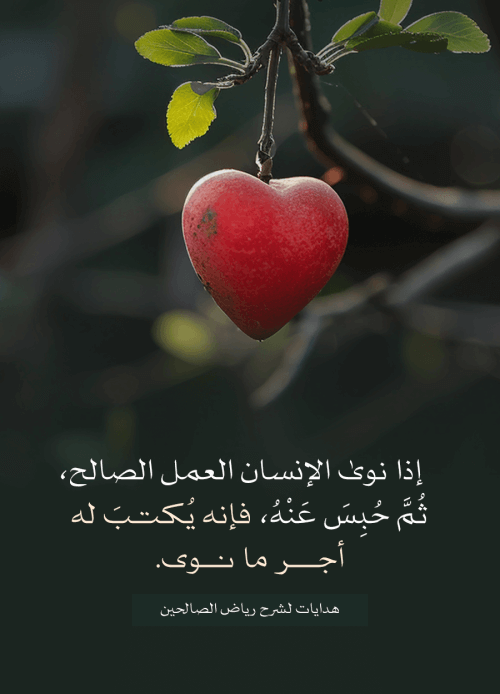
Truthfulness of the hearts is a cause to attain what is desired. Whoever intends to do a good deed will be rewarded for it even if he were unable to do it or failed to complete it.
Riyadh Al-Salheen with explanation and benefits
Thanking Allah for His blessings is one of the reasons for their permanence and increase.
Riyadh Al-Salheen with explanation and benefits
Once something is blessed, it becomes abundant even if it is little; and once something is stripped of blessings, it becomes little even if it is abundant.
Riyadh Al-Salheen with explanation and benefits
Taqwa is a [metaphorical] light helping the individual to discern between the truth and falsehood, the good and the harmful, and the [standard practice] of Sunnah from [religious] innovation.
Riyadh Al-Salheen with explanation and benefits