




Categories
Discover our diverse collection of categories covering multiple topics to meet your various interestsDa\'wa cards that highlight great meanings of the verses of the Holy Quran and the noble prophetic hadiths in a simple style and attractive display that helps the Muslim to have a deeper understanding of his religion in an easy way
﴿ هَلۡ أُنَبِّئُكُمۡ عَلَىٰ مَن تَنَزَّلُ ٱلشَّيَٰطِينُ ﴾
سورة الشعراء
Shall I inform you upon whom the devils descend?

﴿ قُلۡ هَلۡ أُنَبِّئُكُم بِشَرّٖ مِّن ذَٰلِكَ مَثُوبَةً عِندَ ٱللَّهِۚ مَن لَّعَنَهُ ٱللَّهُ وَغَضِبَ عَلَيۡهِ وَجَعَلَ مِنۡهُمُ ٱلۡقِرَدَةَ وَٱلۡخَنَازِيرَ وَعَبَدَ ٱلطَّٰغُوتَۚ أُوْلَٰٓئِكَ شَرّٞ مَّكَانٗا وَأَضَلُّ عَن سَوَآءِ ٱلسَّبِيلِ ﴾
سورة المائدة
60. Say (O Muhammad صلى الله عليه وسلم to the people of the Scripture): "Shall I inform you of something worse than that, regarding the recompense from Allâh: those (Jews) who incurred the Curse of Allâh and His Wrath, and those of whom (some) He transformed into monkeys and swines, and those who worshipped Tâghût [21] (false deities); such are worse in rank (on the Day of Resurrection in the Hell-fire), and far more astray from the Right Path (in the life of this world)."
﴿ نَحۡنُ خَلَقۡنَٰكُمۡ فَلَوۡلَا تُصَدِّقُونَ ﴾
سورة الواقعة
We have created you, so why do you not believe?
﴿ إِنَّ فِي ذَٰلِكَ لَأٓيَةٗ لِّلۡمُؤۡمِنِينَ ﴾
سورة الحجر
Indeed, there are signs in this for the believers.
﴿ ثُمَّ عَفَوۡنَا عَنكُم مِّنۢ بَعۡدِ ذَٰلِكَ لَعَلَّكُمۡ تَشۡكُرُونَ ﴾
سورة البقرة
52. Then after that We forgave you so that you might be grateful.
﴿ وَإِن تَعُدُّواْ نِعۡمَةَ ٱللَّهِ لَا تُحۡصُوهَآۗ إِنَّ ٱللَّهَ لَغَفُورٞ رَّحِيمٞ ﴾
سورة النحل
If you try to count Allah’s favors, you will not be able to enumerate them. Indeed, Allah is All-Forgiving, Most Merciful.
﴿ وَيَوۡمَ نَحۡشُرُ مِن كُلِّ أُمَّةٖ فَوۡجٗا مِّمَّن يُكَذِّبُ بِـَٔايَٰتِنَا فَهُمۡ يُوزَعُونَ ﴾
سورة النمل
83. And (remember) the Day when We shall gather out of every nation a troop of those who denied Our Ayât (proofs, evidence, verses, lessons, signs, revelations, etc.), and (then) they (all) shall be driven (to the place of reckoning),
﴿ وَأُزۡلِفَتِ ٱلۡجَنَّةُ لِلۡمُتَّقِينَ ﴾
سورة الشعراء
Paradise will be brought near to the righteous,
﴿ أَمۡ يَقُولُونَ شَاعِرٞ نَّتَرَبَّصُ بِهِۦ رَيۡبَ ٱلۡمَنُونِ ﴾
سورة الطور
Or do they say: “He is a poet for whom we await a misfortune[11]”?
Abu Ayyūb al-Ansāri (may Allah be pleased with him) reported: The Messenger of Allah (may Allah's peace and blessings be upon him) said: "It is unlawful for a Muslim to desert his fellow Muslim for more than three nights. As they meet, both of them turn their backs on each other. But the best of them is the one who starts by greeting the other."
Narrated by Bukhari & Muslim
The Prophet (may Allah's peace and blessings be upon him) forbade that a Muslim should desert his fellow Muslim for more than three nights. None of them greets the other or talks to him when they meet. The best of such two estranged persons is the one who tries to end their estrangement, so he greets the other first. The kind of desertion intended in this Hadīth is what a person engages in for his own sake. However, a person may desert others for the sake of Allah Almighty, like deserting sinners, heretic innovators, and bad companions. This does not have a time limit. Instead, it is contingent on a cause and should end when the cause is no longer there.
Abu Sirmah (may Allah be pleased with him) reported: The Messenger of Allah (may Allah's peace and blessings be upon him) said: "Whoever causes harm will be harmed by Allah, and whoever causes hardship will be put in hardship by Allah."
Narrated by Abu Daoud & At-Termedhy Ibn Majah & Ahmad
The Prophet (may Allah's peace and blessings be upon him) warned against causing harm or hardship to a Muslim in any matter, in himself, his wealth, or his family, and that whoever does so, Allah will subject him to a punishment similar to his action.
Jarīr ibn ‘Abdullah (may Allah be pleased with him) reported: We were in the presence of the Prophet (may Allah's peace and blessings be upon him) when he looked at the moon when it was full, and he said: "You will see your Lord as you see this moon, you will not have any difficulty in seeing Him. So if you are able to not be overcome in observing a prayer before sunrise (the Fajr) and a prayer before sunset (the ‘Asr), then do so." Then, he recited: "{And glorify the praise of your Lord before sunrise and before sunset.}"
Narrated by Bukhari & Muslim
One night, the Companions were in the presence of the Prophet (may Allah's peace and blessings be upon him) when he looked at the full moon - on the 14th night of the lunar month - and said: The believers will see their Lord in the real sense clearly with their own eyes. They will not cause a crowd to one another, get tired, or experience hardship when seeing their Almighty Lord. Then, the Messenger of Allah (may Allah's peace and blessings be upon him) said: If you are able to get over whatever distracts you from observing the Fajr and ‘Asr prayers, then do so and observe them fully in their due times in a congregation, for this is one of the causes that lead to looking at the Countenance of Allah Almighty. Then, he (may Allah's peace and blessings be upon him) recited the verse that reads: {And glorify the praise of your Lord before sunrise and before sunset.}
Abu Mūsa (may Allah be pleased with him) reported: The Messenger of Allah (may Allah's peace and blessings be upon him) said: "Verily, Allah gives respite to the oppressor, but when He seizes him, He does not release him." Then, he recited: {Such is the seizing of your Lord when He seizes the towns that are given to wrongdoing; His seizing is surely painful and severe.} [Surat Hūd: 102]"
Narrated by Bukhari & Muslim
The Prophet (may Allah's peace and blessings be upon him) warns against persistent wrongdoing by committing sins, polytheism, and injustice to people about their rights, for indeed Allah Almighty gives respite to the oppressor and endows him with a long lifetime and abundant wealth and does not hasten to punish him. But, if he does not repent, He seizes him and does not release him due to his persistent wrongdoing. Then, he (may Allah's peace and blessings be upon him) recited: {Such is the seizing of your Lord when He seizes the towns that are given to wrongdoing; His seizing is surely painful and severe.} [Surat Hūd: 102]
Abu al-Hayyāj al-Asadi reported: 'Ali (may Allah be pleased with him) said to me: "Shall I not send you with the same instructions as the Messenger of Allah (may Allah's peace and blessings be upon him) sent me with? Do not leave any statue without blotting it out or any raised grave without leveling it."
Narrated by Muslim
The Prophet (may Allah's peace and blessings be upon him) would send his Companions and instruct them not to leave any statue - three-dimensional or flat image - without removing it or blotting it out, and not to leave any raised grave without leveling it and destroying any structure built above it; or making it flat as high as a span above the ground.
‘Imrān ibn Husayn (may Allah be pleased with him) reported: The Messenger of Allah (may Allah's peace and blessings be upon him) said: "He is not one of us who seeks bad omens or has it done for him, or who practices soothsaying or has it done for him, or who practices sorcery or has it done for him; and whoever ties a knot, and whoever goes to a soothsayer and believes in what he says has disbelieved in what was revealed to Muhammad (may Allah's peace and blessings be upon him)."
Narrated by Al-Bazzar
The Prophet (may Allah's peace and blessings be upon him) gave a warning to those members of his Ummah who practices certain acts by saying: "He is not one of us." Those acts include: First: "Who seeks omens, or has it done for him." Seeking omens is tatyyur in Arabic, and it comes from the word 'tayr' (bird). They used to release birds before taking any course of action. If the bird flew to the right, they would feel optimistic and go ahead with their plan, but if it flew to the left, they would feel pessimistic and abandon their plan. It is not permissible for a person to do this by himself or appoint someone to do it on his behalf. Falling under this is being pessimistic due to anything heard or seen, including birds, animals, people with deformities, specific numbers or days, etc. Second: "Who practices soothsaying, or has it done for him." Whoever claims to know the unseen, through the stars or anything else, or comes to someone who claims knowledge of the unseen, like a soothsayer or diviner, and believes what he says, based on his claim to know the unseen, has thus disbelieved in what was revealed to Muhammad (may Allah's peace and blessings be upon him). Third: "Who practices sorcery, or has it done for him." Such is a person who performs magic by himself or asks another person to perform magic for him to bring benefit or cause harm to someone, or he ties a knot by connecting a string and practicing magic on it by reciting prohibited talismans and blowing on it.
Some of the Prophet's wives reported that the Prophet (may Allah's peace and blessings be upon him) said: "Whoever goes to a soothsayer and asks him about something and believes him, his prayer will not be accepted for forty nights."
Narrated by Muslim
The Prophet (may Allah's peace and blessings be upon him) warns us against going to soothsayers - a general term also applying to fortune tellers, astrologers, geomancers, and others who use certain things as means for knowing the unseen - and says that if a person merely asks a soothsayer about anything of the unseen, Allah will deny him the reward for his prayers for forty days, as a punishment for this great sin and misdeed.
Ibn ‘Abbās (may Allah be pleased with him) reported: The Messenger of Allah (may Allah’s peace and blessings be upon him) said: "Whoever acquires a branch of the knowledge of astrology acquires a branch of magic, of which he acquires more as long as he continues to do so."
Narrated by Abu Daoud & Ibn Majah & Ahmad
The Prophet (may Allah's peace and blessings be upon him) points out that if a person acquires knowledge of the stars and planets and uses their movements and entry and exit as guidance for earthly events, like the birth of someone or his demise or illness, or any other future incident, he has thus learned part of magic, and the more he acquires of it, the more magic he learns.
‘Abdullāh ibn Mas‘ūd (may Allah be pleased with him) reported that the Prophet (may Allah's peace and blessings be upon him) said: "The gravest major sins are: associating partners with Allah in worship, feeling secure from Allah's plan, despairing of Allah's mercy, and losing hope in relief coming from Allah.”
‘Abdur-Razzaaq
The Prophet (may Allah's peace and blessings be upon him) mentioned in this Hadīth the sins that are considered the gravest and worst ones. These sins include associating partners with Allah, the Almighty, in His lordship or His worship. He started with polytheism because it is the gravest sin ever. Another sin is losing hope in Allah’s mercy, because it involves having ill expectations of Allah, and ignorance of the vastness of His mercy. It is one of the gravest sins as well to feel secure against being dragged by way of favors until Allah punishes the sinner all of a sudden. The Hadīth, however, does not aim at listing all the major sins, rather, it aims at highlighting the gravest of them, because the list of major sins contains so many more.
The path of Allah is one whereas the paths of the devil are many; and a truly guided individual is he whom Allah Almighty guided to His path. Allah Almighty said: {This is My straight path; follow it and do not follow other ways, lest they lead you away from His way.} [Surat al-An‘ām: 153]
Riyadh Al-Salheen with explanation and benefits
Waiting to do a good deed is in itself a good deed.
Riyadh Al-Salheen with explanation and benefits
Good intention leads its holder to good things.
Riyadh Al-Salheen with explanation and benefits
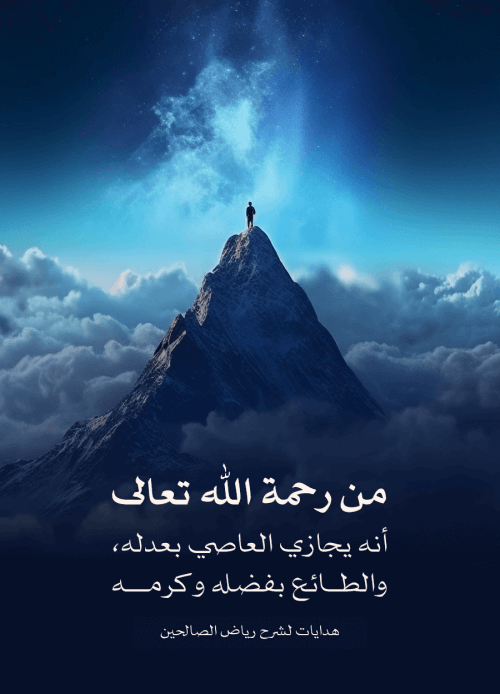
One of the manifestations of Allah’s mercy is that He uses justice to recompense the sinner but uses His grace and bounty to recompense the good-doer.
Riyadh Al-Salheen with explanation and benefits
Sincerity is one of the means to alleviate adversity because each one of them said: “O Allah! If I did that for Your sake only, then relieve us from the distress we are in.”
Riyadh Al-Salheen with explanation and benefits
Good deeds are means to alleviating adversity.
Riyadh Al-Salheen with explanation and benefits
“The righteousness of the heart results from the righteousness of deeds, and the righteousness of deeds results from the righteousness of intention.”
Riyadh Al-Salheen with explanation and benefits
Repentance is a cause for success, which is why a true successful person is the one seeking and committing to a means leading to success.
Riyadh Al-Salheen with explanation and benefits
Hastening to repentance is one of the causes to earning the pleasure of Allah with His servant.
Riyadh Al-Salheen with explanation and benefits