





Categories
Discover our diverse collection of categories covering multiple topics to meet your various interestsDa\'wa cards that highlight great meanings of the verses of the Holy Quran and the noble prophetic hadiths in a simple style and attractive display that helps the Muslim to have a deeper understanding of his religion in an easy way
﴿ فَإِن كَذَّبُوكَ فَقَدۡ كُذِّبَ رُسُلٞ مِّن قَبۡلِكَ جَآءُو بِٱلۡبَيِّنَٰتِ وَٱلزُّبُرِ وَٱلۡكِتَٰبِ ٱلۡمُنِيرِ ﴾
سورة آل عمران
Then if they reject you [O Prophet], there were messengers who were rejected before you, who came with clear proofs, written ordinances [i.e., Psalms of David], and the enlightening Scripture.

﴿ بَلِ ٱللَّهُ مَوۡلَىٰكُمۡۖ وَهُوَ خَيۡرُ ٱلنَّٰصِرِينَ ﴾
سورة آل عمران
But Allāh is your protector, and He is the best of helpers.
﴿ قَالَ رَبِّ ٱغۡفِرۡ لِي وَلِأَخِي وَأَدۡخِلۡنَا فِي رَحۡمَتِكَۖ وَأَنتَ أَرۡحَمُ ٱلرَّٰحِمِينَ ﴾
سورة الأعراف
Moses said, “My Lord, forgive me and my brother[53], and admit us into Your mercy, for You are the Most Merciful of those who show mercy.”
﴿ لَا يُؤۡمِنُونَ بِهِۦ حَتَّىٰ يَرَوُاْ ٱلۡعَذَابَ ٱلۡأَلِيمَ ﴾
سورة الشعراء
201. They will not believe in it until they see the painful torment.
﴿ إِنَّمَا نُطۡعِمُكُمۡ لِوَجۡهِ ٱللَّهِ لَا نُرِيدُ مِنكُمۡ جَزَآءٗ وَلَا شُكُورًا ﴾
سورة الإنسان
[Saying], "We feed you only for the face [i.e., approval] of Allāh. We wish not from you reward or gratitude.
﴿ وَمَا خَلَقۡنَا ٱلسَّمَآءَ وَٱلۡأَرۡضَ وَمَا بَيۡنَهُمَا لَٰعِبِينَ ﴾
سورة الأنبياء
And We did not create the heaven and earth and that between them in play.
﴿ وَخَلَقۡنَٰكُمۡ أَزۡوَٰجٗا ﴾
سورة النبأ
and created you in pairs,
﴿ لِيَحۡمِلُوٓاْ أَوۡزَارَهُمۡ كَامِلَةٗ يَوۡمَ ٱلۡقِيَٰمَةِ وَمِنۡ أَوۡزَارِ ٱلَّذِينَ يُضِلُّونَهُم بِغَيۡرِ عِلۡمٍۗ أَلَا سَآءَ مَا يَزِرُونَ ﴾
سورة النحل
That they may bear their own burdens [i.e., sins] in full on the Day of Resurrection and some of the burdens of those whom they misguide without [i.e., by lack of] knowledge. Unquestionably, evil is that which they bear.
﴿ وَمَا ذَٰلِكَ عَلَى ٱللَّهِ بِعَزِيزٖ ﴾
سورة فاطر
17. And that is not hard for Allâh.
Yahya ibn ‘Umārah al-Māzini reported: I witnessed 'Amr ibn Abi Hasan asking 'Abdullah ibn Zayd about the ablution of the Prophet (may Allah's peace and blessings be upon him), so he asked for a vessel of water and performed ablution like that of the Prophet (may Allah's peace and blessings be upon him) in front of them. He poured water from the vessel on his hand, washing his hands thrice. Then, he put his hand inside the vessel, rinsed his mouth, sniffed water, and blew it out with three handfuls. He put his hand in the water again and washed his face thrice. Then, he washed his hands twice up to the elbows, after which he put his hand in the water and wiped over his head, bringing them to the front and the back of his head once. Then, he washed his feet up to the ankles.
Narrated by Bukhari & Muslim
‘Abdullah ibn Zayd (may Allah be pleased with him) clarified how the Prophet (may Allah's peace and blessings be upon him) used to perform ablution practically. He asked for a small water container. First, he started by washing his hands; he tilted the container, poured water, and washed them thrice outside the container. Then, he put his hand inside the container and took three handfuls of water, and with each handful of water, he rinsed his mouth, sniffed water into his nostrils, and blew it out. After that, he took water from the container and washed his face thrice. Then, he took water therefrom and washed his hands up to the elbows twice each. He again put his hand in the container and wiped over his head with both hands, starting from the hairline and back to the nape, the upper part of the neck, and then returned them to the place where he started from. After that, he washed his feet along with the ankles.
Abu Bakrah (may Allah be pleased with him) reported: The Prophet (may Allah's peace and blessings be upon him) said: "Shall I inform you of the gravest of the major sins?" He repeated this three times. They said: "Yes, O Messenger of Allah." He said: "Associating partners with Allah and undutifulness to parents." He was reclining and then sat up and said: "And indeed, the false statement." He repeated it so many times that we wished he would stop.
Narrated by Bukhari & Muslim
The Prophet (may Allah's peace and blessings be upon him) informed his Companions about the gravest of the major sins and mentioned these three: 1. Associating partners with Allah: This is to devote any form of worship to other than Allah and regard anyone as equal to Allah in His divinity, lordship, names, and attributes. 2. Undutifulness to parents: This is any hurt to one's parents, whether by word or deed, and not showing kindness to them. 3. False statement, which includes perjury: Every false and untrue statement intended to detract from the one about whom it is made by taking his property, damaging his honor, and the like. The Prophet (may Allah's peace and blessings be upon him) repeated the warning about the false testimony to highlight its hideousness and evil consequences for society, so much that the Companions wished that he would be quiet out of compassion towards him and disliking what would annoy him.
Al-Miqdām ibn Ma‘di Karib (may Allah be pleased with him) reported that the Prophet (may Allah's peace and blessings be upon him) said: "When a man loves his brother, he should tell him that he loves him."
Narrated by Abu Daoud & At-Termedhy & Ahmad & An-Nasa'i in Major Sunan
The Prophet (may Allah's peace and blessings be upon him) demonstrates one of the means that strengthens the bond between the believers and spreads love among them: If a person loves his fellow Muslim, he should tell him that he loves him.
‘Abdullāh ibn ‘Amr ibn al-‘Aas (may Allah be pleased with him) reported that the Prophet (may Allah's peace and blessings be upon him) said: "The major sins are associating partners with Allah, undutifulness to parents, murder, and intentional false oath."
Narrated by Bukhari
The Prophet (may Allah's peace and blessings be upon him) demonstrates the major sins, whose perpetrators are given a severe warning in this world and the Hereafter. The first of them is "associating partners with Allah": This is to devote any form of worship to other than Allah and regard anyone as equal to Allah in His peculiar traits, including His divinity, lordship, names, and attributes. The second among them is "undutifulness to parents": Anything that causes hurt to one's parents, whether by word or deed and not showing kindness to them. The third among them is "murder": without right, like killing by way of oppression and aggression. And the fourth is "the intentional false oath": This is to take a false oath while knowing it to be false. It is called that (in Arabic: ghamūs) because it dips (taghmis) its perpetrator in sin or Hellfire.
Abu Hurayrah reported that the Prophet (may Allah's peace and blessings be upon him) said: "The one who looks after a widow or a needy person is like one who performs Jihad in the cause of Allah, or one who regularly observes voluntary prayer at night and fasting during the day."
Narrated by Bukhari & Muslim
The Prophet (may Allah's peace and blessings be upon him) informs us that the one who tends to the needs of a woman whose husband has died and has none to look after her or the needy person, and provides for them seeking the reward from Allah Almighty will have the same reward as the one who fights in the cause of Allah, or the one who performs the voluntary night prayer and never gets tired, and the one who always fasts incessantly.
Abu Hurayrah (may Allah be pleased with him) reported: The Prophet (may Allah’s peace and blessings be upon him) said: “Avoid the seven destructive sins” They said: “O Messenger of Allah, what are they?” He said: “Associating partners with Allah; magic (sorcery); killing a person whose killing Allah has prohibited except by legal right; consuming usury; devouring the property of an orphan; fleeing from the battlefield; and slandering chaste, innocent, and believing women.”
Narrated by Bukhari & Muslim
The Messenger of Allah (may Allah's peace and blessings be upon him) commands his Ummah to shun seven ruinous crimes and sins. When asked about them, he outlined them as the following: First: associating partners with Allah by taking anyone or anything as a peer and equal to Him and by devoting any act of worship to other than Allah Almighty. He began with polytheism because it is the gravest sin. Second: magic, which includes knots, incantations, treatments, and making smoke, affects the bewitched person's body, causing him to die or fall ill, or it causes separation between husband and wife. It is the work of the devil and mostly cannot be performed except through polytheism and pleasing the evil spirits by doing any of the things they like. Third: killing a person whose killing Allah has prohibited except by a legal cause implemented by the ruler. Fourth: consuming usury by taking it or any other form of benefit. Fifth: encroaching upon the property of a child whose father died before he reaches puberty. Sixth: fleeing the battle with the disbelievers. Seventh: accusing chaste and noble women of adultery, as well as accusing men.
Abu Hurayrah (may Allah be pleased with him) reported: The Messenger of Allah (may Allah's peace and blessings be upon him) said: "Do not turn your houses like graves, and do not take my grave a place for celebration, and invoke (Allah's) blessings upon me, for your invoking of Allah's blessings upon me will reach me wherever you may be."
Narrated by Abu Daoud
The Prophet (may Allah's peace and blessings be upon him) forbade that houses be free from prayers and thus become like graves, where prayer is not offered. He forbade frequently visiting his grave and gathering there in an usual manner, for this is a means leading to polytheism. He commanded that we invoke Allah's blessings upon him from any place on earth, for this will reach him from the near and the distant places alike; so, there is no need to frequent his grave.
Sahl ibn Sa‘d (may Allah be pleased with him) reported: The Messenger of Allah (may Allah’s peace and blessings be upon him) said: "Whoever gives me a guarantee to safeguard what is between his jaws and what is between his legs, I will guarantee him Paradise."
Narrated by Bukhari
The Prophet (may Allah's peace and blessings be upon him) informs us about two things, which if a Muslim observes, he will enter Paradise. First: protecting the tongue from saying things that displease Allah Almighty. Second: preserving the private parts from obscenity. This is because these two organs are often used in the perpetration of sins.
Jābir (may Allah be pleased with him) reported: I heard the Messenger of Allah (may Allah’s peace and blessings be upon him) say: "The best dhikr is lā ilāha illa Allah (there is no god but Allah), and the best supplication is Alhamdulillah (praise be to Allah)."
Narrated by At-Termedhy & Ibn Majah & An-Nasa'i in Major Sunan
The Prophet (may Allah's peace and blessings be upon him) informs us that the best dhikr (remembrance of Allah) is Lā ilāha illa Allah (there is no god but Allah), which means that no one is worthy of worship except Allah; and that the best supplication is Alhamdulillah (praise be to Allah), and it means acknowledgment that Allah Almighty is the Bestower of favors and the One worthy of possessing the attributes of perfection and excellence.
The path of Allah is one whereas the paths of the devil are many; and a truly guided individual is he whom Allah Almighty guided to His path. Allah Almighty said: {This is My straight path; follow it and do not follow other ways, lest they lead you away from His way.} [Surat al-An‘ām: 153]
Riyadh Al-Salheen with explanation and benefits
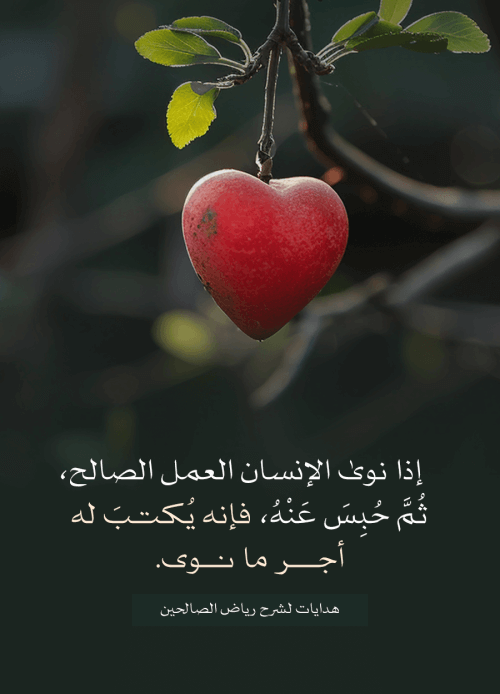
Waiting to do a good deed is in itself a good deed.
Riyadh Al-Salheen with explanation and benefits
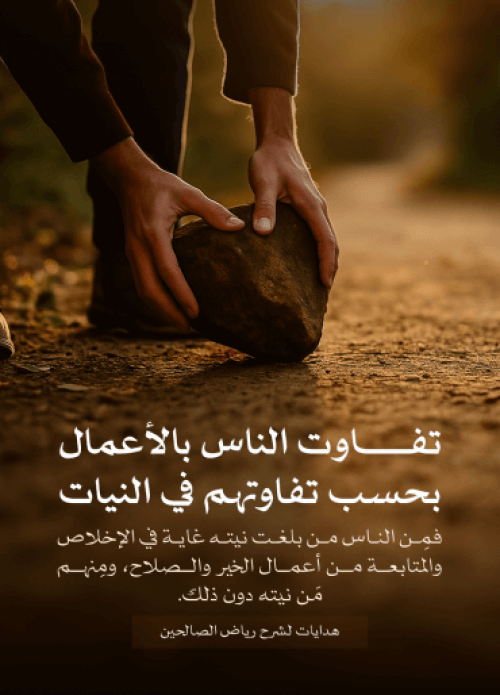
Good intention leads its holder to good things.
Riyadh Al-Salheen with explanation and benefits
One of the manifestations of Allah’s mercy is that He uses justice to recompense the sinner but uses His grace and bounty to recompense the good-doer.
Riyadh Al-Salheen with explanation and benefits
Sincerity is one of the means to alleviate adversity because each one of them said: “O Allah! If I did that for Your sake only, then relieve us from the distress we are in.”
Riyadh Al-Salheen with explanation and benefits
Good deeds are means to alleviating adversity.
Riyadh Al-Salheen with explanation and benefits
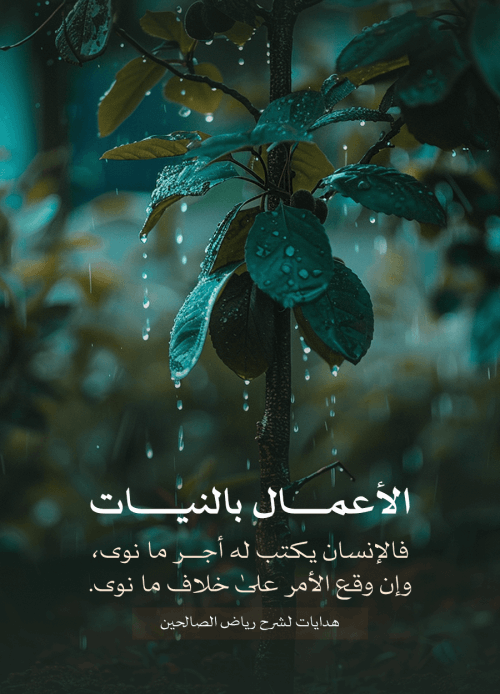
“The righteousness of the heart results from the righteousness of deeds, and the righteousness of deeds results from the righteousness of intention.”
Riyadh Al-Salheen with explanation and benefits
Repentance is a cause for success, which is why a true successful person is the one seeking and committing to a means leading to success.
Riyadh Al-Salheen with explanation and benefits
Hastening to repentance is one of the causes to earning the pleasure of Allah with His servant.
Riyadh Al-Salheen with explanation and benefits