







Categories
Discover our diverse collection of categories covering multiple topics to meet your various interestsDa\'wa cards that highlight great meanings of the verses of the Holy Quran and the noble prophetic hadiths in a simple style and attractive display that helps the Muslim to have a deeper understanding of his religion in an easy way
﴿ إِنَّ وَلِـِّۧيَ ٱللَّهُ ٱلَّذِي نَزَّلَ ٱلۡكِتَٰبَۖ وَهُوَ يَتَوَلَّى ٱلصَّٰلِحِينَ ﴾
سورة الأعراف
Indeed, my protector is Allāh, who has sent down the Book; and He is an ally to the righteous.

﴿ وَإِن كَانَ كَبُرَ عَلَيۡكَ إِعۡرَاضُهُمۡ فَإِنِ ٱسۡتَطَعۡتَ أَن تَبۡتَغِيَ نَفَقٗا فِي ٱلۡأَرۡضِ أَوۡ سُلَّمٗا فِي ٱلسَّمَآءِ فَتَأۡتِيَهُم بِـَٔايَةٖۚ وَلَوۡ شَآءَ ٱللَّهُ لَجَمَعَهُمۡ عَلَى ٱلۡهُدَىٰۚ فَلَا تَكُونَنَّ مِنَ ٱلۡجَٰهِلِينَ ﴾
سورة الأنعام
35. If their aversion (from you, O Muhammad صلى الله عليه وسلم and from that with which you have been sent) is hard on you, (and you cannot be patient of their harm to you), then if you were able to seek a tunnel in the earth or a ladder to the sky, so that you may bring them a sign (and you cannot do it, so be patient). And had Allâh willed, He could have gathered them together (all) on true guidance, so be not you one of those who are Al-Jâhilûn (the ignorant).
﴿ أَلَمۡ تَرَ كَيۡفَ فَعَلَ رَبُّكَ بِأَصۡحَٰبِ ٱلۡفِيلِ ﴾
سورة الفيل
1. Have you (O Muhammad صلى الله عليه وسلم) not seen how your Lord dealt with the owners of the Elephant? [The Elephant army which came from Yemen under the command of Abrahah Al-Ashram intending to destroy the Ka‘bah at Makkah].
﴿ وَلَقَدۡ أَنزَلۡنَآ إِلَيۡكُمۡ ءَايَٰتٖ مُّبَيِّنَٰتٖ وَمَثَلٗا مِّنَ ٱلَّذِينَ خَلَوۡاْ مِن قَبۡلِكُمۡ وَمَوۡعِظَةٗ لِّلۡمُتَّقِينَ ﴾
سورة النور
And We have certainly sent down to you distinct verses[995] and examples from those who passed on before you and an admonition for those who fear Allāh.
﴿ وَأَقۡبَلَ بَعۡضُهُمۡ عَلَىٰ بَعۡضٖ يَتَسَآءَلُونَ ﴾
سورة الصافات
27. And they will turn to one another and question one another.
﴿ وَيَعۡبُدُونَ مِن دُونِ ٱللَّهِ مَا لَمۡ يُنَزِّلۡ بِهِۦ سُلۡطَٰنٗا وَمَا لَيۡسَ لَهُم بِهِۦ عِلۡمٞۗ وَمَا لِلظَّٰلِمِينَ مِن نَّصِيرٖ ﴾
سورة الحج
Yet they worship other than Allah that for which He has not sent down any authority, and of which they have no knowledge. The wrongdoers will have no helper.
﴿ وَٱلَّذِينَ كَفَرُواْ وَكَذَّبُواْ بِـَٔايَٰتِنَآ أُوْلَٰٓئِكَ أَصۡحَٰبُ ٱلۡجَحِيمِ ﴾
سورة المائدة
86. But those who disbelieved and belied Our Ayât (proofs, evidence, verses, lessons, signs, revelations, etc.), they shall be the dwellers of the (Hell) Fire.
﴿ ٱلَّذِي يُوَسۡوِسُ فِي صُدُورِ ٱلنَّاسِ ﴾
سورة الناس
5. "Who whispers in the breasts of mankind.
﴿ قُلۡ أَغَيۡرَ ٱللَّهِ أَبۡغِي رَبّٗا وَهُوَ رَبُّ كُلِّ شَيۡءٖۚ وَلَا تَكۡسِبُ كُلُّ نَفۡسٍ إِلَّا عَلَيۡهَاۚ وَلَا تَزِرُ وَازِرَةٞ وِزۡرَ أُخۡرَىٰۚ ثُمَّ إِلَىٰ رَبِّكُم مَّرۡجِعُكُمۡ فَيُنَبِّئُكُم بِمَا كُنتُمۡ فِيهِ تَخۡتَلِفُونَ ﴾
سورة الأنعام
Say [O Prophet], “Should I seek a lord other than Allah, when He is the Lord of everything?” Every soul will face the consequences of its actions. No bearer of burden will bear the burden of another. Then to your Lord is your return, and He will inform you concerning that over which you used to differ.
Ibn ‘Abbās (may Allah be pleased with him) reported: A group of polytheists, who went to excess in killing and committing illegal sexual intercourse, came to Muhammad (may Allah's peace and blessings be upon him) and said: "What you say and invite people to is indeed good. If only you could tell us whether there is an expiation for what we did. Thereupon, it was revealed: {and those who do not invoke besides Allah, another god, and who do not kill a soul whom Allah has forbidden, except in the course of justice, and who do not commit adultery} [Surat al-Furqān: 68]. And the following verse was revealed: {Say [Allah says]: "O My slaves who have transgressed against themselves, do not despair of Allah's mercy."} [Surat az-Zumar: 53]
Narrated by Bukhari & Muslim
Some men from the polytheists came to the Prophet (may Allah's peace and blessings be upon him), as they had gone to extremes in killing and committing adultery, and said: Indeed, what you call to (Islam) and its teachings are something good. But, as for our condition and the polytheism and major sins we have committed, is there an expiation for them? Thereupon, the two verses were revealed, as Allah accepted the repentance of those people despite their numerous and severe sins. Had it not been for that, they would have persisted in their disbelief and transgression and would not have embraced this religion.
Ibn ‘Umar (may Allah be pleased with him) reported: The Messenger of Allah (may Allah's peace and blessings be upon him) delivered a speech on the day of the Conquest of Makkah. He said: "O people, verily Allah has removed the arrogance of jāhiliyyah from you and their boastfulness about their forefathers. So, now, there are two types of men: a righteous, pious, and honorable person in the sight of Allah and a wicked, wretched, and insignificant person in the sight of Allah. People are the children of Adam, and Allah created Adam from dust. Allah says: {O mankind, We have created you from a male and a female, and made you into nations and tribes so that you may recognize one another. Indeed, the most noble of you before Allah is the most righteous among you. Indeed, Allah is All-Knowing and all-aware.} [Surat al-Hujurāt: 13]"
Narrated by At-Termedhy & Ibn Hebban
The Prophet (may Allah's peace and blessings be upon him) delivered a speech on the day of the Conquest of Makkah, saying: O people, indeed Allah removed from you the arrogance and fanaticism of jāhiliyyah and the boastfulness about one's ancestors. People are of two types: Either a believer who is pious, righteous, and obedient to Allah Almighty - and this is honorable in the sight of Allah, even if he does not occupy high status among the people. Or a disbeliever who is wicked and wretched - and this is insignificant and worthless in the sight of Allah, even if he occupies a high status, strong position and authority. People are the children of Adam, and Allah created Adam from dust. Allah says: {O mankind, We have created you from a male and a female, and made you into nations and tribes so that you may recognize one another. Indeed, the most noble of you before Allah is the most righteous among you. Indeed, Allah is All-Knowing and all-aware.} [Surat al-Hujurāt: 13]"
Az-Zubayr ibn al-‘Awwām reported: When the following verse was revealed {Then, on that Day, you will definitely be questioned about your worldly pleasures.} [Surat at-Takāthur: 8], Az-Zubayr said: "O Messenger of Allah, which pleasures will we be asked about; there are only the two black things: dates and water?" He said: "This will certainly come."
Narrated by At-Termedhy & Ibn Majah
When the following verse was revealed: {Then on that Day, you will indeed be asked about your worldly pleasures} i.e., You will be asked about the gratitude you showed for the pleasures Allah has bestowed upon you - Az-Zubayr ibn al-‘Awwām (may Allah be pleased with him) said: O Messenger of Allah, which pleasures will we be asked about?! Only two blessings are not among the things that deserve to be asked about, namely dates and water! Thereupon, the Prophet (may Allah's peace and blessings be upon him) said: Verily, you will be asked about the worldly pleasures despite the state you are in, for these two are great blessings from among the blessings of Allah Almighty.
‘Abdullāh ibn ‘Amr (may Allah be pleased with him) reported: The Prophet (may Allah's peace and blessings be upon him) said: "Convey from me even if one verse, and narrate from the Children of Israel, and there is no sin in doing that. And whoever intentionally tells a lie about me, let him occupy his seat in Hellfire."
Narrated by Bukhari
The Prophet (may Allah's peace and blessings be upon him) commands us to convey knowledge from him, from the Qur’an or the Sunnah, even if it is something short, like a verse from the Qur’an or a Hadīth, provided that a person should have knowledge of what he conveys and invites people to it. Then, the Prophet (may Allah's peace and blessings be upon him) points out that there is no sin in narrating about the Children of Israel and the events that happened to them, in a way that does not run counter to our Shariah. Then, he warns against telling lies about him and states that whoever intentionally lies about him should occupy his dwelling in Hellfire.
Al-Miqdām ibn Ma‘dikarib (may Allah be pleased with him) reported: The Messenger of Allah (may Allah's peace and blessings be upon him) said: "Lo! Soon a Hadīth from me will be conveyed to a man, while he is reclining on his couch, and he says: ‘Between us and you is Allah’s Book. So, whatever we find in it that is lawful, we consider lawful, and whatever we find in it that is unlawful, we consider unlawful.’ Indeed, whatever the Messenger of Allah made unlawful, it is the same as what Allah made unlawful."
Narrated by Abu Daoud & At-Termedhy & Ibn Majah
The Prophet (may Allah's peace and blessings be upon him) reports that there will soon come a time in which some type of people will be sitting, with one of them reclining on his couch, and when a Hadīth from the Prophet (may Allah's peace and blessings be upon him) reaches him, he will say: What decides the matters between you and us is the noble Qur’an. It is sufficient for us. What we find therein as lawful, we act upon it, and what we find therein as unlawful, we avoid it. Then, the Prophet (may Allah's peace and blessings be upon him) pointed out that anything he prohibited or forbade in his Sunnah is the same as what Allah prohibited in His Book, for he only conveys from his Lord.
Al-‘Irbād ibn Sāriyah (may Allah be pleased with him) reported: One day, the Messenger of Allah (may Allah's peace and blessings be upon him) gave us an eloquent admonition that caused hearts to become afraid and eyes to shed tears. Someone then said: O Messenger of Allah, this is the admonition of someone who will soon part; so, advise us. He said: "I advise you to fear Allah and to hear and obey, even if an Abyssinian slave. You will see after me great discord. So, hold fast to my Sunnah and the Sunnah of the rightly guided Caliphs. Bite onto it with the molar teeth. Beware of newly invented matters (in religion), for every newly invented matter is misguidance."
Narrated by Abu Daoud & At-Termedhy Ibn Majah & Ahmad
The Prophet (may Allah's peace and blessings be upon him) delivered an eloquent sermon that filled the Companions' hearts with fear and filled their eyes with tears. They said: O Messenger of Allah, it seems as if it is an admonition by one who will soon leave us - seeing his earnest effort in doing so. Hence, they asked him to give them advice that they would hold onto after him. He said: I advise you to fear Allah Almighty by carrying out duties and avoiding prohibitions. And to hear and obey, i.e., hear and obey the rulers, even if your ruler or the one who seized authority over you is a slave. In other words, if the most inferior among people became your ruler, you should not disdain to obey him, out of fear of turbulence and strife, for whoever lives from you after me will see a great discord. Then, he (may Allah's peace and blessings be upon him) clarified that the way out of this discord is by adhering firmly to his Sunnah and to the Sunnah of the rightly guided Caliphs after him, namely Abu Bakr as-Siddīq, ‘Umar ibn al-Khattāb, ‘Uthmān ibn ‘Affān, and ‘Ali ibn Abi Tālib (may Allah be pleased with them all), and by biting onto it with the molar teeth, i.e., by strictly observing and holding fast to the Sunnah. He (may Allah's peace and blessings be upon him) also warned them against the newly introduced matters in religion, as every religious innovation is a misguidance.
Samurah ibn Jundab and Al-Mughīrah ibn Shu‘bah (may Allah be pleased with both of them) reported: The Messenger of Allah (may Allah's peace and blessings be upon him) said: "Whoever reports a Hadīth on my authority that is thought to be false is one of the two liars."
The Prophet (may Allah's peace and blessings be upon him) informs that if a person reports a Hadīth from him which he knows, thinks, or deems it highly likely to be false, he has lied about him (may Allah's peace and blessings be upon him). Sharing in the lying is the one who initially related it to him.
Abu Sa‘īd al-Khudri reported that the Messenger of Allah (may Allah's peace and blessings be upon him) said: "Do not write down anything from me, and he who wrote down anything from me except the Qur'an, he should erase it. But, narrate from me, for there is nothing wrong in doing so. Whoever attributes any falsehood to me - Hammām said: I think he also said 'deliberately' - let him occupy his seat in Hellfire.”
Narrated by Muslim
The Prophet (may Allah's peace and blessings be upon him) forbade his Companions to write anything from him, and ordered anyone who wrote anything, other than the Qur'an, to erase it. Then, he allowed them to narrate from him without incurring sin in doing so. However, they have to be truthful in what they transmit from him. He also warned that whoever tells a lie intentionally about him, his punishment is Hellfire. The prohibition to write Hadīth was later abrogated, for the Prophet (may Allah's peace and blessings be upon him) forbade it at an earlier time. But later on, when the Hadīths became numerous, and some of them might not be kept to memory, the Prophet (may Allah's peace and blessings be upon him) allowed writing them down. In this respect, he said in his sermon: ''Write for Abu Shāh'' when Abu Shāh asked for a written record. The Prophet (may Allah's peace and blessings be upon him) also allowed ‘Abdullāh ibn ‘Amr to write. He also commanded his Ummah to convey knowledge, which if not written, will be lost. The prohibition in the Hadīth in hand is said to refer to the writing of Hadīth along with the Qur'an in the same scroll; or that it is specific to the time when the Qur'an was being revealed, so that it would not be confused with something else. Then the writing was later allowed. The first probability, i.e. abrogation, is more preponderant.
Abu Hurayrah (may Allah be pleased with him) reported that the Messenger of Allah (may Allah's peace and blessings be upon him) said: "Whoever tells a lie about me intentionally, let him take his seat in Hellfire."
Narrated by Bukhari & Muslim
The Prophet (may Allah's peace and blessings be upon him) clarified that whoever deliberately tells a lie about him, by falsely attributing a statement or action to him, will have a seat in Hellfire in the Hereafter as a recompense for lying about him.
The path of Allah is one whereas the paths of the devil are many; and a truly guided individual is he whom Allah Almighty guided to His path. Allah Almighty said: {This is My straight path; follow it and do not follow other ways, lest they lead you away from His way.} [Surat al-An‘ām: 153]
Riyadh Al-Salheen with explanation and benefits
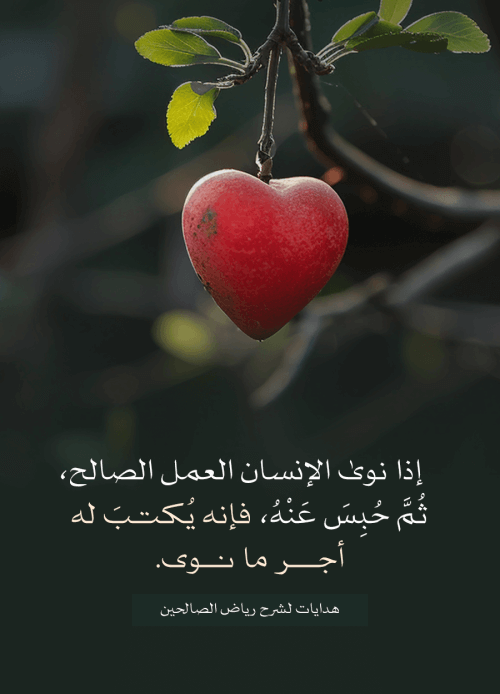
Waiting to do a good deed is in itself a good deed.
Riyadh Al-Salheen with explanation and benefits
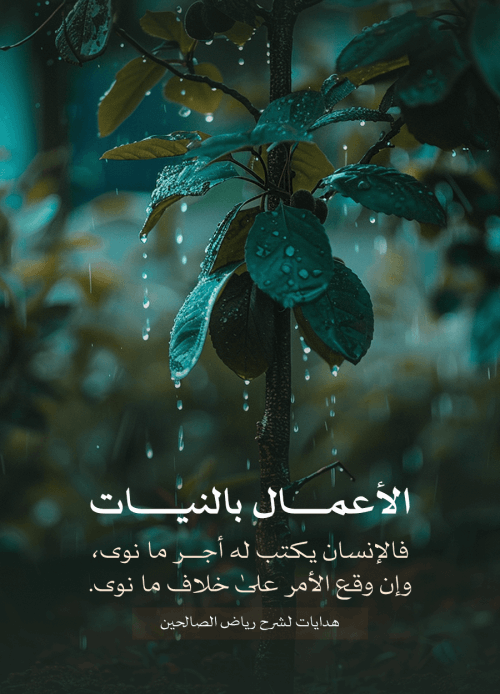
Good intention leads its holder to good things.
Riyadh Al-Salheen with explanation and benefits
One of the manifestations of Allah’s mercy is that He uses justice to recompense the sinner but uses His grace and bounty to recompense the good-doer.
Riyadh Al-Salheen with explanation and benefits
Sincerity is one of the means to alleviate adversity because each one of them said: “O Allah! If I did that for Your sake only, then relieve us from the distress we are in.”
Riyadh Al-Salheen with explanation and benefits
Good deeds are means to alleviating adversity.
Riyadh Al-Salheen with explanation and benefits
“The righteousness of the heart results from the righteousness of deeds, and the righteousness of deeds results from the righteousness of intention.”
Riyadh Al-Salheen with explanation and benefits
Repentance is a cause for success, which is why a true successful person is the one seeking and committing to a means leading to success.
Riyadh Al-Salheen with explanation and benefits
Hastening to repentance is one of the causes to earning the pleasure of Allah with His servant.
Riyadh Al-Salheen with explanation and benefits