








Categories
Discover our diverse collection of categories covering multiple topics to meet your various interestsDa\'wa cards that highlight great meanings of the verses of the Holy Quran and the noble prophetic hadiths in a simple style and attractive display that helps the Muslim to have a deeper understanding of his religion in an easy way
﴿ ۞ لَّا خَيۡرَ فِي كَثِيرٖ مِّن نَّجۡوَىٰهُمۡ إِلَّا مَنۡ أَمَرَ بِصَدَقَةٍ أَوۡ مَعۡرُوفٍ أَوۡ إِصۡلَٰحِۭ بَيۡنَ ٱلنَّاسِۚ وَمَن يَفۡعَلۡ ذَٰلِكَ ٱبۡتِغَآءَ مَرۡضَاتِ ٱللَّهِ فَسَوۡفَ نُؤۡتِيهِ أَجۡرًا عَظِيمٗا ﴾
سورة النساء
There is no good in much of their private talks, except for one who enjoins charity[81], kindness[82], or reconciliation between people. Anyone who does that, seeking Allah’s pleasure, We will give him a great reward.

﴿ يَٰٓأَيُّهَا ٱلَّذِينَ ءَامَنُوٓاْ إِذَا نُودِيَ لِلصَّلَوٰةِ مِن يَوۡمِ ٱلۡجُمُعَةِ فَٱسۡعَوۡاْ إِلَىٰ ذِكۡرِ ٱللَّهِ وَذَرُواْ ٱلۡبَيۡعَۚ ذَٰلِكُمۡ خَيۡرٞ لَّكُمۡ إِن كُنتُمۡ تَعۡلَمُونَ ﴾
سورة الجمعة
9. O you who believe (Muslims)! When the call is proclaimed for the Salât (prayer) on Friday (Jumu‘ah prayer), come to the remembrance of Allâh [Jumu‘ah religious talk (Khutbah) and Salât (prayer)] and leave off business (and every other thing). That is better for you if you did but know!
﴿ ٱلصَّٰبِرِينَ وَٱلصَّٰدِقِينَ وَٱلۡقَٰنِتِينَ وَٱلۡمُنفِقِينَ وَٱلۡمُسۡتَغۡفِرِينَ بِٱلۡأَسۡحَارِ ﴾
سورة آل عمران
17. (They are) those who are patient, those who are true (in Faith, words, and deeds), and obedient with sincere devotion in worship to Allâh. Those who spend [give the Zakât and alms in the Way of Allâh] and those who pray and beg Allâh’s Pardon in the last hours of the night.
﴿ تُؤۡتِيٓ أُكُلَهَا كُلَّ حِينِۭ بِإِذۡنِ رَبِّهَاۗ وَيَضۡرِبُ ٱللَّهُ ٱلۡأَمۡثَالَ لِلنَّاسِ لَعَلَّهُمۡ يَتَذَكَّرُونَ ﴾
سورة إبراهيم
It produces its fruit all the time, by permission of its Lord. And Allāh presents examples for the people that perhaps they will be reminded.
﴿ ٱلَّذِينَ يَتَرَبَّصُونَ بِكُمۡ فَإِن كَانَ لَكُمۡ فَتۡحٞ مِّنَ ٱللَّهِ قَالُوٓاْ أَلَمۡ نَكُن مَّعَكُمۡ وَإِن كَانَ لِلۡكَٰفِرِينَ نَصِيبٞ قَالُوٓاْ أَلَمۡ نَسۡتَحۡوِذۡ عَلَيۡكُمۡ وَنَمۡنَعۡكُم مِّنَ ٱلۡمُؤۡمِنِينَۚ فَٱللَّهُ يَحۡكُمُ بَيۡنَكُمۡ يَوۡمَ ٱلۡقِيَٰمَةِۚ وَلَن يَجۡعَلَ ٱللَّهُ لِلۡكَٰفِرِينَ عَلَى ٱلۡمُؤۡمِنِينَ سَبِيلًا ﴾
سورة النساء
Those who wait [and watch] you. Then if you gain a victory from Allāh, they say, "Were we not with you?" But if the disbelievers have a success, they say [to them], "Did we not gain the advantage over you, but we protected you from the believers?" Allāh will judge between [all of] you on the Day of Resurrection, and never will Allāh give the disbelievers over the believers a way [to overcome them].[227]
﴿ ۞ قَٰلَ أَوَلَوۡ جِئۡتُكُم بِأَهۡدَىٰ مِمَّا وَجَدتُّمۡ عَلَيۡهِ ءَابَآءَكُمۡۖ قَالُوٓاْ إِنَّا بِمَآ أُرۡسِلۡتُم بِهِۦ كَٰفِرُونَ ﴾
سورة الزخرف
[Each warner] said, "Even if I brought you better guidance than that [religion] upon which you found your fathers?" They said, "Indeed we, in that with which you were sent, are disbelievers."
﴿ أَن رَّءَاهُ ٱسۡتَغۡنَىٰٓ ﴾
سورة العلق
when he deems himself to be self-sufficient.
﴿ وَٱلَّيۡلِ إِذَا يَسۡرِ ﴾
سورة الفجر
4. And by the night when it departs.
﴿ وَإِنَّا لَنَحۡنُ ٱلۡمُسَبِّحُونَ ﴾
سورة الصافات
And indeed, we are those who exalt Allāh."
Abu Hurayrah (may Allah be pleased with him) reported that Abu Jahl asked (the people of Makkah): "Does Muhammad place his face on the ground in your presence?" It was said to him: 'Yes.' He said: "By Al-Lāt and Al-‘Uzza! If I were to see him do that, I would trample his neck, or I would smear his face with dust." He went to the Messenger of Allah (may Allah's peace and blessings be upon him) as he was engaged in prayer and thought of trampling his neck (and the people say) that he came near him but turned upon his heels and tried to ward off something with his hands. It was said to him: "What is the matter with you?" He said: "There is a ditch of fire and horror and wings between me and him." Thereupon, Allah's Messenger (may Allah's peace and blessings be upon him) said: "If he had come near me, the angels would have torn him to pieces." Then Allah, the Exalted, revealed this verse. (The narrator) said: "We do not know whether it is the Hadīth transmitted by Abu Hurayrah or something conveyed to him from another source:" {No! [But] indeed, man transgresses, because he sees himself self-sufficient. Indeed, to your Lord is the return. Have you seen the one who forbids a servant when he prays? Have you seen if he is upon guidance or enjoins righteousness? Have you seen if he (Abu Jahl) denies and turns away? Does he not know that Allah sees? No! If he does not desist, We will surely drag him by the forelock - a lying, sinful forelock. Then let him call his associates; We will summon the guards of Hell. No! Do not obey him} [Sūrat al-‘Alaq: 6-19]. ‘Ubaydullāh (a sub-narrator) made this addition: "And He ordered him (to do what is mentioned in the verse)." Ibn ‘Abd al-A‘la also added that by "Nādiyah" (in the verse: associates), he meant his people.
Narrated by Muslim
One day, Abu Jahl asked his companions whether Muhammad prayed and prostrated on dust while they saw him. They said: 'Yes.' So he swore by the two idols of Al-Lāt and Al-‘Uzza that if he saw Muhammad (may Allah's peace and blessings be upon him) prostrate, he would trample on his neck or throw dust on his face. Abu Jahl saw the Messenger of Allah (may Allah's peace and blessings be upon him) prostrate, so he came over to step on his neck. Suddenly, however, the people saw Abu Jahl retreat in terror, extending his hand as if he was pushing something away. His companions asked why he was doing so. He told them that when he tried to step on the Prophet's neck, he saw a ditch of fire, wings, and horrible things in between the both of them. The scene terrified him so much that he withdrew. The Prophet (may Allah's peace and blessings be upon him) remarked that had Abu Jahl drawn closer to him, the angels would have torn him apart. Hence, Allah revealed these verses: {No! [But] indeed, man transgresses, because he sees himself self-sufficient. Indeed, to your Lord is the return. Have you seen the one who forbids a servant when he prays? Have you seen if he is upon guidance or enjoins righteousness? Have you seen if he (Abu Jahl) denies and turns away? Does he not know that Allah sees? No! If he does not desist, We will surely drag him by the forelock - a lying, sinful forelock. Then let him call his associates; We will summon the guards of Hell. No! Do not obey him} [Sūrat al-‘Alaq: 6-19]. In these verses, ''man'' refers to Abu Jahl, who indulged himself in disbelief, sins, and injustice, for he considered himself rich enough. This disbeliever will return to your Lord, O Muhammad, so that Allah lets him taste a painful punishment. Abu Jahl indeed tried to prevent the Prophet (may Allah's peace and blessings be upon him) from praying at the Ka‘bah, puffed with arrogance and unbelief. That is quite amazing. The verses go on to draw this comparison between the Prophet (may Allah's peace and blessings be upon him) and Abu Jahl. The former was on the right way, commanding piety. The latter, however, was belying the truth with which Muhammad was sent. So he did not believe in him. Yet, Abu Jahl should have learnt that Allah sees him and will punish him on the Day of Resurrection. He is even warned that if he does not stop offending the Prophet (may Allah's peace and blessings be upon him) Allah will take him by the forehead, the forehead of a monstrous liar. Again, let Abu Jahl seek the support of his companions. If he does, then strong harsh angels will be summoned against them. Finally, the Prophet (may Allah's peace and blessings be upon him) is commanded not to listen to Abu Jahl and just continue his prayers to get closer to Allah through worship.
Zayd ibn Thābit al-Ansāri (may Allah be pleased with him) one of the scribes of the Qur'an, reported: Abu Bakr as-Siddīq sent for me when the people (of the battle) of Yamāmah were killed. I found ‘Umar ibn al-Khattāb sitting with him. Abu Bakr said: "‘Umar came to me and said: 'The death toll was heavy on the day of (the battle of) Yamāmah and I feared that many of the memorizers of the Qur'an would be killed on other battlefields, and a large part of the Qur'an might be lost unless you collect it. Can I suggest that you collect it?' I said to ‘Umar: 'How could I do something that the Messenger of Allah had not done?' ‘Umar said: 'By Allah, this is good.' ‘Umar kept on debating with me until Allah opened my heart to it and I accepted ‘Umar’s point of view." Then Abu Bakr said: "While ‘Umar was sitting with him silently: 'You are a wise young man and we do not have any suspicions about you. You used to write the revelation for the Messenger (may Allah's peace and blessings be upon him). So track down the Qur'an and collect it.' By Allah, had he ordered me to move one of the mountains, it would not have been harder on me than what he ordered me to do in collecting the Qur'an." I said to Abu Bakr: "How could you do something that the Messenger (may Allah's peace and blessings be upon him) had not done?" Abu Bakr replied: "By Allah, this is good." Abu Bakr kept on talking to me about it until Allah opened my heart to what He had opened the hearts of Abu Bakr and ‘Umar to. So I tracked down the Qur'an, collecting it (written) on parchment, shoulder blades, and palm stalks, and from the hearts of men, until I found these last two verses of Sūrat At-Tawbah from Khuzaymah al-Ansāri; I did not find them with anyone else: {There has certainly come to you a Messenger from among yourselves. Grievous to him is what you suffer, [he is] concerned over you...} until the end of the two verses [Sūrat At-Tawbah: 128-129]. The sheets on which the Qur'an was collected remained with Abu Bakr until he died, then with ‘Umar until he died, and then with Hafsah, the daughter of ‘Umar.
Narrated by Bukhari
Zayd ibn Thābit al-Ansāri (may Allah be pleased with him) reported that Abu Bakr As-Siddīq summoned him during his caliphate, after the Companions of the Prophet had fought against Musaylimah the Liar in the battle of Yamāmah in 11 AH. The battle was sparked due to Musaylimah's claim to be a prophet and also due to the apostasy of many of the Arabs. Many of the Prophet's Companions were killed in those battles. Zayd went to Abu Bakr and found ‘Umar sitting with him. Abu Bakr told Zayd that ‘Umar had come to him and told him that many of the Companions had been killed in their battles with Musaylimah and he feared that more of the Qur'an memorizers would be killed in subsequent battles with the disbelievers, and consequently parts of the Qur'an could be lost. So ‘Umar had proposed that the Qur'an should be collected. Abu Bakr wondered how he could do something that the Messenger of Allah had not done. ‘Umar replied that collecting the Qur'an would be better than leaving it scattered around. Abu Bakr said that ‘Umar had talked to him about collecting the Qur'an until he had felt comfortable with the idea and decided to collect it. Zayd ibn Thābit commented that ‘Umar was sitting there, silently. Then Abu Bakr said to Zayd that he was an intelligent young man whom they could not accuse of lying or forgetfulness. As Zayd had written the revelation for the Messenger of Allah, they suggested that he should track down the Qur'an and collect it. The whole Qur'an had been written down during the Prophet's life, but it had not been collected in one place nor were the Sūrahs arranged in their current order. Zayd commented that moving a mountain would have been easier for him than collecting the Qur'an. He wondered how Abu Bakr and ‘Umar could do something that the Prophet had not done. Abu Bakr said that this would be good, and he continued to talk to Zayd about the benefits of collecting the Qur'an until he felt comfortable with the proposal and decided to collect the Qur'an for the public interest. Zayd collected the Qur'an written on parchments, shoulder blades, and palm stalks, and also from the hearts of men who had fully memorized it, such as Ubai ibn Ka‘b and Mu‘ādh ibn Jabal. In this way, the text that was written on parchment and shoulder blades would be further evidence to what had been memorized by the Companions. He only found the last two verses of Sūrat At-Tawbah written down by Khuzaymah ibn Thābit al-Ansāri. These are the verses that state: {There has certainly come to you a Messenger from among yourselves. Grievous to him is what you suffer, [he is] concerned over you...} until the end of the two verses [Sūrat At-Tawbah: 128-129]. The sheets on which the Qur'an were collected remained with Abu Bakr until he died, then with ‘Umar until he died, and then with Hafsah, ‘Umar’s daughter (may Allah be pleased with them all). The Shias objected to Abu Bakr's collection of the Qur'an, because he had done something that the Messenger of Allah (may Allah's peace and blessings be upon him) had not done. Abu Bakr did not do anything objectionable, as he embarked on this project for the sake of Allah, His Messenger, and His Book. The Prophet (may Allah's peace and blessings be upon him) had allowed this as in the Hadīth reported by Abu Sa‘īd: ''Do not write anything from me other than the Qur'an.'' [Muslim]. So Abu Bakr did nothing other than collecting the Qur'an that was already written. Thus, the Shias' objection to Abu Bakr's collection is baseless.
Ibn Shihāb reported from Anas ibn Mālik that he informed him that Hudhayfah ibn al-Yamān came to ‘Uthmān when he was preparing the people of the Levant and Iraq to conquer Armenia and Azerbaijan. Hudhayfah was alarmed by their difference in reading the Qur’an, so he said to ‘Uthmān: "O Commander of the Believers, save this nation before they diverge on the Book as the Jews and Christians diverged (on their scriptures)." So ‘Uthmān sent a message to Hafsah: "Send us the sheets so that we will transcribe them in the Mus'hafs, and then we will return them to you." Hafsah sent them to ‘Uthmān, who then ordered Zayd ibn Thābit, ‘Abdullāh ibn Az-Zubayr, Sa‘īd ibn al-‘Ās, and ‘Abdur-Rahmān ibn al-Hārith ibn Hishām to transcribe the sheets into the codices. ‘Uthmān said to the three Qurayshi men: "In case you disagree with Zayd ibn Thābit on anything of the Qur’an, then write it in the dialect of Quraysh, for the Qur’an was revealed in their dialect." They did so, and when they had transcribed the sheets into the Mus'hafs, ‘Uthmān returned the sheets to Hafsah. He sent one of the Mus'hafs which they had transcribed to every province and ordered that all the other Qur’anic materials, in each manuscript or Mus'haf be burned.
Narrated by Bukhari
Hudhayfah ibn al-Yamān (may Allah be pleased with him) visited ‘Uthmān (may Allah be pleased with him) who was then preparing the Syrians and Iraqis to conquer Armenia and Azerbaijan. Hudhayfah heard people read the Qur’an differently. Some of them followed the reading of Ubai, while others followed the reading of Ibn Mas‘ūd, to the point that conflict and turmoil was about to develop among them. This situation alarmed Hudhayfah, who therefore asked the Commander of the Believers ‘Uthmān to save the situation lest the people would diverge on the Qur’an as the Jews and Christians diverged on the Torah and the Gospel and tampered with them by adding to and deleting from them. At that point, the Qur’an was collected in sheets, not in a Mus'haf. Therefore, ‘Uthmān sent to Hafsah, requesting her to send him the sheets in which the Qur’an was written so that he would transcribe them into the Mus'hafs and then return the sheets to her. The sheets that he received from Hafsah were the sheets which Abu Bakr and ‘Umar had commanded the Qur’an be written in. So ‘Uthmān then collected the Qur’an in a Mus'haf. The difference between this Mus'haf and the sheets is that the sheets were the edited papers in which the Qur’an was collected during the time of Abu Bakr, may Allah be pleased with him. They had separate Sūrahs, and each Sūrah was arranged in the order of its own verses. However, these Sūrahs were not arranged one after another in one volume. So when these Sūrahs were transcribed and arranged, they formed the Mus'haf. Thus, the Mus'haf started to exist only during ‘Uthmān's time. So Hafsah sent the sheets to ‘Uthmān, who then commissioned Zayd ibn Thābit, ‘Abdullāh ibn Az-Zubayr, Sa‘īd ibn al-‘Ās, and ‘Abdur-Rahmān ibn Hishām to transcribe the sheets into the Mus'hafs. Zayd ibn Thābit was from the Ansār, whereas the rest were from the Quraysh. ‘Uthmān told the three Qurayshis that if they differed with Zayd ibn Thābit on anything of the Qur’an, they should write it in the dialect of Quraysh, for the Qur’an was revealed in their dialect. They did so. When they had transcribed the sheets in the Mus'hafs, ‘Uthmān returned the sheets to Hafsah. He also sent a Mus'haf to each province. Other Qur’anic materials, sheets, and private Mus'hafs were burned on ‘Uthmān's order.
Ubayy ibn Ka‘b (may Allah be pleased with him) reported: The Messenger of Allah (may Allah's peace and blessings be upon him) met Jibrīl and said: "O Jibrīl, I have been sent to an illiterate nation among whom there are the elderly woman, the old man, the young boy, the young girl, and the man who have never read a book." He said: "O Muhammad, indeed the Qur'an was revealed in seven Ahruf (modes of recitation/styles of Arabic language)."
Narrated by At-Termedhy - Narrated by Ahmad
The Messenger of Allah (may Allah's peace and blessings be upon him) met Jibrīl and told him that he had been sent to an illiterate nation who could not read. By this, the Prophet (may Allah's peace and blessings be upon him) meant that if he instructed people to recite the Qur'an according to one Harf (mode of recitation/style of Arabic language), they could not do it, because some of them pronounced words differently, others were too old to learn, others were too young to read, and others had never read anything that was written before. So Jibrīl told the Prophet (may Allah's peace and blessings be upon him) that the Qur'an was revealed in seven Ahruf (plural of Harf), so each person could read it in a way that was easy for them. Scholars have differed greatly on what the seven Ahruf meant. It seems (and Allah knows best) that they refer to the different styles of pronouncing the Arabic language. The Qur'an was revealed according to those styles to make things easy at the beginning of Islam, as the Arabs were dispersed then, in disagreement, and every tribe had their own dialect. Some tribes would have had a linguistic style that other tribes did not. However, when Islam brought them together, and they were united and harmonious under Islam, each tribe knew the linguistic style of the other tribes. ‘Uthmān ibn ‘Affān (may Allah be pleased with him) got the people to recite in one Harf and burned the other copies of the Qur’an that were written in other Ahruf, so there would be no differences in the recitation of the Qur'an.
Jundub ibn ‘Abdullāh (may Allah be pleased with him) reported that the Prophet (may Allah's peace and blessings be upon him) said: "Recite the Qur’an as long as your hearts are harmonious, but if you diverge, then move away from it."
Narrated by Bukhari & Muslim
This Hadīth means that the Muslims should recite the Qur’an together as long as they agree on its interpretation. However, if they disagree in understanding its meanings, then they should stop reciting it lest this disagreement should lead to evil. Another possible meaning: stick to the meanings of the Qur’an which are not prone to different interpretations. If you come across meanings which can be interpreted differently and cause dispute, avoid debating and arguing regarding them. This could also be an instruction to recite the Qur’an as long as one's heart is inclined to do so. If the heart feels bored or tired, then recitation should be left until the heart becomes fresh and active again. The same command was given concerning the prayer. The first interpretation, however, seems more probable.
‘Uqbah ibn ‘Āmir (may Allah be pleased with him) reported: The Messenger of Allah (may Allah's peace and blessings be upon him) said: "I fear two things for my Ummah: the Qur’an and milk. As for milk, they seek the countryside, follow desires, and neglect the prayers. As for the Qur’an, the hypocrites learn it to argue with the believers by means of it."
Narrated by Ahmad
In this Hadīth, the Prophet (may Allah's peace and blessings be upon him) says that he fears two things for his Ummah: the Qur’an and milk. As for milk, some people seek it in pastures and plantations, follow their desires and pleasures, and stay away from the cities, where the Friday prayer and the congregational prayers are held. Then they neglect the prayers in their pursuit of milk. As for the Qur’an, the hypocrites learn it, not to benefit from it or comply with it, but to argue with the believers by means of it in order to falsify the truth that they believe in. Neither milk nor the Qur’an are subjects of fear or damage in themselves. However, they are mentioned metaphorically in relation to things that are pertinent to them. Allah knows best.
Ibn ‘Abbās (may Allah be pleased with him) said: "If [a man] forbids his wife, this is nothing." He further quoted: {There is in the Messenger of Allah a good example to you.} [Sūrat al-Ahzāb: 21]
Narrated by Bukhari
This report means that if a man says to his wife: "You are unlawful for me," or: "You are forbidden," or something similar, this saying does not constitute divorce. It will be treated like a normal oath for which an expiation is required. In this respect, Allah, the Almighty, says: {O Prophet, why do you prohibit [yourself from] what Allah has made lawful for you, seeking the approval of your wives? And Allah is Forgiving and Merciful. Allah has already ordained for you [Muslims] the dissolution of your oaths. And Allah is your protector, and He is the Knowing, the Wise} [Sūrat At-Tahrīm: 1-2]. The last verse means that Allah ordained for the Muslims the dissolution of their oath by making the expiation that is stipulated in Sūrat al-Mā’idah.
Abu Umāmah (may Allah be pleased with him) reported: I heard the Messenger of Allah (may Allah’s peace and blessings be upon him) say: "Read the Qur’an, as it will come as an intercessor for its companions on the Day of Resurrection."
Narrated by Muslim
The Prophet (may Allah's peace and blessings be upon him) encouraged his Ummah to read the Qur’an, and said that if they do so, on the Day of Resurrection Allah, the Almighty, will make the reward of their Qur'an recitation come in the form of an independent entity who will intercede for those who had read the Qur'an, those who were preoccupied with it, and those who abided by its commands and prohibitions.
Abu Mūsa al-Ash‘ari (may Allah be pleased with him) reported: The Prophet (may Allah’s peace and blessings be upon him) said: "Keep on reciting this Qur'an, for by the One in Whose Hand my soul is, the Qur'an slips away from memory faster than camels escaping their tying ropes."
Narrated by Bukhari & Muslim
The Prophet (may Allah's peace and blessings be upon him) ordered the Companions to recite the Qur'an regularly and not to forget it after they had learned it by heart. He emphasized this fact by swearing that the Qur'an slips away from one's memory faster than camels tied with ropes in the middle of their foreleg. If their shepherd pays attention to them, they remain with him, and if he releases them, they go away and will be lost.
The path of Allah is one whereas the paths of the devil are many; and a truly guided individual is he whom Allah Almighty guided to His path. Allah Almighty said: {This is My straight path; follow it and do not follow other ways, lest they lead you away from His way.} [Surat al-An‘ām: 153]
Riyadh Al-Salheen with explanation and benefits
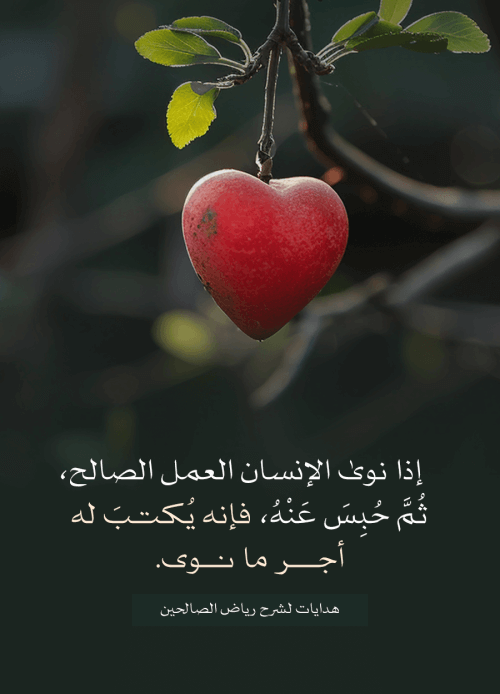
Waiting to do a good deed is in itself a good deed.
Riyadh Al-Salheen with explanation and benefits
Good intention leads its holder to good things.
Riyadh Al-Salheen with explanation and benefits
One of the manifestations of Allah’s mercy is that He uses justice to recompense the sinner but uses His grace and bounty to recompense the good-doer.
Riyadh Al-Salheen with explanation and benefits
Sincerity is one of the means to alleviate adversity because each one of them said: “O Allah! If I did that for Your sake only, then relieve us from the distress we are in.”
Riyadh Al-Salheen with explanation and benefits
Good deeds are means to alleviating adversity.
Riyadh Al-Salheen with explanation and benefits
“The righteousness of the heart results from the righteousness of deeds, and the righteousness of deeds results from the righteousness of intention.”
Riyadh Al-Salheen with explanation and benefits
Repentance is a cause for success, which is why a true successful person is the one seeking and committing to a means leading to success.
Riyadh Al-Salheen with explanation and benefits
Hastening to repentance is one of the causes to earning the pleasure of Allah with His servant.
Riyadh Al-Salheen with explanation and benefits