








Categories
Discover our diverse collection of categories covering multiple topics to meet your various interestsDa\'wa cards that highlight great meanings of the verses of the Holy Quran and the noble prophetic hadiths in a simple style and attractive display that helps the Muslim to have a deeper understanding of his religion in an easy way
﴿ أَمۡ أَمِنتُمۡ أَن يُعِيدَكُمۡ فِيهِ تَارَةً أُخۡرَىٰ فَيُرۡسِلَ عَلَيۡكُمۡ قَاصِفٗا مِّنَ ٱلرِّيحِ فَيُغۡرِقَكُم بِمَا كَفَرۡتُمۡ ثُمَّ لَا تَجِدُواْ لَكُمۡ عَلَيۡنَا بِهِۦ تَبِيعٗا ﴾
سورة الإسراء
69. Or do you feel secure that He will not send you back a second time to sea and send against you a hurricane of wind and drown you because of your disbelief? Then you will not find any avenger therein against Us.

﴿ وَلَقَدۡ أَرۡسَلۡنَا مِن قَبۡلِكَ فِي شِيَعِ ٱلۡأَوَّلِينَ ﴾
سورة الحجر
10. Indeed, We sent (Messengers) before you (O Muhammad صلى الله عليه و سلم) amongst the sects (communities) of old.
﴿ وَمِنۡهُم مَّن يَقُولُ رَبَّنَآ ءَاتِنَا فِي ٱلدُّنۡيَا حَسَنَةٗ وَفِي ٱلۡأٓخِرَةِ حَسَنَةٗ وَقِنَا عَذَابَ ٱلنَّارِ ﴾
سورة البقرة
But among them is he who says, "Our Lord, give us in this world [that which is] good and in the Hereafter [that which is] good and protect us from the punishment of the Fire."
﴿ كُلُواْ مِن طَيِّبَٰتِ مَا رَزَقۡنَٰكُمۡ وَلَا تَطۡغَوۡاْ فِيهِ فَيَحِلَّ عَلَيۡكُمۡ غَضَبِيۖ وَمَن يَحۡلِلۡ عَلَيۡهِ غَضَبِي فَقَدۡ هَوَىٰ ﴾
سورة طه
[Saying], "Eat from the good things with which We have provided you and do not transgress [or oppress others] therein, lest My anger should descend upon you. And he upon whom My anger descends has certainly fallen [i.e., perished]."
﴿ قُلۡ عَسَىٰٓ أَن يَكُونَ رَدِفَ لَكُم بَعۡضُ ٱلَّذِي تَسۡتَعۡجِلُونَ ﴾
سورة النمل
Say, “Perhaps some of what you seek to hasten is quite near to you.”
﴿ ثُمَّ جَعَلۡنَٰكُمۡ خَلَٰٓئِفَ فِي ٱلۡأَرۡضِ مِنۢ بَعۡدِهِمۡ لِنَنظُرَ كَيۡفَ تَعۡمَلُونَ ﴾
سورة يونس
14. Then We made you successors after them, generations after generations in the land, that We might see how you would work.
﴿ ثُمَّ يَأۡتِي مِنۢ بَعۡدِ ذَٰلِكَ سَبۡعٞ شِدَادٞ يَأۡكُلۡنَ مَا قَدَّمۡتُمۡ لَهُنَّ إِلَّا قَلِيلٗا مِّمَّا تُحۡصِنُونَ ﴾
سورة يوسف
Then will come after that seven difficult [years] which will consume what you advanced [i.e., saved] for them, except a little from which you will store.
﴿ قَالَ رَبِّ بِمَآ أَنۡعَمۡتَ عَلَيَّ فَلَنۡ أَكُونَ ظَهِيرٗا لِّلۡمُجۡرِمِينَ ﴾
سورة القصص
He said, "My Lord, for the favor You bestowed upon me, I will never be an assistant to the criminals."
﴿ لَا تَحۡسَبَنَّ ٱلَّذِينَ يَفۡرَحُونَ بِمَآ أَتَواْ وَّيُحِبُّونَ أَن يُحۡمَدُواْ بِمَا لَمۡ يَفۡعَلُواْ فَلَا تَحۡسَبَنَّهُم بِمَفَازَةٖ مِّنَ ٱلۡعَذَابِۖ وَلَهُمۡ عَذَابٌ أَلِيمٞ ﴾
سورة آل عمران
And never think that those who rejoice in what they have perpetrated and like to be praised for what they did not do - never think them [to be] in safety from the punishment, and for them is a painful punishment.
Abu Dharr al-Ghifāri (may Allah be pleased with him) reported that the Prophet (may Allah's peace and blessings be upon him) said: "The Kursi in comparison to the Throne is only like an iron ring thrown in a desert on earth."
Ibn Abi Shaybah in Al-‘Arsh - Adh-Dhahabi in Al-‘Uluww
The Prophet (may Allah's peace and blessings be upon him) here says that the Kursi, despite its hugeness, is in comparison to the Throne like an iron ring thrown in a boundless desert on earth. This indicates the greatness and absolute power of its Creator.
Anas ibn Mālik (may Allah be pleased with him) reported that the Prophet (may Allah's peace and blessings be upon him) said: "There is no transitive disease and no evil omen, and I like a good omen." It was said: What is a good omen? He said: "A good word."
Narrated by Bukhari & Muslim
The Prophet (may Allah's peace and blessings be upon him) informs that transitive disease in which the people of the pre-Islamic era of ignorance used to believe, thinking the disease is transmitted by itself to others apart from Allah's decree, is false. And the Tiyarah, which is regarding something audible or visible, as an evil omen whether it is from birds, animals, people with deformities, numbers, days, etc. He mentioned the "Tayr" (bird) specifically because it was commonly known during the pre-Islamic era of ignorance, as a bird would be urged to fly when someone intended to do something like travel, trade, or anything else. If the bird flew to the right, he would take this as a good omen and proceed with what he intended, whereas if the bird flew to the left, he would take this as a bad omen and refrain from doing what he intended. Then, he (may Allah's peace and blessings be upon him) informed that he liked the good omen, which is the happiness and joy that one feels when hearing a good word that makes him have good expectations of his Lord.
Al-Barā’ (may Allah be pleased with him) reported: The Prophet (may Allah's peace and blessings be upon him) said about the Ansār (Supporters): "No one loves them except a believer, and no one hates them except a hypocrite. Allah loves whoever loves them and hates whoever hates them."
Narrated by Bukhari & Muslim
The Prophet (may Allah's peace and blessings be upon him) informed that having love for the Ansār from among the people of Madīnah is a sign of perfect faith given their precedence in supporting Islam and the Prophet (may Allah's peace and blessings be upon him), their keenness on sheltering Muslims, and their sacrifice of their properties and lives in the cause of Allah; and hating them is a sign of hypocrisy. The Prophet (may Allah's peace and blessings be upon him) then clarified that Allah loves whoever loves the Ansār and hates whoever hates them.
Abu Hurayrah (may Allah be pleased with him) reported: The Messenger of Allah (may Allah's peace and blessings be upon him) said: "Pursue the right course and be as close to it as possible, and keep in mind that none of you will be saved by his deeds." They said: O Messenger of Allah, not even you? He said: "Not even me unless Allah encompasses me with mercy and favor from Him."
Narrated by Bukhari & Muslim
The Prophet (may Allah's peace and blessings be upon him) urges the Companions to offer good deeds and fear Allah as much as they can, with neither extremism nor negligence, and to intend what is right by their deeds through being fully sincere to Allah and complying with the Sunnah so their deeds would be accepted and would be a cause for bestowing mercy upon them. Then he informed them that none of them would be saved by his deeds alone; rather, there must be Allah's mercy. They said: O Messenger of Allah, not even you would be saved by your deeds despite their great significance? He said: Not even me unless Allah conceals me by virtue of His mercy.
‘Abdullah ibn Mas‘ūd (may Allah be pleased with him) reported that the Messenger of Allah (may Allah's peace and blessings be upon him) said: "No prophet had been sent before me by Allah except that he had disciples and companions from his nation who adhered to his way and followed his command. They were, then, succeeded by successors who would say what they did not do and do what they were not commanded to do. Whoever strives against them with his hand is a believer; whoever strives against them with his tongue is a believer; whoever strives against them with his heart is a believer; and beyond that, there is no mustard seed's weight of faith."
Narrated by Muslim
The Prophet (may Allah's peace and blessings be upon him) informed that no prophet had been sent by Allah to a nation before him except that he had close friends, supporters, and sincere fighters from among his nation who were qualified to succeed him, adopting his way and following his command. These righteous predecessors would, then, be succeeded by people who were void of goodness; claiming what they did not practice and practicing what they were not commanded to do. Whoever strives against them with his hand is a believer, whoever strives against them with his tongue is a believer, and whoever strives against them with his heart is a believer, but beyond that, there is no mustard seed's weight of faith.
Jābir ibn ‘Abdullah (may Allah be pleased with him and his father) reported that the Prophet (may Allah's peace and blessings be upon him) said: "I was granted five that none before me was granted: I was granted victory through terror from a distance of one month's journey; the earth has been made for me a mosque and a means of purification, so any man from my Ummah who is caught up by the prayer should pray; the spoils of war have been made lawful for me, although they were not lawful for anyone before me; I have been granted the intercession; and a prophet used to be sent to his people in specific, whereas I have been sent to all people."
Narrated by Bukhari & Muslim
The Prophet (may Allah's peace and blessings be upon him) informed that Allah granted him five privileges that none of the prophets before him had been granted. First: I was made victorious through terror that was cast into my enemies' hearts, although a distance of one month's journey separated us. Second: The earth has been made for us a place of worship where we can pray wherever we are, and it has been made for us a means of purification through dust when water is not an option. Third: The spoils of war, which Muslims take during their war against the disbelievers, have been made lawful for us. Fourth: I have been granted the major intercession to relieve people of the horror of the Day of Judgment. Fifth: "I have been sent to all creation": mankind and jinn, unlike the prophets before him who were sent to their people only.
Hārithah ibn Wahb al-Khuzā‘i reported: I heard the Prophet (may Allah's peace and blessings be upon him) say: "Shall I inform you about the people of Paradise? Every weak person who is looked down upon, if he were to make an oath in the name of Allah, He would fulfill it. Shall I inform you about the people of Hellfire? Every cruel, greedy, and arrogant person."
Narrated by Bukhari & Muslim
The Prophet (may Allah's peace and blessings be upon him) informed about some of the qualities of the dwellers of Paradise and those of Hellfire. The majority among the dwellers of Paradise are: "Every weak person who is looked down upon," i.e., modest and submissive to Allah Almighty, who humbles himself to Him to the extent that some people may overpower and despise him. If this person, who humbles himself to Allah Almighty, makes an oath by Allah hoping for the generosity of Allah Almighty, He will fulfill it for him and make him realize his oath and will answer his request and supplication. The majority among the dwellers of Hellfire are: every ‘Utul (cruel), i.e., harsh, rude, vehement disputer, or the indecent person who does no good; Jawāzh (greedy), i.e., the arrogant, gluttonous person who has an enormous body and who walks with a conceited gait and adopts bad morals; and Mustakbir (arrogant) for rejecting the truth and looking down upon others.
Abu Hurayrah (may Allah be pleased with him) reported that the Messenger of Allah (may Allah’s peace and blessings be upon him) said: “In Paradise, there are one hundred degrees that Allah prepared for those who make jihad in the cause of Allah. The distance between each two degrees is like the distance between the heaven and earth.”
Narrated by Bukhari
In this Hadīth, the Prophet (may Allah's peace and blessings be upon him) tells us about the virtue of those who practice jihad in Allah's cause. Allah, the Almighty, has prepared for them one hundred degrees in Paradise, the distance between each two degrees is like the distance between the heaven and earth.
Abu Hurayrah (may Allah be pleased with him) reported: The Messenger of Allah (may Allah's peace and blessings be upon him) said: "Allah, the Exalted and Majestic, says: I am as My slave thinks of Me and I am with him when he remembers Me. If he remembers Me within himself, I remember him within Myself; and if he remembers me in an assembly, I remember him in a better assembly. If he draws near to Me by a handspan, I draw near to him by a cubit; and if he draws near to Me by a cubit, I draw near to him by a fathom, and if he comes to Me walking, I come to him jogging."
Narrated by Bukhari & Muslim
The Prophet (may Allah's peace and blessings be upon him) informed that Allah Almighty says: I am as My slave thinks of Me, so I treat My slave according to his thoughts about Me when hoping for and expecting pardon, and I do to him what He expects of Me either good or other than that; and I am with him through mercy, success, guidance, care, and support when he remembers Me. If he remembers Me inwardly while being alone and in seclusion through Tasbīh (exalting Allah), Tahlīl (proclaiming Allah's oneness), or others, I remember him within Myself. And if he remembers Me in an assembly, I remember him in a larger and better assembly. And whoever draws near to Allah by a handspan, Allah will add to this and draw near to him by a cubit, and if he draws near to Him by a cubit, Allah draws near to him by a fathom. And if he comes walking to Allah, Allah will come to him jogging. When the slave seeks to get closer to his Lord by obeying Him and focusing on Him, the Almighty Lord brings him even closer to Him as a recompense that suits his deed. The more perfect the believer's worship of his Lord is, the closer Allah Almighty brings him, as the bestowal and reward of Allah exceed the slave's deeds and toil. In fact, Allah's reward outweighs the slave's deeds in terms of quality and quantity. The believer, thus, entertains good expectations of Allah, acts, hastens, and increases his good deeds until he meets Allah.
The path of Allah is one whereas the paths of the devil are many; and a truly guided individual is he whom Allah Almighty guided to His path. Allah Almighty said: {This is My straight path; follow it and do not follow other ways, lest they lead you away from His way.} [Surat al-An‘ām: 153]
Riyadh Al-Salheen with explanation and benefits
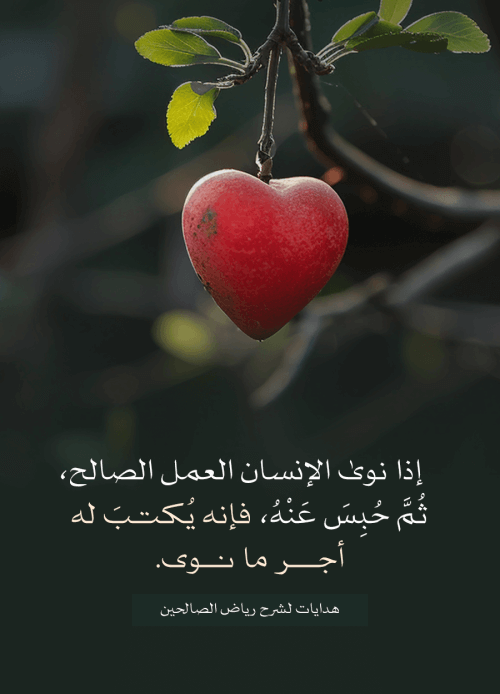
Waiting to do a good deed is in itself a good deed.
Riyadh Al-Salheen with explanation and benefits
Good intention leads its holder to good things.
Riyadh Al-Salheen with explanation and benefits
One of the manifestations of Allah’s mercy is that He uses justice to recompense the sinner but uses His grace and bounty to recompense the good-doer.
Riyadh Al-Salheen with explanation and benefits
Sincerity is one of the means to alleviate adversity because each one of them said: “O Allah! If I did that for Your sake only, then relieve us from the distress we are in.”
Riyadh Al-Salheen with explanation and benefits
Good deeds are means to alleviating adversity.
Riyadh Al-Salheen with explanation and benefits
“The righteousness of the heart results from the righteousness of deeds, and the righteousness of deeds results from the righteousness of intention.”
Riyadh Al-Salheen with explanation and benefits
Repentance is a cause for success, which is why a true successful person is the one seeking and committing to a means leading to success.
Riyadh Al-Salheen with explanation and benefits
Hastening to repentance is one of the causes to earning the pleasure of Allah with His servant.
Riyadh Al-Salheen with explanation and benefits