



Categories
Discover our diverse collection of categories covering multiple topics to meet your various interestsDa\'wa cards that highlight great meanings of the verses of the Holy Quran and the noble prophetic hadiths in a simple style and attractive display that helps the Muslim to have a deeper understanding of his religion in an easy way
﴿ وَمَآ أَصَٰبَكُمۡ يَوۡمَ ٱلۡتَقَى ٱلۡجَمۡعَانِ فَبِإِذۡنِ ٱللَّهِ وَلِيَعۡلَمَ ٱلۡمُؤۡمِنِينَ ﴾
سورة آل عمران
And what struck you on the day the two armies met [at Uḥud] was by permission of Allāh that He might make evident the [true] believers

﴿ لَهُم مَّا يَشَآءُونَ فِيهَا وَلَدَيۡنَا مَزِيدٞ ﴾
سورة ق
35. There they will have all that they desire - and We have more (for them, i.e. a glance at the All-Mighty, All-Majestic جل جلاله).
﴿ قُلۡ أَعُوذُ بِرَبِّ ٱلۡفَلَقِ ﴾
سورة الفلق
1. Say: "I seek refuge with (Allâh), the Lord of the daybreak,
﴿ وَأَقِيمُواْ ٱلۡوَزۡنَ بِٱلۡقِسۡطِ وَلَا تُخۡسِرُواْ ٱلۡمِيزَانَ ﴾
سورة الرحمن
9. And observe the weight with equity and do not make the balance deficient.
﴿ إِنَّهُۥ لَقَوۡلٞ فَصۡلٞ ﴾
سورة الطارق
13. Verily, this (the Qur’ân) is the Word that separates (the truth from falsehood, and commands strict laws for mankind to cut the roots of evil).
﴿ حَتَّىٰٓ إِذَا جَآءُو قَالَ أَكَذَّبۡتُم بِـَٔايَٰتِي وَلَمۡ تُحِيطُواْ بِهَا عِلۡمًا أَمَّاذَا كُنتُمۡ تَعۡمَلُونَ ﴾
سورة النمل
84. Till, when they come (before their Lord at the place of reckoning), He will say: "Did you deny My Ayât (proofs, evidence, verses, lessons, signs, revelations, etc.) whereas you comprehended them not by knowledge (of their truth or falsehood), or what (else) was it that you used to do?"
﴿ وَلَقَدۡ كَذَّبَ أَصۡحَٰبُ ٱلۡحِجۡرِ ٱلۡمُرۡسَلِينَ ﴾
سورة الحجر
And certainly did the companions of al-Ḥijr[683] [i.e., the Thamūd] deny the messengers.
﴿ أَفِي قُلُوبِهِم مَّرَضٌ أَمِ ٱرۡتَابُوٓاْ أَمۡ يَخَافُونَ أَن يَحِيفَ ٱللَّهُ عَلَيۡهِمۡ وَرَسُولُهُۥۚ بَلۡ أُوْلَٰٓئِكَ هُمُ ٱلظَّٰلِمُونَ ﴾
سورة النور
50. Is there a disease in their hearts? Or do they doubt or fear lest Allâh and His Messenger (صلى الله عليه وسلم) should wrong them in judgement. Nay, it is they themselves who are the Zâlimûn (polytheists, hypocrites and wrong-doers).
﴿ وَٱجۡعَل لِّي لِسَانَ صِدۡقٖ فِي ٱلۡأٓخِرِينَ ﴾
سورة الشعراء
And grant me a mention [i.e., reputation] of honor among later generations.
‘Ā’ishah, the Mother of the Believers, (may Allah be pleased with her) reported: On taking a ritual bath from Janābah (major ritual impurity), the Messenger of Allah (may Allah's peace and blessings be upon him) used to wash his hands and perform ablution like that for prayer, then wash himself. He would, then, run his wet hand through his hair until he would feel that his skin had become wet. Then, he would pour water thrice over it, and then wash the rest of his body. She further said: I and the Messenger of Allah (may Allah's peace and blessings be upon him) used to bathe from a single container from which we used to take water simultaneously.
Narrated by Bukhari
On taking a ritual bath from Janābah, the Prophet (may Allah's peace and blessings be upon him) would start washing his hands. Then, he would make Wudū’ (ablution) as he would for prayer. Then, he would pour water over his body. Then, he would run his wet hands through his hair, and when feeling that water had reached the roots of the hair and had wetted the skin, he would pour the water thrice over his head, then, he would wash the rest of his body. ‘Ā’ishah (may Allah be pleased with her) said: I and the Messenger of Allah (may Allah's peace and blessings be upon him) used to bathe from a single container from which we would take water simultaneously.
‘Ali ibn al-Husayn reported that he saw a man entering through a gap at the grave of the Prophet (may Allah's peace and blessings be upon him) and making supplication therein. He told him not to do that and said: "Shall I not tell you a Hadīth that I heard from my father from my grandfather from the Messenger of Allah (may Allah's peace and blessings be upon him)? He said: "Do not take my grave as a place of festivity (which you visit repeatedly), and do not take your houses as graves. Send blessings upon me, for your greeting will reach me no matter where you are."
Ibn Abi Shaybah
Ali ibn al-Husayn (may Allah be pleased with him) informs us that he saw a man invoking Allah at the grave of the Prophet (may Allah's peace and blessings be upon him). He forbade the man from doing so based on a Hadīth in which the Prophet (may Allah's peace and blessings be upon him) forbade visiting his grave repeatedly, and also forbade non-observance of remembering Allah and worshiping Allah at homes, thereby rendering them similar to graves. The Prophet (may Allah's peace and blessings be upon him) said that sending peace upon him will definitely reach him, regardless of the sender's whereabouts.
‘Ali (may Allah be pleased with him) reported: "I was a man of frequent discharge of Madhi (pre-seminal fluid) and I was too shy to ask the Prophet (may Allah's peace and blessings be upon him) about it given his daughter's status. So, I asked Al-Miqdād ibn al-Aswad to ask him and he did. Thereupon, the Prophet (may Allah's peace and blessings be upon him) said: 'Let him wash his penis and perform ablution.'" A narration of Al-Bukhāri reads: Thereupon, he (may Allah's peace and blessings be upon him) said: "Perform ablution and wash your penis."
Narrated by Bukhari & Muslim
‘Ali ibn Abi Tālib (may Allah be pleased with him) stated that he would frequently experience the discharge of Madhi, which is a thin and sticky whitish fluid that seeps out of the penis upon sexual arousal or before sexual intercourse. He did not know what he should do about it and was too shy to ask the Prophet (may Allah's peace and blessings be upon him) because he was the husband of Fātimah, daughter of the Prophet (may Allah's peace and blessings be upon him). So, he asked Al-Miqdād ibn al-Aswad to ask the Prophet (may Allah's peace and blessings be upon him) about it. The Prophet (may Allah's peace and blessings be upon him) replied: He should wash his penis, then, perform ablution.
Abu Hurayrah (may Allah be pleased with him) reported that the Prophet (may Allah's peace and blessings be upon him) said: "When you put on clothes and when you perform ablution, you should begin with your right side."
Narrated by Ibn Majah - Narrated by At-Termedhy - Narrated by Abu Daoud - Narrated by Ahmad
This Hadīth affirms the desirability of beginning with the right side in all good things. So, the Prophet (may Allah's peace and blessings be upon him) exhorts us to start from the right side when we wear our clothes or when we perform ablution. An exception are some organs included in the ablution, namely the two ears, the two palms, and the two cheeks. Each of those pairs is to be washed at the same time, if possible; otherwise, we should begind with the right one.
‘Abdullah ibn Mas‘ūd (may Allah be pleased with him) reported: I asked the Prophet (may Allah's peace and blessings be upon him): Which deed is dearest to Allah? He said: "Offering prayer at its earliest appointed time." I said: Then, what comes next? He said: "Dutifulness to one's parents." I said: Then, what comes next? He said: "Jihad in the way of Allah." He said: These were the things he said to me, and if I had asked him for more, he would have given me more.
Narrated by Bukhari & Muslim
The Prophet (may Allah's peace and blessings be upon him) was asked: Which deed is dearest to Allah? He said: Offering the obligatory prayer at its appointed time prescribed by the Legislator. Then, being dutiful to one's parents by being kind to them, fulfilling their rights, and refraining from being undutiful to them. Then, making Jihad in the cause of Allah with one's life and wealth to make Allah's word supreme, defend the religion of Islam and its people, and spread its rituals. Ibn Mas‘ūd (may Allah be pleased with him) said: He informed me of these deeds, and if I had said to him: Then, what comes next? he would have informed me of more.
Abu Hurayrah (may Allah be pleased with him) reported that the Prophet (may Allah's peace and blessings be upon him) said: "There is no day wherein the slaves reach the morning except that two angels descend. One of them says: O Allah, give the spender compensation; whereas the other one says: O Allah, give the withholder damage."
Narrated by Bukhari & Muslim
The Prophet (may Allah's peace and blessings be upon him) informed that every day upon which the sun rises, two angels descend, calling out. One of them says: O Allah, give compensation to the spender, who spends on acts of obedience, on his dependents and guests, and on voluntary acts, and grant him goodness and blessing in return for what he spends. The other one says: O Allah, give the withholder damage and destroy the wealth that he withholds from those entitled to it.
Husayn ibn ‘Abdur-Rahmān reported: I was with Sa‘īd ibn Jubayr when he said: "Who among you saw a shooting star last night?" I said: "It was I." Then I said: "In fact, I was not (busy) in prayer, but I was stung by a scorpion (and that is the reason why I was awake and had a glimpse of the shooting star)." He said: "Then what did you do?" I said: "I performed Ruqyah (healing through Qur’an recitation and supplication)." He said: "What urged you to do this?" I said: "I did it in compliance with a Hadīth which Ash-Sha‘bi narrated to us." Sa‘īd said: "What did Ash-Sha‘bi narrate to you?" I said: "He narrated that Buraydah ibn al-Husayb al-Aslami said: ‘Ruqyah is of no avail except in case of the (evil influence) of an eye or the sting of a scorpion.'" He said: "The one who acted according to what he heard (from the Prophet) acted rightly, but Ibn ‘Abbās narrated to us from the Messenger of Allah (may Allah's peace and blessings be upon him) that he said: 'The nations were presented before me, and I saw a prophet and a small group (of his followers) along with him, another (prophet) and one or two persons (along with him), and (yet another) prophet having no one with him. When a very large group was brought to me, I thought it to be my Ummah (nation). Then it was said to me: 'It is Moses and his nation. You should look at the horizon,' and I saw a very huge group. It was again said to me: 'See the other side of the horizon,' and there was (also) a very huge group. It was said to me: 'This is your Ummah,' and among them, there were seventy thousand people who will enter Paradise without being called to account and without (suffering) any torment.’ He then stood up and went to his house. Then the people began to talk about the people who would be admitted to Paradise without Judgment and without (suffering) any torment. Some of them said: ‘They may be those who (have had the good fortune of living) in the company of the Messenger of Allah (may Allah's peace and blessings be upon him).’ And some of them said: ‘Perhaps they are those who were born in Islam and did not associate anything with Allah.’ Some people mentioned other things. Thereupon the Messenger of Allah (may Allah's peace and blessings be upon him) came out before them and said: ‘What was that which you were talking about?’ They informed him of it. He said: ‘They are those persons who neither ask others to do Ruqyah for them, nor do they cauterize, and they rely upon their Lord.’ Upon this, ‘Ukkāshah ibn Mihsan stood up and said: ‘Supplicate Allah for me that He should make me one among them.’ Upon this, he said: ‘You are one among them.’ Then another man stood up and said: ‘Supplicate Allah that He should make me one among them.’ Upon this, the Prophet (may Allah's peace and blessings be upon him) said: 'Ukkāshah has preceded you.'"
Narrated by Bukhari & Muslim
Husayn ibn ‘Abdur-Rahmān (may Allah have mercy on him) informs us about his conversation with Sa‘īd ibn Jubayr (may Allah have mercy on him) regarding Ruqyah. Husayn had been stung by a scorpion and performed the Shariah-approved Ruqyah. After Sa‘īd asked him about his proof for such practice, so he related the Hadīth that he heard from Ash-Sha‘bi which indicates the permissibility of Ruqyah [to resist] the evil influence of the evil eye and poison. Sa‘īd, in return, praised him for it, yet, he narrated to him a Hadīth that recommends leaving it. It is the Hadīth narrated by Ibn ‘Abbās which includes the four characteristics of those who will enter Paradise without account or torment. They do not ask others to perform Ruqyah for them, do not cauterize, refrain from believing in bad omens, and rely sincerely upon Allah, the Exalted. ‘Ukkāshah immediately asked the Prophet (may Allah's peace and blessings be upon him) to supplicate Allah to include him among them. Another man stood up, asking the same thing, but the Prophet (may Allah's peace and blessings be upon him) gently told him that it was not possible in order to stop further requests.
Sahl ibn Sa‘d (may Allah be pleased with him) reported that the Messenger of Allah (may Allah's peace and blessings be upon him) said on the Day of Khaybar: "Verily, I shall give this banner tomorrow to a man at whose hands Allah will grant victory; He loves Allah and His Messenger, and Allah and His Messenger love him." He said: People spent their night conversing and talking as to whom it would be given. In the morning, people went to the Messenger of Allah (may Allah's peace and blessings be upon him), all of them hoping to be given the banner. He said: "Where is ‘Ali ibn Abi Tālib?" It was said: O Messenger of Allah, he is suffering from sore eyes. He said: "Send for him." He was, thus, brought, and the Messenger of Allah (may Allah's peace and blessings be upon him) spat into his eyes and supplicated for him. Thereupon, he recovered as if he had suffered no pain at all, so he gave him the banner. ‘Ali said: O Messenger of Allah, should I fight them until they are like us? He said: "Proceed steadily until you reach their courtyard, then, call them to Islam and inform them of what is obligatory upon them from the rights of Allah therein, for by Allah, if Allah guides a single person through you, that will be better for you than red camels."
Narrated by Bukhari & Muslim
The Prophet (may Allah's peace and blessings be upon him) informed the Companions that Muslims would win victory over the Jews of Khaybar the following day at the hands of a man to whom he would give the banner, which is the flag the army takes as its slogan. Among the traits of this man is that he loves Allah and His Messenger and Allah and His Messenger love him. So, the Companions spent their night conversing and talking about the one who would be given the banner, hoping to win that great honor. In the morning, they went to the Prophet (may Allah's peace and blessings be upon him), each wishing to be the one who would win that honor. The Prophet (may Allah's peace and blessings be upon him) asked about ‘Ali ibn Abi Tālib. It was said: He is sick suffering from sore eyes. So, he (may Allah's peace and blessings be upon him) sent for him, and when they brought him, he spat his honorable saliva into ‘Ali's eyes and supplicated for him. ‘Ali thus recovered from his sickness as if he had suffered no pain at all. Then he gave him the banner and ordered him to proceed gently until approaching the enemy's fortress, and he should then invite them to Islam. In case they respond to him, he should inform them of what is obligatory upon them. Then, the Prophet (may Allah's peace and blessings be upon him) clarified to ‘Ali the merit of calling people to Allah and the fact that if the preacher succeeds in guiding one single person, that will be better for him than having red camels, which represent the Arabs' most precious property, to possess or give out in charity.
Zayd ibn Khālid (may Allah be pleased with him) reported: The Messenger of Allah (may Allah's peace and blessings be upon him) said: "Whoever equips a fighter in the cause of Allah has indeed taken part in the fight himself; and whoever looks after the dependents of a fighter in his absence properly has indeed taken part in the fight himself."
Narrated by Bukhari & Muslim
The Prophet (may Allah's peace and blessings be upon him) informed that if a person equips a warrior in the cause of Allah and provides him with the means for travel and the necessary provisions, such as the weapon, mount, food, expenses, etc., he is considered to be a warrior in the cause of Allah and obtains the same reward. And if a person takes care of the affairs of a warrior in the cause of Allah and takes his place in looking after his family during his absence, he is considered to be a warrior in the cause of Allah.
The path of Allah is one whereas the paths of the devil are many; and a truly guided individual is he whom Allah Almighty guided to His path. Allah Almighty said: {This is My straight path; follow it and do not follow other ways, lest they lead you away from His way.} [Surat al-An‘ām: 153]
Riyadh Al-Salheen with explanation and benefits
Waiting to do a good deed is in itself a good deed.
Riyadh Al-Salheen with explanation and benefits
Good intention leads its holder to good things.
Riyadh Al-Salheen with explanation and benefits
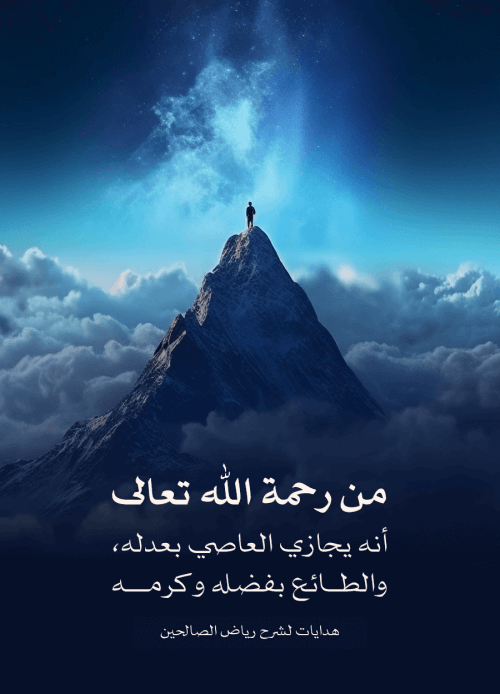
One of the manifestations of Allah’s mercy is that He uses justice to recompense the sinner but uses His grace and bounty to recompense the good-doer.
Riyadh Al-Salheen with explanation and benefits
Sincerity is one of the means to alleviate adversity because each one of them said: “O Allah! If I did that for Your sake only, then relieve us from the distress we are in.”
Riyadh Al-Salheen with explanation and benefits
Good deeds are means to alleviating adversity.
Riyadh Al-Salheen with explanation and benefits
“The righteousness of the heart results from the righteousness of deeds, and the righteousness of deeds results from the righteousness of intention.”
Riyadh Al-Salheen with explanation and benefits
Repentance is a cause for success, which is why a true successful person is the one seeking and committing to a means leading to success.
Riyadh Al-Salheen with explanation and benefits
Hastening to repentance is one of the causes to earning the pleasure of Allah with His servant.
Riyadh Al-Salheen with explanation and benefits