








Categories
Discover our diverse collection of categories covering multiple topics to meet your various interestsDa\'wa cards that highlight great meanings of the verses of the Holy Quran and the noble prophetic hadiths in a simple style and attractive display that helps the Muslim to have a deeper understanding of his religion in an easy way
﴿ وَلَا تَقۡتُلُوٓاْ أَوۡلَٰدَكُمۡ خَشۡيَةَ إِمۡلَٰقٖۖ نَّحۡنُ نَرۡزُقُهُمۡ وَإِيَّاكُمۡۚ إِنَّ قَتۡلَهُمۡ كَانَ خِطۡـٔٗا كَبِيرٗا ﴾
سورة الإسراء
And do not kill your children for fear of poverty. We provide for them and for you. Indeed, their killing is ever a great sin.

﴿ سَلۡ بَنِيٓ إِسۡرَٰٓءِيلَ كَمۡ ءَاتَيۡنَٰهُم مِّنۡ ءَايَةِۭ بَيِّنَةٖۗ وَمَن يُبَدِّلۡ نِعۡمَةَ ٱللَّهِ مِنۢ بَعۡدِ مَا جَآءَتۡهُ فَإِنَّ ٱللَّهَ شَدِيدُ ٱلۡعِقَابِ ﴾
سورة البقرة
Ask the Children of Israel how many clear signs We have given them. But anyone who substitutes the favors of Allah [for disbelief] after receiving it, then Allah is severe in punishment.
﴿ وَٱلنَّهَارِ إِذَا جَلَّىٰهَا ﴾
سورة الشمس
And [by] the day when it displays it[1931]
﴿ فَذَٰلِكَ ٱلَّذِي يَدُعُّ ٱلۡيَتِيمَ ﴾
سورة الماعون
For that is the one who drives away the orphan
﴿ إِنَّهُۥ لَقَوۡلُ رَسُولٖ كَرِيمٖ ﴾
سورة الحاقة
Indeed, this is the word of a noble Messenger[8],
﴿ فِيهِنَّ قَٰصِرَٰتُ ٱلطَّرۡفِ لَمۡ يَطۡمِثۡهُنَّ إِنسٞ قَبۡلَهُمۡ وَلَا جَآنّٞ ﴾
سورة الرحمن
In them are women limiting [their] glances,[1604] untouched[1605] before them by man or jinnī -
﴿ لَٰكِنِ ٱلَّذِينَ ٱتَّقَوۡاْ رَبَّهُمۡ لَهُمۡ غُرَفٞ مِّن فَوۡقِهَا غُرَفٞ مَّبۡنِيَّةٞ تَجۡرِي مِن تَحۡتِهَا ٱلۡأَنۡهَٰرُۖ وَعۡدَ ٱللَّهِ لَا يُخۡلِفُ ٱللَّهُ ٱلۡمِيعَادَ ﴾
سورة الزمر
20. But those who fear their Lord (Allâh) and keep their duty to Him, for them are built lofty rooms, one above another under which rivers flow (i.e. Paradise). (This is) the Promise of Allâh: and Allâh does not fail in (His) Promise.
﴿ أَلَّا تَطۡغَوۡاْ فِي ٱلۡمِيزَانِ ﴾
سورة الرحمن
That you not transgress within the balance.
﴿ ٱلَّذِينَ كَذَّبُواْ بِٱلۡكِتَٰبِ وَبِمَآ أَرۡسَلۡنَا بِهِۦ رُسُلَنَاۖ فَسَوۡفَ يَعۡلَمُونَ ﴾
سورة غافر
70. Those who deny the Book (this Qur’ân), and that with which We sent Our Messengers (i.e. to worship none but Allâh Alone sincerely, and to reject all false deities and to confess resurrection after the death for recompense) they will come to know (when they will be cast into the Fire of Hell).
Anas (may Allah be pleased with him) reported that the Messenger of Allah (may Allah’s peace and blessings be upon him) said: "I have been intimidated in the path of Allah at a time when no one else was intimidated, and I have been harmed for the sake of Allah at a time when no one else was harmed, and I once spent thirty days and nights wherein I and Bilāl had nothing a living being can eat except a little that was kept under Bilāl's armpit."
Narrated by Ibn Majah - Narrated by At-Termedhy - Narrated by Ahmad
In this Hadīth, the Prophet (may Allah's peace and blessings be upon him) says that he was alone when he started proclaiming the message of Islam, and that the disbelievers intimidated him and harmed him because of that. At that time, he was alone with no support in the face of this harm other than the help, protection, and guidance of Allah, the Almighty. The Prophet (may Allah's peace and blessings be upon him) also says that he lacked money, food, and provisions at that phase to the extent that he once spent thirty days with no food but a little something that Bilāl (may Allah be pleased with him) used to carry under his armpit, because they did not even have a pot for keeping food. This Hadīth refers to the period when the Prophet (may Allah's peace and blessings be upon him) fled from Makkah.
‘Urwah ibn Az-Zubayr reported: I asked ‘Abdullāh ibn ‘Amr about the worst thing the polytheists did to the Messenger of Allah (may Allah's peace and blessings be upon him). He said: "I saw ‘Uqbah ibn Abi Mu‘ayt coming to the Prophet (may Allah's peace and blessings be upon him) while he was praying. ‘Uqbah wrapped his garment around the Prophet's neck and strangled him therewith severely. Abu Bakr came and pulled ‘Uqbah away from the Prophet (may Allah's peace and blessings be upon him) and said: '{Do you kill a man [merely] because he says: 'My Lord is Allah' while he has brought you clear proofs from your Lord?} [Sūrat Ghāfir: 28]'"
Narrated by Bukhari
‘Urwah ibn Az-Zubayr ibn al-‘Awwām (may Allah have mercy upon him) asked ‘Abdullāh ibn ‘Amr ibn al-‘Ās (may Allah be pleased with him) about the worst harm and persecution the polytheists had ever done to the Messenger of Allah (may Allah's peace and blessings be upon him). He told him that he saw ‘Uqbah ibn Abi Mu‘ayt approaching the Prophet (may Allah's peace and blessings be upon him) while he was praying in the Hijr of the Ka‘bah. He wrapped the Prophet's neck with his garment or that of the Prophet, and squeezed it severely. Abu Bakr (may Allah be pleased with him) came and pushed him away while crying and said: "{Do you kill a man [merely] because he says: 'My Lord is Allah' while he has brought you clear proofs from your Lord?} [Sūrat Ghāfir: 28]" This was the worst thing ‘Abdullāh (may Allah be pleased with him) had ever seen. ‘Urwah found out that there was a severer persecution as in the report he narrated from ‘Ā'ishah (may Allah be pleased with her) the Prophet's wife where she said that she asked the Prophet (may Allah's peace and blessings be upon him): "Have you ever encountered a day harder than the day of the battle of Uhud?" The Prophet (may Allah's peace and blessings be upon him) replied: "Your people have troubled me a lot, and the worst trouble was what I experienced on the Day of ‘Aqabah when I presented myself to Ibn ‘Abd Yālīl ibn ‘Abd Kulāl and he did not respond to my call. So I departed, overwhelmed with excessive sorrow, and proceeded on, and could not recover till I found myself at Qarn Ath-Tha‘ālib where I lifted my head towards the sky to see a cloud shading me unexpectedly. I looked up and saw Jibrīl in it. He called me saying: 'Allah heard what your people had said to you, and what they had said in response to your call. He has sent the angel of the mountains to you, so that you may order him to do whatever you wish him to do to these people.' The angel of the mountains called and greeted me, and then said: 'O Muhammad! Order what you wish. If you like, I will let Al-Akhshabayn (i.e. two mountains) fall upon them.' The Prophet (may Allah's peace and blessings be upon him) said: 'No but I hope that Allah will let them beget children who will worship Allah alone, and worship none besides Him.'" [Al-Bukhāri and Muslim]
‘Amr ibn ‘Abasah (may Allah be pleased with him) said: 'In the pre-Islamic time of ignorance, I used to think that people were misguided. They were not on a right path, as they worshipped idols. Then I heard of a man in Makkah who was telling news. So I mounted my camel and went to him. It was the Messenger of Allah (may Allah's peace and blessings be upon him). He was hiding, since his own people were aggressive toward him. So I acted gently until I entered upon him. I said to him, "Who are you?" He said: "I am a Prophet." I said: "What is a Prophet?" He said: "Allah has sent me.'' I said: "With what has He sent you?" He said: "He sent me with [a message] of maintaining kinship ties, breaking the idols, and upholding the oneness of Allah without associating anything with him." I said: "Who is with you on that?" He said: "A free man and a slave man.'' (At that time only Abu Bakr and Bilāl (may Allah be pleased with both of them) were with him. I said: "I shall follow you.'' He said: "You cannot do that today. Do you not see my situation and that of the people? However, go back to your people, and when you hear that I have succeeded in my mission, come to me.'' So I went to my people. Later, the Messenger of Allah (may Allah's peace and blessings be upon him) went to Madīnah. It was until some of my people went to Madīnah., that I said: "What happened to this man who came to Madīnah?" They said: "People are hastening to him. His own people wanted to kill him, but they could not." So I went to Madīnah and entered upon him and said: "O Messenger of Allah, do you recognize me?" He said: "Yes, you are the one who met me in Makkah." I said: "O Messenger of Allah, tell me about what Allah has taught you, which I am unaware of. Tell me about prayer." He said: "Perform the morning prayer. Then do not pray until the sun has risen up to the height of a lance, for when it rises, it rises between two horns of a devil. It is when the unbelievers prostrate themselves to it. Then pray, for prayer is witnessed and attended, until the shadow of the lance shrinks. Then do not pray, for at that time Hell is fired up. Then pray when the shadow becomes longer, for the prayer is witnessed and attended, until you perform ‘Asr. Then do not pray until the sun sets, for it sets between two horns of a devil. It is when the unbelievers prostrate themselves to it." I further said: ''O Prophet, tell me about ablution.'' He said: "When anyone of you approaches his ablution water, and rinses his mouth and nose, the sins of his face fall with water from the edges of his beard. Then when he washes his hands up to elbows, the sins of his hands fall with water from his fingertips. Then when he wipes over his head, the sins of his head fall with water from the ends of his hair. Then when he washes his feet up to the ankles, the sins of his feet fall with water from his toes. Then, when he stands up for prayer, praises Allah, the Almighty,, extols Him, glorifies Him as He deserves, and empties his heart for Allah, the Almighty, he becomes free from his sins as he was on the day his mother gave birth to him.'' ‘Amr ibn ‘Abasah narrated this Hadīth to Abu Umāmah, a companion of the Messenger of Allah (may Allah's peace and blessings be upon him). Abu Umāmah, therefore, said to him: "O ‘Amr ibn ‘Abasah, think about what you are saying. Will a man be getting all of this on one occasion?" ‘Amr said: "O Abu Umāmah, I am old in age, weak in bones, and close to death. I do not need to tell lies about Allah and His Messenger (may Allah's peace and blessings be upon him). Had I not heard this from the Messenger of Allah (may Allah's peace and blessings be upon him) only once, twice, thrice (he counted up to seven times), I would have not reported it. However, I heard it more than that.''
Narrated by Muslim
‘Amr ibn ‘Abasah As-Sulami (may Allah be pleased with him) informs us about his situation in the pre-Islamic times and how Allah guided him to Islam. Before Islam, he had light in his heart that showed him that the unbelievers were misguided, as they worshiped false objects, which they associated with Allah. He did not share their beliefs. However, when he heard of someone in Makkah telling prophetic news, he mounted his camel and went to him. Prophet Muhammad was then hiding to avoid the abuse of the Makkans. ‘Amr says that he used gentle ways to get access to the Prophet. He then approached him and asked him about his message. The Prophet told him that Allah sent him with a message of upholding kinship relations, breaking idols, and worshiping Allah alone without associating partners with Him. Here the Prophet was inviting him to Allah, explaining to ‘Amr great aspects of Islam. The most important thing he told him was to believe in the oneness of Allah and to have good manners. He told ‘Amr what people would realize with their reason that idols were a falsehood. Before coming to Islam, ‘Amr knew that the polytheists were on a false course of worship. He was searching for the truth. So when he reached the Prophet and asked him about his message, he told him that Allah sent him with a message that maintains kinship relations. Indeed, the Makkans had spread rumors that the Prophet came with a message that severs kinship ties. Against these backdrop, the Prophet asserted that his message maintained kinship ties. The Prophet further told ‘Amr that his message included the breaking of idols, i.e. everything that is worshipped besides Allah, so that Allah is worshipped alone, without any partners associated with Him. Upom hearing that, ‘Amr asked the Prophet about his followers, and the Prophet told him that a free man (i.e. Abu Bakr) and a slave man (i.e. Bilāl) were following him. So he said that he too would follow the Prophet. However, the Prophet told him that he can not do so on that day. This means that if ‘Amr joined the Prophet in Makkah, thus leaving his own people, the Prophet would not be able to protect him from the Makkans. So he told him to stay as a Muslim among his people until Islam is strong enough, then ‘Amr would join Muslims. This was an aspect of the Prophet’s compassion. ‘Amr was weak and the Makkans were plenty in number and hostile towards the Prophet, who could not defend himself rather than someone else. ‘Amr went back to his own people as a Muslim, and thus he would often check on the Prophet's news. However, he kept his conversion a secret, fearing for his own life. When some of his people came back from a visit to Madīnah, ‘Amr asked them about the Prophet. They told him that people were quick in responding to him and that the Makkans wanted to kill him but failed. So ‘Amr travelled to Madīnah and entered upon the Prophet, who recognized him. ‘Amr asked the Prophets about the teachings of Islam; so as to learn what he is unaware of the divine knowledge. The Prophet told him that he should pray the morning prayer on time and then stop praying until the sun rises, because when it rises the unbelievers prostrate themselves to it. A Muslim, however, is not allowed to delay his morning prayer, nor to pray optionally when the sun rises. The time for sunrise can be known from the calendar. Now, the Prophet forbade that Muslims emulate the disbelievers by praying at sunrise, because the sun rises between two horns of a devil. Later, however, angels attend the prayers, so as to record a Muslim's prayer and be witness for him. No prayer is allowed when the sun is in the middle of the sky, because then Hell is fired up. At this time, one's shade is under his feet. It is a short time that lasts for only two Rak‘ahs. However, when the shade shrinks under one's feet and moves to the other direction, marking the noon time, the angels attend the prayer, so a Muslim may pray from Zhuhr until ‘Asr. This is an open time for prayer. After praying ‘Asr, one does not pray until sunset. Before sunset, it is forbidden to pray because the sun sets, as it rises, between two horns of a devil. A Muslim, meanwhile, is not allowed to delay praying ‘Asr until shortly before sunset, because in doing so he emulates the unbelievers. The Prophet called it the prayer of hypocrites, who wait until the sun is orange and pray four Rak‘ahs quickly, with little remembrance of Allah. So a Muslim should not behave like unbelievers and hypocrites, willingly delaying the 'Asr prayer until the sun is going to set. ‘Amr then asked the Prophet about ablution. The Prophet told him that doing ablution as prescribed eliminates sins, which fall with water when one washes his limbs. ‘Amr used to tell others about this Hadīth, yet Abu Umāmah warned him, concluding that he was exaggerating. He might have thought that the reward was too large for doing ablution, that a Muslim becomes sin-free as if he is just born. ‘Amr, however, explained that he did not have to lie, because he was already old, weak, and about to die. He further said that he heard the Hadīth not only once or even seven times, but more than that.
As-Sāib ibn Yazīd (may Allah be pleased with him) reported: When the Prophet (may Allah's peace and blessings be upon him) returned from the Battle of Tabūk, the people went out to receive him. I received him with the boys at Thaniyyat al-Wadā‘.” Al-Bukhāri narrated it with the following wording: “We went with the boys to Thaniyyat al-Wadā‘ to receive the Messenger of Allah (may Allah's peace and blessings be upon him).”
Narrated by Bukhari - Narrated by Abu Daoud
Hadīth explanation: As-Sāib ibn Yazīd (may Allah be pleased with him) reported that when the Prophet (may Allah's peace and blessings be upon him) returned from the battle of Tabūk, the people – those who had been excused from going and stayed behind and the others - went to Thaniyyat al-Wadā‘ (a place on the outskirts of Madīnah) to greet him on his arrival. As-Sāib ibn Yazīd went out with the boys of Madīnah to receive the Prophet (may Allah's peace and blessings be upon him).
‘Ā’ishah and Ibn ‘Abbās (may Allah be pleased with both of them) reported that the Prophet (may Allah's peace and blessings be upon him) stayed in Makkah for ten years and then in Madīnah for ten years, and the Qur’an was descending upon him (in both).
Narrated by Bukhari
This Hadīth shows that the Prophet (may Allah's peace and blessings be upon him) stayed for ten years in Makkah, after having become a Prophet, and stayed for ten years in Madīnah as well, and that the Qur’an was sent down on him during that whole period. It is proved in other than this Hadīth that the Prophet (may Allah's peace and blessings be upon him) stayed in Makkah for thirteen years after he had been sent as a Prophet. Both traditions could be reconciled as follows: the Prophet (may Allah's peace and blessings be upon him) stayed for three years in Makkah without proclaiming his message. After that, the revelation was sent down successively. It is as if those who reported the ten-year-period did not count those three years, or they just rounded up the thirteen years to ten.
Ibn ‘Abbās (may Allah be pleased with him) reported: On the day of (the battle of) Badr, the Messenger of Allah (may Allah's peace and blessings be upon him) looked at the polytheists, who were one thousand (fighters), while his Companions were three hundred and nineteen. The Prophet (may Allah's peace and blessings be upon him) turned towards the Qiblah, stretched his hands up, and started calling upon his Lord: "O Allah, fulfill for me what You have promised to me. O Allah, accomplish what You have promised to me. O Allah, if this small band of Muslims is destroyed, You will not be worshiped on earth." He continued his supplication to his Lord while raising his hands and facing the Qiblah until his mantle slipped down from his shoulders. So Abu Bakr came to him, picked up his mantle, and put it back on his shoulders. Then he embraced him from behind and said: "O Prophet, you have sufficiently prayed to your Lord, and He will fulfill for you what He has promised you." So Allah, the Exalted, revealed: {When you appealed to your Lord for help, He responded to your call (saying): I will help you with one thousand angels coming in succession} [Sūrat al-Anfāl: 9]. So Allah supported him with angels." Abu Zumayl reported that Ibn ‘Abbās told him: "On that day, a Muslim was chasing a disbeliever who was running in front of him, he heard the sound of a whip from above, and the voice of a rider, saying: 'Go ahead, Hayzūm.' He glanced at the polytheist, who had (then) fallen down on his back. When he looked at him, there was a scar on his nose, and his face was torn as if it had been lashed with a whip, and it all turned purple. The Ansāri (man from the Ansār came to the Messenger of Allah (may Allah's peace and blessings be upon him) and related this (incident) to him. He said: 'You have told the truth. This was help from the third heaven.' On that day (the day of the battle of Badr), the Muslims killed seventy disbelievers and captured seventy as captives. The Messenger of Allah (may Allah's peace and blessings be upon him) said to Abu Bakr and ‘Umar (may Allah be pleased with both of them): 'What is your opinion regarding these captives?' Abu Bakr said: 'They are our kith and kin. I think you charge them a ransom (in return for releasing them), which (the ransom) will be a source of strength to us against the disbelievers. Perhaps, Allah will guide them to Islam.' Then the Messenger of Allah (may Allah's peace and blessings be upon him) said: 'What is your opinion, O Ibn al-Khattāb?' He said: 'No, by Allah, O Messenger of Allah, I do not agree with the opinion of Abu Bakr. I am of the opinion that you should hand them over to us so that we cut off their heads. Hand over ‘Aqīl to ‘Ali to cut off his head, and hand over such-and-such relative to me to cut off his head. These are the leaders of the disbelief and its veterans.' ‘Umar noted: 'The Messenger of Allah (may Allah's peace and blessings be upon him) favored the opinion of Abu Bakr and did not favor what I had said. The next day, when I came to the Messenger of Allah (may Allah's peace and blessings be upon him) I found that both he and Abu Bakr were sitting and crying. I said: ‘O Messenger of Allah, why are you and your companion crying? Tell me the reason. For I will cry, or I will at least pretend to cry in sympathy with you.’ The Messenger of Allah (may Allah's peace and blessings be upon him) said: ‘I cry for what has been offered to your companions of taking the ransom (from the prisoners). I was shown the punishment to which they will be subjected. It was brought to me as close as this tree.’ Then Allah, the Exalted, revealed: {It is not befitting for a Prophet that he should take prisoners until the force of the disbelievers has been crushed...} [Sūrat al-Anfāl: 67] {so eat of what you have gained of the spoils of war, (it is) lawful and pure} [Sūrat al-Anfāl: 69]. So Allah made war spoils lawful for them."
Narrated by Muslim
When it was the battle of Badr, the Messenger of Allah (may Allah's peace and blessings be upon him) looked at the polytheists, who were numbered one thousand fighters, whereas his Companions consisted of only three hundred and nineteen men. As the Muslims were a minority compared to the disbelievers, the Prophet (may Allah's peace and blessings be upon him) turned toward the Qiblah and raised his hands to the heaven, audibly invoking Allah: "O Allah, fulfill for me what You have promised to me. O Allah, accomplish what You have promised to me. O Allah, if this small band of Muslims is destroyed, You will not be worshiped on earth." He continued his prayer until his cloak fell off his shoulders. Abu Bakr picked it up and put it back on the Prophet's shoulders, embracing him from behind and telling him that he made sufficient invocation to Allah, Who would fulfill His promise of victory to the Prophet. Hence, Allah, the Almighty, revealed: {When you appealed to your Lord for help, He responded to your call (saying): I will help you with one thousand angels coming in succession} [Sūrat al-Anfāl: 9]. This means that Allah would provide the believers with a thousand fighters among the angels who would be sent one after another to support the believers in their fight against the polytheists. Ibn ‘Abbās mentioned that while a Muslim man from among the Ansār was chasing a disbeliever to kill him, he heard a crack of a whip and the voice of a horseman saying "Go ahead, Hayzūm." The Ansāri looked to find the infidel on the ground with the trace of a whip on his nose and a rupture across his face. The Ansāri told the Prophet (may Allah's peace and blessings be upon him) about that, and the Prophet told him that this was an angel from the third heaven and that Hayzūm was the name of that angel's horse. On that day, the Muslims killed seventy disbelievers and took another seventy as captives. Concerning the captives, the Prophet (may Allah's peace and blessings be upon him) consulted Abu Bakr and ‘Umar on what to do with them. Abu Bakr opined that those were the Muslims' relatives and kin, and therefore the Prophet should take a financial ransom and release them. The ransom would support the Muslims in their subsequent fights against the disbelievers. Abu Bakr added that, perhaps, Allah would guide them to Islam. ‘Umar, however, did not agree with Abu Bakr's opinion and opined that the Muslims should kill them and the Prophet should ask each Muslim to kill his relative among these captives, for they were the leaders of disbelief and the heads of misguidance. The Prophet (may Allah's peace and blessings be upon him) inclined to Abu Bakr's suggestion rather than that of ‘Umar. One day later, ‘Umar found the Prophet and Abu Bakr crying. He asked why they were crying, for if there was a reason for crying, he would join them in it, and if not, then he would pretend to cry in sympathy with them. The Messenger (may Allah's peace and blessings be upon him) told him that they were crying because Allah spoke of the punishment of those who spoke of accepting the ransom from the captive disbelievers; the Prophet (may Allah's peace and blessings be upon him) pointed to a tree near him and said that the punishment was presented closer than that tree. In this regard, Allah, the Almighty, revealed: {It is not befitting for a Prophet that he should take prisoners until the force of the disbelievers has been crushed...} [Sūrat al-Anfāl: 67] to the end of the verse: {So eat of what you have gained of the spoils of war, (it is) lawful and pure} [Sūrat al-Anfāl: 69]. This means that it is not appropriate for a Prophet, while fighting the disbelievers who want to extinguish the light of Allah and extirpate Islam, to hasten to arrest them and keep them alive to collect their ransom. Such ransom is of little value compared with the benefit of eradicating them and ending their evil. As long as those infidels were strong enough to act maliciously and threaten the Muslims, it was not appropriate to take them as captives. However, if they were incapable of doing evil, it would be fine to arrest them and keep them alive. Then Allah declared the riches that the Muslims take from the disbelievers by force in war to be lawful for them.
‘Abdullāh ibn ‘Umar (may Allah be pleased with both of them) reported: The Messenger of Allah (may Allah's peace and blessings be upon him) sent a detachment to Najd, and I went with the troops. We seized camels and sheep as spoils of war. Our shares amounted to twelve camels per fighter and the Messenger of Allah (may Allah's peace and blessings be upon him) gave an extra camel to each of us.
Narrated by Bukhari & Muslim
‘Abdullāh ibn ‘Umar (may Allah be pleased with both of them) reports that the Prophet (may Allah's peace and blessings be upon him) sent them on a detachment to Najd and they seized many camels and sheep as spoils of war. Each of them received twelve camels and the Prophet (may Allah's peace and blessings be upon him) gave each of them an extra camel in addition to his share.
‘Abdullāh ibn ‘Umar (may Allah be pleased with him) reported: I was presented to the Messenger of Allah (may Allah's peace and blessings be upon him) on the Day of Uhud. I was fourteen years old, and so he did not grant me permission (to join the fight). Then, I was presented to him on the Day of Al-Khandaq, and I was fifteen years old, and he granted me permission.
Narrated by Bukhari & Muslim
‘Abdullāh ibn ‘Umar (may Allah be pleased with him) reported that he was presented to the Messenger of Allah (may Allah's peace and blessings be upon him) in order to join the battle (as a way of presenting the soldiers to the leader). This took place during the Battle of Uhud in the third year after Hijrah. As he was fourteen years old, the Prophet (may Allah's peace and blessings be upon him) refused to allow him to participate due to his young age. Later on, he was presented to him in the year of the battle of Al-Khandaq. This was in the fifth year after Hijrah, and he was fifteen years old. The Prophet (may Allah's peace and blessings be upon him) enlisted him in the forces. Perhaps on the Day of Uhud, ‘Abdullāh ibn ‘Umar had recently turned fourteen years old, while on the Day of Al-Khandaq, he was nearly sixteen years old.
Jābir ibn ‘Abdullāh (may Allah be pleased with him) reported: ‘Umar ibn al-Khattāb came cursing the disbelievers of Quraysh after the sun had set on the Day of the Trench, and he said: "O Messenger of Allah, I could not offer the ‘Asr prayer till the sun had set." The Prophet (may Allah's peace and blessings be upon him) said: "By Allah! I have not yet prayed it either." So we went to But-hān, and he performed ablution and so did we, and then he offered the ‘Asr prayer after the sun had set and then followed it with the Maghrib prayer.
Narrated by Bukhari & Muslim
‘Umar ibn al-Khattāb (may Allah be pleased with him) came to the Prophet (may Allah's peace and blessings be upon him) on the Day of the battle of the Trench after the sun had set, and he was cursing the disbelievers of Quraysh, because they had distracted him from offering the ‘Asr prayer, and he could not pray it until after the sun had set. So the Prophet (may Allah's peace and blessings be upon him) swore by Allah, and he is the truthful, that he too had not yet prayed it, in order to calm ‘Umar (may Allah be pleased with him) because it was hard for him. Then the Prophet (may Allah's peace and blessings be upon him) got up and performed ablution, and the Companions did so too, and then he offered the ‘Asr prayer after the sun had set, followed by the Maghrib prayer.
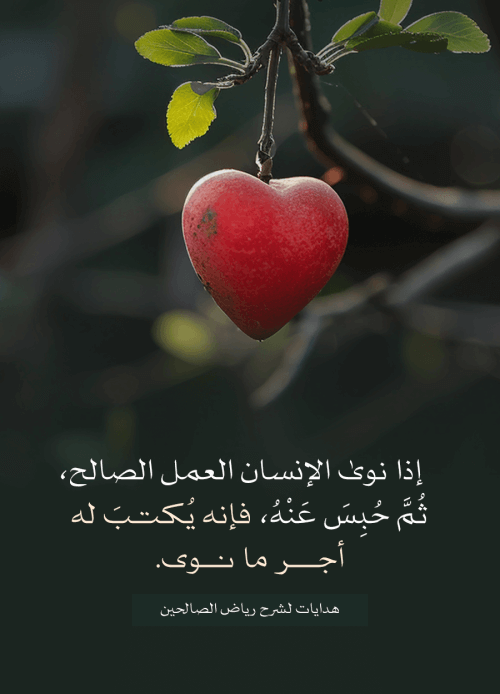
If someone intends to do a good deed but was prevented by a valid excuse, he shall gain the reward of his intention.
Riyadh Al-Salheen with explanation and benefits
Variation of reward for good deeds is based on sincerity and following of the Prophet’s guidance. The more a person is sincere to Allah, and the keener he is on following the Prophet (may Allah’s peace and blessings be upon him), the more perfect his worship will be, and consequently his reward will be bigger.
Riyadh Al-Salheen with explanation and benefits
People differ with regards to their acts of worship according to their intentions. The intentions of some people have reached the ultimate level of sincerity (to Allah) and keenness in following the Sunnah (of the Messenger of Allah) with regard to doing good and righteous deeds, while the intentions of others are below that.
Riyadh Al-Salheen with explanation and benefits
Anyone partaking a role with transgressors and wrongdoers will share their punishment because it is inclusive.
Riyadh Al-Salheen with explanation and benefits
If someone intends to do a good deed but was prevented by a valid excuse, he shall gain the reward of his intention.
Riyadh Al-Salheen with explanation and benefits
Actions are recompensed according to the intentions behind them, and the individual shall receive the reward of what he intended even if the outcome was contrary to his intention.
Riyadh Al-Salheen with explanation and benefits
There is not a single good deed intended sincerely to please Allah except that its doer will be raised in rank and status thereby, so that he would reap the full reward.
Riyadh Al-Salheen with explanation and benefits
Love and contentment is measured by good deeds and intentions because they are the criteria for Allah’s acceptance of the servant; perhaps a small deed reaps great reward because of the intention behind it and perhaps a big deed reaps little reward because of the intention behind it
Riyadh Al-Salheen with explanation and benefits
One of the proofs Allah supports the servant is the latter’s sincere endeavor to rectify his intention and purify his heart by good deeds.
هدايات لشرح رياض الصالحين