



Categories
Discover our diverse collection of categories covering multiple topics to meet your various interestsDa\'wa cards that highlight great meanings of the verses of the Holy Quran and the noble prophetic hadiths in a simple style and attractive display that helps the Muslim to have a deeper understanding of his religion in an easy way
﴿ ثُمَّ قَبَضۡنَٰهُ إِلَيۡنَا قَبۡضٗا يَسِيرٗا ﴾
سورة الفرقان
46. Then We withdraw it to Us a gradual concealed withdrawal.

﴿ وَمَآ أَرۡسَلۡنَا قَبۡلَكَ مِنَ ٱلۡمُرۡسَلِينَ إِلَّآ إِنَّهُمۡ لَيَأۡكُلُونَ ٱلطَّعَامَ وَيَمۡشُونَ فِي ٱلۡأَسۡوَاقِۗ وَجَعَلۡنَا بَعۡضَكُمۡ لِبَعۡضٖ فِتۡنَةً أَتَصۡبِرُونَۗ وَكَانَ رَبُّكَ بَصِيرٗا ﴾
سورة الفرقان
We did not send any messengers before you [O Prophet] except that they ate food and walked in the markets. We have made some of you as a trial for others. Will you have patience? For your Lord is All-Seeing.
﴿ بَلۡ نَحۡنُ مَحۡرُومُونَ ﴾
سورة القلم
Rather, we have been deprived.”
﴿ فَلَآ أُقۡسِمُ بِٱلۡخُنَّسِ ﴾
سورة التكوير
15. So verily, I swear by the planets that recede (i.e. disappear during the day and appear during the night).
﴿ وَقَٰتِلُوهُمۡ حَتَّىٰ لَا تَكُونَ فِتۡنَةٞ وَيَكُونَ ٱلدِّينُ لِلَّهِۖ فَإِنِ ٱنتَهَوۡاْ فَلَا عُدۡوَٰنَ إِلَّا عَلَى ٱلظَّٰلِمِينَ ﴾
سورة البقرة
Fight them until there is no [more] fitnah and [until] religion [i.e., worship] is [acknowledged to be] for Allāh. But if they cease, then there is to be no aggression [i.e., assault] except against the oppressors.
﴿ وَيُطۡعِمُونَ ٱلطَّعَامَ عَلَىٰ حُبِّهِۦ مِسۡكِينٗا وَيَتِيمٗا وَأَسِيرًا ﴾
سورة الإنسان
And they give food in spite of love for it[1813] to the needy, the orphan, and the captive,
﴿ وَيَوۡمَ يَقُولُ نَادُواْ شُرَكَآءِيَ ٱلَّذِينَ زَعَمۡتُمۡ فَدَعَوۡهُمۡ فَلَمۡ يَسۡتَجِيبُواْ لَهُمۡ وَجَعَلۡنَا بَيۡنَهُم مَّوۡبِقٗا ﴾
سورة الكهف
And [warn of] the Day when He will say, "Call My 'partners' whom you claimed," and they will invoke them, but they will not respond to them. And We will put between them [a valley of] destruction.
﴿ وَإِنَّ رَبَّكَ لَهُوَ ٱلۡعَزِيزُ ٱلرَّحِيمُ ﴾
سورة الشعراء
Your Lord is indeed the All-Mighty, the Most Merciful.
﴿ وَيَٰقَوۡمِ ٱعۡمَلُواْ عَلَىٰ مَكَانَتِكُمۡ إِنِّي عَٰمِلٞۖ سَوۡفَ تَعۡلَمُونَ مَن يَأۡتِيهِ عَذَابٞ يُخۡزِيهِ وَمَنۡ هُوَ كَٰذِبٞۖ وَٱرۡتَقِبُوٓاْ إِنِّي مَعَكُمۡ رَقِيبٞ ﴾
سورة هود
O my people, do whatever you can; I will do mine. You will come to know who will receive a disgracing punishment, and who is a liar. Wait; I too am waiting with you.”
Abu Hurayrah (may Allah be pleased with him) reported that the Prophet (may Allah's peace and blessings be upon him) said: "Leave me as I leave you. Verily, what destroyed those before you was their asking questions and their disagreement with their prophets. So, if I forbid you from something, avoid it; and if I command you with something, do as much of it as you can."
Narrated by Bukhari & Muslim
The Prophet (may Allah's peace and blessings be upon him) mentioned that the Shariah rulings fall into three categories: what is left unaddressed, prohibitions, and commands. As for the first: It is what the Shariah has left unaddressed, as there is no ruling, and things, in principle, are not obligatory. During the Prophet's lifetime, it was a must not to ask about something that had not occurred for fear that it might become obligatory or forbidden through revelation, as Allah has left it unaddressed out of mercy towards His slaves. After the Prophet's death, on the other hand, if the question is posed by way of seeking legal opinion or learning about what one needs of the religion, then it is not only permissible but also commanded. However, if the question is posed by way of obstinacy and affectation, then this kind of question should be avoided, and this is what the Hadīth refers to, as it could lead to what happened to the Children of Israel when they were commanded to slaughter a cow. It was sufficient for them to obey the command by slaughtering any cow; however, when they acted obstinately, things were made hard for them. Second: The prohibitions: It is whatever one is rewarded for abandoning and is punished for doing. So, all prohibitions must be avoided. Third: The commands: It is whatever one is rewarded for doing and punished for abandoning. The commands must be carried out to the best of one's ability.
Usāmah ibn Zayd (may Allah be pleased with him) reported: Once, the Prophet (may Allah's peace and blessings be upon him) stood at the top of one of Madīnah's forts looking down and said: "Do you see what I see? Verily, I see the trials that occur in the midst of your houses as plenty as the raindrops that fall (during heavy rain)."
Narrated by Bukhari & Muslim
The Messenger (may Allah's peace and blessings be upon him) looked out from a high fort from the forts of Madīnah and said to his Companions: Do you see what I see? I see the trials and tribulations that occur in the midst of your houses as plenty and heavy as the raindrops. This is an indication to the wars and trials that were to occur in Madīnah after the Prophet’s death, such as the killing of ‘Uthmān, the battle of Al-Harrah, etc.
Abu Hurayrah (may Allah be pleased with him) reported: It was said: "O Messenger of Allah, who is the most honorable among people?" He replied: "The most pious among them." They said: "We are not asking you about this." He said: "Then, Yusuf (Joseph), the prophet of Allah, son of the prophet of Allah, son of the prophet of Allah, son of the intimate friend of Allah." They said: "We are not asking you about this." He said: "Are you then asking me about the origins of the Arabs? The best of them in the pre-Islamic era are the best of them in Islam, provided that they acquire religious knowledge."
Narrated by Bukhari & Muslim
The Hadīth explains that the most honorable among people in terms of ancestry, lineage, and origins are the best during the pre-Islamic era, provided that they attain religious knowledge. For example, it is known that Banu Hāshim are the best of Quraysh in Islam, provided that they understand Allah's religion and learn its rulings. However, failing to attain understanding in religion, noble lineage will be of no avail. If one is of a high lineage and from the most noble of Arab ancestry, this will not make such a person from the most honorable of creation in the sight of Allah. Based on this, a person is honored by his lineage, on condition that he possesses understanding of the religion.
Abu Hurayrah (may Allah be pleased with him) reported that the Prophet (may Allah's peace and blessings be upon him) said: "When Allah created Adam (peace be upon him), He said to him: 'Go and greet those – a group of angels who were sitting – and listen to what they are going to say in response to your greeting as that will be your greeting and the greeting of your offspring.' He (Adam) said: 'As-Salāmu ‘alaykum (peace be upon you).' They replied: 'As-Salāmu ‘alayk wa rahmatullāh (Peace and mercy of Allah be upon you),' thus adding 'wa-rahmatullāh (and mercy of Allah)' in their response to his greeting."
Narrated by Bukhari & Muslim
When Allah created Adam, He ordered him to go to a group of angels and greet them with peace and then listen to their response to his greeting because that would be the prescribed greeting for him and his offspring after him who follow the religion of the messengers. So he said: As-Salāmu ‘alaykum (peace be upon you), and they replied: As-Salāmu ‘alayk wa rahmatullāh (peace and mercy of Allah be upon you), adding 'rahmatullāh' (mercy of Allah). This has, thus, become the prescribed wording when greeting and returning the greeting. Other Hadīths had the addition: "wa rahmatullāh wa barakātuh (...and mercy of Allah and His blessings be upon you!)"
Abu ‘Abdur-Rahmān ‘Abdullāh ibn Mas‘ūd (may Allah be pleased with him) said: "It is as though I am looking at Allah's Messenger as he tells the story of one of the prophets (peace be upon them) as his people struck him and caused him to bleed, and he wiped the blood from his face, saying: 'Allah, forgive my people for they do not know.'"
Narrated by Bukhari & Muslim
Our prophet related a story about another prophet, saying that his people struck him and as he wiped blood off his face invoking Allah for their forgiveness. This consists in the furthest extent of patience and leniency. Not only did he pray for them but he also found an excuse for them out of sympathy for them due to their ignorance of the facts.
Abu Hurayrah (may Allah be pleased with him) reported that the Messenger of Allah (may Allah's peace and blessings be upon him) said: "Zakariyya (peace be upon him) was a carpenter."
Narrated by Muslim
The Prophet (may Allah's peace and blessings be upon him) informs us in this Hadīth that Prophet Zakariyya (peace be upon him) worked as a carpenter, and he used to earn his sustenance from carpentry.
Umm Sharīk (may Allah be pleased with her) reported that the Messenger of Allah (may Allah's peace and blessings be upon him) ordered her to kill geckos and said: “They used to blow [the fire] on Ibrahīm."
Narrated by Bukhari & Muslim
The Prophet (may Allah's peace and blessings be upon him) ordered to kill geckos, saying that they used to blow the fire on Ibrahīm to make it more intense. This implies that geckos are totally hostile towards devout monotheists.
Abu Hurayrah (may Allah be pleased with him) reported: Two cups of wine and milk were presented to the Prophet (may Allah's peace and blessings be upon him) on the Night of Isrā' (the night journey to the Aqsa Mosque). He looked at them and took the milk. Jibrīl said: "Praise be to Allah, Who guided you to the Fitrah. Had you taken the wine, your Ummah would have gone astray.”
Narrated by Bukhari & Muslim
Jibrīl presented two cups to the Prophet (may Allah's peace and blessings be upon him) on the Night of Isrā' and Mi’rāj refers to his night journey to the Aqsa Mosque in Jerusalem and his ascent to heaven, one filled with wine and the other with milk. “He looked at them,” meaning: as if he was asked to choose between them. “He took the milk,” meaning: he received inspiration to choose the milk. Jibrīl said: “Praise be to Allah, Who guided you to the Fitrah,” meaning: you chose the sign of Islam and uprightness. Milk was made a sign of that because it is pleasant, pure, palatable, and of no evil consequences. (And then he said:) “Had you taken the wine, your nation would have gone astray."
Abu Umāmah al-Bāhili (may Allah be pleased with him) reported: A man said: "O Messenger of Allah, was Adam a prophet?" He said: 'Yes.' The man said: "How long was the period between him (Adam) and Nūh?" He replied: "Ten centuries." The man asked again: "How long was the period between Nūh and Ibrahīm?" He said: "Ten centuries." The man said: "O Messenger of Allah, how many messengers were there?" He said: "Three hundred and fifteen."
Al-Haakim - At-Tabaraani
Abu Umāmah (may Allah be pleased with him) mentioned in this Hadīth that a man went to the Prophet (may Allah's peace and blessings be upon him) and asked him whether Adam was a prophet. The Prophet answered in the affirmative. The man then asked about the time gap between Adam and Nūh (peace be upon them). The Prophet (may Allah's peace and blessings be upon him) said that it was ten centuries. The man further asked about the time gap between Nūh and Ibrahīm. The Prophet gave the same answer: ten centuries. The man finally asked about the number of messengers, and the Prophet (may Allah's peace and blessings be upon him) said that they were three hundred and fifteen.
The path of Allah is one whereas the paths of the devil are many; and a truly guided individual is he whom Allah Almighty guided to His path. Allah Almighty said: {This is My straight path; follow it and do not follow other ways, lest they lead you away from His way.} [Surat al-An‘ām: 153]
Riyadh Al-Salheen with explanation and benefits
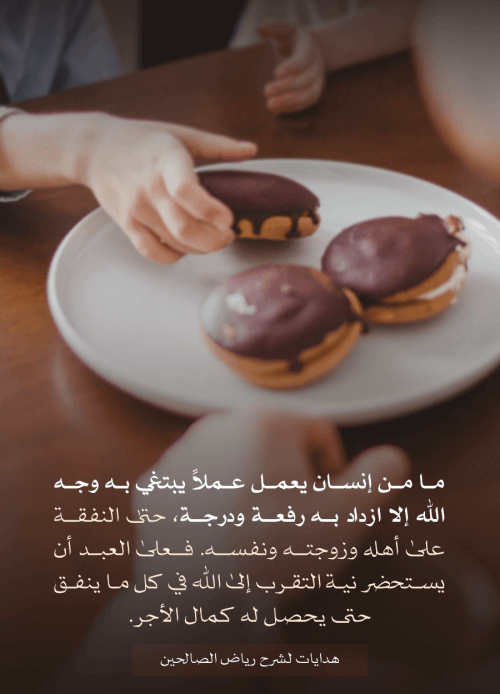
Waiting to do a good deed is in itself a good deed.
Riyadh Al-Salheen with explanation and benefits
Good intention leads its holder to good things.
Riyadh Al-Salheen with explanation and benefits
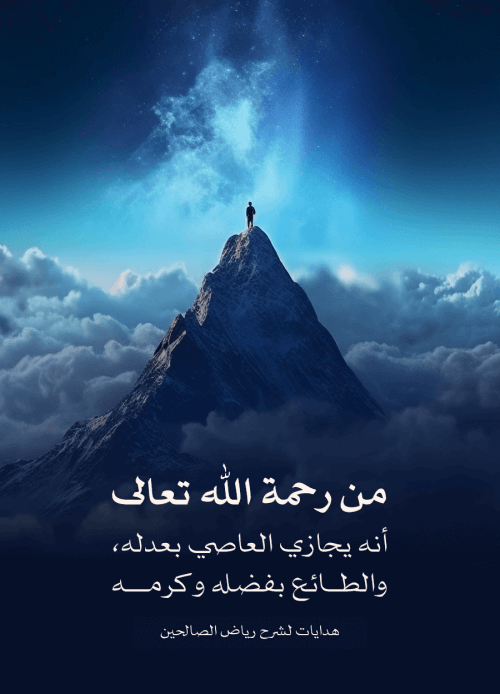
One of the manifestations of Allah’s mercy is that He uses justice to recompense the sinner but uses His grace and bounty to recompense the good-doer.
Riyadh Al-Salheen with explanation and benefits
Sincerity is one of the means to alleviate adversity because each one of them said: “O Allah! If I did that for Your sake only, then relieve us from the distress we are in.”
Riyadh Al-Salheen with explanation and benefits
Good deeds are means to alleviating adversity.
Riyadh Al-Salheen with explanation and benefits
“The righteousness of the heart results from the righteousness of deeds, and the righteousness of deeds results from the righteousness of intention.”
Riyadh Al-Salheen with explanation and benefits
Repentance is a cause for success, which is why a true successful person is the one seeking and committing to a means leading to success.
Riyadh Al-Salheen with explanation and benefits
Hastening to repentance is one of the causes to earning the pleasure of Allah with His servant.
Riyadh Al-Salheen with explanation and benefits