








Categories
Discover our diverse collection of categories covering multiple topics to meet your various interestsDa\'wa cards that highlight great meanings of the verses of the Holy Quran and the noble prophetic hadiths in a simple style and attractive display that helps the Muslim to have a deeper understanding of his religion in an easy way
﴿ ثُمَّ لَنَنزِعَنَّ مِن كُلِّ شِيعَةٍ أَيُّهُمۡ أَشَدُّ عَلَى ٱلرَّحۡمَٰنِ عِتِيّٗا ﴾
سورة مريم
69. Then indeed We shall drag out from every sect all those who were worst in obstinate rebellion against the Most Gracious (Allâh).

﴿ قَالُوٓاْ إِنَّمَآ أَنتَ مِنَ ٱلۡمُسَحَّرِينَ ﴾
سورة الشعراء
They said, "You are only of those affected by magic.
﴿ وَٱلۡبَحۡرِ ٱلۡمَسۡجُورِ ﴾
سورة الطور
and by the sea set on fire[5].
﴿ وَأُوحِيَ إِلَىٰ نُوحٍ أَنَّهُۥ لَن يُؤۡمِنَ مِن قَوۡمِكَ إِلَّا مَن قَدۡ ءَامَنَ فَلَا تَبۡتَئِسۡ بِمَا كَانُواْ يَفۡعَلُونَ ﴾
سورة هود
36. And it was revealed to Nûh (Noah): "None of your people will believe except those who have believed already. So be not sad because of what they used to do.
﴿ فَسَبِّحۡ بِحَمۡدِ رَبِّكَ وَكُن مِّنَ ٱلسَّٰجِدِينَ ﴾
سورة الحجر
So glorify your Lord with praise and be among those who prostrate [to Him][51],
﴿ لَّقَدۡ سَمِعَ ٱللَّهُ قَوۡلَ ٱلَّذِينَ قَالُوٓاْ إِنَّ ٱللَّهَ فَقِيرٞ وَنَحۡنُ أَغۡنِيَآءُۘ سَنَكۡتُبُ مَا قَالُواْ وَقَتۡلَهُمُ ٱلۡأَنۢبِيَآءَ بِغَيۡرِ حَقّٖ وَنَقُولُ ذُوقُواْ عَذَابَ ٱلۡحَرِيقِ ﴾
سورة آل عمران
Allah has heard the words of those who said, “Allah is poor and we are rich[89]!” We will write down what they said and their killing of the prophets unjustly, and We will say, “Taste the punishment of the burning Fire.
﴿ ٱلَّتِي تَطَّلِعُ عَلَى ٱلۡأَفۡـِٔدَةِ ﴾
سورة الهمزة
Which mounts directed at the hearts.[1989]
﴿ أُحِلَّ لَكُمۡ لَيۡلَةَ ٱلصِّيَامِ ٱلرَّفَثُ إِلَىٰ نِسَآئِكُمۡۚ هُنَّ لِبَاسٞ لَّكُمۡ وَأَنتُمۡ لِبَاسٞ لَّهُنَّۗ عَلِمَ ٱللَّهُ أَنَّكُمۡ كُنتُمۡ تَخۡتَانُونَ أَنفُسَكُمۡ فَتَابَ عَلَيۡكُمۡ وَعَفَا عَنكُمۡۖ فَٱلۡـَٰٔنَ بَٰشِرُوهُنَّ وَٱبۡتَغُواْ مَا كَتَبَ ٱللَّهُ لَكُمۡۚ وَكُلُواْ وَٱشۡرَبُواْ حَتَّىٰ يَتَبَيَّنَ لَكُمُ ٱلۡخَيۡطُ ٱلۡأَبۡيَضُ مِنَ ٱلۡخَيۡطِ ٱلۡأَسۡوَدِ مِنَ ٱلۡفَجۡرِۖ ثُمَّ أَتِمُّواْ ٱلصِّيَامَ إِلَى ٱلَّيۡلِۚ وَلَا تُبَٰشِرُوهُنَّ وَأَنتُمۡ عَٰكِفُونَ فِي ٱلۡمَسَٰجِدِۗ تِلۡكَ حُدُودُ ٱللَّهِ فَلَا تَقۡرَبُوهَاۗ كَذَٰلِكَ يُبَيِّنُ ٱللَّهُ ءَايَٰتِهِۦ لِلنَّاسِ لَعَلَّهُمۡ يَتَّقُونَ ﴾
سورة البقرة
It has been made permissible for you to be intimate with your wives on the nights of the fast. They are a garment for you just as you are a garment for them. Allah knows that you used to deceive yourselves, so He accepted your repentance and pardoned you. So now you may have intimacy with them[84] and seek what Allah has destined for you. And eat and drink until you see the light of dawn distinct from the darkness of night, then complete the fast until nightfall. However, should you be in a devotional retreat in the mosques then do not be intimate with them. These are the limits set by Allah, so do not even come near to them. This is how Allah makes His verses clear to people, so that they may become righteous.
﴿ وَأَنَّ سَعۡيَهُۥ سَوۡفَ يُرَىٰ ﴾
سورة النجم
And that his effort is going to be seen -
Ibn Mas‘ūd (may Allah be pleased with him) reported: The Prophet (may Allah’s peace and blessings be upon him) said: "Paradise is nearer to one of you than his shoelaces, and so is Hellfire."
Narrated by Bukhari
The Prophet (may Allah's peace and blessings be upon him) informs that Paradise and Hellfire are so close to people like their shoelaces, which lie above their feet. This is because a person may perform a good deed that pleases Allah Almighty and causes him to enter Paradise or commit a sin that leads him to Hellfire.
Abu Sa‘īd al-Khudri and Abu Hurayah (may Allah be pleased with both of them) reported that the Prophet (may Allah's peace and blessings be upon him) said: "No fatigue, disease, sorrow, sadness, harm, or distress befalls a Muslim, even if it were a prick of a thorn, but Allah will expiate some of his sins thereby."
Narrated by Bukhari & Muslim
The Messenger of Allah (may Allah's peace and blessings be upon him) clarifies that whatever afflicts the Muslim of diseases, sorrows, sadness, adversities, calamities, hardships, fear, and hunger, even the prick of a thorn that hurts him, expiates his sins and erases his misdeeds.
Abu Hurayrah (may Allah be pleased with him) reported: The Messenger of Allah (may Allah's peace and blessings be upon him) said: "Hellfire is surrounded by lusts, and Paradise is surrounded by adversities."
Narrated by Bukhari
The Prophet (may Allah's peace and blessings be upon him) points out that Hellfire is surrounded by desirable things, namely the commission of sins or the failure to perform duties. So, whoever follows his desires in this regard deserves Hellfire. And that Paradise is surrounded by undesirable things, like persistence and patience in observing the commands and avoiding the prohibitions. So, whoever determines and strives to do this deserves Paradise.
Abu Hurayrah (may Allah be pleased with him) reported: I heard the Messenger of Allah (may Allah’s peace and blessings be upon him) say: "A Muslim owes another Muslim five rights: returning the greeting of peace, visiting the sick, following the funeral processions, accepting invitations, and saying tashmīt (yarhamuk Allah) (may Allah show mercy to you) to the person who sneezes."
Narrated by Bukhari & Muslim
The Prophet (may Allah's peace and blessings be upon him) mentions some of the rights Muslims have toward one another. The first among these rights is to return the greeting of peace to the one who greets you. The second right is to visit the sick. The third right is to follow the funeral procession from the deceased person's home to the praying place and the cemetery until he is buried. The fourth right is to accept the invitation of someone who invites you to a wedding banquet and the like. The fifth right is to say tashmīt to a person who sneezes and praises Allah. Tashmīt is to say: yarhamuk Allah (may Allah show mercy to you). In response, the sneezing person should say: yahdīkum Allah wa yuslih bālakum (may Allah guide you and amend your condition).
Jābir (may Allah be pleased with him) reported: The Messenger of Allah (may Allah's peace and blessings be upon him) said: "May Allah have mercy on a man who is lenient when he sells, when he buys, and when he asks for repayment of the debt."
Narrated by Bukhari
The Prophet (may Allah's peace and blessings be upon him) supplicates for Allah's mercy upon everyone who is lenient and generous in his sale transactions. He does not overprice the product and treats the buyer in a good manner. And he is lenient and generous when he buys something, and he does not undervalue the product. And he is lenient and generous when he asks for repayment of the debts owed to him. He does not make things hard for the poor and needy; rather, he asks them for repayment in a kind and gentle manner and gives respite to those unable to pay.
Abu Hurayrah (may Allah be pleased with him) reported: The Messenger of Allah (may Allah's peace and blessings be upon him) said: "There was a man who used to give loans to people. He would say to his servant: ‘When you come to an insolvent person, overlook his debt; perhaps Allah would overlook our sins.’ So, the man met Allah (after death), and He overlooked his sins."
Narrated by Bukhari & Muslim
The Prophet (may Allah's peace and blessings be upon him) talks about a man who used to give loans to people or sell to them with deferred payment. He used to say to his servant who would collect debts from the people: When you go to a debtor and find him unable to repay the debt, "overlook his debt", either by giving him respite or not pressing him to pay, or by accepting the little he offers, though it falls below the due amount. He did that in the hope that Allah would pardon and forgive him. When he died, Allah forgave him and overlooked his sins.
Anas (may Allah be pleased with him) reported that the Prophet (may Allah's peace and blessings be upon him) said: “Whoever goes out to seek knowledge is in the cause of Allah until he returns.”
Narrated by At-Termedhy
Anyone who leaves his home or country in search of Shariah knowledge is in the same category of the one who goes out to fight in the cause of Allah, the Almighty, until he returns to his family. Indeed, the knowledge seeker is like a fighter in the cause of Allah in reviving religion, putting the devil to disgrace, and tiring his own soul out in a good cause.
Abu Bakrah (may Allah be pleased with him) reported: I heard the Messenger of Allah (may Allah's peace and blessings be upon him) say: "When two Muslims meet to fight each other with their swords, both the killer and the killed are doomed to Hellfire." I said: "O Messenger of Allah, that is the case with the killer, but what about the killed one?" He said: "Indeed, he was keen to kill his companion."
Narrated by Bukhari & Muslim
The Prophet (may Allah's peace and blessings be upon him) informs that if two Muslims fight each other with their swords, with each one intending to kill the other, the killer will be in Hellfire for the actual killing of his companion; but the Companions were confused regarding the killed one and why he would be in Hellfire! The Prophet (may Allah's peace and blessings be upon him) explained that he, too, would be in Hellfire because of his keenness to kill his companion and that nothing prevented him except that his companion managed to kill him first.
‘Umar ibn al-Khattāb (may Allah be pleased with him) reported: The Messenger of Allah (may Allah’s peace and blessings be upon him) said: "Verily, the reward of deeds depends on the intention, and a person will be rewarded according to what he intended. So, he whose migration is for the sake of Allah and His Messenger, then his migration is for the sake of Allah and His Messenger, and he whose migration is to achieve some worldly gain or take some woman in marriage, then his migration is for what he migrated for." In a version by Al-Bukhāri: "Verily, the reward of deeds depends on the intentions, and each person will be rewarded according to what he intended."
Narrated by Bukhari & Muslim
The Prophet (may Allah's peace and blessings be upon him) explains that all deeds are considered according to the intention behind them. This ruling generally applies to all deeds, including acts of worship and dealings. So, he who seeks by his deed some worldly benefit will attain that benefit and will not be rewarded for it. And he who performs a deed with the intention to draw close to Allah Almighty will be rewarded, even if his deed is an ordinary one, like eating and drinking. Then, the Prophet (may Allah's peace and blessings be upon him) provided an example to illustrate the impact of intention while both deeds apparently look equal. He pointed out that if a person migrates and leaves his homeland with the intention to win the pleasure of his Lord, his migration is a Shar‘i and accepted one, for which he will be rewarded, given his sincere intention; and if a person migrates to attain some worldly benefit, like wealth, high standing, business, or a wife, he will not attain anything from his migration except what benefit he intended, and no reward will be given to him.
The path of Allah is one whereas the paths of the devil are many; and a truly guided individual is he whom Allah Almighty guided to His path. Allah Almighty said: {This is My straight path; follow it and do not follow other ways, lest they lead you away from His way.} [Surat al-An‘ām: 153]
Riyadh Al-Salheen with explanation and benefits
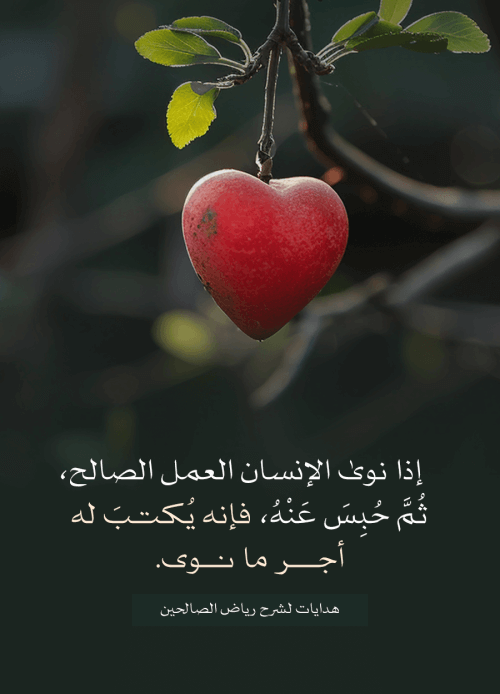
Waiting to do a good deed is in itself a good deed.
Riyadh Al-Salheen with explanation and benefits
Good intention leads its holder to good things.
Riyadh Al-Salheen with explanation and benefits
One of the manifestations of Allah’s mercy is that He uses justice to recompense the sinner but uses His grace and bounty to recompense the good-doer.
Riyadh Al-Salheen with explanation and benefits
Sincerity is one of the means to alleviate adversity because each one of them said: “O Allah! If I did that for Your sake only, then relieve us from the distress we are in.”
Riyadh Al-Salheen with explanation and benefits
Good deeds are means to alleviating adversity.
Riyadh Al-Salheen with explanation and benefits
“The righteousness of the heart results from the righteousness of deeds, and the righteousness of deeds results from the righteousness of intention.”
Riyadh Al-Salheen with explanation and benefits
Repentance is a cause for success, which is why a true successful person is the one seeking and committing to a means leading to success.
Riyadh Al-Salheen with explanation and benefits
Hastening to repentance is one of the causes to earning the pleasure of Allah with His servant.
Riyadh Al-Salheen with explanation and benefits