








Categories
Discover our diverse collection of categories covering multiple topics to meet your various interestsDa\'wa cards that highlight great meanings of the verses of the Holy Quran and the noble prophetic hadiths in a simple style and attractive display that helps the Muslim to have a deeper understanding of his religion in an easy way
﴿ ٱلَّذِينَ يَلۡمِزُونَ ٱلۡمُطَّوِّعِينَ مِنَ ٱلۡمُؤۡمِنِينَ فِي ٱلصَّدَقَٰتِ وَٱلَّذِينَ لَا يَجِدُونَ إِلَّا جُهۡدَهُمۡ فَيَسۡخَرُونَ مِنۡهُمۡ سَخِرَ ٱللَّهُ مِنۡهُمۡ وَلَهُمۡ عَذَابٌ أَلِيمٌ ﴾
سورة التوبة
79. Those who defame such of the believers who give charity (in Allâh’s Cause) voluntarily, and such who could not find to give charity (in Allâh’s Cause) except what is available to them - so they mock at them (believers); Allâh will throw back their mockery on them, and they shall have a painful torment.

﴿ ثُمَّ شَقَقۡنَا ٱلۡأَرۡضَ شَقّٗا ﴾
سورة عبس
26. And We split the earth in clefts.
﴿ وَإِذَآ أَذَقۡنَا ٱلنَّاسَ رَحۡمَةٗ فَرِحُواْ بِهَاۖ وَإِن تُصِبۡهُمۡ سَيِّئَةُۢ بِمَا قَدَّمَتۡ أَيۡدِيهِمۡ إِذَا هُمۡ يَقۡنَطُونَ ﴾
سورة الروم
When We give people a taste of mercy, they rejoice in pride. But when they are afflicted with evil because of what their hands have done, they fall into utter despair.
﴿ وَمَا كَانَ لِنَبِيٍّ أَن يَغُلَّۚ وَمَن يَغۡلُلۡ يَأۡتِ بِمَا غَلَّ يَوۡمَ ٱلۡقِيَٰمَةِۚ ثُمَّ تُوَفَّىٰ كُلُّ نَفۡسٖ مَّا كَسَبَتۡ وَهُمۡ لَا يُظۡلَمُونَ ﴾
سورة آل عمران
It is not for a prophet to misappropriate the spoils of war. Whoever misappropriates will carry it with him on the Day of Resurrection[76]. Then every soul will be paid in full for what it has earned, and none will be wronged.
﴿ ۞ وَقَالَ نِسۡوَةٞ فِي ٱلۡمَدِينَةِ ٱمۡرَأَتُ ٱلۡعَزِيزِ تُرَٰوِدُ فَتَىٰهَا عَن نَّفۡسِهِۦۖ قَدۡ شَغَفَهَا حُبًّاۖ إِنَّا لَنَرَىٰهَا فِي ضَلَٰلٖ مُّبِينٖ ﴾
سورة يوسف
And women in the city said, "The wife of al-ʿAzeez is seeking to seduce her slave boy; he has impassioned her with love. Indeed, we see her [to be] in clear error."
﴿ لَتَرۡكَبُنَّ طَبَقًا عَن طَبَقٖ ﴾
سورة الانشقاق
[That] you will surely embark upon [i.e., experience] state after state.[1893]
﴿ إِنَّ جَهَنَّمَ كَانَتۡ مِرۡصَادٗا ﴾
سورة النبأ
Indeed, Hell is lying in wait,
﴿ قَالُواْ لَمۡ نَكُ مِنَ ٱلۡمُصَلِّينَ ﴾
سورة المدثر
They will say, "We were not of those who prayed,
﴿ لَكُمۡ فِيهَا فَٰكِهَةٞ كَثِيرَةٞ مِّنۡهَا تَأۡكُلُونَ ﴾
سورة الزخرف
For you therein is much fruit[1448] from which you will eat.
Abu Dharr (may Allah be pleased with him) reported: The Prophet (may Allah's peace and blessings be upon him) said to me: "Do not belittle any good deed, even if it be meeting your brother with a cheerful face."
Narrated by Muslim
The Prophet (may Allah's peace and blessings be upon him) urges us to do good and not belittle any act of goodness, even if it is simple. An example is meeting one another with a cheerful face. A Muslim should be keen on doing this, for it brings a sense of friendliness and joy to his Muslim brother.
Abu Hurayrah (may Allah be pleased with him) reported: The Messenger of Allah (may Allah's peace and blessings be upon him) said: "The strong man is not the one who can overpower others; rather, the strong man is the one who controls himself when he is angry."
Narrated by Bukhari & Muslim
The Prophet (may Allah's peace and blessings be upon him) points out that true strength is not the strength of a person's body or his ability to overpower other strong men. But a truly strong person is one who strives to control and restrain himself while in a fit of rage. This indicates the power he exercises over himself and his ability to overpower the devil.
Abu Mas‘ūd al-Ansāri (may Allah be pleased with him) reported: A man came to the Prophet (may Allah's peace and blessings be upon him) and said: "My camel has become exhausted, so give me a mount." He replied: "I do not have any." Someone said: "O Messenger of Allah, I can guide him to one who will give him a mount." Thereupon, the Messenger of Allah (may Allah's peace and blessings be upon him) said: "Whoever guides to a good deed will get the same reward as the doer of that deed."
Narrated by Muslim
A man came to the Prophet (may Allah's peace and blessings be upon him) and said that his camel had become exhausted and asked for a mount to carry him. But the Prophet (may Allah's peace and blessings be upon him) said he had no mount to give him. So, a man who was present said: O Messenger of Allah, I will guide him to someone who will give him a mount. Thereupon, the Prophet (may Allah's peace and blessings be upon him) told that man that he will also have a reward like the donor himself because he guided the person who needed a mount to him.
Jubayr ibn Mut‘im (may Allah be pleased with him) reported: I heard the Prophet (may Allah's peace and blessings be upon him) say: "The one who severs the ties of kinship will not enter Paradise."
Narrated by Bukhari & Muslim
The Prophet (may Allah's peace and blessings be upon him) informs that he who withholds from his relatives the rights due to them or harms them and does wrong to them is worthy of not entering Paradise.
Hudhayfah (may Allah be pleased with him) reported: I heard the Prophet (may Allah's peace and blessings be upon him) say: "A scandalmonger will not enter Paradise."
Narrated by Bukhari & Muslim
The Prophet (may Allah's peace and blessings be upon him) informs that the scandalmonger who spreads gossip to stir up discord among people deserves the punishment of not entering Paradise.
Anas ibn Mālik (may Allah be pleased with him) reported: The Messenger of Allah (may Allah’s peace and blessings be upon him) said: "Whoever loves to have his sustenance expanded and his term of life prolonged should maintain his kinship ties."
Narrated by Bukhari & Muslim
The Prophet (may Allah's peace and blessings be upon him) urges the upholding of kinship ties by visiting, physically and financially honoring, and the like. It points out that it is a cause for expanding sustenance and prolonging lifespan.
Abu Hurayrah (may Allah be pleased with him) reported: The Messenger of Allah (may Allah's peace and blessings be upon him) said: "The nearest a slave to his Lord is while he is prostrating, so increase supplication."
Narrated by Muslim
The Prophet (may Allah's peace and blessings be upon him) pointed out that the closer a servant comes to his Lord is when he is prostrating, for he puts the highest and noblest part of his body on the ground in submission and humility to Allah Almighty. The Prophet (may Allah's peace and blessings be upon him) ordered us to increase supplication while prostrating. Thus, we become submissive to Allah both by words and action.
Abu Hurayrah (may Allah be pleased with him) reported: The Messenger of Allah (may Allah's peace and blessings be upon him) said: "Whoever believes in Allah and the Last Day should say what is good or keep silent. Whoever believes in Allah and the Last Day should honor his neighbor. Whoever believes in Allah and the Last Day should honor his guest."
Narrated by Bukhari & Muslim
The Prophet (may Allah's peace and blessings be upon him) pointed out that a person who believes in Allah and the Last Day, that he will be resurrected and recompensed therein for his deeds, is driven by his belief to do these things: First: good words: Examples of good words include glorification of Allah and proclamation of His oneness, enjoining the right and forbidding the wrong, and reconciling between people. If a person does not say something good, he should then keep silent, restraining his tongue and sparing people from his harm. Second: honoring the neighbors: by being benevolent to them and not causing them any harm. Third: honoring the guests: by speaking to them in a nice manner, presenting food to them, and so on.
Jarīr ibn ‘Abdullāh (may Allah be pleased with him) reported: The Messenger of Allah (may Allah's peace and blessings be upon him) said: "Whoever does not show mercy to people, Allah Almighty does not show mercy to him."
Narrated by Bukhari & Muslim
The Prophet (may Allah's peace and blessings be upon him) informs that Allah Almighty does not show him who does not show mercy to people mercy. Indeed, showing compassion to people is one of the greatest means of receiving Allah's mercy.
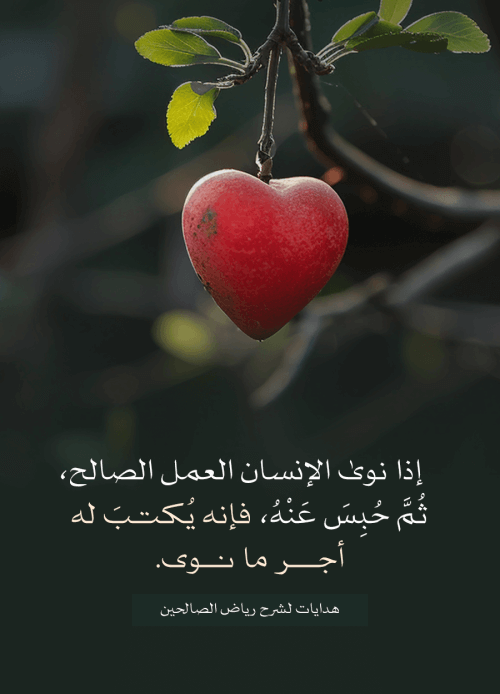
If someone intends to do a good deed but was prevented by a valid excuse, he shall gain the reward of his intention.
Riyadh Al-Salheen with explanation and benefits
Variation of reward for good deeds is based on sincerity and following of the Prophet’s guidance. The more a person is sincere to Allah, and the keener he is on following the Prophet (may Allah’s peace and blessings be upon him), the more perfect his worship will be, and consequently his reward will be bigger.
Riyadh Al-Salheen with explanation and benefits
People differ with regards to their acts of worship according to their intentions. The intentions of some people have reached the ultimate level of sincerity (to Allah) and keenness in following the Sunnah (of the Messenger of Allah) with regard to doing good and righteous deeds, while the intentions of others are below that.
Riyadh Al-Salheen with explanation and benefits
Anyone partaking a role with transgressors and wrongdoers will share their punishment because it is inclusive.
Riyadh Al-Salheen with explanation and benefits
If someone intends to do a good deed but was prevented by a valid excuse, he shall gain the reward of his intention.
Riyadh Al-Salheen with explanation and benefits
Actions are recompensed according to the intentions behind them, and the individual shall receive the reward of what he intended even if the outcome was contrary to his intention.
Riyadh Al-Salheen with explanation and benefits
There is not a single good deed intended sincerely to please Allah except that its doer will be raised in rank and status thereby, so that he would reap the full reward.
Riyadh Al-Salheen with explanation and benefits
Love and contentment is measured by good deeds and intentions because they are the criteria for Allah’s acceptance of the servant; perhaps a small deed reaps great reward because of the intention behind it and perhaps a big deed reaps little reward because of the intention behind it
Riyadh Al-Salheen with explanation and benefits
One of the proofs Allah supports the servant is the latter’s sincere endeavor to rectify his intention and purify his heart by good deeds.
هدايات لشرح رياض الصالحين