







Categories
Discover our diverse collection of categories covering multiple topics to meet your various interestsDa\'wa cards that highlight great meanings of the verses of the Holy Quran and the noble prophetic hadiths in a simple style and attractive display that helps the Muslim to have a deeper understanding of his religion in an easy way
﴿ كِتَٰبٞ فُصِّلَتۡ ءَايَٰتُهُۥ قُرۡءَانًا عَرَبِيّٗا لِّقَوۡمٖ يَعۡلَمُونَ ﴾
سورة فصلت
a Book whose verses are well explained; an Arabic Qur’an[2] for people who understand,

﴿ أَمۡ تَقُولُونَ إِنَّ إِبۡرَٰهِـۧمَ وَإِسۡمَٰعِيلَ وَإِسۡحَٰقَ وَيَعۡقُوبَ وَٱلۡأَسۡبَاطَ كَانُواْ هُودًا أَوۡ نَصَٰرَىٰۗ قُلۡ ءَأَنتُمۡ أَعۡلَمُ أَمِ ٱللَّهُۗ وَمَنۡ أَظۡلَمُ مِمَّن كَتَمَ شَهَٰدَةً عِندَهُۥ مِنَ ٱللَّهِۗ وَمَا ٱللَّهُ بِغَٰفِلٍ عَمَّا تَعۡمَلُونَ ﴾
سورة البقرة
Or do you say that Abraham, Ishmael, Isaac, Jacob, and the descendants [of Jacob] were Jews or Christians?” Say, “Are you more knowledgeable or Allah?” Who does greater wrong than the one who hides a testimony he has from Allah? But Allah is not unaware of what you do.
﴿ وَقَالُوٓاْ إِن نَّتَّبِعِ ٱلۡهُدَىٰ مَعَكَ نُتَخَطَّفۡ مِنۡ أَرۡضِنَآۚ أَوَلَمۡ نُمَكِّن لَّهُمۡ حَرَمًا ءَامِنٗا يُجۡبَىٰٓ إِلَيۡهِ ثَمَرَٰتُ كُلِّ شَيۡءٖ رِّزۡقٗا مِّن لَّدُنَّا وَلَٰكِنَّ أَكۡثَرَهُمۡ لَا يَعۡلَمُونَ ﴾
سورة القصص
57. And they say: "If we follow the guidance with you, we would be snatched away from our land." Have We not established for them a secure sanctuary (Makkah), to which are brought fruits of all kinds, a provision from Ourselves, but most of them know not.[4]
﴿ ٱلرَّحۡمَٰنِ ٱلرَّحِيمِ ﴾
سورة الفاتحة
The Entirely Merciful, the Especially Merciful,
﴿ يَقُولُ يَٰلَيۡتَنِي قَدَّمۡتُ لِحَيَاتِي ﴾
سورة الفجر
He will say, "Oh, I wish I had sent ahead [some good] for my life."[1922]
﴿ فَلَوۡلَآ إِذَا بَلَغَتِ ٱلۡحُلۡقُومَ ﴾
سورة الواقعة
83. Then why do you not (intervene) when (the soul of a dying person) reaches the throat?
﴿ وَمَا يُؤۡمِنُ أَكۡثَرُهُم بِٱللَّهِ إِلَّا وَهُم مُّشۡرِكُونَ ﴾
سورة يوسف
And most of them do not believe in Allah except that they associate partners with Him.
﴿ وَلَيَالٍ عَشۡرٖ ﴾
سورة الفجر
and the ten nights[1],
﴿ يَٰٓأَيُّهَا ٱلۡمُدَّثِّرُ ﴾
سورة المدثر
1. O you (Muhammad صلى الله عليه وسلم) enveloped in garments!
Abu Sa‘īd al-Khudri (may Allah be pleased with him) reported that the Messenger of Allah (may Allah's peace and blessings be upon him) said: "The devil said: 'By Your Might O Lord, I will continue to misguide Your slaves as long as their souls remain in their bodies.' The Lord said: 'By My Might and My Majesty, I will continue to forgive them as long as they seek forgiveness from Me.'"
Narrated by Ahmad
"The devil said: 'By Your Might O Lord, I will continue to misguide Your slaves as long as their souls remain in their bodies.'" i.e. the devil swore by Allah's Might that he will continue to misguide people as long as they are alive. "The Lord said: 'By My Might and My Majesty, I will continue to forgive them as long as they seek forgiveness from Me'", i.e. the Lord, the Most High, said in response to the devil: By My might and majesty I will continue to forgive them as long as they seek forgiveness for their sins from Me.
Ibn ‘Umar (may Allah be pleased with him) reported that the Prophet (may Allah's peace and blessings be upon him) said: "Beware of the invocations of the oppressed person, for, indeed, they rise to heaven as if they were sparks of fire."
Al-Haakim
Avoid oppression, and fear the supplication of the oppressed one, for it ascends to Allah in the heavens as if it is a spark of fire. It was compared to a spark in the swiftness of its rise in the sky, or because it comes out of a heart that is burning with the fire of injustice and suffering, and it is like the spark in the way it penetrates the heavenly barriers.
Anas (may Allah be pleased with him) reported: The Prophet (may Allah's peace and blessings be upon him) came to visit Sa‘d ibn ‘Ubādah (may Allah be pleased with him) so he brought some bread and oil. The Prophet ate then said: "May the fasting people break their fast in your house, and may the righteous eat your food, and may the angels ask forgiveness and mercy for you."
Narrated by Ibn Majah - Narrated by Abu Daoud - Narrated by Ahmad - Ad-Daarimi
Anas (may Allah be pleased with him) narrated that the Prophet (may Allah's peace and blessings be upon him) went to the house of Sa‘d ibn ‘Ubādah, Chief of the Khazraj tribe. Sa‘d brought some bread and oil, which indicates that he brought what was easy for him to offer, and that this does not negate generosity. After the Prophet (may Allah's peace and blessings be upon him) had finished eating, he made this supplication: "Aftara ‘indakum as-sā’imūn," meaning; may Allah give you the reward that is promised for the one who offers food to fasting people to break their fast with; "wa akala ta‘āmakum al-abrār," meaning; may the righteous eat your food; and "wa sallat ‘alaykum al-malā’ikah," meaning; and may the angels ask forgiveness and mercy for you.
Zayd, the Prophet's servant, reported that the Prophet (may Allah's peace and blessings be upon him) said: ''If anyone says 'I ask forgiveness from Allah, there is no deity except Him, the Ever-Living, the Sustainer of existence, and I turn to Him in repentance,' his sins will be forgiven even if he has fled from the battlefield."
Narrated by At-Termedhy - Narrated by Abu Daoud
Anyone who says "I ask forgiveness from Allah, there is no deity except Him, the Ever-Living, the Sustainer of existence, and I turn to Him in repentance," his sins will be forgiven even if he fled from fighting the infidels on the battlefield. It is known from a Hadīth that desertion is one of the seven major sins. The correct meaning of the present Hadīth is that one should repent from all sins, including desertion. Otherwise, seeking forgiveness while continuing to commit a certain sin is useless, unless one repents from it.
‘Āsim reported: I asked Anas about the Qunūt (invocation in the prayer). Anas said: "It should be recited before Rukū‘." I said: "So-and-so claims that you said it should be recited after rising from Rukū‘." He replied: "He is mistaken." Then Anas narrated to us that the Prophet invoked evil on the tribe of Banu Sulaym for one month after rising from Rukū‘. He then said: "The Prophet (may Allah's peace and blessings be upon him) sent 40 or 70 reciters (men well versed in the knowledge of the Qur'an) to some pagans, who killed them, even though there was a peace pact between them and the Prophet (may Allah's peace and blessings be upon him). I never saw the Prophet hating anyone as much as he hated those pagans."
Narrated by Bukhari & Muslim
This Hadīth clarifies the permissibility of supplicating during calamities. It is to be performed after rising from Rukū‘, according to the way the Prophet (may Allah's peace and blessings be upon him) did when Banu Sulaym broke the covenant between them and the Muslims by killing 40 or 70 of the reciters whom the Prophet had sent to them. The Prophet supplicated against them for a month after rising from Rukū‘.
Sohaib (may Allah be pleased with him) reported: The Messenger of Allah (may Allah's peace and blessings be upon him) said: "How astonishing the believer's affair is! Indeed, all of his affairs are good, and this is for none but the believer. If something good happens to him, he is grateful, which is good for him; and if something bad happens to him, he shows patience, which is good for him."
Narrated by Muslim
The Prophet (may Allah's peace and blessings be upon him) expresses wonder, by way of admiration, at the believer's affairs and conditions because all of his conditions are good, and this is for none except the believer. Whenever something good happens to him, he thanks Allah for it and gets rewarded for showing gratitude. If something bad happens to him, he shows patience and seeks reward from Allah and, thus, gets rewarded for showing patience. So, he gets rewarded in all cases.
Abu Sa‘īd al-Khudri (may Allah be pleased with him) reported that the Prophet (may Allah's peace and blessings be upon him) said: "Shall I tell you what I fear more for you than the Antichrist?" They said: "Yes, O Messenger of Allah." He said: "Hidden polytheism; when a man gets up to pray and improves his prayer because he sees another man watching him."
Narrated by Ibn Majah
The Companions were discussing the trial of the Antichrist, and expressing their fear thereof. The Prophet (may Allah's peace and blessings be upon him) told them that there was a more frightening trial than that of the Antichrist which was hidden polytheism, i.e. being insincere in one's intention and practice, such as improving something that is originally done for Allah's sake so as to attract people's attention.
Osāmah ibn Zayd (may Allah be pleased with him) reported that it was said to him: "Why do you not visit ‘Uthmān and talk to him?" He replied: "Do you think that I do not talk to him except that I make you hear? By Allah, I talked to him privately, without beginning something I do not like to be the first to begin; and I do not say to my ruler "You are the best among people" after I heard the Messenger of Allah (may Allah's peace and blessings be upon him) say: 'A man will be brought on the Day of Resurrection and thrown into Hellfire, and his intestines will slip out and he will go around by them like a donkey goes around a millstone. The dwellers of Hellfire will gather around him and say: 'So-and-so, what is the matter with you? Did you not use to command us to do right and forbid us from doing wrong?' He will reply: 'Yes, I used to command what is right, but I would not do it myself, and I used to forbid doing what is wrong, but I fall into it myself''"
Narrated by Bukhari & Muslim
It was said to Osāmah ibn Zayd (may Allah be pleased with him): Why do you not go to ‘Uthmān ibn Affān (may Allah be pleased with him) and speak to him about the strife that has occurred among the people and the effort to put a complete end to it? He informed them that he spoke to him secretly, seeking the best interest, not inciting strife; that was because he did not want to openly denounce the rulers in public, lest it may be a reason for offense towards the Caliph - a door to strife and evil I will not be the first to open. Then, Osāmah (may Allah be pleased with him) said that he advised the rulers in secret and did not flatter anyone, even if he was a ruler, and did not flatter them by praising them to their faces falsely. This was after he heard the Prophet (may Allah's peace and blessings be upon him) say that a man will be brought on the Day of Resurrection and thrown into Hellfire, and his intestines will come out of his stomach quickly due to the intense heat and severe torment. He will go around his intestines in this state in Hellfire like a donkey goes around its millstone. The people of Hellfire will gather around him in the form of a circle surrounding him, and they will ask him: O so-and-so, did you not use to command what is right and forbid what is wrong?! He will say: I used to command what is right, but I would not do it, and I used to forbid what is wrong, but I would do it.
Abu Hurayrah (may Allah be pleased with him) reported: We were in the company of the Messenger of Allah (may Allah's peace and blessings be upon him) when he heard a bang. Thereupon, the Prophet (may Allah's peace and blessings be upon him) said: "Do you know what it is?" We said: "Allah and His Messenger know best." He said: "This is a stone that was thrown into Hellfire seventy years ago and it was falling into Hellfire until it reached its bottom."
Narrated by Muslim
The Prophet (may Allah's peace and blessings be upon him) heard a disturbing sound like that of a falling object. He asked the Companions who were with him about that sound, and they said: Allah and His Messenger know best. He (may Allah's peace and blessings be upon him) said to them: This sound that you heard is a stone that was thrown from the edge of Hellfire seventy years ago, and it kept descending and going down into it until it reached its bottom now when you heard the sound.
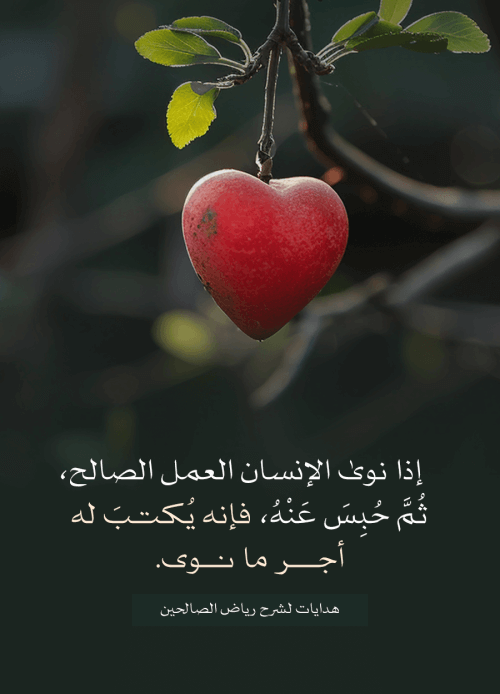
If someone intends to do a good deed but was prevented by a valid excuse, he shall gain the reward of his intention.
Riyadh Al-Salheen with explanation and benefits
Variation of reward for good deeds is based on sincerity and following of the Prophet’s guidance. The more a person is sincere to Allah, and the keener he is on following the Prophet (may Allah’s peace and blessings be upon him), the more perfect his worship will be, and consequently his reward will be bigger.
Riyadh Al-Salheen with explanation and benefits
People differ with regards to their acts of worship according to their intentions. The intentions of some people have reached the ultimate level of sincerity (to Allah) and keenness in following the Sunnah (of the Messenger of Allah) with regard to doing good and righteous deeds, while the intentions of others are below that.
Riyadh Al-Salheen with explanation and benefits
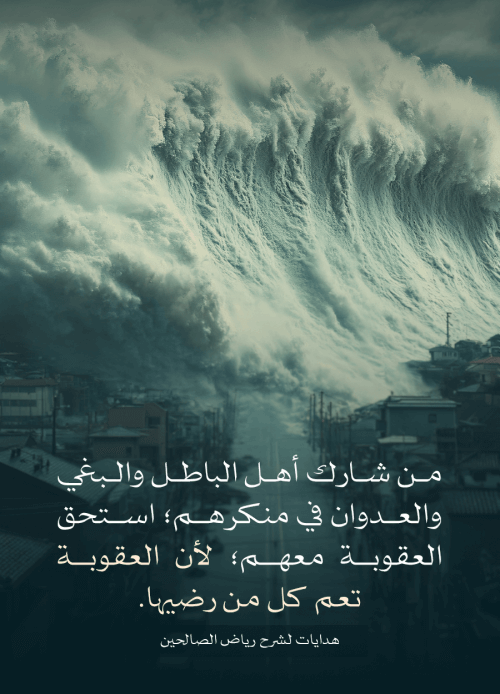
Anyone partaking a role with transgressors and wrongdoers will share their punishment because it is inclusive.
Riyadh Al-Salheen with explanation and benefits
If someone intends to do a good deed but was prevented by a valid excuse, he shall gain the reward of his intention.
Riyadh Al-Salheen with explanation and benefits
Actions are recompensed according to the intentions behind them, and the individual shall receive the reward of what he intended even if the outcome was contrary to his intention.
Riyadh Al-Salheen with explanation and benefits
There is not a single good deed intended sincerely to please Allah except that its doer will be raised in rank and status thereby, so that he would reap the full reward.
Riyadh Al-Salheen with explanation and benefits
Love and contentment is measured by good deeds and intentions because they are the criteria for Allah’s acceptance of the servant; perhaps a small deed reaps great reward because of the intention behind it and perhaps a big deed reaps little reward because of the intention behind it
Riyadh Al-Salheen with explanation and benefits
One of the proofs Allah supports the servant is the latter’s sincere endeavor to rectify his intention and purify his heart by good deeds.
هدايات لشرح رياض الصالحين