



Categories
Discover our diverse collection of categories covering multiple topics to meet your various interestsDa\'wa cards that highlight great meanings of the verses of the Holy Quran and the noble prophetic hadiths in a simple style and attractive display that helps the Muslim to have a deeper understanding of his religion in an easy way
﴿ قَالَ رَبِّ ٱجۡعَل لِّيٓ ءَايَةٗۖ قَالَ ءَايَتُكَ أَلَّا تُكَلِّمَ ٱلنَّاسَ ثَلَٰثَةَ أَيَّامٍ إِلَّا رَمۡزٗاۗ وَٱذۡكُر رَّبَّكَ كَثِيرٗا وَسَبِّحۡ بِٱلۡعَشِيِّ وَٱلۡإِبۡكَٰرِ ﴾
سورة آل عمران
He said, “My Lord, give me a sign.” He said, “Your sign is that you will not speak to people for three days except by gestures. And remember your Lord often and glorify Him in the evening and the morning.”

﴿ وَكَأَيِّن مِّن نَّبِيّٖ قَٰتَلَ مَعَهُۥ رِبِّيُّونَ كَثِيرٞ فَمَا وَهَنُواْ لِمَآ أَصَابَهُمۡ فِي سَبِيلِ ٱللَّهِ وَمَا ضَعُفُواْ وَمَا ٱسۡتَكَانُواْۗ وَٱللَّهُ يُحِبُّ ٱلصَّٰبِرِينَ ﴾
سورة آل عمران
146. And many a Prophet (i.e. many from amongst the Prophets) fought (in Allâh’s Cause) and along with him (fought) large bands of religious learned men. But they never lost heart for that which did befall them in Allâh’s Way, nor did they weaken nor degrade themselves. And Allâh loves As-Sâbirûn (the patient).
﴿ وَجَآءَ رَجُلٞ مِّنۡ أَقۡصَا ٱلۡمَدِينَةِ يَسۡعَىٰ قَالَ يَٰمُوسَىٰٓ إِنَّ ٱلۡمَلَأَ يَأۡتَمِرُونَ بِكَ لِيَقۡتُلُوكَ فَٱخۡرُجۡ إِنِّي لَكَ مِنَ ٱلنَّٰصِحِينَ ﴾
سورة القصص
And a man came from the farthest end of the city, running. He said, "O Moses, indeed the eminent ones are conferring over you [intending] to kill you, so leave [the city]; indeed, I am to you of the sincere advisors."
﴿ إِلَّا مَنۡ هُوَ صَالِ ٱلۡجَحِيمِ ﴾
سورة الصافات
163. Except those who are predestined to burn in Hell!
﴿ قُلۡ سِيرُواْ فِي ٱلۡأَرۡضِ فَٱنظُرُواْ كَيۡفَ بَدَأَ ٱلۡخَلۡقَۚ ثُمَّ ٱللَّهُ يُنشِئُ ٱلنَّشۡأَةَ ٱلۡأٓخِرَةَۚ إِنَّ ٱللَّهَ عَلَىٰ كُلِّ شَيۡءٖ قَدِيرٞ ﴾
سورة العنكبوت
Say, “Travel through the land and see how He originated the creation, and then Allah will repeat it a second time. Indeed, Allah is Most Capable of all things.”
﴿ وَقَدۡ خَابَ مَن دَسَّىٰهَا ﴾
سورة الشمس
and he who corrupts it will be doomed.
﴿ ۞ قَالَ سَنَنظُرُ أَصَدَقۡتَ أَمۡ كُنتَ مِنَ ٱلۡكَٰذِبِينَ ﴾
سورة النمل
Solomon said, “We will see whether you have told the truth or you are one of the liars.
﴿ حمٓ ﴾
سورة غافر
1. Hâ-Mîm.
﴿ وَنُمَكِّنَ لَهُمۡ فِي ٱلۡأَرۡضِ وَنُرِيَ فِرۡعَوۡنَ وَهَٰمَٰنَ وَجُنُودَهُمَا مِنۡهُم مَّا كَانُواْ يَحۡذَرُونَ ﴾
سورة القصص
and to establish them in the land, and to show Pharaoh, Hāmān[5] and their soldiers[6] that which they feared[7].
Hanzhalah ibn Qays reported: When I asked Rāfi‘ ibn Khadīj about leasing land in return for gold and silver, he replied: "There is no harm in it. At the time of the Messenger of Allah (may Allah’s peace and blessings be upon him) the people used to lease lands in return for the yield of what grows on the banks of large rivers and beginnings of water streams or the yield of certain parts of the land. Some of the harvest would be affected with blight and some would remain safe. This was the only system the people had for renting lands, and, thus, he forbade it. If the rent is something known and guaranteed, there is no harm in it."
Narrated by Muslim
Rāfi‘ ibn Khadīj mentioned that his family owned the largest farms and orchards in Madīnah. They used to lease land according to a practice that was common during the pre-Islamic era. They would give out the land to be cultivated in return for the harvest of one side of the land, while the cultivator gets that harvest of the other side. Perhaps one side would yield fruit, while the other would not. They might also allocate the best harvest for the landowner, such as the yield that grows on the banks of rivers and streams. The yield of those parts might be destroyed and the rest would remain safe, or vice versa. The Prophet (may Allah's peace and blessings be upon him) forbade them from this practice because of the uncertainty, ignorance, and injustice it involves. The compensation must be known and specified; and there must be equality in the sharing of profit and loss. If the transaction is entered into for part of the land produce, it will be a sort of partnership in which profits and losses should be equally shared and according to a specific percentage such as one fourth or one half of the produce. If the transaction is made in return for a compensation, this will be a sort of lease in which the compensation must be known. In this case, it does not matter if the compensation takes the form of gold, silver, food produced from the land, food of the same type, or food of a different type. This is because it is either a land lease, letting orchards on special terms, or sharecropping, which are permissible pursuant to this Hadīth, which states: "If the rent is something known and guaranteed, there is no harm in it."
Abu Hurayrah (may Allah be pleased with him) reported that the Messenger of Allah (may Allah's peace and blessings be upon him) granted concession for the sale of Al-‘Arāyā (unpicked ripe dates for dry dates) when they are equal to or less than five Wasqs (a standard measure).
Narrated by Bukhari & Muslim
Al-‘Arāyā (sing. ‘Ariyyah) refers to the case in which a man wants to eat ripe dates but does not afford it due to his poverty. However, he has dry dates that he can give in exchange for the dry dates on the tree provided the weight of the dry dates does not exceed five Wasqs. The case of Al-‘Arāyā has been made permissible as an exception to the rule of prohibition because of people's need. Therefore, the concession is given only to the amount that is usually needed, which is five Wasqs or less than that. This is because such weight is sufficient for satisfying one’s need for eating ripe dates. The basic rule of prohibition is usury of excess referred to in the Hadīth in which the Prophet (may Allah's peace and blessings be upon him) said when asked about selling fresh dates for dry ones: "Will fresh dates decrease (in weight) when it becomes dry?" They said: 'Yes.' He said: "So, do not do it."
Zayd ibn Thābit (may Allah be pleased with him) reported the Messenger of Allah (may Allah's peace and blessings be upon him) granted concession to the owner of Al-‘Ariyyah (a dates palm) to sell its unpicked fruits for dry dates by estimation. Another narration by Imām Muslim reads: "...for dry dates by estimation and the new owners might eat their dates fresh."
Narrated by Bukhari & Muslim
Selling dates on the trees for dry dates is forbidden. This transaction is called Al-Muzābanah that is prohibited because the weight of the dates, which is required to be equal in goods subject to rulings of usury, is not known. Currencies like dinars and dirhams were scarce in the past. Sometimes seasons of the fresh ripe dates would arrive, and people in Madīnah need to eat them; yet, they did not have the money to purchase them. Therefore, it was made permissible for them to purchase some ripe dates to eat in exchange for dry dates by estimation, taking into consideration that they should be approximately equal in amount were the dates on the trees to become dry. This kind of Al-‘Ariyyah transaction was an exception to the rule of prohibition applicable to Al-Muzābanah.
Zayd ibn Khālid al-Juhani (may Allah be pleased with him) reported that the Messenger of Allah (may Allah's peace and blessings be upon him) was asked about the lost and picked up item that is made of gold or silver, whereupon he said: "Remember the description of its container and the string with which it is tied. Make a public announcement of it for one year. If nobody comes and claims it, then utilize the money but keep it as a trust with you. If its owner comes back one day seeking it, then return it to him." Then, he asked him about the lost camel, whereupon the Prophet (may Allah's peace and blessings be upon him) said: "It is none of your concern. Leave it, for it has its feet and a water container (reservoir), and it will reach water and eat from the trees until its owner finds it." He then asked him about the lost sheep, whereupon he said: "Take it, for it is either for you, or for your brother, or for the wolf."
Narrated by Bukhari & Muslim
A man asked the Prophet (may Allah's peace and blessings be upon him) about the ruling on lost property, such as gold, silver, camels, and sheep. The Prophet (may Allah's peace and blessings be upon him) clarified to him the ruling on these things so that it could be an example of other similar lost properties that would, thus, take the same ruling. He said about gold and silver: Remember the description of its container and the string with which it is tied, so that you can distinguish it from your own property and you can tell if it belongs to those who claim it. If one comes claiming it, and his description of such an item matches the description that you know, then give it to that person; otherwise, it will be clear to you that his claim is false. Then, the Prophet (may Allah's peace and blessings be upon him) ordered him to announce it for one year after finding it. The announcement should be made in public places where people gather like the markets, at the doors of mosques, in public assembly places, and in the place where it was found. Then, the Prophet (may Allah's peace and blessings be upon him) allowed him - after announcing it in public for one year and not finding its owner - to spend it or use it. If the owner appears at any time, then the one who found it should give it to him. As for a lost camel and the like, the Prophet (may Allah's peace and blessings be upon him) prohibited him from taking it, because it does not need anyone to protect it. It is naturally an animal that can take care of itself and protect itself from small wild animals. A camel has hooves and legs that can travel long distances; its neck enables it to eat from the trees and drink water, and its stomach is equipped to store water and food. So the camel can protect itself until it is found by its owner who will be looking for it in the place where it got lost. As for lost sheep and other small animals, the Prophet (may Allah's peace and blessings be upon him) ordered him to take it and protect it from destruction or being attacked by predatory animals. After taking possession of it, either its owner will come and claim it, or a year will pass after announcing it with no one to claim it, so it will be a property of the one who found it.
Jābir ibn ‘Abdullāh (may Allah be pleased with him) reported that the Messenger of Allah (may Allah’s peace and blessings be upon him) decreed that the lifelong gift is for the one to whom it was given. Another narration reads: “Whoever is given a lifelong gift in association with his offspring, it is indeed for him and his offspring. It does not return to the one who gave it, because he gave something that has become part of the inheritance.” Jābir said that the lifelong gift that the Messenger of Allah (may Allah’s peace and blessings be upon him) ordained is the gift in which the granter says to the recipient: "This is for you and your offspring." However, if the granter says: "This is for you as long as you live, then it returns to its owner." In another narration reported by Imām Muslim, the Prophet (may Allah's peace and blessings be upon him) said: “Keep your wealth and do not spoil it. For indeed, whoever is given a lifelong gift, then it is for the one to whom it has been given and for his offspring, no matter he is alive or dead."
Narrated by Muslim - Narrated by Bukhari & Muslim
Al-‘Umrā” and Ar-Ruqbā are two types of lifelong gifts that used to be given during the pre-Islamic era. A man would give someone a house or something else by saying: I give this to you forever, or I give this to you as long as you are alive or as long as I am alive. Therefore, they used to wait for the death of the one given such a gift, in order to take back their gift. Islamic Shariah has approved the gift and annulled the condition of taking it back, which was often associated with it. This is because, in Islam, the one who takes his gift back is like the dog that vomits and swallows its vomit. Therefore, the Prophet (may Allah's peace and blessings be upon him) decreed that the lifelong gift is for the one to whom it was given and to his offspring after him. On the other hand, the Prophet (may Allah's peace and blessings be upon him) advised them to maintain their wealth because they assumed that the condition associated with the gift is not binding, and they are allowed to take their gifts back. So, he said: "Keep your wealth and do not spoil it. For indeed, whoever is given a lifelong gift, then it is for the one to whom it has been given and for his offspring, no matter he is alive or dead."
Jābir ibn ‘Abdullāh (may Allah be pleased with him) reported that the Prophet (may Allah's peace and blessings be upon him) decreed for partners the right of preemption in property which had not been divided up. However, if the boundaries are demarcated, and the roads are fixed, then there will be no right of preemption."
Narrated by Bukhari & Muslim
The wise Shariah has been legislated to give people their due rights and establish justice and to keep away all harm and evil. Since partnership in real estate entails many problems, and joint property is difficult to divide, Allah has legislated the right of preemption for the partner. This means that if one of the two partners sells his share of the real estate, then it will be permissible for the other partner, who did not sell his share, to retrieve that sold share from the one who bought it at the same price, to avoid any harm that may be caused by the new partner. This is a constant right of the partner as long as the joint real estate has not been divided up, the boundaries have not been known, and the roads have not been laid. However, after defining the boundaries between the two shares and after the streets or roads are laid, there is no preemption right. This is because there is no more harm entailed by the partnership and mixing for which the right of retrieving the sold share from the buyer is ordained.
‘Ā’ishah bint Abu Bakr (may Allah be pleased with him) reported: There were three Sunnahs established in connection with Barīrah: When she was manumitted from slavery, she was given the choice whether to remain with her husband or leave him. She was once given a gift of meat, and the Messenger of Allah (may Allah's peace and blessings be upon him) came in while the pot of meat was cooking on the fire. He asked for something to eat so he was brought some bread and condiments from the household stock. Thereupon he asked: "Didn't I see a pot of meat cooking on the fire?" They said: "Yes, O Messenger of Allah. That meat was given as charity to Barīrah, and you do not eat from charity." He said: "It is charity to her, and it is a gift from her to us." The Prophet (may Allah's peace and blessings be upon him) said with regards to her: "Walā' (allegiance/inheritance) is for the one who manumits."
Narrated by Bukhari & Muslim
‘Ā’ishah (may Allah be pleased with her) recalls the blessings related to her freed bondmaid Barīrah, finding goodness in that deal of manumission that brought them close: Allah, the Almighty, legislated three Sunnahs related to her which remained as general religious rulings for all Muslims until the end of time. The first Sunnah: She was given the choice regarding her marriage. Barīrah was freed while being married to Mughīth, who was also a slave. So, she was given the choice to either remain married to him or to be separated from him, because after being freed from slavery, they were no longer equivalent in status as she was a free woman and he was still a slave. Equivalency of status is taken into consideration in this case. She chose to annul her marriage, and this became a Sunnah (permissible) for anyone else in a similar situation. The second Sunnah: she was given some meat as a charity while she was still living in the house of ‘Ā’ishah. The Prophet (may Allah's peace and blessings be upon him) came in while the meat was cooking on the fire. He asked for food so they brought him some bread and condiment which they normally ate. They did not bring him any of the meat that was given to Barīrah as charity because of their knowledge that he did not eat from charity. So he asked: "Didn't I see meat cooking on the fire?" They replied: "Yes, but it was given as charity to Barīrah and we disliked to give you any." So he said: "It is considered charity for her, and for us it is a gift from her." The third Sunnah: her former masters, when they agreed to sell her to ‘Ā’ishah, stipulated that her allegiance (or right of inheritance) would be to them, so that they would receive pride that she is ascribed to them and perhaps receive some material benefit from her, such as inheritance, or support, or other. So the Prophet (may Allah's peace and blessings be upon him) said: "Walā' is for the one who frees the slave, not for the one who sells the slave or any other." Walā' is a relation between the master and the slave, after the latter's manumission, via which the master inherits the slave, in case he has no heirs or in case something is left after everyone takes his assigned share of the inheritance.
‘Ali ibn Abi Tālib (may Allah be pleased with him) reported that the Prophet (may Allah's peace and blessings be upon him) said: "There is no orphanhood after reaching puberty, and there is no silence for the whole day till the night."
Narrated by Abu Daoud
Firstly as person is not legally considered an orphan after reaching puberty. Secondly, in the pre-Islamic period people used to commit themselves to silence for an entire day and night as an act of worship. A person would stay silent without speaking all day at all until sunset. Muslims were prohibited from this because this necessitates leaving many worships of Allah like not glorifying Allah by making Tasbīh (saying "Subhān Allah"), or declaring Allah’s Oneness by making Tahlīl (saying "there is no god but Allah"), or praising Him by making Tahmīd (saying "praise be to Allah"), or by enjoining good and forbidding evil, reading the Qur'an, and so forth. This is from the practices of the period of pre-Islamic ignorance and this is another reason why Islam prohibited this practice.
Qays ibn Abi Hāzim reported: Abu Bakr As-Siddīq (may Allah be pleased with him) entered upon a woman from Ahmas tribe, called Zaynab, and he noticed that she was not speaking, he asked: "Why is she not speaking?" They said: "She has intended to perform Hajj without speaking." He said to her: "Speak, for this is unlawful; it is a practice of the pre-Islamic period of ignorance." Thereupon, she spoke.
Narrated by Bukhari
Abu Bakr (may Allah be pleased with him) entered upon a woman from the tribe of Ahmas, called Zaynab, and he found that she was not speaking. He asked the people about the reason behind her refusal to speak, and they clarified that she had intended to perform Hajj without speaking. Thereupon, Abu Bakr (may Allah be pleased with him) told her that she should speak, for it was not permissible to refrain from speaking altogether, because this was an act of worship observed during the pre-Islamic period of ignorance and subsequently banned by Islam. It is noteworthy here that it is permissible for a man to enter upon a woman if this involves no suspicion or seclusion, as done by Abu Bakr.
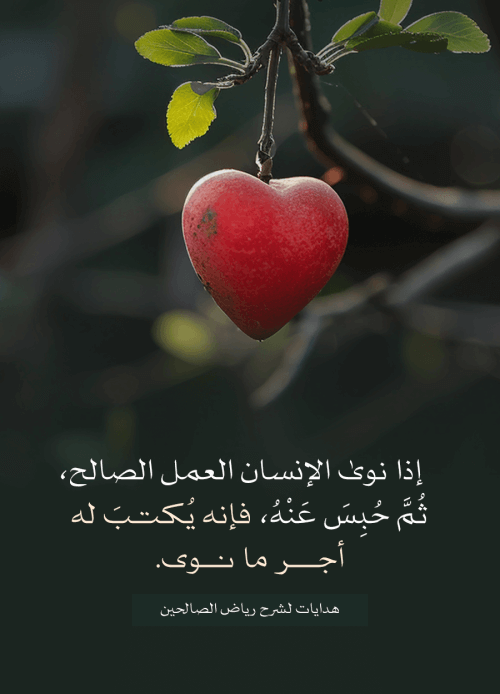
If someone intends to do a good deed but was prevented by a valid excuse, he shall gain the reward of his intention.
Riyadh Al-Salheen with explanation and benefits
Variation of reward for good deeds is based on sincerity and following of the Prophet’s guidance. The more a person is sincere to Allah, and the keener he is on following the Prophet (may Allah’s peace and blessings be upon him), the more perfect his worship will be, and consequently his reward will be bigger.
Riyadh Al-Salheen with explanation and benefits
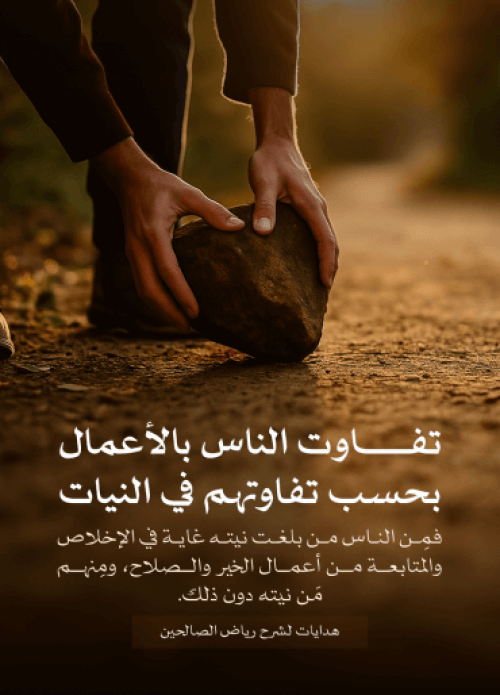
People differ with regards to their acts of worship according to their intentions. The intentions of some people have reached the ultimate level of sincerity (to Allah) and keenness in following the Sunnah (of the Messenger of Allah) with regard to doing good and righteous deeds, while the intentions of others are below that.
Riyadh Al-Salheen with explanation and benefits
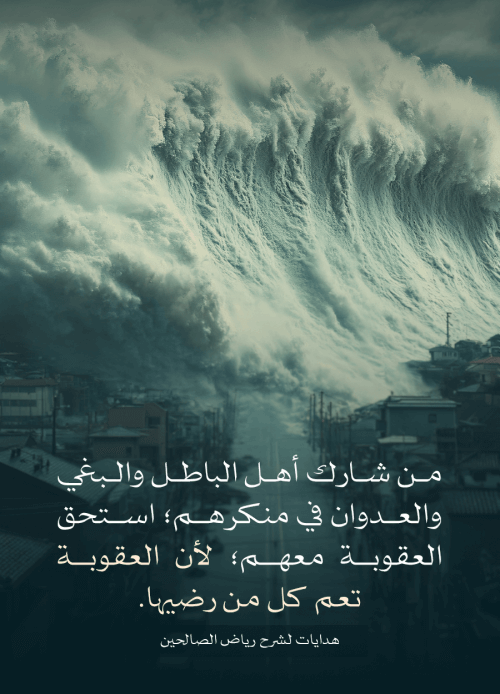
Anyone partaking a role with transgressors and wrongdoers will share their punishment because it is inclusive.
Riyadh Al-Salheen with explanation and benefits
If someone intends to do a good deed but was prevented by a valid excuse, he shall gain the reward of his intention.
Riyadh Al-Salheen with explanation and benefits
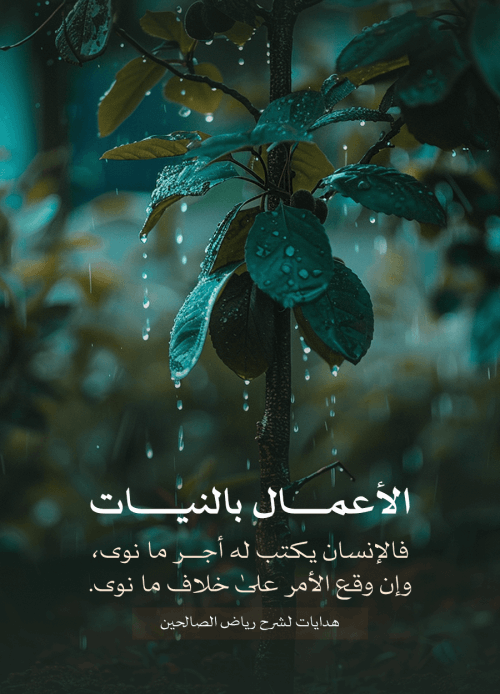
Actions are recompensed according to the intentions behind them, and the individual shall receive the reward of what he intended even if the outcome was contrary to his intention.
Riyadh Al-Salheen with explanation and benefits
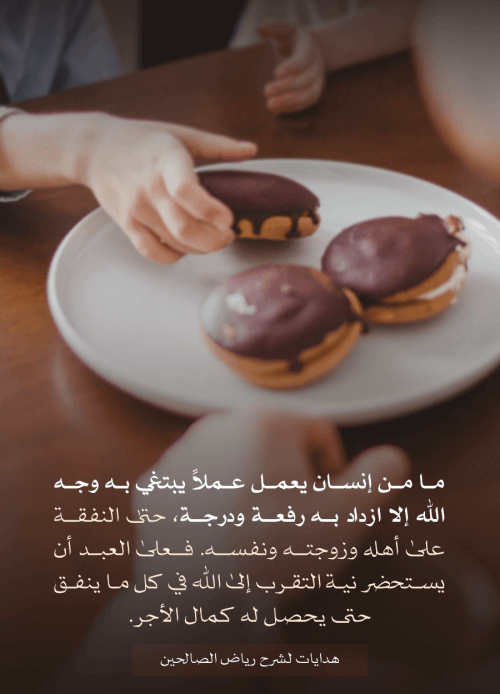
There is not a single good deed intended sincerely to please Allah except that its doer will be raised in rank and status thereby, so that he would reap the full reward.
Riyadh Al-Salheen with explanation and benefits
Love and contentment is measured by good deeds and intentions because they are the criteria for Allah’s acceptance of the servant; perhaps a small deed reaps great reward because of the intention behind it and perhaps a big deed reaps little reward because of the intention behind it
Riyadh Al-Salheen with explanation and benefits
One of the proofs Allah supports the servant is the latter’s sincere endeavor to rectify his intention and purify his heart by good deeds.
هدايات لشرح رياض الصالحين